Brand Name

Erivedge

Generic Name
Vismodegib
View Brand Information
FDA approval date: January 30, 2012
Classification: Hedgehog Pathway Inhibitor
Form: Capsule

What is Erivedge (Vismodegib)?

ERIVEDGE is indicated for the treatment of adults with metastatic basal cell carcinoma, or with locally advanced basal cell carcinoma that has recurred following surgery or who are not candidates for surgery and who are not candidates for radiation. ERIVEDGE ® is a hedgehog pathway inhibitor indicated for the treatment of adults with metastatic basal cell carcinoma, or with locally advanced basal cell carcinoma that has recurred following surgery or who are not candidates for surgery and who are not candidates for radiation.

Approved To Treat

Save this treatment for later
Sign Up
Not sure about your diagnosis?
Check Your Symptoms
Tired of the same old research?
Check Latest Advances

Related Clinical Trials

Phase II Trial of SMO/ AKT/ NF2/CDK Inhibitors in Progressive Meningiomas With SMO/ AKT/ NF2/CDK Pathway Mutations

Summary: This phase II trial studies how well vismodegib, focal adhesion kinase (FAK) inhibitor GSK2256098, and capivasertib work in treating patients with meningioma that is growing, spreading, or getting worse (progressive). Vismodegib, FAK inhibitor GSK2256098, capivasertib, and abemaciclib may stop the growth of tumor cells by blocking some of the enzymes needed for cell growth.

Evaluation of Radiotherapy After Complete Response to Sonic Hedgehog Pathway Inhibitors in Patients With Locally Advanced Basal Cell Carcinoma: a Prospective Multicenter Study

Summary: Locally advanced basal cell carcinoma (BCC) are large BCCs or BCCs located in areas subject to functional and aesthetic risk following surgery or radiotherapy. In these particular situations, surgery and radiotherapy are sometimes not appropriate, and Sonic Hedgehog inhibitors (SHHi) (Vismodegib and Sonidegib) can be proposed. SHHi are effective treatments in laBCC but most CR patients discontinue...

Canadian Profiling and Targeted Agent Utilization Trial (CAPTUR): A Phase II Basket Trial

Summary: Cancer drugs which target the effects of abnormal gene changes are called 'targeted therapies'. This study, called PM.1 or CAPTUR, will include some targeted therapies that are currently available. The purpose of this study is to find out what are the effects on a patient and their cancer when they are given a targeted therapy drug that is specific to an abnormal gene change in their cancer.

Brand Information

ERIVEDGE (vismodegib)
WARNING: EMBRYO-FETAL TOXICITY
  • ERIVEDGE can cause embryo-fetal death or severe birth defects when administered to a pregnant woman. ERIVEDGE is embryotoxic, fetotoxic, and teratogenic in animals. Teratogenic effects included severe midline defects, missing digits, and other irreversible malformations
  • Verify the pregnancy status of females of reproductive potential within 7 days prior to initiating ERIVEDGE. Advise pregnant women of the potential risks to a fetus. Advise females of reproductive potential to use effective contraception during and after ERIVEDGE
  • Advise males of the potential risk of ERIVEDGE exposure through semen and to use condoms with a pregnant partner or a female partner of reproductive potential
1INDICATIONS AND USAGE
ERIVEDGE is indicated for the treatment of adults with metastatic basal cell carcinoma, or with locally advanced basal cell carcinoma that has recurred following surgery or who are not candidates for surgery and who are not candidates for radiation.
2DOSAGE FORMS AND STRENGTHS
Capsules: 150 mg with "150 mg" printed on pink opaque body and "VISMO" printed on grey opaque cap in black ink.
3CONTRAINDICATIONS
None.
4ADVERSE REACTIONS
The following clinically significant adverse reactions are described elsewhere in the labeling:
  • Embryo-Fetal Toxicity
  • Severe Cutaneous Adverse Reactions
  • Musculoskeletal Adverse Reactions
  • Premature Fusion of the Epiphyses
4.1Clinical Trials Experience
Because clinical trials are conducted under widely varying conditions, adverse reaction rates observed in the clinical trials of a drug cannot be directly compared to rates in the clinical trials of another drug and may not reflect the rates observed in clinical practice.
The safety data described below reflect exposure to ERIVEDGE in 138 patients with advanced basal cell carcinoma (BCC) who received ERIVEDGE at doses ≥ 150 mg orally daily in four open-label, uncontrolled, dose-ranging or fixed single dose clinical trials [Study SHH3925g, SHH4437g, SHH4476g and SHH4610g]. The median age of these patients was 61 years (range 21 to 101 years), 100% were White (including Hispanics), and 64% were male. The median duration of treatment was approximately 10 months (range 21 days to 36 months); 111 patients received ERIVEDGE for 6 months or longer.
The most common adverse reactions (≥ 10%) were muscle spasms, alopecia, dysgeusia, weight loss, fatigue, nausea, diarrhea, decreased appetite, constipation, arthralgias, vomiting, and ageusia (
4.2Postmarketing Experience
The following adverse reactions have been identified during post-approval use of ERIVEDGE. Because these reactions are reported voluntarily from a population of uncertain size, it is not always possible to reliably estimate their frequency or establish a causal relationship to drug exposure.
Hepatobiliary disorders: Drug-induced liver injury
Skin and subcutaneous tissue disorders: Stevens-Johnson syndrome/toxic epidermal necrolysis, drug reaction with eosinophilia and systemic symptoms [see .
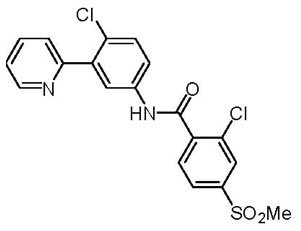
5DESCRIPTION
Vismodegib is a hedgehog (Hh) pathway inhibitor, which is described chemically as 2-Chloro-
Chemical Structure
Vismodegib is a crystalline free base with a pKa (pyridinium cation) of 3.8, appearing as a white to tan powder. The solubility of vismodegib is pH dependent with 0.1 µg/mL at pH 7 and 0.99 mg/mL at pH 1. The partition coefficient (log P) is 2.7.
ERIVEDGE (vismodegib) for oral administration is supplied in capsules containing 150 mg vismodegib and the following inactive ingredients: microcrystalline cellulose, lactose monohydrate, sodium lauryl sulfate, povidone, sodium starch glycolate, talc, and magnesium stearate (non-bovine). The capsule shell contains gelatin, titanium dioxide, red iron oxide, and black iron oxide. The black printing ink contains shellac and black iron oxide.
6CLINICAL STUDIES
A single, international, single-arm, multi-center, open-label, 2-cohort trial [SHH4476g (NCT00833417)] was conducted in 104 patients with either metastatic basal cell carcinoma (mBCC) (n = 33) or locally advanced BCC (laBCC) (n = 71). Patients with laBCC were required to have lesions that had recurred after radiotherapy, unless radiotherapy was contraindicated or inappropriate (e.g. Gorlin syndrome; limitations because of location of tumor or cumulative prior radiotherapy dose), and where the lesions were either unresectable or surgical resection would result in substantial deformity. Patients were to receive ERIVEDGE 150 mg orally once daily until disease progression or unacceptable toxicity.
The major efficacy outcome measure was objective response rate (ORR) as assessed by an independent review facility (IRF). In the mBCC cohort, tumor response was assessed according to the Response Evaluation Criteria in Solid Tumors (RECIST) version 1.0. In the laBCC cohort, tumor response evaluation included measurement of externally assessable tumor (including scar) and assessment for ulceration in photographs, radiographic assessment of target lesions (if appropriate), and tumor biopsy. An objective response in laBCC required at least one of the following criteria
Of the 104 patients enrolled, 96 patients were evaluable for ORR. Twenty-one percent of patients carried a diagnosis of Gorlin syndrome. The median age of the efficacy evaluable population was 62 years (46% were at least 65 years old), 61% male and 100% White. For the mBCC cohort (n = 33), 97% of patients had prior therapy including surgery (97%), radiotherapy (58%), and systemic therapies (30%). For the laBCC cohort (n = 63), 94% of patients had prior therapies including surgery (89%), radiotherapy (27%), and systemic/topical therapies (11%). The median duration of treatment was 10.2 months (range 0.7 to 18.7 months).
The efficacy results are presented in
7HOW SUPPLIED/STORAGE AND HANDLING
ERIVEDGE capsules have a pink opaque body and a grey opaque cap with "150 mg" printed on the capsule body and "VISMO" printed on the capsule cap in black ink.
ERIVEDGE capsules are available in bottles of 28 capsules (NDC 50242-140-01).
8PATIENT COUNSELING INFORMATION
Advise the patient to read the FDA-approved patient labeling (
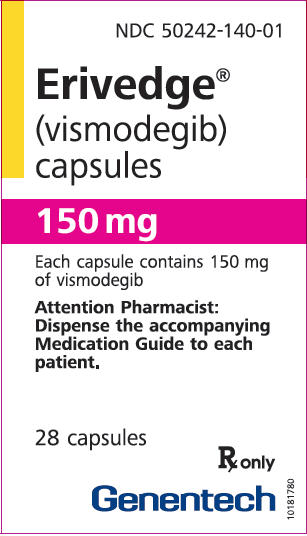
9PRINCIPAL DISPLAY PANEL - 150 mg Capsule Bottle Carton
NDC 50242-140-01
Erivedge
(vismodegib)
capsules
150 mg
Each capsule contains 150 mg
Attention Pharmacist:
28 capsules
Rx only
Genentech
10181780
PRINCIPAL DISPLAY PANEL - 150 mg Capsule Bottle Carton