Varicose Veins Treatments
Find Varicose Veins Treatments
Generic Name
Polidocanol
Brand Names
Asclera, Varithena
FDA approval date: June 01, 2010
Classification: Sclerosing Agent
Form: Injection, Kit
What is Asclera (Polidocanol)?
Asclera ® is indicated to sclerose uncomplicated spider veins and uncomplicated reticular veins in the lower extremity. Asclera has not been studied in varicose veins more than 3 mm in diameter. Asclera is a sclerosing agent indicated to sclerose uncomplicated spider veins and uncomplicated reticular veins in the lower extremity. Asclera has not been studied in varicose veins more than 3mm in diameter.
Approved To Treat
Top Global Experts


Save this treatment for later
Not sure about your diagnosis?
Tired of the same old research?
Related Clinical Trials
A Prospective Cohort Register Study for Validation of Caprini Score in Patients Undergoing Varicose Vein Surgery
Summary: The aim of the study is to make a validation of Caprini score in patients undergoing varicose veins surgery, especially endovascular procedures (endovascular laser treatment - EVLT, radiofrequency ablation - RFA, ultrasound-guided foam sclerotherapy - USFS) and to identify patients with elevated risk of postoperative venous thromboembolism (VTE) who will benefit from prophylactic anticoagulation.
Related Latest Advances
Brand Information
Asclera (POLIDOCANOL)
1INDICATIONS AND USAGE
Asclera
2DOSAGE AND ADMINISTRATION
For intravenous use only. Parenteral drug products should be inspected visually for particulate matter and discoloration prior to administration, whenever solution and container permit. Do not use if particulate matter is seen or if the contents of the vial are discolored or if the vial is damaged in any way.
For spider veins (varicose veins ≤1 mm in diameter), use Asclera 0.5%. For reticular veins (varicose veins 1 to 3 mm in diameter), use Asclera 1%. Use 0.1 to 0.3 mL per injection and no more than 10 mL per session.
Use a syringe (glass or plastic) with a fine needle (typically, 26- or 30-gauge). Insert the needle tangentially into the vein and inject the solution slowly while the needle is still in the vein. Apply only gentle pressure during injection to prevent vein rupture. After the needle has been removed and the injection site has been covered, apply compression in the form of a stocking or bandage. After the treatment session, encourage the patient to walk for 15 to 20 minutes. Keep the patient under observation to detect any anaphylactic or allergic reaction
Maintain compression for 2 to 3 days after treatment of spider veins and for 5 to 7 days for reticular veins. For extensive varicosities, longer compression treatment with compression bandages or a gradient compression stocking of a higher compression class is recommended. Post-treatment compression is necessary to reduce the risk of deep vein thrombosis.
Repeat treatments may be necessary if the extent of the varicose veins requires more than 10 mL. These treatments should be separated by 1 to 2 weeks.
Small intravaricose thrombi that develop may be removed by microthrombectomy.
3DOSAGE FORMS AND STRENGTHS
Asclera (polidocanol) is an injection for intravenous use and is available as follows:
• 0.5% [10 mg/2 mL (5 mg/mL)] solution in 2 mL single-dose glass ampule
4CONTRAINDICATIONS
Asclera is contraindicated for patients with known allergy to polidocanol and patients with acute thromboembolic diseases.
5DRUG INTERACTIONS
No drug-drug interactions have been studied with Asclera.
6OVERDOSAGE
Overdose may result in a higher incidence of localized reactions such as necrosis.
7DESCRIPTION
Asclera is a sterile, nonpyrogenic, and colorless to faintly greenish-yellow solution of polidocanol for intravenous use as a sclerosing agent.
The active ingredient, polidocanol is a non-ionic detergent, consisting of two components, a polar hydrophilic (dodecyl alcohol) and an apolar hydrophobic (polyethylene oxide) chain. Polidocanol has the following structural formula:
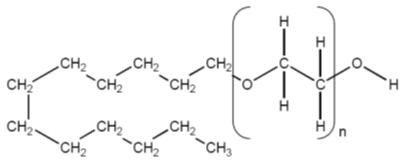
C
Each mL contains 5 mg (0.5%) or 10 mg (1.0%) polidocanol in water for injection with 5% (v/v) ethanol at pH 6.5-8.0; disodium hydrogen phosphate dihydrate (1.2 mg), potassium dihydrogen phosphate (0.43 mg).
8CLINICAL STUDIES
Asclera was evaluated in a multicenter, randomized, double-blind, placebo- and comparator-controlled trial (EASI-study) in patients with spider or reticular varicose veins. A total of 338 patients were treated with Asclera [0.5% for spider veins (n=94), 1% for reticular veins (n=86)], sodium tetradecyl sulfate (STS) 1% (n=105), or placebo (0.9% isotonic saline solution) (n=53) for either spider or reticular veins. Patients were predominately female, ranging in age from 19 to 70 years. All of them received an intravenous injection in the first treatment session; repeat injections were given three and six weeks later if the previous injection was evaluated as unsuccessful (defined as 1, 2 or 3 on a 5-point scale, see below). Patients returned at 12 and 26 weeks after the last injection for final assessments.
The primary effectiveness endpoint was improvement of veins judged by a blinded panel. Digital images of the selected treatment area were taken prior to injection, compared with those taken at 12 weeks post-treatment, and rated on a 5-point scale (1 = worse than before, 2 = same as before, 3 = moderate improvement, 4 = good improvement, 5 = complete treatment success); results are shown in Table 2.
The secondary efficacy criterion was the rate of treatment success, pre-defined as a score of 4 or 5 with patients scoring 1, 2, or 3 considered treatment failures; results are shown in Table 3.
At 12 and 26 weeks, patients' judgement of the results was assessed by showing them the digital images of their treatment area taken at baseline and asking them to rate their satisfaction with their treatment using a verbal rating scale (1 = very unsatisfied; 2 = somewhat unsatisfied; 3 = slightly satisfied; 4 = satisfied and 5 = very satisfied); results are shown in Table 4.
9HOW SUPPLIED/STORAGE AND HANDLING
Asclera (polidocanol) injection is a colorless to faintly greenish-yellow solution supplied in single-dose, sterile, preservative free ampules in the following packages:
NDC 67850-140-05 Five 0.5 % ampules [10 mg/2 mL (5 mg/mL)]
NDC 67850-141-05 Five 1 % ampules [20 mg/2 mL (10 mg/mL)]
Each ampule is intended for immediate use in a single patient. Each unopened ampule is stable up to three years.
10PATIENT COUNSELING INFORMATION
Advise the patient to wear compression stockings or support hose on the treated legs continuously for 2 to 3 days and for 2 to 3 weeks during the daytime. Compression stockings or support hose should be thigh or knee high depending upon the area treated in order to provide adequate coverage.
Advise the patient to walk for 15 to 20 minutes immediately after the procedure and daily for the next few days.
For two to three days following treatment, advise the patient to avoid heavy exercise, sunbathing, long plane flights, and hot baths or sauna.
Distributed by:
Methapharm, Inc.
Manufactured by:
Chemische Fabrik Kreussler & Co. GmbH
Chemische Fabrik Kreussler & Co. GmbH
65203 Wiesbaden GERMANY
Asclera is a registered trademark of Chemische Fabrik Kreussler & Co. GmbH, 65203 Wiesbaden, GERMANY
11PRINCIPAL DISPLAY PANEL - 20 mg Ampule Carton
NDC 67850-141-05
ASCLERA®
(polidocanol) Injection
(polidocanol) Injection
20 mg per 2 mL
(10 mg per mL)
(10 mg per mL)
1%
For Intravenous Use Only

12PRINCIPAL DISPLAY PANEL - 10 mg Ampule Carton
NDC 67850-140-05
ASCLERA®
(polidocanol) Injection
(polidocanol) Injection
10 mg per 2 mL
(5 mg per mL)
(5 mg per mL)
0.5%
For Intravenous Use Only
