Viral Gastroenteritis Treatments
Find Viral Gastroenteritis Treatments
Generic Name
Mesalamine
Brand Names
Apriso, Canasa, Lialda, Pentasa, Rowasa
FDA approval date: May 10, 1993
Classification: Aminosalicylate
Form: Suppository, Tablet, Enema, Kit, Suspension, Capsule
What is Apriso (Mesalamine)?
APRISO is indicated for the maintenance of remission of ulcerative colitis in adults. APRISO is an aminosalicylate indicated for the maintenance of remission of ulcerative colitis in adults.
Top Global Experts


Save this treatment for later
Not sure about your diagnosis?
Tired of the same old research?
Related Clinical Trials
Efficacy of Acupuncture Combined With Mesalazine in Inducing and Maintaining Clinical Remission in Mild-to-Moderate Active Ulcerative Colitis: A Single-Center, Randomized Controlled Clinical Trial.
Summary: This study aims to evaluate the efficacy and safety of acupuncture combined with mesalazine (an integrated acupuncture-medication regimen) for ulcerative colitis.
A Randomised, Controlled, Double-blind Exploratory Study of ND-12 Combined With H-6 in the Treatment of Adult Chronic Inflammatory Diarrhea
Summary: This is a randomized controlled trial to explore the efficacy and safety of ND-12 combined with H-6 for patients with chronic inflammatory diarrhea
Diagnostic Value of Quantitative Fecal Immunochemical Test (qFIT) and Calprotectin (FC) Dynamic Changes at 2 Weeks for Predicting 52-Week Relapse or Treatment Escalation in Biologic-Naive Ulcerative Colitis: A Multicenter, Prospective Cohort Study (DYNAMIC-UC)
Summary: This multicenter prospective cohort study aims to evaluate whether a \>50% decrease or normalization of both quantitative fecal immunochemical test (qFIT) and fecal calprotectin (FC) levels at 2 weeks after starting conventional therapy (mesalazine or corticosteroids) can predict clinical relapse or need for biologic/JAK inhibitor therapy escalation by 52 weeks in biologic-naive patients with acti...
Related Latest Advances
Brand Information
APRISO (mesalamine)
1INDICATIONS AND USAGE
APRISO
2DOSAGE AND ADMINISTRATION
Dosage
The recommended dosage in adults is 1.5 g (four 0.375 g capsules) orally once daily in the morning.
The recommended dosage in adults is 1.5 g (four 0.375 g capsules) orally once daily in the morning.
Administration Instructions
- Evaluate renal function before initiating therapy with APRISO
- Swallow APRISO capsules whole. Do not cut, break, crush or chew the capsules.
- Avoid co-administration of APRISO with antacids
- Drink an adequate amount of fluids
- Take APRISO without regard to meals
3DOSAGE FORMS AND STRENGTHS
Extended-release capsules: 0.375 g mesalamine in a light blue opaque gelatin capsule with the letters “G” and “M” imprinted on either side of a black band.
4CONTRAINDICATIONS
APRISO is contraindicated in patients with hypersensitivity to salicylates or aminosalicylates or to any of the components of APRISO capsules
5ADVERSE REACTIONS
The following clinically significant adverse reactions are described elsewhere in labeling:
- Renal Impairment
- Mesalamine-Induced Acute Intolerance Syndrome
- Hypersensitivity Reactions
- Hepatic Failure
- Severe Cutaneous Adverse Reactions
- Photosensitivity
- Nephrolithiasis
- Risks in Patients with Phenylketonuria
5.1Clinical Trials Experience
Because clinical studies are conducted under widely varying conditions, adverse reaction rates observed in the clinical trials of a drug cannot be directly compared to rates in the clinical trials of another drug and may not reflect the rates observed in practice.
The data described below reflect exposure to APRISO in 557 patients, including 354 exposed for at least 6 months and 250 exposed for greater than one year. APRISO was studied in two placebo-controlled trials (n=367 treated with APRISO) and in one open-label, long-term study (n=190 additional patients). The population consisted of patients with ulcerative colitis; the mean age was 47 years, 54% were female, and 93% were white. Patients received doses of APRISO 1.5 g administered orally once per day for six months in the placebo-controlled trials and for up to 24 months in the open‑label study.
In the two placebo-controlled trials, the most common reactions reported in at least 3% of APRISO-treated patients and at a greater rate than placebo are shown in Table 1 below.
The following adverse reactions, presented by body system, were reported at a frequency less than 3% in patients treated with APRISO for up to 24 months in controlled and open-label trials.
Ear and Labyrinth Disorders: tinnitus, vertigo
Dermatological Disorder: alopecia
Gastrointestinal: lower abdominal pain, rectal hemorrhage
Laboratory Abnormalities: increased triglycerides, decreased hematocrit and hemoglobin
General Disorders and Administration Site Disorders: fatigue
Hepatic: hepatitis cholestatic, transaminases increased
Renal Disorders: creatinine clearance decreased, hematuria
Musculoskeletal: pain, arthralgia
Respiratory: dyspnea
5.2Postmarketing Experience
The following adverse reactions have been identified during post approval use of APRISO or other mesalamine-containing products. Because many of these reactions are reported voluntarily from a population of unknown size, it is not always possible to reliably estimate their frequency or establish a causal relationship to drug exposure.
Body as a Whole: lupus-like syndrome, drug fever
Cardiovascular: pericarditis, pericardial effusion, myocarditis [see (
Gastrointestinal: pancreatitis, cholecystitis, gastritis, gastroenteritis, gastrointestinal bleeding, perforated peptic ulcer
Hepatic: jaundice, cholestatic jaundice, hepatitis, liver necrosis, liver failure, Kawasaki-like syndrome including changes in liver enzymes
Hematologic: agranulocytosis, aplastic anemia
Nervous System: intracranial hypertension
Neurological/Psychiatric: peripheral neuropathy, Guillain-Barré syndrome, transverse myelitis
Renal and Urinary: nephrogenic diabetes insipidus, interstitial nephritis, renal failure, minimal change disease, nephrolithiasis [see (
- Urine discoloration occurring ex-vivo caused by contact of mesalamine, including inactive metabolite, with surfaces or water treated with hypochlorite-containing bleach.
Respiratory/Pulmonary: eosinophilic pneumonia, interstitial pneumonitis, pleurisy/pleuritis
Skin: psoriasis, pyoderma gangrenosum, erythema nodosum, SJS/TEN, DRESS, and AGEP [see Warnings and Precautions (5.5)]
Renal/Urogenital: reversible oligospermia
6OVERDOSAGE
APRISO is an aminosalicylate, and symptoms of salicylate toxicity include nausea, vomiting and abdominal pain, tachypnea, hyperpnea, tinnitus, and neurologic symptoms (headache, dizziness, confusion, seizures). Severe salicylate intoxication may lead to electrolyte and blood pH imbalance and potentially to other organ (e.g., renal and liver) damage. There is no specific antidote for mesalamine overdose; however, conventional therapy for salicylate toxicity may be beneficial in the event of acute overdosage and may include gastrointestinal tract decontamination to prevent further absorption. Correct fluid and electrolyte imbalance by the administration of appropriate intravenous therapy and maintain adequate renal function. APRISO is a pH-dependent delayed-release product and this factor should be considered when treating a suspected overdose.
7DESCRIPTION
Each APRISO

Molecular Weight: 153.14
Molecular Formula: C
Each APRISO capsule contains granules composed of mesalamine in a polymer matrix with an enteric coating that dissolves at pH 6 and above.
The inactive ingredients of APRISO capsules are: anhydrous citric acid, aspartame, colloidal silicon dioxide, edible black ink, hypromellose, magnesium stearate, methacrylic acid copolymer, microcrystalline cellulose, povidone, simethicone emulsion, ethyl acrylate/methyl methacrylate copolymer, talc, titanium dioxide, triethyl citrate, vanilla flavor.
Each APRISO 0.375 g capsule contains 0.56 mg of phenylalanine.
8CLINICAL STUDIES
Two similar, randomized, double-blind, placebo-controlled, multi-center studies were conducted in a total of 562 adult patients in remission from ulcerative colitis. The study populations had a mean age of 46 years (11% age 65 years or older), were 53% female, and were primarily white (92%).
Ulcerative colitis disease activity was assessed using a modified Sutherland Disease Activity Index (DAI), which is a sum of four subscores based on stool frequency, rectal bleeding, mucosal appearance on endoscopy, and physician’s rating of disease activity. Each subscore can range from 0 to 3, for a total possible DAI score of 12.
At baseline, approximately 80% of patients had a total DAI score of 0 or 1.0. Patients were randomized 2:1 to receive either APRISO 1.5 g or placebo once daily in the morning for six months. Patients were assessed at baseline, 1 month, 3 months, and 6 months in the clinic, with endoscopy performed at baseline, at end of study, or if clinical symptoms developed. Relapse was defined as a rectal bleeding subscale score of 1 or more and a mucosal appearance subscale score of 2 or more using the DAI. The analysis of the intent-to-treat population was a comparison of the proportions of patients who remained relapse-free at the end of six months of treatment. For the table below (Table 3) all patients who prematurely withdrew from the study for any reason were counted as relapses.
In both studies, the proportion of patients who remained relapse-free at six months was greater for APRISO than for placebo.
Examination of gender subgroups did not identify difference in response to APRISO among these subgroups. There were too few elderly and too few African-American patients to adequately assess difference in effects in those populations.
The use of APRISO for treating ulcerative colitis beyond six months has not been evaluated in controlled clinical trials.
9HOW SUPPLIED/STORAGE AND HANDLING
APRISO
Storage:
Store at 20° to 25°C (68° to 77°F); excursions permitted between 15° and 30°C (59° and 86°F) [see USP Controlled Room Temperature].
10PATIENT COUNSELING INFORMATION
Administration
Instruct patients:
- Swallow the capsules whole. Do not cut, break, crush or chew the capsules.
- Avoid co-administration of APRISO with antacids.
- Drink an adequate amount of fluids.
- APRISO capsules can be taken without regard to meals
- Urine may become discolored reddish-brown while taking APRISO when it comes in contact with surfaces or water treated with hypochlorite-containing bleach. If discolored urine is observed, advise patients to observe their urine flow. Report to the healthcare provider only if urine is discolored on leaving the body, before contact with any surface or water (e.g., in the toilet).
Renal Impairment
Inform patients that APRISO may decrease their renal function, especially if they have known renal impairment or are taking nephrotoxic drugs, including NSAIDs, and periodic monitoring of renal function will be performed while they are on therapy. Advise patients to complete all blood tests ordered by their healthcare provider
Mesalamine-Induced Acute Intolerance Syndrome and Other Hypersensitivity Reactions
Inform patients of the signs and symptoms of hypersensitivity reactions. Instruct patients to stop taking APRISO and report to their healthcare provider if they experience new or worsening symptoms of Acute Intolerance Syndrome (cramping, abdominal pain, bloody diarrhea, fever, headache, and rash) or other symptoms suggestive of mesalamine-induced hypersensitivity
Hepatic Failure
Inform patients with known liver disease of the signs and symptoms of worsening liver function and advise them to report to their healthcare provider if they experience such signs or symptoms
Severe Cutaneous Adverse Reactions
Inform patients of the signs and symptoms of severe cutaneous adverse reactions. Instruct patients to stop taking APRISO and report to their healthcare provider at first appearance of a severe cutaneous adverse reaction or other sign of hypersensitivity
Photosensitivity
Advise patients with pre-existing skin conditions to avoid sun exposure, wear protective clothing, and use a broad-spectrum sunscreen when outdoors
Nephrolithiasis
Instruct patients to drink an adequate amount of fluids during treatment in order to minimize the risk of kidney stone formation and to contact their healthcare provider if they experience signs or symptoms of a kidney stone (e.g., severe side or back pain, blood in the urine)
Patients with Phenylketonuria
Inform patients with phenylketonuria (PKU) or their caregivers that each APRISO capsule contains aspartame equivalent to 0.56 mg of phenylalanine, so that the recommended adult dosing provides an equivalent of 2.24 mg of phenylalanine per day
Blood Disorders
Inform elderly patients and those taking azathioprine or 6-mercaptopurine of the risk for blood disorders and the need for periodic monitoring of complete blood cell counts and platelet counts while on therapy. Advise patients to complete all blood tests ordered by their healthcare provider
Distributed by:
Salix Pharmaceuticals, a division of
Bausch Health US, LLC
Bridgewater, NJ 08807 USA
Patented. See https://patents.salix.com/for US patent information.
Salix Pharmaceuticals, a division of
Bausch Health US, LLC
Bridgewater, NJ 08807 USA
Patented. See https://patents.salix.com/for US patent information.
APRISO is a trademark of Salix Pharmaceuticals, Inc. or its affiliates.
© 2023 Salix Pharmaceuticals, Inc. or its affiliates
9602407
11PACKAGE/LABEL PRINCIPAL DISPLAY PANEL
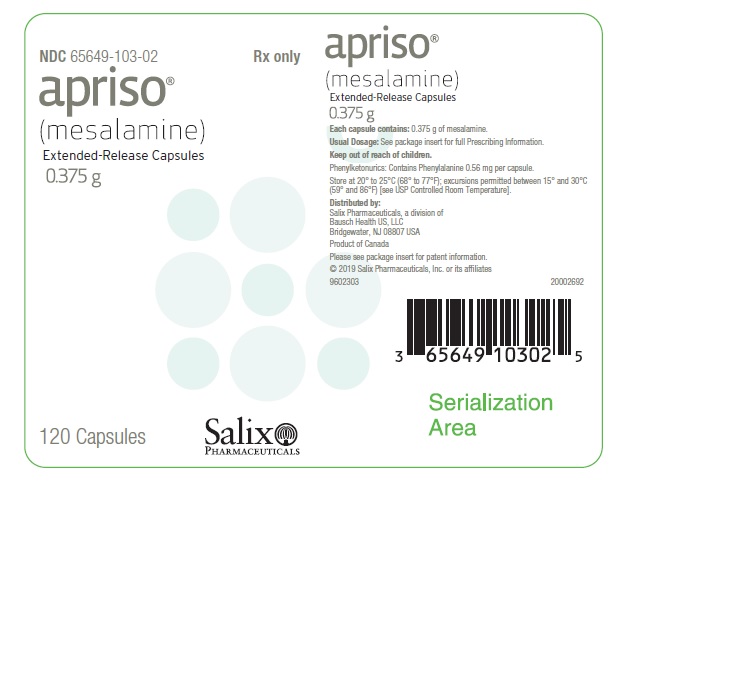
NDC65649-103-02
Rx only
apriso
(mesalamine)
Extended-Release Capsules
0.375 g
(mesalamine)
Extended-Release Capsules
0.375 g
120 Capsules
Salix Pharmaceuticals