Generic Name

Candesartan Cilexetil

Brand Names
Atacand, Candesartan
FDA approval date: December 04, 2012
Classification: Angiotensin 2 Receptor Blocker
Form: Tablet

What is Atacand (Candesartan Cilexetil)?

ATACAND is an angiotensin II receptor blocker indicated for: Treatment of hypertension in adults and children 1 to < 17 years of age, to lower blood pressure. Lowering blood pressure reduces the risk of fatal and non-fatal cardiovascular events, primarily strokes and myocardial infarctions.
Save this treatment for later
Sign Up
Not sure about your diagnosis?
Check Your Symptoms

Related Clinical Trials

Bariatric Surgery and Pharmacokinetics Candesartan: BAR-MEDS Candesartan

Summary: Changes to gastric pH, gastric emptying time, gastrointestinal transit-time or the pre-systemic metabolizing effect of enzymes secreted in the mucosa may all alter the pharmacokinetics of medicines. These factors are potentially influenced by bariatric surgery. Little is so far known about how gastric bypass and sleeve gastrectomy impacts the biological availability of medication. In this study th...

A Multicenter, Randomized, Double-Blind, Parallel, Phase 2(2b) Clinical Trial to Compare and Evaluate the Efficacy and Safety of SPC1001 in Patients With Essential Hypertension

Objective: This study aims to evaluate the safety and efficacy of the fixed-dose triple combination therapy (SPC1001) of candesartan, amlodipine, and indapamide in adult patients with essential hypertension compared to dual-component therapies of each ingredient for 8 weeks. Additionally, it seeks to confirm the contribution of each component at low doses. \- Inclusion Criteria: Men and women aged 19 to 75 y...

Effect of Sacubitril/Valsartan on Cardiac Function Assessed by Cardiac Magnetic Resonance (CMR) in Hypertensive Patients Stratified by Body Mass Index (BMI): A Real World Study

Summary: The purpose of this study is to investigate the effect of sacubitril/valsartan on cardiac function assessed by cardiac magnetic resonance (CMR) in hypertensive patients stratified by BMI.

Brand Information

    ATACAND (Candesartan Cilexetil)
    WARNING: FETAL TOXICITY
    • When pregnancy is detected, discontinue ATACAND as soon as possible
    • Drugs that act directly on the renin-angiotensin system can cause injury and death to the developing fetus
    1DOSAGE FORMS AND STRENGTHS
    4 mg are white to off-white, circular/biconvex-shaped, non-film-coated scored tablets, coded ACF on one side and 004 on the other.
    8 mg are light pink, circular/biconvex-shaped, non-film-coated scored tablets, coded ACG on one side and 008 on the other.
    16 mg are pink, circular/biconvex-shaped, non-film-coated scored tablets, coded ACH on one side and 016 on the other.
    32 mg are pink, circular/biconvex-shaped, non-film-coated scored tablets, coded ACL on one side and 032 on the other.
    2CONTRAINDICATIONS
    ATACAND is contraindicated in patients who are hypersensitive to candesartan.
    Do not co-administer aliskiren with ATACAND in patients with diabetes
    3OVERDOSAGE
    No lethality was observed in acute toxicity studies in mice, rats, and dogs given single oral doses of up to 2000 mg/kg of candesartan cilexetil. In mice given single oral doses of the primary metabolite, candesartan, the minimum lethal dose was greater than 1000 mg/kg but less than 2000 mg/kg.
    The most likely manifestation of overdosage with ATACAND would be hypotension, dizziness, and tachycardia; bradycardia could occur from parasympathetic (vagal) stimulation. If symptomatic hypotension should occur, supportive treatment should be instituted.
    Candesartan cannot be removed by hemodialysis.
    Treatment: To obtain up-to-date information about the treatment of overdose, consult your Regional Poison Control Center. Telephone numbers of certified poison control centers are listed in the Physicians’ Desk Reference (PDR). In managing overdose, consider the possibilities of multiple-drug overdoses, drug-drug interactions, and altered pharmacokinetics in your patient.
    4DESCRIPTION
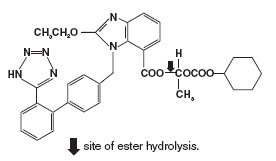
    ATACAND (candesartan cilexetil), a prodrug, is hydrolyzed to candesartan during absorption from the gastrointestinal tract. Candesartan is a selective AT
    Candesartan cilexetil, a nonpeptide, is chemically described as (±)-1-Hydroxyethyl 2-ethoxy-1-[
    Its empirical formula is C
    structural formula
    Candesartan cilexetil is a white to off-white powder with a molecular weight of 610.67. It is practically insoluble in water and sparingly soluble in methanol. Candesartan cilexetil is a racemic mixture containing one chiral center at the cyclohexyloxycarbonyloxy ethyl ester group. Following oral administration, candesartan cilexetil undergoes hydrolysis at the ester link to form the active drug, candesartan, which is achiral.
    ATACAND is available for oral use as tablets containing either 4 mg, 8 mg, 16 mg, or 32 mg of candesartan cilexetil and the following inactive ingredients: hydroxypropyl cellulose, polyethylene glycol, lactose, corn starch, carboxymethylcellulose calcium, and magnesium stearate. Ferric oxide (reddish brown) is added to the 8-mg, 16-mg, and 32-mg tablets as a colorant.
    5HOW SUPPLIED/STORAGE AND HANDLING
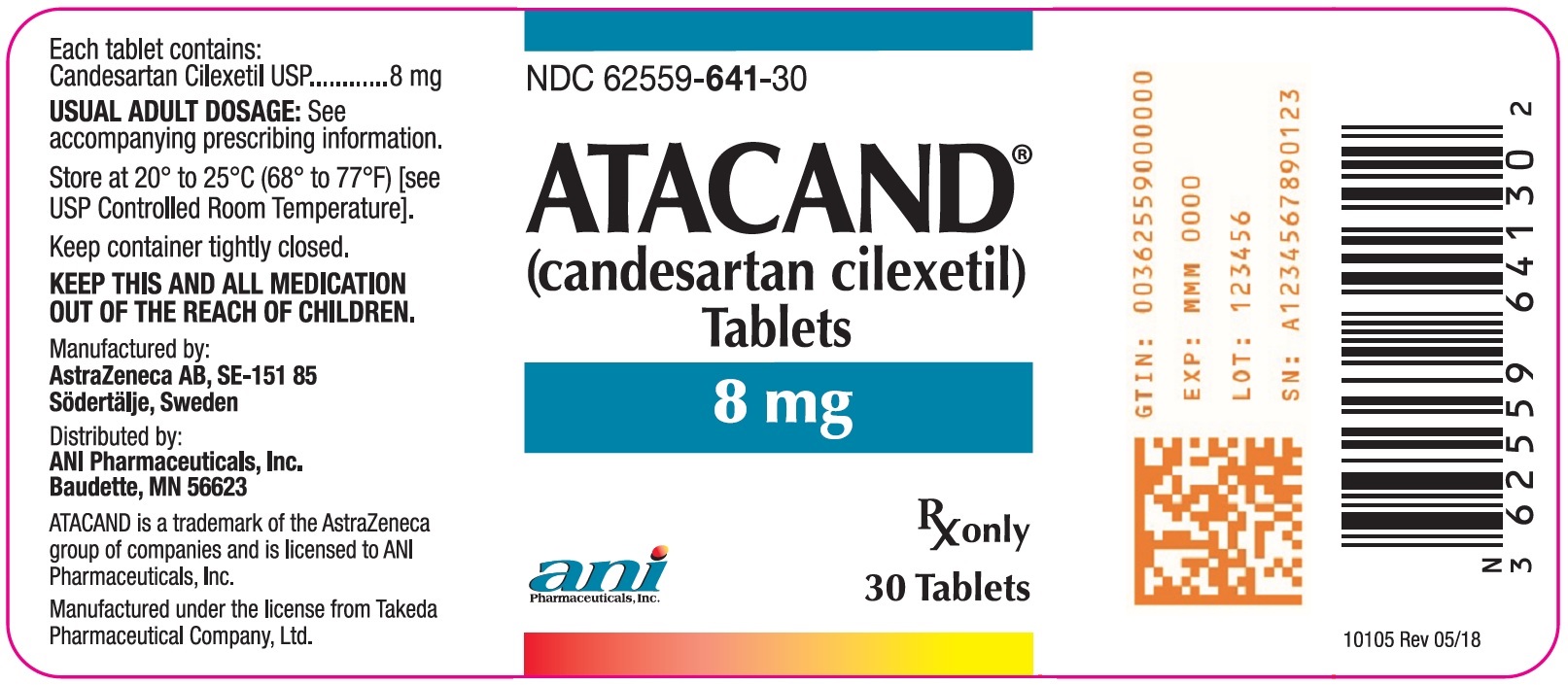
    ATACAND Tablets, 4 mg, are white to off-white, circular/biconvex-shaped, non-film-coated scored tablets, coded ACF on one side and 004 on the other. They are supplied in bottles of 30 tablets (NDC 62559-640-30).
    ATACAND Tablets, 8 mg, are light pink, circular/biconvex-shaped, non-film-coated scored tablets, coded ACG on one side and 008 on the other. They are supplied in bottles of 30 tablets (NDC 62559-641-30).
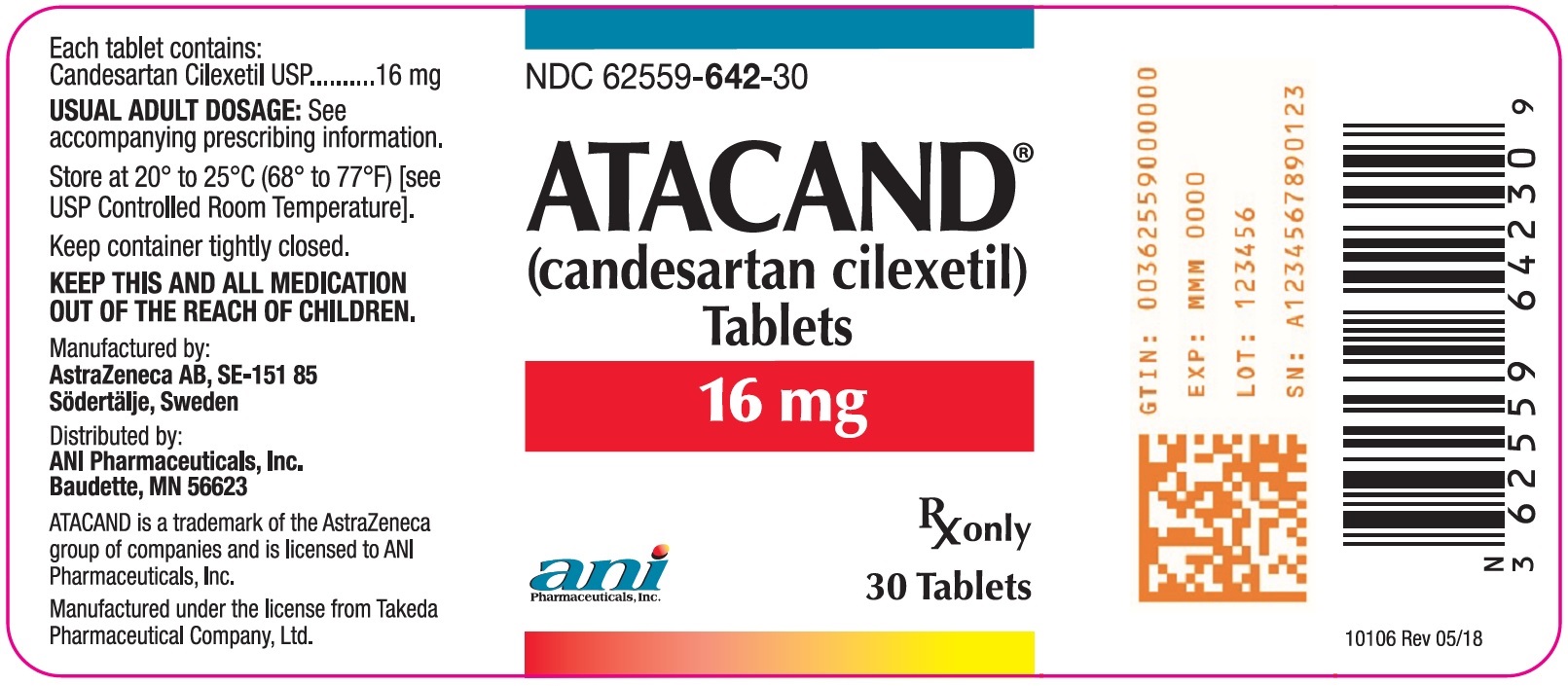
    ATACAND Tablets, 16 mg, are pink, circular/biconvex-shaped, non-film-coated scored tablets, coded ACH on one side and 016 on the other. They are supplied in bottles of 30 tablets (NDC 62559-642-30) and bottles of 90 tablets (NDC 62559-642-90).
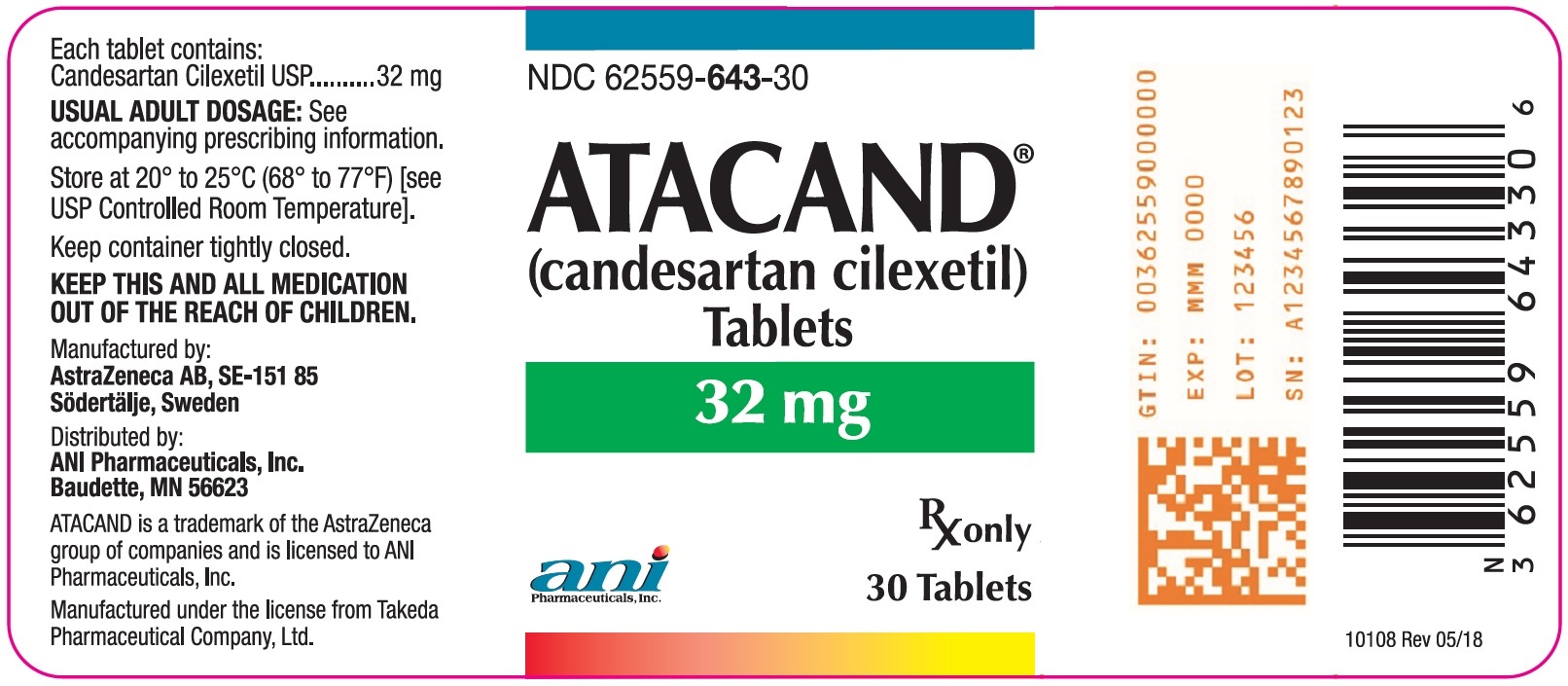
    ATACAND Tablets, 32 mg, are pink, circular/biconvex-shaped, non-film-coated scored tablets, coded ACL on one side and 032 on the other. They are supplied in bottles of 30 tablets (NDC 62559-643-30) and bottles of 90 tablets (NDC 62559-643-90).
    Storage
    Store at 20° to 25°C (68° to 77°F); excursions permitted at 15° to 30°C (59° to 86°F) [see USP Controlled Room Temperature]
    6PATIENT COUNSELING INFORMATION
    Advise patient to read FDA-approved patient labeling (Patient Information).
    Pregnancy
    Advise female patients of childbearing age about the consequences of exposure to ATACAND during pregnancy. Discuss treatment options with women planning to become pregnant. Tell patients to report pregnancies to their physicians as soon as possible.
    Manufactured under the license from Takeda Pharmaceutical Company, Ltd.
    Manufactured by:
    Distributed by:
    ATACAND is a registered trademark of the AstraZeneca group of companies and is licensed to ANI Pharmaceuticals, Inc.
    10110 Rev 07/25
    7Patient Information
    ATACAND
    Read the Patient Information that comes with ATACAND before you start taking it and each time you get a refill. There may be new information. This leaflet does not take the place of talking with your doctor about your medical condition or your treatment. If you have any questions about ATACAND, ask your doctor or pharmacist.
    What is the most important information I should know about ATACAND?
    ATACAND can cause harm or death to an unborn baby. Talk to your doctor about other ways to lower your blood pressure if you plan to become pregnant. If you get pregnant while taking ATACAND, tell your doctor right away.
    What is ATACAND?
    ATACAND is a prescription medicine called an angiotensin receptor blocker (ARB).
    ATACAND is used to:
    • treat high blood pressure in adults and children, 1 to 17 years of age
    • treat certain types of heart failure in adults, to reduce death and hospitalization for heart damage and heart failure
    Heart failure is a condition where the heart does not pump blood as well as it should.
    ATACAND must not be used in children less than 1 year of age for high blood pressure.
    Who should not take ATACAND?
    Do not take ATACAND if you:
    • are allergic to any of the ingredients in ATACAND. See the end of this leaflet for a complete list of ingredients in ATACAND.
    • are diabetic and taking aliskiren.
    What should I tell my doctor before taking ATACAND?
    Before you take ATACAND, tell your doctor if you:
    • have heart problems
    • have liver problems
    • have kidney problems
    • currently have vomiting or diarrhea
    • are scheduled for surgery or anesthesia. Low blood pressure can happen in people who take ATACAND and have major surgery and anesthesia.
    • have any other medical conditions
    • are pregnant or planning to become pregnant. See “What is the most important information I should know about ATACAND?”
    • are breast-feeding or plan to breast-feed. It is not known if ATACAND passes into your breast milk. You and your doctor should decide if you will take ATACAND or breast-feed. You should not do both.
    Tell your doctor about all the medicines you take, including prescription and non-prescription medicines, vitamins and herbal supplements. ATACAND and other medicines may affect each other causing serious side effects. ATACAND may affect the way other medicines work, and other medicines may affect how ATACAND works.
    Especially tell your doctor if you take:
    • lithium carbonate (Lithobid) or lithium citrate, medicines used in some types of depression
    • other medicines for high blood pressure, especially water pills (diuretics)
    • potassium supplements
    • salt substitutes
    • non-steroidal anti-inflammatory drugs (NSAIDs)
    Know the medicines you take. Keep a list of your medications with you to show your doctor and pharmacist when a new medication is prescribed. Talk to your doctor or pharmacist before you start taking any new medicine. Your doctor or pharmacist will know what medicines are safe to take together.
    How should I take ATACAND?
    • Take ATACAND exactly as prescribed by your doctor.
    • Do not change your dose or stop ATACAND without talking to your doctor, even if you are feeling well.
    • If your child cannot swallow tablets, or if tablets are not available in the prescribed strength, your pharmacist will prepare ATACAND as a liquid suspension for your child. If your child switches between taking the tablet and the suspension, your doctor will change the dose as needed. Shake the bottle of suspension well before each dose.
    • ATACAND is taken by mouth with or without food.
    • If you miss a dose of ATACAND, take it as soon as you remember. If it is almost time for your next dose, skip the missed dose. Take the next dose on time. Do not take 2 doses at one time. If you are not sure about your dosing call your doctor or pharmacist.
    • If you take more ATACAND than prescribed, call your doctor, local poison control center, or go to the nearest emergency room.
    What should I avoid while taking ATACAND?
    ATACAND can cause you to feel dizzy or tired. Do not drive, operate machinery, or do other dangerous activities until you know how ATACAND affects you.
    What are the possible side effects of ATACAND?
    ATACAND may cause serious side effects, including:
    • Injury or death to your unborn baby. See “What is the most important information I should know about ATACAND?”
    • Low blood pressure (hypotension). Low blood pressure is most likely to happen if you:
    • take water pills (diuretics)
    • are on a low salt diet
    • get dialysis treatments
    • are dehydrated (decreased body fluids) due to vomiting and diarrhea
    • have heart problems
    If you feel dizzy or faint lie down and call your doctor right away.
    Low blood pressure can also happen if you have major surgery or anesthesia. You will be monitored for this and treated if needed. See “What should I tell my doctor before taking ATACAND?”
    • Worsening kidney problems. Kidney problems may get worse in people that already have kidney disease or heart problems. Your doctor may do blood tests to check for this.
    • Increased potassium in your blood. Your doctor may do a blood test to check your potassium levels as needed.
    • Symptoms of allergic reaction. Call your doctor right away if you have any of these symptoms of an allergic reaction:
    • swelling of your face, lips, tongue or throat
    • rash
    • hives and itching
    The most common side effects of ATACAND are:
    • back pain
    • dizziness
    • cold or flu symptoms (upper respiratory tract infection)
    • sore throat (pharyngitis)
    • nasal congestion and stuffiness (rhinitis)
    Tell your doctor or pharmacist about any side effect that bothers you or that does not go away.
    These are not all the side effects of ATACAND. Ask your doctor or pharmacist for more information.
    Call your doctor for medical advice about side effects. You can report side effects to FDA at 1-800-FDA-1088.
    How should I store ATACAND?
    • Do not keep medicine that is out of date or that you no longer need.
    • Store ATACAND tablets at room temperature below 86°F (30°C).
    • Store ATACAND oral suspension at room temperature below 86°F (30°C).
    • Use the oral suspension within 30 days after first opening the bottle. Do not use after the expiration date stated on the bottle.
    • Do not freeze.
    • Keep the container of ATACAND closed tightly.
    Keep ATACAND and all medicine out of the reach of children.
    General information about ATACAND
    Medicines are sometimes prescribed for conditions that are not mentioned in patient information leaflets. Do not use ATACAND for a condition for which it was not prescribed. Do not give ATACAND to other people, even if they have the same problem you have. It may harm them.
    This leaflet summarizes the most important information about ATACAND. If you would like more information, talk with your doctor. You can ask your doctor or pharmacist for information about ATACAND that is written for health professionals.
    For more information, visit www.anipharmaceuticals.com or call 1-855-204-1431.
    What are the ingredients in ATACAND?
    Active ingredient: candesartan cilexetil.
    Inactive ingredients in ATACAND tablets and ATACAND oral suspension are: hydroxypropyl cellulose, polyethylene glycol, lactose, corn starch, carboxymethylcellulose calcium, and magnesium stearate. Ferric oxide (reddish brown) is added to the 8-mg, 16-mg, and 32-mg tablets as a colorant.
    In addition to the above, ATACAND oral suspension also includes the following inactive ingredients: Ora Plus, Ora Sweet or Ora-Blend.
    How does ATACAND work?
    ATACAND is a type of medicine called angiotensin receptor blocker, which blocks the effect of the hormone angiotensin II, causing the blood vessels to relax. This helps lower blood pressure. Medicines that lower your blood pressure lower your chance of having a stroke or heart attack.
    This Patient Information has been approved by the U.S. Food and Drug Administration.
    Manufactured under the license from Takeda Pharmaceutical Company, Ltd.
    Manufactured by:
    Distributed by:
    ATACAND is a registered trademark of the AstraZeneca group of companies and is licensed to ANI Pharmaceuticals, Inc.
    All brand names listed are the registered trademarks of their respective owners and are not trademarks of ANI Pharmaceuticals, Inc.
    Issued: 07/2025
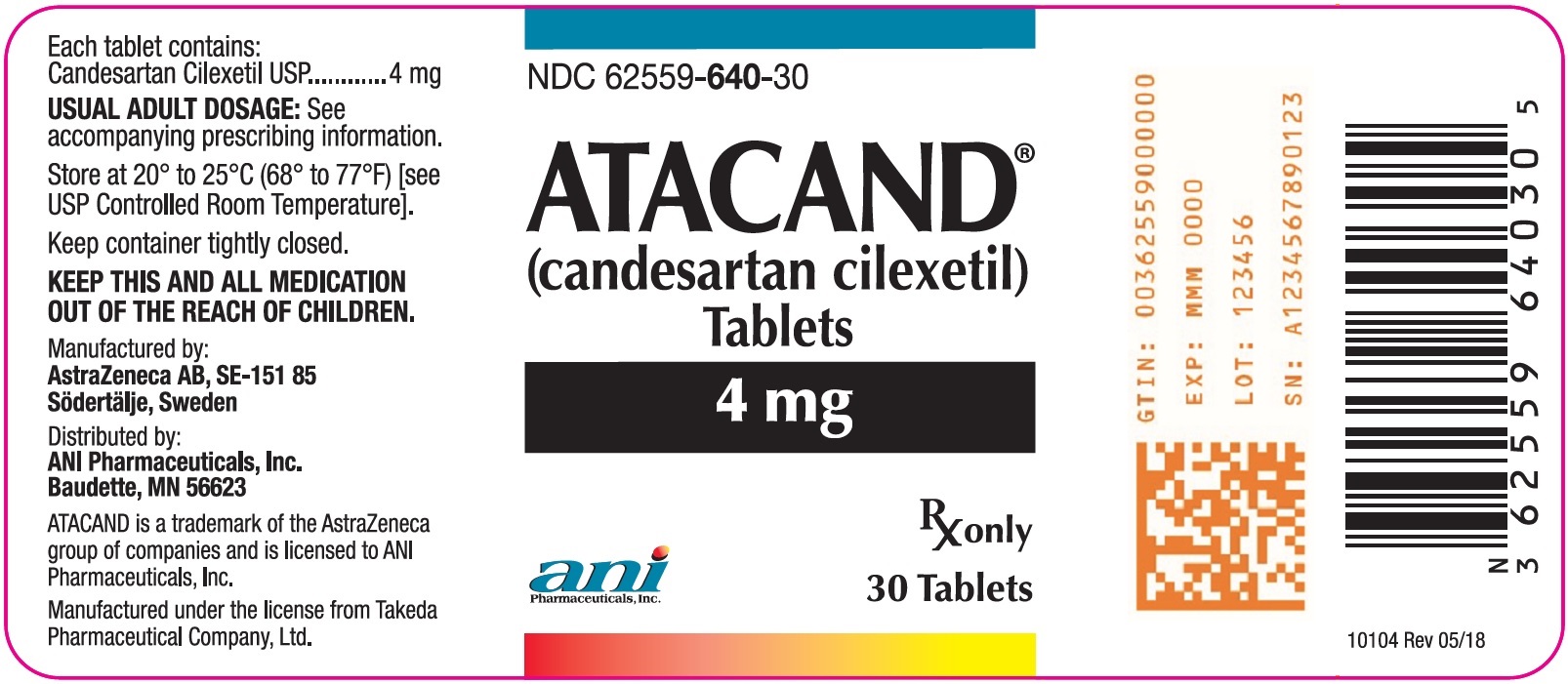
    8PRINCIPAL DISPLAY PANEL – 4 mg
    NDC 62559-640-30
    Label-4mg
    9PRINCIPAL DISPLAY PANEL – 8 mg
    NDC 62559-641-30
    Label-8mg
    10PRINCIPAL DISPLAY PANEL – 16 mg
    NDC 62559-642-30
    Label-16mg
    11PRINCIPAL DISPLAY PANEL – 32 mg
    NDC 62559-643-30
    Label-32mg
    Atacand has been selected.