Brand Name

Pomalyst

Generic Name
Pomalidomide
View Brand Information
FDA approval date: February 18, 2013
Classification: Thalidomide Analog
Form: Capsule

What is Pomalyst (Pomalidomide)?

POMALYST is a thalidomide analogue indicated, for the treatment of adult patients: in combination with dexamethasone, for patients with multiple myeloma who have received at least two prior therapies including lenalidomide and a proteasome inhibitor and have demonstrated disease progression on or within 60 days of completion of the last therapy.
Save this treatment for later
Sign Up
Not sure about your diagnosis?
Check Your Symptoms

Related Clinical Trials

A PHASE 3, OPEN-LABEL STUDY OF ELRANATAMAB MONOTHERAPY VERSUS ELOTUZUMAB, POMALIDOMIDE, DEXAMETHASONE (EPd) OR POMALIDOMIDE, BORTEZOMIB, DEXAMETHASONE (PVd) OR CARFILZOMIB, DEXAMETHASONE (Kd) IN PARTICIPANTS WITH RELAPSED/REFRACTORY MULTIPLE MYELOMA WHO RECEIVED PRIOR ANTI-CD38 DIRECTED THERAPY

Summary: The purpose of this study is to learn about the study medicine called elranatamab.This study aims to compare elranatamab to other medicines for the treatment of MM (a type of cancer). This study is seeking participants who: * Are 18 years of age or older and have MM. * Have received treatments before for MM. * Have MM that has returned or not responded to their most recent treatment. Half of the p...

AN OPEN-LABEL, 3-ARM, MULTICENTER, RANDOMIZED PHASE 3 STUDY TO EVALUATE THE EFFICACY AND SAFETY OF ELRANATAMAB (PF-06863135) MONOTHERAPY AND ELRANATAMAB + DARATUMUMAB VERSUS DARATUMUMAB + POMALIDOMIDE + DEXAMETHASONE IN PARTICIPANTS WITH RELAPSED/REFRACTORY MULTIPLE MYELOMA WHO HAVE RECEIVED AT LEAST 1 PRIOR LINE OF THERAPY INCLUDING LENALIDOMIDE AND A PROTEASOME INHIBITOR

Summary: The purpose of this clinical trial is to (1) learn whether the BCMA-CD3 bispecific antibody elranatamab can provide more benefit to people with multiple myeloma compared to a combination therapy including daratumumab, pomalidomide, and dexamethasone, and (2) learn about the safety and activity of elranatamab in combination with the anti-CD38 monoclonal antibody daratumumab. People with multiple my...

An Open-label, Randomized, Phase 3 Study of Linvoseltamab (REGN5458; Anti- BCMA x Anti-CD3 Bispecific Antibody) Versus the Combination of Elotuzumab, Pomalidomide, and Dexamethasone (EPd), in Patients With Relapsed/Refractory Multiple Myeloma (LINKER-MM3)

Summary: This study is researching an experimental drug called linvoseltamab, also called REGN5458. Linvoseltamab has previously been studied by itself (without other cancer drugs) in participants who had advanced multiple myeloma that returned and needed to be treated again after many other therapies had failed. These participants were no longer benefiting from standard medications and had no good treatme...

Brand Information

Pomalyst (pomalidomide)
1DOSAGE FORMS AND STRENGTHS
  • Capsules:1 mg, dark blue opaque cap and yellow opaque body, imprinted "POML" on the cap in white ink and "1 mg" on the body in black ink
  • 2 mg, dark blue opaque cap and orange opaque body, imprinted "POML" on the cap and "2 mg" on the body in white ink
  • 3 mg, dark blue opaque cap and green opaque body, imprinted "POML" on the cap and "3 mg" on the body in white ink
  • 4 mg, dark blue opaque cap and blue opaque body, imprinted "POML" on the cap and "4 mg" on the body in white ink
2ADVERSE REACTIONS
The following clinically significant adverse reactions are described in detail in other labeling sections:
  • Embryo-Fetal Toxicity
  • Venous and Arterial Thromboembolism
  • Increased Mortality in Patients with Multiple Myeloma When Pembrolizumab Is Added to a Thalidomide Analogue and Dexamethasone
  • Hematologic Toxicity
  • Hepatotoxicity
  • Severe Cutaneous Reactions
  • Dizziness and Confusional State
  • Neuropathy
  • Risk of Second Primary Malignancies
  • Tumor Lysis Syndrome
  • Hypersensitivity
2.1Clinical Trials Experience
Because clinical trials are conducted under widely varying conditions, adverse reaction rates observed in the clinical trials of a drug cannot be directly compared to rates in the clinical trials of another drug and may not reflect the rates observed in practice.
2.2Postmarketing Experience
The following adverse reactions have been identified during postapproval use of POMALYST. Because these reactions are reported voluntarily from a population of uncertain size, it is not always possible to reliably estimate their frequency or establish a causal relationship to drug exposure.
Blood and Lymphatic System Disorders: Pancytopenia
Endocrine Disorders: Hypothyroidism, hyperthyroidism
Gastrointestinal Disorders: Gastrointestinal hemorrhage
Hepatobiliary Disorders: Hepatic failure (including fatal cases), elevated liver enzymes
Immune system Disorders: Allergic reactions (e.g., angioedema, anaphylaxis, urticaria), solid organ transplant rejection
Infections and Infestations: Hepatitis B virus reactivation, Herpes zoster, progressive multifocal leukoencephalopathy (PML)
Neoplasms benign, malignant and unspecified (incl cysts and polyps): Tumor lysis syndrome, basal cell carcinoma, and squamous cell carcinoma of the skin
Skin and Subcutaneous Tissue Disorders: Stevens-Johnson Syndrome, toxic epidermal necrolysis, drug reaction with eosinophilia and systemic symptoms (DRESS)
3OVERDOSAGE
Hemodialysis can remove pomalidomide from circulation.
4DESCRIPTION
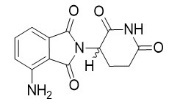
Pomalidomide is a thalidomide analog. The chemical name is (RS)-4-Amino-2-(2,6-dioxo-piperidin-3-yl)-isoindoline-1,3-dione and it has the following chemical structure:
pom-chem-structure
The empirical formula for pomalidomide is C
Pomalidomide is a yellow solid powder. It has limited to low solubility into organic solvents and it has low solubility in all pH solutions (about 0.01 mg/mL). Pomalidomide has a chiral carbon atom which exists as a racemic mixture of the R(+) and S(-) enantiomers.
POMALYST is available in 1-mg, 2-mg, 3-mg, and 4-mg capsules for oral administration. Each capsule contains pomalidomide as the active ingredient and the following inactive ingredients: mannitol, pregelatinized starch, and sodium stearyl fumarate. The 1-mg capsule shell contains gelatin, titanium dioxide, FD&C blue 2, yellow iron oxide, white ink, and black ink. The 2-mg capsule shell contains gelatin, titanium dioxide, FD&C blue 2, yellow iron oxide, FD&C red 3, and white ink. The 3-mg capsule shell contains gelatin, titanium dioxide, FD&C blue 2, yellow iron oxide, and white ink. The 4-mg capsule shell contains gelatin, titanium dioxide, FD&C blue 1, FD&C blue 2, and white ink.
5REFERENCES
  1. OSHA Hazardous Drugs.
6HOW SUPPLIED/STORAGE AND HANDLING
Dark blue opaque cap and yellow opaque body, imprinted "POML" on the cap in white ink and "1 mg" on the body in black ink
Dark blue opaque cap and orange opaque body, imprinted "POML" on the cap and "2 mg" on the body in white ink
Dark blue opaque cap and green opaque body, imprinted "POML" on the cap and "3 mg" on the body in white ink
Dark blue opaque cap and blue opaque body, imprinted "POML" on the cap and "4 mg" on the body in white ink
7PATIENT COUNSELING INFORMATION
Advise the patient to read the FDA-approved patient labeling (Medication Guide).
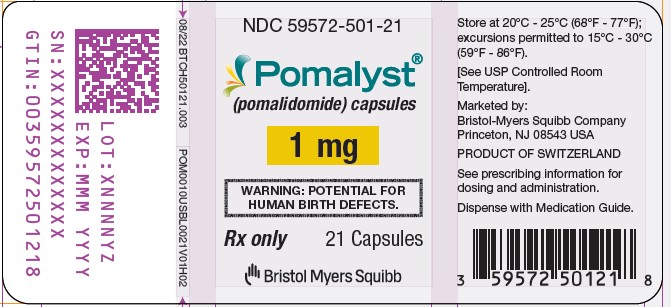
8POMALYST 1 mg Representative Packaging
NDC 59572-501-21
pom-1mg-21ct
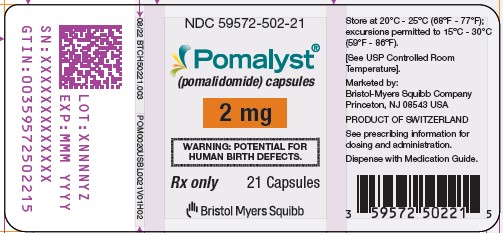
9POMALYST 2 mg Representative Packaging
NDC 59572-502-21
pom-2mg-21ct
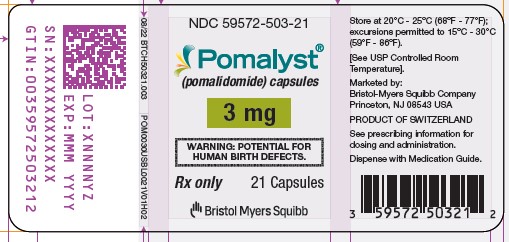
10POMALYST 3 mg Representative Packaging
NDC 59572-503-21
pom-3mg-21ct
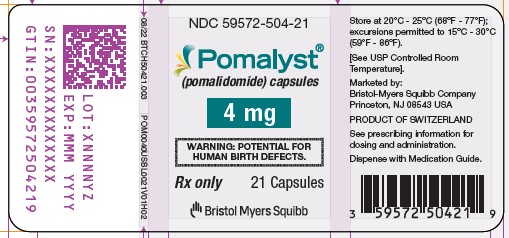
11POMALYST 4 mg Representative Packaging
NDC 59572-504-21
pom-4mg-21ct