Brand Name

Tabrecta

Generic Name
Capmatinib
View Brand Information
FDA approval date: May 06, 2020
Classification: Kinase Inhibitor
Form: Tablet

What is Tabrecta (Capmatinib)?

TABRECTA is indicated for the treatment of adult patients with metastatic non-small cell lung cancer whose tumors have a mutation that leads to mesenchymal-epithelial transition exon 14 skipping as detected by an FDA-approved test. This indication is approved under accelerated approval based on overall response rate and duration of response. Continued approval for this indication may be contingent upon verification and description of clinical benefit in confirmatory trial. TABRECTA is a kinase inhibitor indicated for the treatment of adult patients with metastatic non-small cell lung cancer whose tumors have a mutation that leads to mesenchymal-epithelial transition exon 14 skipping as detected by an FDA-approved test. This indication is approved under accelerated approval based on overall response rate and duration of response. Continued approval for this indication may be contingent upon verification and description of clinical benefit in confirmatory trial.
Save this treatment for later
Sign Up
Not sure about your diagnosis?
Check Your Symptoms

Related Clinical Trials

A Randomized Phase II Study of INC280 (Capmatinib) Plus Osimertinib With or Without Ramucirumab in Participants With EGFR-Mutant, MET-Amplified Stage IV or Recurrent Non-Small Cell Lung Cancer (Lung-MAP Sub-Study)

Summary: This phase II Lung-MAP treatment trial test the combination of targeted drugs (capmatinib, osimertinib, and/or ramucirumab) in treating patients with non-small cell lung cancer that may have spread from where it first started to nearby tissue, lymph nodes, or distant parts of the body (advanced) and that has EGFR and MET gene changes. Capmatinib and osimertinib are in a class of medications called...

Brand Information

TABRECTA (capmatinib)
1INDICATIONS AND USAGE
TABRECTA is indicated for the treatment of adult patients with metastatic non-small cell lung cancer (NSCLC) whose tumors have a mutation that leads to mesenchymal-epithelial transition (MET) exon 14 skipping as detected by an FDA-approved test.
2DOSAGE FORMS AND STRENGTHS
Tablets:
  • 150 mg: pale orange brown, ovaloid, curved film-coated with beveled edges, unscored, debossed with ‘DU’ on one side and ‘NVR’ on the other side
  • 200 mg: yellow, ovaloid, curved film-coated with beveled edges, unscored, debossed with ‘LO’ on one side and ‘NVR’ on the other side
3CONTRAINDICATIONS
None.
4ADVERSE REACTIONS
The following clinically significant adverse reactions are described elsewhere in the labeling:
  • ILD/Pneumonitis
  • Hepatotoxicity
  • Pancreatic Toxicity
  • Hypersensitivity reactions
4.1Clinical Trials Experience
Because clinical trials are conducted under widely varying conditions, adverse reaction rates observed in the clinical trials of a drug cannot be directly compared to rates in the clinical trials of another drug and may not reflect the rates observed in practice.
Metastatic Non-Small Cell Lung Cancer
The safety of TABRECTA was evaluated in GEOMETRY mono-1
Serious adverse reactions occurred in 53% of patients who received TABRECTA. Serious adverse reactions in ≥ 2% of patients included dyspnea (7%), pneumonia (7%), pleural effusion (4.3%), musculoskeletal pain (3.8%), general physical health deterioration (2.9%), ILD/pneumonitis (2.7%), edema (2.4%), and vomiting (2.4%). Fatal adverse reactions occurred in 0.5% of patients who received TABRECTA, including pneumonitis (0.3%) and death, not otherwise specified (0.3%).
Permanent discontinuation of TABRECTA due to an adverse reaction occurred in 17% of patients. The most frequent adverse reactions (≥ 1%) leading to permanent discontinuation of TABRECTA were ILD/pneumonitis (2.4%), edema (2.4%), fatigue (1.3%), and pneumonia (1.1%).
Dose interruptions due to an adverse reaction occurred in 57% of patients who received TABRECTA. Adverse reactions requiring dosage interruption in > 2% of patients who received TABRECTA included edema, increased blood creatinine, nausea, increased lipase, vomiting, increased ALT, dyspnea, pneumonia, fatigue, increased amylase, increased AST, musculoskeletal pain, abdominal pain, and increased blood bilirubin.
Dose reductions due to an adverse reaction occurred in 26% of patients who received TABRECTA. Adverse reactions requiring dosage reductions in > 2% of patients who received TABRECTA included edema, increased ALT and increased blood creatinine.
The most common adverse reactions (≥ 20%) in patients who received TABRECTA were edema, nausea, musculoskeletal pain, fatigue, vomiting, dyspnea, cough, and decreased appetite.
Table 3 summarizes the adverse reactions in GEOMETRY mono-1.
Clinically relevant adverse reactions occurring in < 10% of patients treated with TABRECTA included pruritus (including allergic pruritus), ILD/pneumonitis, cellulitis, acute kidney injury (including renal failure), urticaria, and acute pancreatitis.
Table 4 summarizes the laboratory abnormalities in GEOMETRY mono-1.
Other Clinical Trials Experience
The following adverse reactions have been reported following administration of TABRECTA: hypersensitivity and thrombocytopenia.
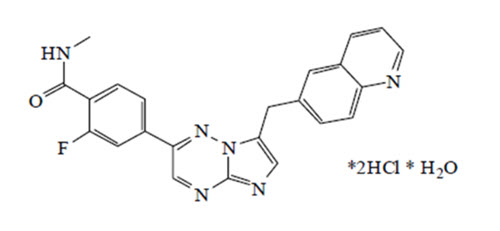
5DESCRIPTION
Capmatinib is a kinase inhibitor. The chemical name is 2-Fluoro-
capmatinib dihydrochloride monohydrate structural formula
Capmatinib dihydrochloride monohydrate is a yellow powder with a pKa
TABRECTA is supplied for oral use as ovaloid, curved film-coated tablets with beveled edges, unscored containing 150 mg (pale orange brown color) or 200 mg (yellow color) capmatinib (equivalent to 183.00 mg or 244.00 mg respectively of capmatinib dihydrochloride monohydrate). Each tablet strength contains colloidal silicon dioxide; crospovidone; magnesium stearate; mannitol; microcrystalline cellulose; povidone; and sodium lauryl sulfate as inactive ingredients.
The 150 mg tablet coating contains ferric oxide, red; ferric oxide, yellow; ferrosoferric oxide; hypromellose; polyethylene glycol (PEG) 4000; talc; and titanium dioxide. The 200 mg tablet coating contains ferric oxide, yellow; hypromellose; polyethylene glycol (PEG) 4000; talc; and titanium dioxide.
6CLINICAL STUDIES
Metastatic NSCLC with a Mutation that Leads to MET Exon 14 Skipping
The efficacy of TABRECTA was evaluated in GEOMETRY mono-1, a multicenter, non-randomized, open-label, multi-cohort study (NCT02414139). Eligible patients were required to have NSCLC with a mutation that leads to MET exon 14 skipping, epidermal growth factor receptor (EGFR) wild-type and anaplastic lymphoma kinase (ALK) negative status, and at least one measurable lesion as defined by Response Evaluation Criteria in Solid Tumors (RECIST) version 1.1. Patients with symptomatic CNS metastases, clinically significant uncontrolled cardiac disease, or who received treatment with any MET or hepatocyte growth factor (HGF) inhibitor were not eligible for the study.
Out of the first 97 patients enrolled in GEOMETRY mono-1 following the central confirmation of MET exon 14 skipping by a RNA-based clinical trial assay, 78 patient samples were retested with the FDA-approved FoundationOne
Patients received TABRECTA 400 mg orally twice daily until disease progression or unacceptable toxicity. The major efficacy outcome measure was overall response rate (ORR) as determined by a Blinded Independent Review Committee (BIRC) according to RECIST 1.1. An additional efficacy outcome measure was duration of response (DOR) by BIRC.
The efficacy population included 60 treatment-naïve patients and 100 previously treated patients. The median age was 71 years (range: 48 to 90 years); 61% female; 77% White; 25% had Eastern Cooperative Oncology Group (ECOG) Performance Status (PS) 0 and 74% had ECOG PS 1; 61% never smoked; 83% had adenocarcinoma; and 16% had CNS metastases. Among previously treated patients, 81% received one, 16% received two and 3% received three prior lines of systemic therapy. Amongst previously treated patients, 86% received prior platinum-based chemotherapy.
Efficacy results are presented in Table 5.
7HOW SUPPLIED/STORAGE AND HANDLING
How Supplied
Storage
Dispense in the original package with the desiccant cartridge. Store at 20°C to 25°C (68°F to 77°F), excursions permitted between 15°C and 30°C (59°F and 86°F) [see USP Controlled Room Temperature]. Protect from moisture.
Discard any unused TABRECTA remaining after 6 weeks of first opening the bottle.
8PATIENT COUNSELING INFORMATION
Advise the patient to read the FDA-approved patient labeling (Patient Information).
Interstitial Lung Disease (ILD)/Pneumonitis
Inform patients of the risks of severe or fatal ILD/pneumonitis. Advise patients to immediately contact their healthcare provider for new or worsening respiratory symptoms
Hepatotoxicity
Inform patients that they will need to undergo lab tests to monitor liver function. Advise patients to immediately contact their healthcare provider for signs and symptoms of liver dysfunction
Pancreatic Toxicity
Inform patients that they will need to undergo lab tests to monitor pancreatic function. Advise patients to immediately contact their healthcare provider for signs and symptoms of pancreatitis
Hypersensitivity Reactions
Inform patients that there is a risk of hypersensitivity reactions with TABRECTA. Advise patients to stop taking TABRECTA and immediately contact their healthcare provider for signs and symptoms of hypersensitivity
Risk of Photosensitivity
Inform patients that there is a potential risk of photosensitivity reactions with TABRECTA. Advise patients to limit direct ultraviolet exposure by using sunscreen or protective clothing during treatment with TABRECTA
Embryo-Fetal Toxicity
Advise pregnant women of the potential risk to a fetus. Advise females of reproductive potential to inform their healthcare provider of a known or suspected pregnancy
Advise females of reproductive potential to use effective contraception during treatment with TABRECTA and for 1 week after the last dose
Advise males with female partners of reproductive potential to use effective contraception during treatment with TABRECTA and for 1 week after the last dose
Drug Interactions
Advise patients to inform their healthcare providers of all concomitant medications, including prescription medicines, over-the-counter drugs, vitamins, and herbal products
Lactation
Advise women not to breastfeed during treatment with TABRECTA and for 1 week after the last dose
Distributed by:
© Novartis
T2024-19
9PRINCIPAL DISPLAY PANEL
NDC 0078-0709-56
TABRECTA
(capmatinib) tablets
150 mg
Attention: Dispense and store Tabrecta
Rx only
56 Film-coated tablets
NOVARTIS
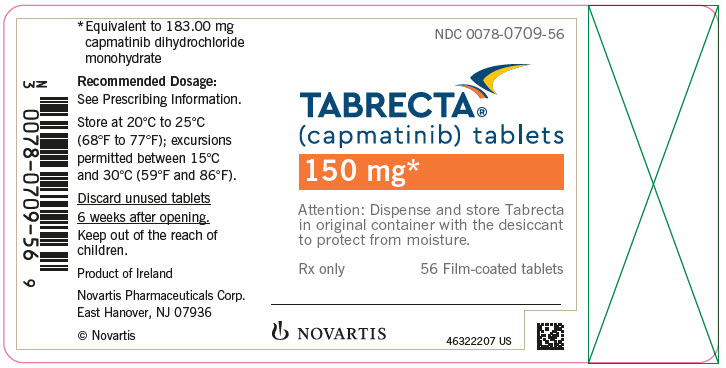
PRINCIPAL DISPLAY PANEL
								NDC 0078-0709-56
								TABRECTA®
								(capmatinib) tablets
								150 mg*
								Attention: Dispense and store Tabrecta
								in original container with the desiccant
								to protect from moisture.
								Rx only
								56 Film-coated tablets
								NOVARTIS
10PRINCIPAL DISPLAY PANEL
NDC 0078-0716-56
TABRECTA
(capmatinib) tablets
200 mg
Attention: Dispense and store Tabrecta
Rx only
56 Film-coated tablets
NOVARTIS
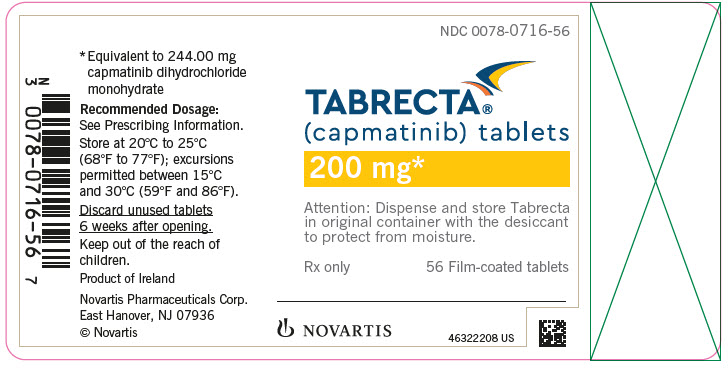
PRINCIPAL DISPLAY PANEL
								NDC 0078-0716-56
								TABRECTA®
								(capmatinib) tablets
								200 mg*
								Attention: Dispense and store Tabrecta
								in original container with the desiccant
								to protect from moisture.
								Rx only
								56 Film-coated tablets
								NOVARTIS