Brand Name
Nilandron
Generic Name
Nilutamide
View Brand Information FDA approval date: July 15, 2013
Classification: Androgen Receptor Inhibitor
Form: Tablet
What is Nilandron (Nilutamide)?
Metastatic Prostate Cancer NILANDRON tablets are indicated for use in combination with surgical castration for the treatment of metastatic prostate cancer . For maximum benefit, NILANDRON treatment must begin on the same day as or on the day after surgical castration.
Approved To Treat
Top Global Experts
There are no experts for this drug
Save this treatment for later
Not sure about your diagnosis?
Related Clinical Trials
There is no clinical trials being done for this treatment
Related Latest Advances
There is no latest advances for this treatment
Brand Information
Nilandron (Nilutamide)
1DESCRIPTION
NILANDRON
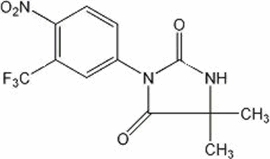
Nilutamide is a microcrystalline, white to practically white powder with a molecular weight of 317.25. Its molecular formula is C
It is freely soluble in ethyl acetate, acetone, chloroform, ethyl alcohol, dichloromethane, and methanol. It is slightly soluble in water [<0.1% W/V at 25°C (77°F)]. It melts between 153°C and 156°C (307.4°F and 312.8°F).
Each NILANDRON tablet contains 150 mg of nilutamide. Other ingredients in NILANDRON tablets are corn starch, lactose, povidone, docusate sodium, magnesium stearate, and talc.
2CONTRAINDICATIONS
NILANDRON tablets are contraindicated:
- in patients with severe hepatic impairment (baseline hepatic enzymes should be evaluated prior to treatment)
- in patients with severe respiratory insufficiency
- in patients with hypersensitivity to nilutamide or any component of this preparation.
3ADVERSE REACTIONS
Clinical Trial Experience
The following adverse experiences were reported during a multicenter clinical trial comparing NILANDRON + surgical castration versus placebo + surgical castration. The most frequently reported (greater than 5%) adverse experiences during treatment with NILANDRON tablets in combination with surgical castration are listed below. For comparison, adverse experiences seen with surgical castration and placebo are also listed.
The overall incidence of adverse experiences was 86% (194/225) for the NILANDRON group and 81% (188/232) for the placebo group.
The following adverse experiences were reported during a multicenter clinical trial comparing NILANDRON + leuprolide versus placebo + leuprolide. The most frequently reported (greater than 5%) adverse experiences during treatment with NILANDRON tablets in combination with leuprolide are listed below. For comparison, adverse experiences seen with leuprolide and placebo are also listed.
The overall incidence of adverse experiences is 99.5% (208/209) for the NILANDRON group and 98.5% (199/202) for the placebo group.
Some frequently occurring adverse experiences, for example hot flushes, impotence, and decreased libido, are known to be associated with low serum androgen levels and known to occur with medical or surgical castration alone. Notable was the higher incidence of visual disturbances (variously described as impaired adaptation to darkness, abnormal vision, and colored vision), which led to treatment discontinuation in 1% to 2% of patients.
Interstitial pneumonitis occurred in one (<1%) patient receiving NILANDRON in combination with surgical castration and in seven patients (3%) receiving NILANDRON in combination with leuprolide and one patient receiving placebo in combination with leuprolide. Overall, it has been reported in 2% of patients receiving NILANDRON. This included a report of interstitial pneumonitis in 8 of 47 patients (17%) in a small study performed in Japan.
In addition, the following adverse experiences were reported in 2 to 5% of patients treated with NILANDRON in combination with leuprolide or orchiectomy.
Body as a Whole: Malaise (2%).
Cardiovascular System: Angina (2%), heart failure (3%), syncope (2%).
Digestive System: Diarrhea (2%), gastrointestinal disorder (2%), gastrointestinal hemorrhage (2%), melena (2%).
Metabolic and Nutritional System: Alcohol intolerance (5%), edema (2%), weight loss (2%).
Musculoskeletal System: Arthritis (2%).
Nervous System: Dry mouth (2%), nervousness (2%), paresthesia (3%).
Respiratory System: Cough increased (2%), interstitial lung disease (2%), lung disorder (4%), rhinitis (2%).
Skin and Appendages: Pruritus (2%).
Special Senses: Cataract (2%), photophobia (2%).
Laboratory Values: Haptoglobin increased (2%), leukopenia (3%), alkaline phosphatase increased (3%), BUN increased (2%), creatinine increased (2%), hyperglycemia (4%).
To report SUSPECTED ADVERSE REACTIONS, contact Advanz Pharma (US) Corp. at 1-877-370-1142 or FDA at 1-800-FDA-1088 or www.fda.gov/medwatch.
4OVERDOSAGE
One case of massive overdosage has been published. A 79-year-old man attempted suicide by ingesting 13 g of nilutamide (i.e., 43 times the maximum recommended dose). Despite immediate gastric lavage and oral administration of activated charcoal, plasma nilutamide levels peaked at 6 times the normal range 2 hours after ingestion. There were no clinical signs or symptoms or changes in parameters such as transaminases or chest X-ray. Maintenance treatment (150 mg/day) was resumed 30 days later.
In repeated-dose tolerance studies, doses of 600 mg/day and 900 mg/day were administered to 9 and 4 patients, respectively. The ingestion of these doses was associated with gastrointestinal disorders, including nausea and vomiting, malaise, headache, and dizziness. In addition, a transient elevation in hepatic enzyme levels was noted in one patient.
Since nilutamide is protein bound, dialysis may not be useful as treatment for overdose. As in the management of overdosage with any drug, it should be borne in mind that multiple agents may have been taken. If vomiting does not occur spontaneously, it should be induced if the patient is alert. General supportive care, including frequent monitoring of the vital signs and close observation of the patient, is indicated.
5DOSAGE AND ADMINISTRATION
The recommended dosage is 300 mg once a day for 30 days, followed thereafter by 150 mg once a day. NILANDRON tablets can be taken with or without food.
6HOW SUPPLIED
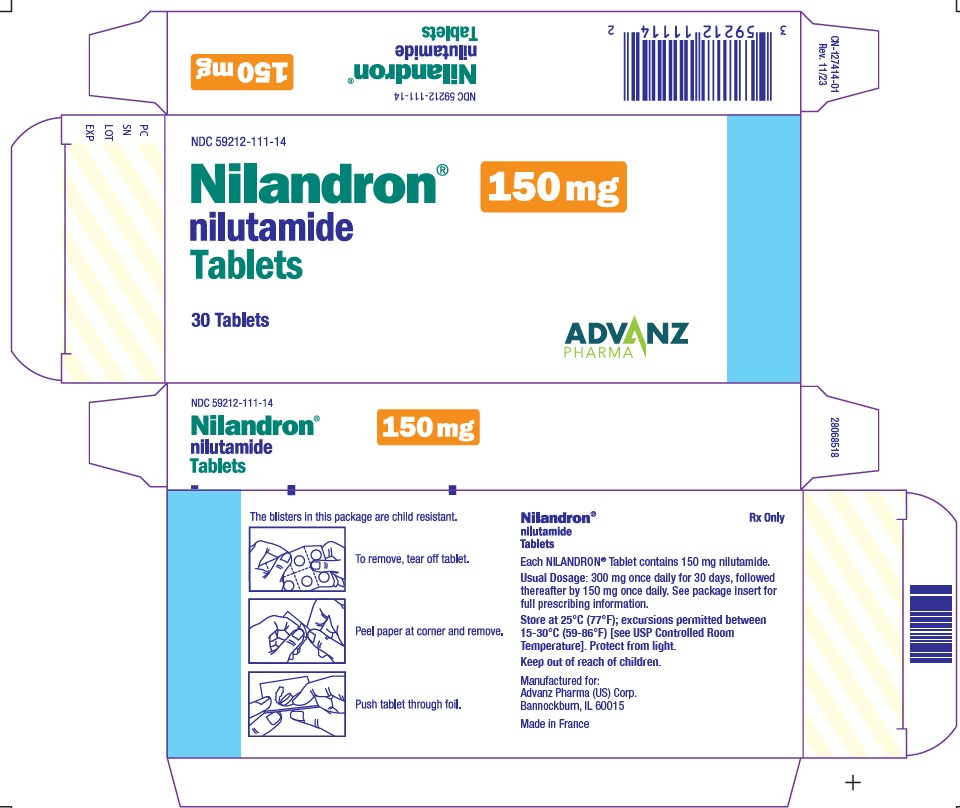
NILANDRON 150 mg tablets are supplied in boxes of 30 tablets. Each box contains 3 child-resistant, PVC, aluminum foil-backed blisters of 10 tablets (NDC 59212-111-14). Each white, biconvex, cylindrical (10 mm in diameter) tablet has a triangular logo on one side and an internal reference number (168D) on the other.
Store at 25°C (77°F); excursions permitted between 15-30°C (59-86°F) [see USP Controlled Room Temperature]. Protect from light. Keep out of reach of children.
NILANDRON
7PRINCIPAL DISPLAY PANEL
NDC 59212-111-14
Nilandron
30 Tablets
ADVANZ PHARMA