Generic Name
Pralidoxime
Brand Names
DuoDote, Protopam
FDA approval date: March 10, 1965
Classification: Cholinesterase Reactivator
Form: Injection, Kit
What is DuoDote (Pralidoxime)?
DuoDote is indicated for the treatment of poisoning by organophosphorus nerve agents as well as organophosphorus insecticides in adults and pediatric patients weighing more than 41 kg . DuoDote, a combination of atropine, a cholinergic muscarinic antagonist, and pralidoxime chloride, a cholinesterase reactivator, is indicated for the treatment of poisoning by organophosphorus nerve agents as well as organophosphorus insecticides in adults and pediatric patients weighing more than 41 kg .
Approved To Treat
Top Global Experts
Save this treatment for later
Not sure about your diagnosis?
Related Clinical Trials
There is no clinical trials being done for this treatment
Related Latest Advances
Brand Information
DuoDote (atropine and pralidoxime chloride)
1INDICATIONS AND USAGE
DuoDote is indicated for the treatment of poisoning by organophosphorus nerve agents as well as organophosphorus insecticides in adults and pediatric patients weighing more than 41 kg (90 pounds).
2DOSAGE FORMS AND STRENGTHS
Each single-dose DuoDote autoinjector contains the following in two separate chambers:
- front chamber (visible): a clear, colorless to yellow, sterile solution of atropine (2.1 mg/0.7 mL)
- back chamber (not visible): a clear, colorless to yellow, sterile solution of pralidoxime chloride (600 mg/2 mL) equivalent to pralidoxime (476.6 mg/2 mL)
When activated, DuoDote sequentially administers both drugs intramuscularly through a single needle in one injection.
3CONTRAINDICATIONS
None.
4ADVERSE REACTIONS
The following serious adverse reactions are described elsewhere in the labeling:
- Cardiovascular Risks
- Heat Injury
- Acute Glaucoma
- Urinary Retention
- Pyloric Stenosis
- Exacerbation of Chronic Lung Disease
The following adverse reactions associated with the use of atropine and pralidoxime chloride were identified in the literature. Because these reactions are reported voluntarily from a population of uncertain size, it is not always possible to reliably estimate their frequency or establish a causal relationship to drug exposure.
4.1Atropine
Because DuoDote contains pralidoxime chloride, which may potentiate the effect of atropine, signs of atropinization may occur earlier than might be expected when atropine is used alone.
Common adverse reactions of atropine can be attributed to its antimuscarinic action. These include dryness of the mouth, blurred vision, dry eyes, photophobia, confusion, headache, dizziness, tachycardia, palpitations, flushing, urinary hesitancy or retention, constipation, abdominal pain, abdominal distention, nausea and vomiting, loss of libido, and impotence. Anhidrosis may produce heat intolerance and impairment of temperature regulation in a hot environment. Dysphagia, paralytic ileus, acute angle closure glaucoma, maculopapular rash, petechial rash, and scarletiniform rash have also been reported. Adverse cardiac reactions, including arrhythmias and myocardial infarction, have been reported with atropine
Larger doses of atropine may produce central nervous system effects such as restlessness, tremor, fatigue, locomotor difficulties, delirium, and hallucinations
Hypersensitivity reactions will occasionally occur, are usually seen as skin rashes, and may progress to exfoliation. Anaphylactic reaction and laryngospasm are rare.
4.2Pralidoxime Chloride
Pralidoxime can cause blurred vision, diplopia and impaired accommodation, dizziness, headache, drowsiness, nausea, tachycardia, increased systolic and diastolic blood pressure
In several cases of organophosphorus poisoning, excitement and manic behavior have occurred immediately following recovery of consciousness, in either the presence or absence of pralidoxime administration. However, similar behavior has not been reported in subjects given pralidoxime in the absence of organophosphorus poisoning.
Elevations in AST and/or ALT enzyme levels were observed in 1 of 6 normal adult volunteers given 1200 mg of pralidoxime intramuscularly, and in 4 of 6 adult volunteers given 1800 mg intramuscularly. Levels returned to normal in about two weeks. Transient elevations in creatine kinase were observed in all normal volunteers given the drug.
4.3Injection Site
Muscle tightness and pain may occur at the injection site.
4.4Inadvertent Injection
In cases where DuoDote is inadvertently administered to people who are not poisoned with nerve agent or organophosphorus insecticide, the following effects on their ability to function normally may occur.
- Atropine 2 mg IM, roughly the equivalent of one DuoDote autoinjector, when given to healthy male volunteers, is associated with minimal effects on visual, motor, and mental functions, though unsteadiness walking and difficulty concentrating may occur. Atropine reduces body sweating and increases body temperature, particularly with exercise and under hot conditions.
- Atropine 4 mg IM, roughly the equivalent of two DuoDote autoinjectors, when given to healthy male volunteers, is associated with impaired visual acuity, visual near point accommodation, logical reasoning, digital recall, learning, and cognitive reaction time. Ability to read is reduced or lost. Subjects are unsteady and need to concentrate on walking. These effects begin about 15 minutes to one hour or more post-dose.
- Atropine 6 mg IM, roughly the equivalent of three DuoDote autoinjectors, when given to healthy male volunteers, is associated with the effects described above plus additional central effects including poor coordination, poor attention span, and visual hallucinations (colored flashes) in many subjects. Frank visual hallucinations, auditory hallucinations, disorientation, and ataxia occur in some subjects. Skilled and labor-intense tasks are performed more slowly and less efficiently. Decision making takes longer and is sometimes impaired.
It is unclear if the above data, obtained from studies of healthy adult subjects, can be extrapolated to other populations. In the elderly and patients with co-morbid conditions, the effects of ≥2 mg atropine on the ability to see, walk, and think properly are unstudied; effects may be greater in susceptible populations.
Patients who are mistakenly injected with DuoDote should avoid potentially dangerous overheating, avoid vigorous physical activity, and seek medical attention as soon as feasible.
5DESCRIPTION
Each prefilled DuoDote autoinjector provides a single intramuscular dose of atropine, a cholinergic muscarinic antagonist, and pralidoxime chloride, a cholinesterase reactivator, in a self-contained unit, specifically designed for administration by emergency medical services personnel.
When activated, each single-dose DuoDote autoinjector delivers the following:
- 2.1 mg of atropine in 0.7 mL of sterile, pyrogen-free solution containing 12.47 mg glycerin, not more than 2.8 mg phenol, 3.05 mg sodium citrate dihydrate, 3.5 mg citric acid monohydrate, and Water for Injection. The pH range is 4.0 – 5.0.
- 600 mg of pralidoxime chloride equivalent to 476.6 mg of pralidoxime in 2 mL of sterile, pyrogen-free solution containing 40 mg benzyl alcohol, 22.5 mg glycine, and Water for Injection. The pH is adjusted with hydrochloric acid. The pH range is 2.0 to 3.0.
Atropine occurs as white crystals, usually needle-like, or as a white, crystalline powder. It is slightly soluble in water with a molecular weight of 289.38. Atropine, a naturally occurring belladonna alkaloid, is a racemic mixture of equal parts of d- and l-hyoscyamine, with activity due almost entirely to the levo isomer of the drug.
Chemically, atropine is designated as 1αH,5αH-Tropan-3α-ol(±)-tropate. Its empirical formula is C
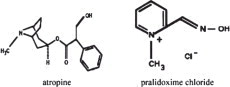
Pralidoxime chloride is an odorless, white to pale-yellow crystalline powder, freely soluble in water, with a molecular weight of 172.61. Chemically, pralidoxime chloride is designated as 2-formyl-l-methylpyridinium chloride oxime. Its empirical formula is C
6HOW SUPPLIED/STORAGE AND HANDLING
Each single-dose DuoDote (atropine and pralidoxime chloride) autoinjector contains atropine (2.1 mg/0.7 mL; colorless to yellow solution, visible in front chamber) and pralidoxime chloride (600 mg/2 mL; colorless to yellow solution, not visible in rear chamber) and is available in a single unit carton, NDC-11704-620-01.
Each DuoDote autoinjector is supplied in a pouch that provides protection from light.
Store at 25ºC (77ºF); excursions permitted between 15ºC and 30ºC (between 59ºF and 86ºF) [See USP Controlled Room Temperature]. Not made with natural rubber latex. Keep from freezing. Protect from light.
7PATIENT COUNSELING INFORMATION
Use by Healthcare Providers
DuoDote is intended for use by Healthcare Providers. See the illustrated Instruction Sheet for Healthcare Providers.
DuoDote is intended for use by Healthcare Providers. See the illustrated Instruction Sheet for Healthcare Providers.