Brand Name
Norpace
Generic Name
Disopyramide
View Brand Information FDA approval date: September 01, 1977
Classification: Antiarrhythmic
Form: Capsule
What is Norpace (Disopyramide)?
Disopyramide phosphate capsules are indicated for the treatment of documented ventricular arrhythmias, such as sustained ventricular tachycardia, that, in the judgment of the physician, are life-threatening. Because of the proarrhythmic effects of disopyramide, its use with lesser arrhythmias is generally not recommended. Treatment of patients with asymptomatic ventricular premature contractions should be avoided. Initiation of disopyramide treatment, as with other antiarrhythmic agents used to treat life-threatening arrhythmias, should be carried out in the hospital. Antiarrhythmic drugs have not been shown to enhance survival in patients with ventricular arrhythmias.
Approved To Treat
Top Global Experts
There are no experts for this drug
Save this treatment for later
Not sure about your diagnosis?
Related Clinical Trials
There is no clinical trials being done for this treatment
Related Latest Advances
There is no latest advances for this treatment
Brand Information
Norpace (disopyramide phosphate)
1DESCRIPTION
Norpace (disopyramide phosphate) is an antiarrhythmic drug available for oral administration in immediate-release and controlled-release capsules containing 100 mg or 150 mg of disopyramide base, present as the phosphate. The base content of the phosphate salt is 77.6%. The structural formula of Norpace is:
Norpace is freely soluble in water, and the free base (pKa 10.4) has an aqueous solubility of 1 mg/ml. The chloroform:water partition coefficient of the base is 3.1 at pH 7.2.
Norpace is a racemic mixture of
Norpace CR (controlled-release) capsules are designed to afford a gradual and consistent release of disopyramide. Thus, for maintenance therapy, Norpace CR provides the benefit of less-frequent dosing (every 12 hours) as compared with the every-6-hour dosage schedule of immediate-release Norpace capsules.
Inactive ingredients of Norpace include corn starch, edible ink, FD&C Red No. 3, FD&C Yellow No. 6, gelatin, lactose, talc, and titanium dioxide; the 150-mg capsule also contains FD&C Blue No. 1.
Inactive ingredients of Norpace CR include corn starch, D&C Yellow No. 10, edible ink, ethylcellulose, FD&C Blue No. 1, gelatin, shellac, sucrose, talc, and titanium dioxide; the 150-mg capsule also contains FD&C Red No. 3 and FD&C Yellow No. 6.
2INDICATIONS AND USAGE
Norpace and Norpace CR are indicated for the treatment of documented ventricular arrhythmias, such as sustained ventricular tachycardia, that, in the judgment of the physician, are life-threatening. Because of the proarrhythmic effects of Norpace and Norpace CR, their use with lesser arrhythmias is generally not recommended. Treatment of patients with asymptomatic ventricular premature contractions should be avoided.
Initiation of Norpace or Norpace CR treatment, as with other antiarrhythmic agents used to treat life-threatening arrhythmias, should be carried out in the hospital. Norpace CR should not be used initially if rapid establishment of disopyramide plasma levels is desired.
Antiarrhythmic drugs have not been shown to enhance survival in patients with ventricular arrhythmias.
3CONTRAINDICATIONS
Norpace and Norpace CR are contraindicated in the presence of cardiogenic shock, preexisting second-or third-degree AV block (if no pacemaker is present), congenital Q-T prolongation, or known hypersensitivity to the drug.
4ADVERSE REACTIONS
The adverse reactions which were reported in Norpace clinical trials encompass observations in 1,500 patients, including 90 patients studied for at least 4 years. The most serious adverse reactions are hypotension and congestive heart failure. The most common adverse reactions, which are dose dependent, are associated with the anticholinergic properties of the drug. These may be transitory, but may be persistent or can be severe. Urinary retention is the most serious anticholinergic effect.
The following reactions were reported in 10% to 40% of patients:
Anticholinergic: dry mouth (32%), urinary hesitancy (14%), constipation (11%)
The following reactions were reported in 3% to 9% of patients:
Anticholinergic: blurred vision, dry nose/eyes/throat
Genitourinary: urinary retention, urinary frequency and urgency
Gastrointestinal: nausea, pain/bloating/gas
General: dizziness, general fatigue/muscle weakness, headache, malaise, aches/pains
The following reactions were reported in 1% to 3% of patients:
Genitourinary: impotence
Cardiovascular: hypotension with or without congestive heart failure, increased congestive heart failure (see
Gastrointestinal: anorexia, diarrhea, vomiting
Dermatologic: generalized rash/dermatoses, itching
Central nervous system: nervousness
Other: hypokalemia, elevated cholesterol/triglycerides
The following reactions were reported in less than 1%:
Depression, insomnia, dysuria, numbness/tingling, elevated liver enzymes, AV block, elevated BUN, elevated creatinine, decreased hemoglobin/hematocrit
Hypoglycemia has been reported in association with Norpace administration (see
Infrequent occurrences of reversible cholestatic jaundice, fever, and respiratory difficulty have been reported in association with disopyramide therapy, as have rare instances of thrombocytopenia, reversible agranulocytosis, and gynecomastia. Some cases of LE (lupus erythematosus) symptoms have been reported; most cases occurred in patients who had been switched to disopyramide from procainamide following the development of LE symptoms. Rarely, acute psychosis has been reported following Norpace therapy, with prompt return to normal mental status when therapy was stopped. The physician should be aware of these possible reactions and should discontinue Norpace or Norpace CR therapy promptly if they occur.
5DOSAGE AND ADMINISTRATION
The dosage of Norpace or Norpace CR must be individualized for each patient on the basis of response and tolerance. The usual adult dosage of Norpace or Norpace CR is 400 to 800 mg per day given in divided doses. The recommended dosage for most adults is 600 mg/day given in divided doses (either 150 mg every 6 hours for immediate-release Norpace or 300 mg every 12 hours for Norpace CR). For patients whose body weight is less than 110 pounds (50 kg), the recommended dosage is 400 mg/day given in divided doses (either 100 mg every 6 hours for immediate-release Norpace or 200 mg every 12 hours for Norpace CR). In the event of increased anticholinergic side effects, plasma levels of disopyramide should be monitored and the dose of the drug adjusted accordingly. A reduction of the dose by one third, from the recommended 600 mg/day to 400 mg/day, would be reasonable, without changing the dosing interval.
For patients with cardiomyopathy or possible cardiac decompensation, a loading dose, as discussed below, should not be given, and initial dosage should be limited to 100 mg of immediate-release Norpace every 6 to 8 hours. Subsequent dosage adjustments should be made gradually, with close monitoring for the possible development of hypotension and/or congestive heart failure (see Warnings).
For patients with moderate renal insufficiency (creatinine clearance greater than 40 ml/min) or hepatic insufficiency, the recommended dosage is 400 mg/day given in divided doses (either 100 mg every 6 hours for immediate-release Norpace or 200 mg every 12 hours for Norpace CR).
For patients with severe renal insufficiency (C
The above dosing schedules are for Norpace immediate-release capsules; Norpace CR is not recommended for patients with severe renal insufficiency.
For patients in whom rapid control of ventricular arrhythmia is essential, an initial loading dose of 300 mg of immediate-release Norpace (200 mg for patients whose body weight is less than 110 pounds) is recommended, followed by the appropriate maintenance dosage. Therapeutic effects are usually attained 30 minutes to 3 hours after administration of a 300-mg loading dose. If there is no response or evidence of toxicity within 6 hours of the loading dose, 200 mg of immediate-release Norpace every 6 hours may be prescribed instead of the usual 150 mg. If there is no response to this dosage within 48 hours, either Norpace should then be discontinued or the physician should consider hospitalizing the patient for careful monitoring while subsequent immediate-release Norpace doses of 250 mg or 300 mg every 6 hours are given. A limited number of patients with severe refractory ventricular tachycardia have tolerated daily doses of Norpace up to 1600 mg per day (400 mg every 6 hours), resulting in disopyramide plasma levels up to 9 mcg/ml. If such treatment is warranted, it is essential that patients be hospitalized for close evaluation and continuous monitoring.
Norpace CR should not be used initially if rapid establishment of disopyramide plasma levels is desired.
5.1Transferring to Norpace or Norpace CR.
The following dosage schedule based on theoretical considerations rather than experimental data is suggested for transferring patients with normal renal function from either quinidine sulfate or procainamide therapy (Type 1 antiarrhythmic agents) to Norpace or Norpace CR therapy:
Norpace or Norpace CR should be started using the regular maintenance schedule
In patients in whom withdrawal of quinidine sulfate or procainamide is likely to produce life-threatening arrhythmias, the physician should consider hospitalization of the patient. When transferring a patient from immediate-release Norpace to Norpace CR, the maintenance schedule of Norpace CR may be started 6 hours after the last dose of immediate-release Norpace.
5.2Pediatric Dosage
Controlled clinical studies have not been conducted in pediatric patients; however, the following suggested dosage table is based on published clinical experience.
Total daily dosage should be divided and equal doses administered orally every 6 hours or at intervals according to individual patient needs. Disopyramide plasma levels and therapeutic response must be monitored closely. Patients should be hospitalized during the initial treatment period, and dose titration should start at the lower end of the ranges provided below.
Norpace CR capsules should not be used to prepare the above suspension.
6HOW SUPPLIED
Norpace (disopyramide phosphate) is supplied in hard gelatin capsules containing either 100 mg or 150 mg of disopyramide base, present as the phosphate.
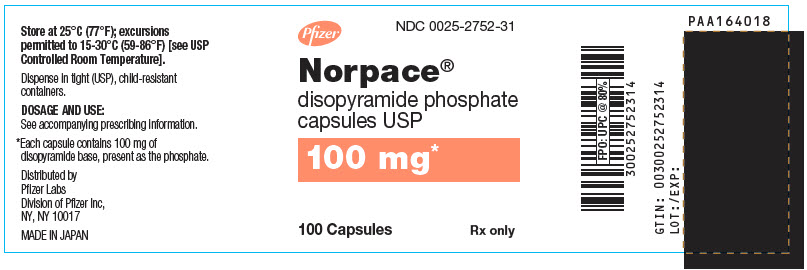
Norpace 100-mg capsules are white and orange, with markings SEARLE, 2752, NORPACE, and 100 MG.
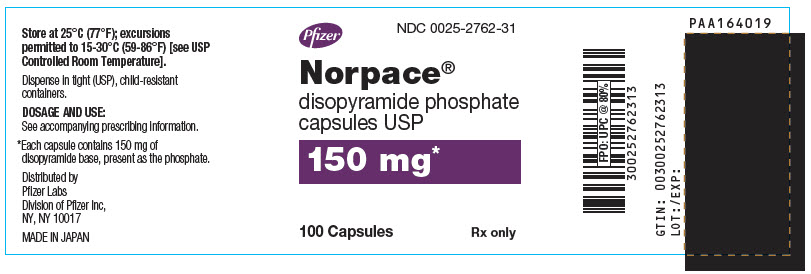
Norpace 150-mg capsules are brown and orange, with markings SEARLE, 2762, NORPACE, and 150 MG.
Norpace CR (disopyramide phosphate) Controlled-Release is supplied as specially prepared controlled-release beads in hard gelatin capsules containing either 100 mg or 150 mg of disopyramide base, present as the phosphate.
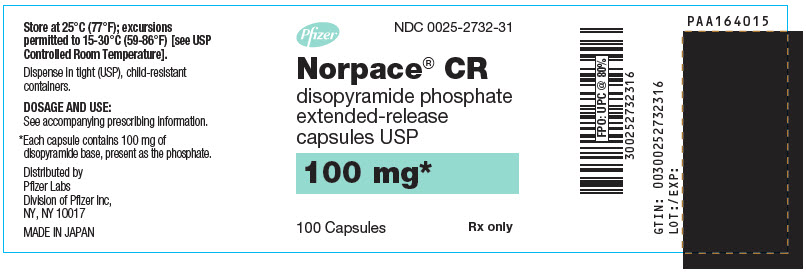
Norpace CR 100-mg capsules are white and light green, with markings SEARLE, 2732, NORPACE CR, and 100 mg.
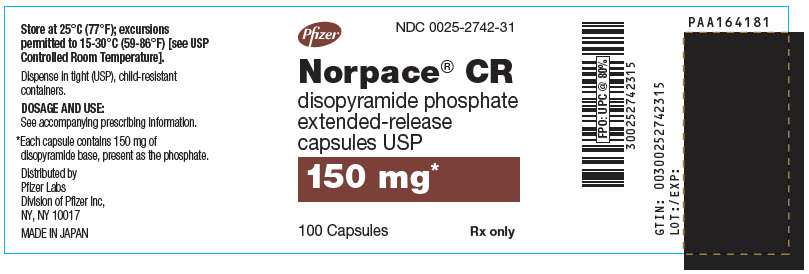
Norpace CR 150-mg capsules are brown and light green, with markings SEARLE, 2742, NORPACE CR, and 150 mg.
7PRINCIPAL DISPLAY PANEL - 100 mg Capsule Bottle Label
NDC 0025-2752-31
Pfizer
Norpace
100 mg*
100 Capsules
8PRINCIPAL DISPLAY PANEL - 150 mg Capsule Bottle Label
NDC 0025-2762-31
Pfizer
Norpace
150 mg*
100 Capsules
9PRINCIPAL DISPLAY PANEL - 100 mg Capsule Bottle Label - NDC 0025-2732-31
NDC 0025-2732-31
Pfizer
Norpace
100 mg*
100 Capsules
10PRINCIPAL DISPLAY PANEL - 150 mg Capsule Bottle Label - NDC 0025-2742-31
NDC 0025-2742-31
Pfizer
Norpace
150 mg*
100 Capsules