Entacapone
View Brand InformationWhat is Entacapone?
Approved To Treat
Top Global Experts

Related Clinical Trials
Summary: Alpha-synucleinopathies refer to age-related neurodegenerative and dementing disorders, characterized by the accumulation of alpha-synuclein in neurons and/or glia. The anatomical location of alpha-synuclein inclusions (Lewy Bodies) and the pattern of progressive neuronal death (e.g. caudal to rostral brainstem) give rise to distinct neurological phenotypes, including Parkinson's disease (PD), Mul...
Summary: This study is a Phase III multicentric randomized controlled trial with parallel group design and waiting list in patients that have an indication to undergo intestinal L-Dopa + entacapone (Lecigon®) under the existing indication criteria (according to SmPC (Fachinformation) Lecigon®). As primary endpoint, we will analyze the difference of the pre-interventional baseline and 6-month follow-up on t...
Summary: This observational, multicenter, case-control study aims to evaluate the efficacy and safety of Entacapone combined with Madopar (levodopa/benserazide) in the treatment of early-stage Parkinson's disease (PD) among Chinese patients. The study will enroll patients diagnosed with PD according to the MDS criteria, aged 18-80, with modified Hoehn-Yahr stages 1-2.5, and who have not previously used Ent...
Related Latest Advances
Brand Information
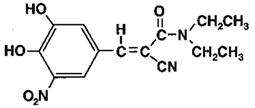
Entacapone is a selective and reversible inhibitor of COMT.
COMT Activity in Erythrocytes
Studies in healthy volunteers have shown that entacapone reversibly inhibits human erythrocyte COMT activity after oral administration. There was a linear correlation between entacapone dose and erythrocyte COMT inhibition, the maximum inhibition being 82% following an 800 mg single dose. With a 200 mg single dose of entacapone, maximum inhibition of erythrocyte COMT activity is on average 65% with a return to baseline level within 8 hours.
When 200 mg entacapone is administered together with levodopa and carbidopa, it increases the area under the curve (AUC) of levodopa by approximately 35% and the elimination half-life of levodopa is prolonged from 1.3 hours to 2.4 hours. In general, the average peak levodopa plasma concentration and the time of its occurrence (T max of 1 hour) are unaffected. The onset of effect occurs after the first administration and is maintained during long-term treatment. Studies in Parkinson’s disease patients suggest that the maximal effect occurs with 200 mg entacapone. Plasma levels of 3-OMD are markedly and dose-dependently decreased by entacapone when given with levodopa and carbidopa.
Entacapone is rapidly absorbed, with a T max of approximately 1 hour. The absolute bioavailability following oral administration is 35%. Food does not affect the pharmacokinetics of entacapone.
The volume of distribution of entacapone at steady state after intravenous injection is small (20 L). Entacapone does not distribute widely into tissues due to its high plasma protein binding. Based on in vitro studies, the plasma protein binding of entacapone is 98% over the concentration range of 0.4 mcg per mL to 50 mcg per mL. Entacapone binds mainly to serum albumin.
Entacapone is almost completely metabolized prior to excretion, with only a very small amount (0.2% of dose) found unchanged in urine. The main metabolic pathway is isomerization to the cis-isomer, followed by direct glucuronidation of the parent and cis-isomer; the glucuronide conjugate is inactive. After oral administration of a 14C-labeled dose of entacapone, 10% of labeled parent and metabolite is excreted in urine and 90% in feces.
Entacapone pharmacokinetics are independent of age. No formal gender studies have been conducted. Racial representation in clinical studies was largely limited to Caucasians; therefore, no conclusions can be reached about the effect of entacapone on groups other than Caucasian.
A single 200 mg dose of entacapone, without levodopa and dopa decarboxylase inhibitor coadministration, showed approximately 2-fold higher AUC and C max values in patients with a history of alcoholism and hepatic impairment (n=10) compared to normal subjects (n=10). All patients had biopsy-proven liver cirrhosis caused by alcohol. According to Child-Pugh grading seven patients with liver disease had mild hepatic impairment and three patients had moderate hepatic impairment. As only about 10% of the entacapone dose is excreted in urine as parent compound and conjugated glucuronide, biliary excretion appears to be the major route of excretion of this drug. Consequently, entacapone should be administered with care to patients with biliary obstruction.
The pharmacokinetics of entacapone have been investigated after a single 200 mg entacapone dose, without levodopa and dopa decarboxylase inhibitor coadministration, in a specific renal impairment study. There were three groups: normal subjects (n=7; creatinine clearance greater than 1.12 mL per sec per 1.73 m 2), moderate impairment (n=10; creatinine clearance ranging from 0.6 mL per sec per 1.73 m 2 to 0.89 mL per sec per 1.73 m 2), and severe impairment (n=7; creatinine clearance ranging from 0.2 mL per sec per 1.73 m 2 to 0.44 mL per sec per 1.73 m 2). No important effects of renal function on the pharmacokinetics of entacapone were found.
In the North American study, abrupt withdrawal of entacapone, without alteration of the dose of levodopa and carbidopa, resulted in a significant worsening of fluctuations, compared to placebo. In some cases, symptoms were slightly worse than at baseline, but returned to approximately baseline severity within two weeks following levodopa dose increase on average by 80 mg. In the Nordic study, similarly, a significant worsening of parkinsonian symptoms was observed after entacapone withdrawal, as assessed two weeks after drug withdrawal. At this phase, the symptoms were approximately at baseline severity following levodopa dose increase by about 50 mg.
When a single 400 mg dose of entacapone was given with intravenous isoprenaline (isoproterenol) and epinephrine without coadministered levodopa and dopa decarboxylase inhibitor, the overall mean maximal changes in heart rate during infusion were about 50% and 80% higher than with placebo, for isoprenaline and epinephrine, respectively.
Patients with Parkinson’s disease treated with entacapone, which increases plasma levodopa levels, or with levodopa have reported suddenly falling asleep without prior warning of sleepiness while engaged in activities of daily living (including the operation of motor vehicles). Some of these episodes resulted in accidents. Although many of these patients reported somnolence while on entacapone, some did not perceive warning signs, such as excessive drowsiness, and believed that they were alert immediately prior to the event. Some of these events have been reported as late as one year after initiation of treatment.
Dopaminergic therapy in Parkinson’s disease patients has been associated with orthostatic hypotension. Entacapone enhances levodopa bioavailability and, therefore, might be expected to increase the occurrence of orthostatic hypotension. In controlled studies, approximately 1.2% and 0.8% of 200 mg entacapone and placebo patients, respectively, reported at least one episode of syncope. Reports of syncope were generally more frequent in patients in both treatment groups who had an episode of documented hypotension.
Dopaminergic therapy in patients with Parkinson’s disease has been associated with hallucinations. In clinical studies, hallucinations led to drug discontinuation and premature withdrawal in 0.8% and 0% of patients treated with 200 mg entacapone and placebo, respectively. Hallucinations led to hospitalization in 1% and 0.3% of patients in the 200 mg entacapone and placebo groups, respectively. Agitation occurred in 1% of patients treated with entacapone and 0% treated with placebo.
Postmarketing reports suggest that patients treated with anti-Parkinson medications can experience intense urges to gamble, increased sexual urges, intense urges to spend money uncontrollably, and other intense urges. Patients may be unable to control these urges while taking one or more of the medications that are used for the treatment of Parkinson’s disease and that increase central dopaminergic tone, including entacapone taken with levodopa and carbidopa. In some cases, although not all, these urges were reported to have stopped when the dose of anti-Parkinson medications was reduced or discontinued. Because patients may not recognize these behaviors as abnormal it is important for prescribers to specifically ask patients or their caregivers about the development of new or increased gambling urges, sexual urges, uncontrolled spending or other urges while being treated with entacapone. Physicians should consider dose reduction or stopping entacapone if a patient develops such urges while taking entacapone.
In clinical studies, diarrhea developed in 60 of 603 (10%) and 16 of 400 (4%) of patients treated with 200 mg entacapone and placebo, respectively. In patients treated with entacapone, diarrhea was generally mild to moderate in severity (8.6%) but was regarded as severe in 1.3%. Diarrhea resulted in withdrawal in 10 of 603 (1.7%) patients, 7 (1.2%) with mild and moderate diarrhea and 3 (0.5%) with severe diarrhea. Diarrhea generally resolved after discontinuation of entacapone. Two patients with diarrhea were hospitalized. Typically, diarrhea presents within 4 weeks to 12 weeks after entacapone is started, but it may appear as early as the first week and as late as many months after the initiation of treatment. Diarrhea may be associated with weight loss, dehydration, and hypokalemia.
Entacapone may potentiate the dopaminergic side effects of levodopa and may cause or exacerbate preexisting dyskinesia. Although decreasing the dose of levodopa may ameliorate this side effect, many patients in controlled studies continued to experience frequent dyskinesia despite a reduction in their dose of levodopa. The incidence of dyskinesia was 25% for treatment with entacapone and 15% for placebo. The incidence of study withdrawal for dyskinesia was 1.5% for 200 mg entacapone and 0.8% for placebo.
Cases of severe rhabdomyolysis have been reported following the approval of entacapone. Although the reactions typically occurred while patients were treated with entacapone, the complicated nature of these cases makes it difficult to determine what role, if any, entacapone played in their pathogenesis. Severe prolonged motor activity including dyskinesia may account for rhabdomyolysis. Signs and symptoms include fever, alteration of consciousness, myalgia, increased values of creatine phosphokinase (CPK) and myoglobin.
Cases of a symptom complex resembling neuroleptic malignant syndrome (NMS) characterized by elevated temperature, muscular rigidity, altered consciousness, and elevated CPK have been reported in association with the rapid dose reduction or withdrawal of other dopaminergic drugs. In most of these cases, symptoms began after abrupt discontinuation of treatment with entacapone or reduction of its dose, or after the initiation of treatment with entacapone. The complicated nature of these cases makes it difficult to determine what role, if any, entacapone may have played in their pathogenesis. No cases have been reported following the abrupt withdrawal or dose reduction of entacapone treatment during clinical studies.
Cases of retroperitoneal fibrosis, pulmonary infiltrates, pleural effusion, and pleural thickening have been reported in some patients treated with ergot derived dopaminergic agents. These complications may resolve when the drug is discontinued, but complete resolution does not always occur. Although these adverse events are believed to be related to the ergoline structure of these compounds, whether other, nonergot derived drugs (e.g., entacapone) that increase dopaminergic activity can cause them is unknown. It should be noted that the expected incidence of fibrotic complications is so low that even if entacapone caused these complications at rates similar to those attributable to other dopaminergic therapies, it is unlikely that it would have been detected in a cohort of the size exposed to entacapone. Four cases of pulmonary fibrosis were reported during clinical development of entacapone; three of these patients were also treated with pergolide and one with bromocriptine. The duration of treatment with entacapone ranged from 7 months to 17 months.
Epidemiological studies have shown that patients with Parkinson’s disease have a higher risk (2-to approximately 6-fold higher) of developing melanoma than the general population. Whether the increased risk observed was due to Parkinson’s disease or other factors, such as drugs used to treat Parkinson’s disease, is unclear.
In a 1-year toxicity study, entacapone (plasma exposure 20 times that in humans receiving the maximum recommended daily dose of 1,600 mg) caused an increased incidence of nephrotoxicity in male rats that was characterized by regenerative tubules, thickening of basement membranes, infiltration of mononuclear cells, and tubular protein casts. These effects were not associated with changes in clinical chemistry parameters, and there is no established method for monitoring for the possible occurrence of these lesions in humans. Although this toxicity could represent a species-specific effect, there is not yet evidence that this is so.
Patients with hepatic impairment should be treated with caution. The AUC and C max of entacapone approximately doubled in patients with documented liver disease compared to controls (see CLINICAL PHARMACOLOGY, Pharmacokinetics of Entacaponeand DOSAGE AND ADMINISTRATION).
Patients with hepatic impairment should be treated with caution (see INDICATIONS, DOSAGE AND ADMINISTRATION).
Entacapone is highly protein bound (98%). In vitrostudies have shown no binding displacement between entacapone and other highly bound drugs, such as warfarin, salicylic acid, phenylbutazone, and diazepam.
Levodopa is known to depress prolactin secretion and increase growth hormone levels. Treatment with entacapone coadministered with levodopa and dopa decarboxylase inhibitor does not change these effects.
See WARNINGSregarding concomitant use of entacapone and non-selective MAO inhibitors.
Entacapone was mutagenic and clastogenic in the in vitro mouse lymphoma tk assay in the presence and absence of metabolic activation, and was clastogenic in cultured human lymphocytes in the presence of metabolic activation. Entacapone, either alone or in combination with levodopa and carbidopa, was not clastogenic in the in vivo mouse micronucleus test or mutagenic in the bacterial reverse mutation assay (Ames test).
Entacapone did not impair fertility or general reproductive performance in rats treated with up to 700 mg/kg/day (plasma AUCs 28 times those in humans receiving the MRDD of 1,600 mg). Delayed mating, but no fertility impairment, was evident in female rats treated with 700 mg/kg/day of entacapone.
Table 4 lists treatment-emergent adverse events that occurred in at least 1% of patients treated with entacapone participating in the double-blind, placebo-controlled studies and that were numerically more common in the entacapone group, compared to placebo. In these studies, either entacapone or placebo was added to levodopa and carbidopa (or levodopa and benserazide).
No differences were noted in the rate of adverse events attributable to entacapone by age or gender.
The following spontaneous reports of adverse events temporally associated with entacapone have been identified since market introduction and are not listed in Table 4. Because these reactions are reported voluntarily from a population of unknown size, it is not always possible to reliably estimate their frequency or establish causal relationship to entacapone exposure.
Management of entacapone overdose is symptomatic; there is no known antidote to entacapone. Hospitalization is advised, and general supportive care is indicated. There is no experience with hemodialysis or hemoperfusion, but these procedures are unlikely to be of benefit, because entacapone is highly bound to plasma proteins. An immediate gastric lavage and repeated doses of charcoal over time may hasten the elimination of entacapone by decreasing its absorption and reabsorption from the gastrointestinal (GI) tract. The adequacy of the respiratory and circulatory systems should be carefully monitored and appropriate supportive measures employed. The possibility of drug interactions, especially with catechol-structured drugs, should be borne in mind.
Patients with hepatic impairment should be treated with caution. The AUC and C max of entacapone approximately doubled in patients with documented liver disease, compared to controls. However, these studies were conducted with single-dose entacapone without levodopa and dopa decarboxylase inhibitor coadministration, and therefore the effects of liver disease on the kinetics of chronically administered entacapone have not been evaluated (see CLINICAL PHARMACOLOGY, Pharmacokinetics of Entacapone).
Rapid withdrawal or abrupt reduction in the entacapone tablets dose could lead to emergence of signs and symptoms of Parkinson’s disease (see CLINICAL PHARMACOLOGY, Clinical Studies), and may lead to hyperpyrexia and confusion, a symptom complex resembling NMS (see PRECAUTIONS, Other Events Reported With Dopaminergic Therapy). This syndrome should be considered in the differential diagnosis for any patient who develops a high fever or severe rigidity. If a decision is made to discontinue treatment with entacapone tablets, patients should be monitored closely and other dopaminergic treatments should be adjusted as needed. Although tapering entacapone tablets has not been systematically evaluated, it seems prudent to withdraw patients slowly if the decision to discontinue treatment is made.
Unit dose packages of 30 (3 x 10) NDC 60687-188-21
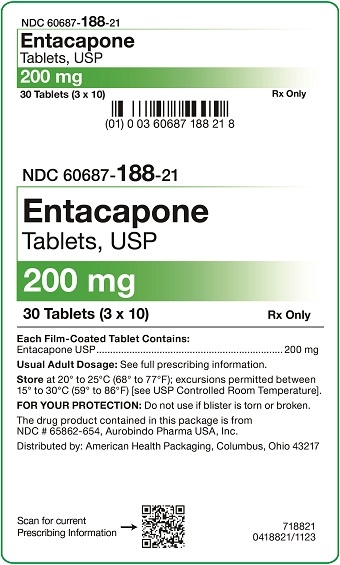
Tablets, USP
Entacapone USP....................................................................200 mg
15° to 30°C (59° to 86°F) [see USP Controlled Room Temperature].