Brand Name

Oriahnn

Generic Name
Norethisterone
View Brand Information
FDA approval date: May 29, 2020
Form: Kit

What is Oriahnn (Norethisterone)?

ORIAHNN is indicated for the management of heavy menstrual bleeding associated with uterine leiomyomas in premenopausal women. Limitation of Use: Use of ORIAHNN should be limited to 24 months due to the risk of continued bone loss, which may not be reversible [see Dosage and Administration.
Save this treatment for later
Sign Up
Not sure about your diagnosis?
Check Your Symptoms

Related Clinical Trials

Estradiol-mediated Inflammation and Central Sensitization in the Pathophysiology of Endometriosis-associated Pelvic Pain

Summary: The purpose of this study is to better understand how hormone suppression with Relugolix Combination-Therapy (CT) affects pelvic pain, inflammation, and pain sensitivity in women with moderate-to-severe endometriosis associated pelvic pain.

A Phase 3b Study to Evaluate the Safety and Efficacy of Elagolix in Combination With Combined Oral Contraceptives in Premenopausal Women With Documented Endometriosis and Associated Moderate to Severe Pain

Summary: Endometriosis is a painful disorder of the uterus affecting 6-10% of women of childbearing age. Endometriosis affects daily activities, social relationships, sexuality and sexual activity, and mental health. This study will evaluate how well elagolix in combination with combined oral contraceptives (COC) works within the body and/or how safe it is compared to placebo (does not contain treatment dr...

MyomaS Aspect Transformation at Ultrasound During Relugolix Estradiol Noretisterone Treatment: MySaturn Study

Summary: Uterine fibroids are benign tumors originating from the uterine muscle, affecting up to 70% of women by their 50s. Risk factors include African descent, nulliparity, obesity, and diabetes. While many fibroids are asymptomatic, 25-50% of affected women experience symptoms like heavy menstrual bleeding, pelvic pain, and pressure-related issues. Accurate diagnosis and differentiation from rare malign...

Brand Information

Oriahnn (Elagolix and Estradiol and Norethisterone)
WARNING: THROMBOEMBOLIC DISORDERS AND VASCULAR EVENTS
  • Estrogen and progestin combinations, including ORIAHNN, increase the risk of thrombotic or thromboembolic disorders including pulmonary embolism, deep vein thrombosis, stroke and myocardial infarction, especially in women at increased risk for these events [see Warnings and Precautions (5.1)].
  • ORIAHNN is contraindicated in women with current or a history of thrombotic or thromboembolic disorders and in women at increased risk for these events, including women over 35 years of age who smoke and women with uncontrolled hypertension [see Contraindications (4)].
1INDICATIONS AND USAGE
ORIAHNN is indicated for the management of heavy menstrual bleeding associated with uterine leiomyomas (fibroids) in premenopausal women.
Limitation of Use:
Use of ORIAHNN should be limited to 24 months due to the risk of continued bone loss, which may not be reversible
2DOSAGE FORMS AND STRENGTHS
ORIAHNN consists of two capsules:
  • The morning (AM) capsule is white and yellow, printed with “EL300 AM” containing 300 mg elagolix, 1 mg estradiol, and 0.5 mg norethindrone acetate.
  • The evening (PM) capsule is white and light blue, printed with “EL300 PM” containing 300 mg elagolix.
3CONTRAINDICATIONS
ORIAHNN is contraindicated in women:
  • With a high risk of arterial, venous thrombotic, or thromboembolic disorders
  • Who are pregnant. Exposure to ORIAHNN early in pregnancy may increase the risk of early pregnancy loss
  • With known osteoporosis because of the risk of further bone loss
  • With current or history of breast cancer or other hormonally-sensitive malignancies, and with increased risk for hormonally-sensitive malignancies
  • With known hepatic impairment or disease
  • With undiagnosed abnormal uterine bleeding.
  • With known anaphylactic reaction, angioedema, or hypersensitivity to ORIAHNN or any of its components.
  • Taking inhibitors of organic anion transporting polypeptide (OATP)1B1 (a hepatic uptake transporter) that are known or expected to significantly increase elagolix plasma concentrations
4ADVERSE REACTIONS
The following serious adverse reactions are discussed elsewhere in labeling:
  • Thromboembolic Disorders and Vascular Events
  • Bone Loss
  • Suicidal Ideation, Suicidal Behavior, and Exacerbation of Mood Disorders
  • Hepatic Transaminase Elevations
  • Elevated Blood Pressure
  • Effects on Carbohydrate and Lipid Metabolism
  • Alopecia
4.1Clinical Trials Experience
Because clinical trials are conducted under widely varying conditions, adverse reaction rates observed in the clinical trials of a drug cannot be directly compared to rates in the clinical trials of another drug and may not reflect the rates observed in clinical practice.
The safety of ORIAHNN was evaluated in two 6-month, randomized, double-blind, placebo-controlled trials (Studies UF-1 and UF-2), in which 790 premenopausal women received at least 1 dose of ORIAHNN (n=395), elagolix 300 mg twice daily (n=199), or placebo (n=196)
Serious Adverse Events
Serious adverse events were reported in three (0.8%) ORIAHNN-treated women in Studies UF-1 and UF-2. Two women had heavy menstrual bleeding and required blood transfusion due to anemia (0.5%) and one woman with history of bariatric surgery had a laparoscopic cholecystectomy due to cholelithiasis.
In Study UF-3, two women were diagnosed with breast cancer. One woman had completed 6 months of treatment with ORIAHNN in Study UF-1 and received 34 additional days of ORIAHNN in Study UF-3 when diagnosed. The second woman had received placebo in Study UF-2 and completed 6 months of ORIAHNN in Study UF-3 when diagnosed
Adverse Reactions Leading to Study Discontinuation
In Studies UF-1 and UF-2, the discontinuation rate due to adverse reactions was 10% among ORIAHNN-treated women and 7% among placebo-treated women. The most common adverse reactions leading to study drug discontinuation in the ORIAHNN group were nausea (1%), headache (1%), alopecia (1%), metrorrhagia (1%), menorrhagia (1%), and hot flush (1%). One event each of the following adverse reactions led to study drug discontinuation: affect lability, angina pectoris, depression, hepatic enzyme increased, homicidal ideation, hypertension, irritability, thrombosis.
In women who received ORIAHNN in Studies UF-1 or UF-2 and then in Study UF-3, 4% discontinued treatment due to adverse reactions. Three women discontinued due to serious adverse events (one each for breast cancer, menorrhagia with pelvic pain, and hysterectomy).
Common Adverse Reactions
Adverse reactions reported in ≥5% of ORIAHNN-treated women in Studies UF-1 and UF-2 and at a greater frequency than placebo-treated women are presented in Table 1.
The most commonly reported adverse reactions in the blinded extension trial (Study UF-3) were consistent with those in the placebo-controlled trials.
Less Common Adverse Reactions
In Studies UF-1 and UF-2, adverse reactions reported in ≥3% and <5% in the ORIAHNN group and greater incidence than the placebo group included: libido decreased, arthralgia, hypertension, alopecia, mood swings, influenza, abdominal distension, upper respiratory tract infection, menorrhagia, vomiting, and weight increased.
Thromboembolic and Vascular Events
In the Studies UF-1, UF-2, and UF-3, two (0.4%) thrombotic events occurred in 453 ORIAHNN-treated patients (thrombosis in the calf and pulmonary embolism)
Bone Loss
The effect of ORIAHNN on BMD was assessed by dual-energy X-ray absorptiometry (DXA).
In Studies UF-1 and UF-2, there was a greater decrease in BMD in women treated with ORIAHNN for 6 months compared to women treated with placebo. In Study UF-3, continued bone loss was observed in some women who received ORIAHNN for 12 consecutive months. The mean percent change from baseline in lumbar spine BMD at Month 6 (Studies UF-1 and UF-2) and Month 12 (Study UF-3) is presented in Table 2.
Following 12 months of ORIAHNN treatment in Study UF-3, a decline in lumbar spine BMD of >3% was seen in 27% (48/175) of women and a decline of ≥8% was seen in 1.7% (3/175) of women.
To assess for recovery, the change in BMD over time was analyzed for women who received continuous ORIAHNN treatment for up to 12 months and were then followed after cessation of therapy for an additional 12 months in Study UF-3 (Figure 1). The LS mean percent change from baseline in BMD 12 months after cessation of therapy was -0.72 (95% CI -1.2, -0.2), -0.59 (-1.0, -0.2), and -0.95 (-1.6, -0.3) at the lumbar spine, total hip, and femoral neck, respectively. Twelve months after cessation of ORIAHNN, continued bone loss was observed at the lumbar spine, total hip, and femoral neck in 24%, 32%, and 40% of women, respectively. Partial recovery was observed in 46%, 33%, and 38% and full recovery was observed in 30%, 35%, and 22% of women at these same sites. The time to maximum recovery in women who partially recovered is unknown.
Figure 1. Mean Percent Change From Baseline in Lumbar Spine BMD in Women Who Received 12 Months of ORIAHNN (On-Treatment) and 12 Months of Follow Up (Off Treatment)
Suicidal Ideation, Suicidal Behavior, and Exacerbation of Mood Disorders
In the placebo-controlled trials (Studies UF-1 and UF-2), ORIAHNN was associated with adverse mood changes. Depression, depressed mood, and/or tearfulness were reported in 3% of ORIAHNN-treated women compared to 1% of placebo-treated women. One woman treated with lower dose elagolix alone for another disease completed suicide 2 days after elagolix discontinuation.
Hepatic Transaminase Elevations
In Studies UF-1 and UF-2, elevations of serum ALT and AST with no concurrent elevations of bilirubin were reported.
  • ALT elevations to at least 3 times the upper limit of normal (ULN) occurred in 1.1% (4/379) of ORIAHNN-treated women and no placebo-treated women. Peak elevation of ALT almost 8 times the ULN was reported in 1 ORIAHNN-treated woman.
  • AST elevations to at least 3 times the ULN occurred in 5/379 (1.3%) in ORIAHNN-treated women and no placebo-treated women. Peak elevation of AST 6 times the ULN was reported in 1 ORIAHNN-treated woman.
Blood Pressure Elevations
There were more ORIAHNN-treated women with systolic blood pressure ≥ 160 mmHg (7.1%) and diastolic blood pressure ≥ 100 mmHg (11.3%) compared to placebo-treated women (3.7% and 6.3%, respectively). The incidence of hypertensive adverse reactions was 3.8% in ORIAHNN-treated women and 3.1% placebo-treated women. One ORIAHNN-treated woman in Study UF-1, with no prior history but with elevated cholesterol levels, had severe hypertension (BP 204/112) and chest pain. ECG was negative. Her hypertension was controlled with anti-hypertensives and she completed Study UF-3.
Changes in Lipid Parameters
Increases in total cholesterol, low-density lipoprotein cholesterol (LDL-C), serum triglycerides, and apolipoprotein B were noted during ORIAHNN treatment in Studies UF-1 and UF-2.
Of the women with Grade 0 LDL-C (<130 mg/dL) at baseline, 1/313 (0.3%) ORIAHNN-treated woman shifted to Grade 3 (≥ 190 mg/dL) compared to no placebo-treated woman. Of those with Grade 1 LDL-C (130 to <160 mg/dL) at baseline, 9/54 (16.7%) ORIAHNN-treated women shifted to Grade 3 compared to no placebo-treated woman. Of those with Grade 2 LDL-C (160 to <190 mg/dL) at baseline, 7/10 (70%) ORIAHNN-treated women shifted to Grade 3 compared to 1/5 (20%) placebo-treated woman.
Alopecia
In Phase 3 placebo-controlled clinical trials (Studies UF-1 and UF-2), 3.5% (14/395) of ORIAHNN-treated women experienced alopecia, hair loss, or hair thinning compared to 1.0% (2/196) of placebo-treated women. No specific pattern in hair loss was observed. In almost one-third (4/14) of affected ORIAHNN-treated women, alopecia was a reason for study drug discontinuation; no placebo-treated women discontinued because of alopecia. In ORIAHNN-treated women, 79% of the cases were mild and 21% were moderate in severity. Hair loss was ongoing at the end of the study for 4 out of 14 women (29%). Of these 4 women, one discontinued treatment due to hair loss, two had ongoing hair loss 12 months after discontinuing ORIAHNN, and one was lost to follow-up. In the remaining 10 women (71%), hair loss either resolved while on treatment or resolved within 24 days to approximately 9 months after discontinuing ORIAHNN.
Resumption of Menses after Discontinuation
After six months of ORIAHNN treatment, resumption of menses was reported by 39%, 68%, and 73% of women within 1, 2, and 6 months, respectively, in Study UF-1 and 39%, 85%, and 92% within 1, 2, and 6 months, respectively, in Study UF-2.
After 12 months of therapy with ORIAHNN (Study UF-1 or Study UF-2 then Study UF-3), resumption of menses was reported by 43%, 82%, and 90% of women within 1, 2, and 6 months after stopping treatment, respectively.
Whether those who did not resume having menses transitioned to a peri-postmenopausal status is unknown.
5OVERDOSAGE
Overdosage of estrogen and progestin combination products may cause nausea, vomiting, breast tenderness, abdominal pain, drowsiness, fatigue, and withdrawal bleeding. In case of ORIAHNN overdose, monitor the patient for any signs or symptoms of adverse reactions and initiate appropriate symptomatic treatment, as needed.
6DESCRIPTION
ORIAHNN consists of two capsules: one to be taken orally in the morning (AM) and one to be taken orally in the evening (PM). The AM capsule is white and yellow and contains 300 mg elagolix (equivalent to 310.4 mg of elagolix sodium), 1 mg estradiol, and 0.5 mg norethindrone acetate. The PM capsule is white and light blue and contains 300 mg of elagolix (equivalent to 310 mg of elagolix sodium).
Elagolix
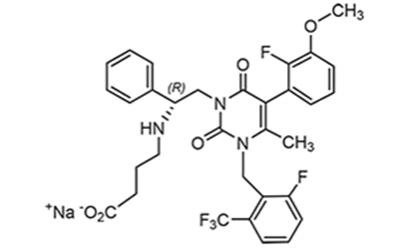
Elagolix sodium is the sodium salt of the active moiety elagolix, a nonpeptide small molecule, GnRH receptor antagonist. Elagolix sodium is chemically described as sodium 4-({(1
Elagolix sodium has the following structural formula:
Elagolix sodium has the following structural formula
Elagolix sodium is a white to off-white to light yellow powder and is freely soluble in water.
Estradiol
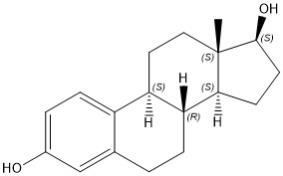
Estradiol (E2), an estrogen, is a white or almost white crystalline powder. Its chemical name is estra-1,3,5(10)-triene-3,17β-diol with the molecular formula of C
Estradiol structure
Norethindrone acetate
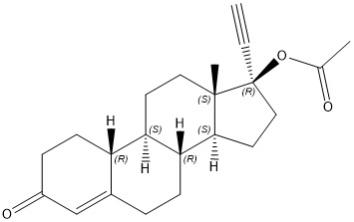
Norethindrone acetate (NETA), a progestin, is a white or yellowish white crystalline powder. Its chemical name is 17β-acetoxy-19-nor-17α-pregn-4-en-20-yn-3-one with the molecular formula of C
Norethindrona Acetate structure
ORIAHNN morning (AM) capsules contain the following inactive ingredients: anhydrous sodium carbonate, polyethylene glycol 3350, crospovidone, colloidal silicon dioxide, magnesium stearate, polyvinyl alcohol, titanium dioxide, polyethylene glycol, talc, purified water, lactose monohydrate, starch (corn), copovidone, talc, hypromellose, triacetin, and gelatin capsule shell. The capsule shell contains the following ingredients: FD&C Red #40, FD&C Yellow #5
ORIAHNN evening (PM) capsules contain the following inactive ingredients: anhydrous sodium carbonate, polyethylene glycol 3350, crospovidone, colloidal silicon dioxide, magnesium stearate, polyvinyl alcohol, titanium dioxide, polyethylene glycol, talc, purified water, and gelatin capsule shell. The capsule shell contains the following ingredients: FD&C Blue #2, FDA/E172 yellow iron oxide, titanium dioxide, gelatin, and printing ink (shellac, dehydrated alcohol, isopropyl alcohol, butyl alcohol, propylene glycol, strong ammonia solution, black iron oxide, potassium hydroxide, and purified water).
7CLINICAL STUDIES
The efficacy of ORIAHNN in the management of heavy menstrual bleeding (HMB) associated with uterine fibroids was demonstrated in two randomized, double-blind, placebo-controlled studies [Study UF-1 (NCT02654054) and Study UF-2 (NCT02691494)] in which 790 premenopausal women with heavy menstrual bleeding received ORIAHNN (elagolix 300 mg, estradiol 1 mg, and norethindrone acetate 0.5 mg in the morning and elagolix 300 mg in the evening) or placebo for 6 months. Heavy menstrual bleeding at baseline was defined as having at least two menstrual cycles with greater than 80 mL of menstrual blood loss (MBL) as assessed by alkaline hematin (AH) method (an objective, validated measure to quantify MBL volume on sanitary products).
In Studies UF-1 and UF-2, the median age of enrolled women was 43 years (ranging from 25 to 53 years); 68% of the women were Black or African American, 29% were White, and 3% were other races.
Menstrual Blood Loss
The primary endpoint in both studies was the proportion of responders, defined as women who achieved both 1) MBL volume less than 80 mL at the Final Month and 2) 50% or greater reduction in MBL volume from Baseline to the Final Month. Final Month was defined as the last 28 days before and including the last treatment visit date or the last dose date. A higher proportion of ORIAHNN-treated women were responders compared to placebo-treated women (
Changes in MBL Volume
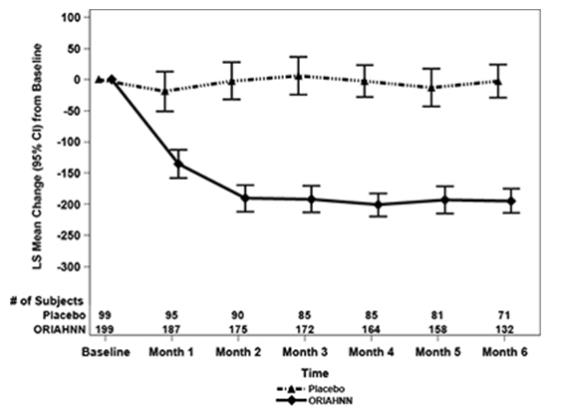
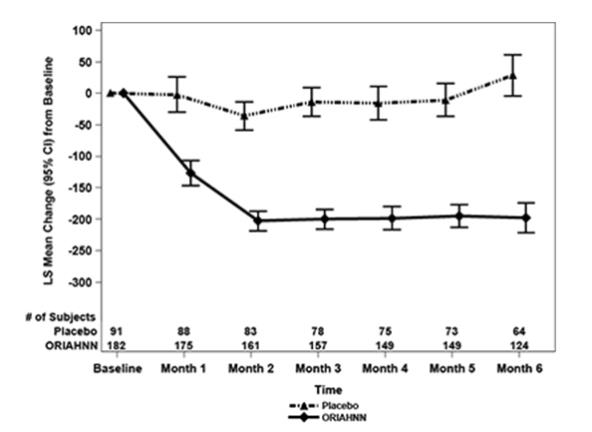
Treatment with ORIAHNN resulted in a reduction in mean MBL volume from Baseline at Months 1, 3, and 6 compared to placebo (see Figures
Figure 2. Monthly Change from Baseline in MBL Volume in Women with Uterine Fibroids (Study UF-1)
Figure 3. Monthly Change from Baseline in MBL Volume in Women with Uterine Fibroids (Study UF-2)
In Study UF-1, mean baseline MBL was 238 mL for ORIAHNN and 255 mL for placebo. In Study UF-2, mean baseline MBL was 228 mL for ORIAHNN and 254 mL for placebo. Women taking ORIAHNN had a mean reduction of MBL volume from Baseline to Final Month in both Studies UF-1 and UF-2 compared to women taking placebo (Study UF-1: -177 mL for ORIAHNN and 1 mL for placebo; Study UF-2: -169 mL for ORIAHNN and -4 mL for placebo).
Suppression of Bleeding
In Studies UF-1 and UF-2, a greater proportion (57% and 61%, respectively) of women receiving ORIAHNN experienced suppression of bleeding, defined as no bleeding (but spotting allowed), at Final Month, compared to 4% and 5%, respectively, of women receiving placebo.
Hemoglobin (Hgb)
In Studies UF-1 and UF-2, a greater proportion of ORIAHNN-treated women who were anemic with baseline Hgb ≤ 10.5 g/dL achieved an increase > 2 g/dL in Hgb from Baseline to Month 6 compared to placebo-treated women (see
8HOW SUPPLIED/STORAGE AND HANDLING
ORIAHNN consists of two capsules: one to be taken in the morning (AM) and one to be taken in the evening (PM).
  • morning (AM) capsules are white and yellow, printed with “EL300 AM” and contain elagolix 300 mg, estradiol 1 mg, and norethindrone acetate 0.5 mg.
  • evening (PM) capsules are white and light blue, printed with “EL300 PM” and contain elagolix 300 mg.
ORIAHNN is packaged in weekly blister packs. Each blister pack contains seven AM capsules and seven PM capsules. Four blisters are packaged into a carton (NDC 0074-1017-56).
Store at 20°C to 25°C (68°F to 77°F), excursions permitted to 15˚C to 30˚C (59˚F to 86˚F). [See USP Controlled Room Temperature].
Dispose unused medication via a take-back option if available. Otherwise, follow FDA instructions for disposing medication in the household trash, www.fda.gov/drugdisposal. Do NOT flush down the toilet.
9PATIENT COUNSELING INFORMATION
Advise the patient to read the FDA-approved patient labeling (
Thromboembolic Disorders and Vascular Events
Advise patients that use of estrogen and progestin combinations may increase the risk of thromboembolic disorders and vascular events, especially in women at high risk for these events
Bone Loss
Advise patients about the risk of bone loss. Advise patients that supplementary calcium and vitamin D may be beneficial if dietary intake of calcium and vitamin D is not adequate. Advise patients that oral iron supplement should not be taken at the same time as calcium and vitamin D
Suicidal Ideation and Exacerbation of Mood Disorders
Advise patients that suicidal ideation and exacerbation of mood disorders may occur with ORIAHNN use. Instruct patients with new onset or worsening depression, anxiety, or other mood changes to promptly seek medical attention
Liver Injury
Advise patients to promptly seek medical attention in case of signs or symptoms that may reflect liver injury, such as jaundice
Change in Menstrual Bleeding Pattern
Advise patients that ORIAHNN may delay the recognition of pregnancy because it may reduce the duration and amount of menstrual bleeding. Advise patients to use effective non-hormonal contraception while taking ORIAHNN, for 28 days after discontinuing ORIAHNN, and to discontinue ORIAHNN if pregnancy is diagnosed. Advise pregnant patients that there is a pregnancy registry that monitors outcomes in women who become pregnant while treated with ORIAHNN. Inform patients they can enroll by calling 1-833-782-7241 or visiting https://www.bloompregnancyregistry.com
Alopecia
Advise patients that alopecia, hair loss, and hair thinning in no specific pattern, may occur with ORIAHNN use. Advise patients that hair loss and hair thinning may not resolve completely after stopping ORIAHNN. Advise patients to contact their healthcare provider if they have concerns about changes to their hair
Drug Interactions
Advise patients to inform their healthcare providers of all concomitant medications, including prescription medicines, over-the-counter drugs, vitamins, and herbal products. Advise patients to avoid grapefruit juice while taking ORIAHNN
ORIAHNN Missed Dose Instructions
Instruct patients about what to do in the event a dose is missed. See “If you miss a dose of ORIAHNN” section in FDA-approved Medication Guide.
ORIAHNN Disposal Instructions
Instruct patients to dispose of unused medication via a take-back option if available or to otherwise follow FDA instructions for disposing of medication in the household trash,
Manufactured by AbbVie Inc. North Chicago, IL 60064
ORIAHNN is a trademark of AbbVie Inc.
© 2023 AbbVie Inc. All rights reserved.
20075868