Brand Name

Nuplazid

Generic Name
Pimavanserin
View Brand Information
FDA approval date: June 28, 2018
Classification: Atypical Antipsychotic
Form: Tablet, Capsule

What is Nuplazid (Pimavanserin)?

NUPLAZID ® is indicated for the treatment of hallucinations and delusions associated with Parkinson's disease psychosis. NUPLAZID is an atypical antipsychotic indicated for the treatment of hallucinations and delusions associated with Parkinson's disease psychosis.
Save this treatment for later
Sign Up
Not sure about your diagnosis?
Check Your Symptoms

Related Clinical Trials

A Pragmatic Randomized Trial Comparing Antipsychotics in Lewy Body Disease

Summary: The primary objective of this study is to determine whether treatment with pimavanserin or quetiapine is associated with a greater improvement in psychosis when used in a routine clinical setting to treat hallucinations and/or delusions due to Parkinson's disease (PD) or dementia with Lewy bodies (DLB) - collectively referred to as Lewy body disease (LBD).

CSP #2015 - Multicenter, Randomized, Double-blind Comparator Study of Antipsychotics Pimavanserin and Quetiapine for Parkinson''s Disease Psychosis (C-SAPP)

Summary: Patients with Parkinson's disease (PD) sometimes experience symptoms affecting their movement, such as slowness, tremor, stiffness, and balance or walking problems. Many patients also have other symptoms not related to movement, called non-motor symptoms, which may affect one's mood or emotions, memory or thinking, or cause one to see or hear things that aren't real (hallucinations) or believe thi...

A Multi-Center, Placebo-Controlled, Double-Blind Trial to Examine the Safety and Efficacy of Pimavanserin in the Treatment of Psychosis in Parkinson's Disease

Summary: The purpose of this study is to evaluate the safety and efficacy of 34 mg pimavanserin compared to placebo in patients with Parkinson's disease psychosis (PDP).

Brand Information

NUPLAZID (pimavanserin tartrate)
WARNING: INCREASED MORTALITY IN ELDERLY PATIENTS WITH DEMENTIA-RELATED PSYCHOSIS
Elderly patients with dementia-related psychosis treated with antipsychotic drugs are at an increased risk of death. NUPLAZID is not approved for the treatment of patients with dementia who experience psychosis unless their hallucinations and delusions are related to Parkinson's disease
1INDICATIONS AND USAGE
NUPLAZID
2DOSAGE FORMS AND STRENGTHS
NUPLAZID (pimavanserin) is available as:
  • 34 mg strength capsules. The capsules are opaque white and light green with "PIMA" and "34" printed in black.
  • 10 mg strength tablets. The orange, round, coated tablets are debossed on one side with a "P" and "10" on the reverse side.
3CONTRAINDICATIONS
NUPLAZID is contraindicated in patients with a history of a hypersensitivity reaction to pimavanserin or any of its components. Rash, urticaria, and reactions consistent with angioedema (e.g., tongue swelling, circumoral edema, throat tightness, and dyspnea) have been reported
4ADVERSE REACTIONS
The following serious adverse reactions are discussed elsewhere in the labeling:
  • Increased Mortality in Elderly Patients with Dementia-Related Psychosis
  • QT Interval Prolongation
4.1Clinical Trials Experience
Because clinical trials are conducted under widely varying conditions, adverse reaction rates observed in the clinical trials of a drug cannot be directly compared to rates in the clinical trials of another drug and may not reflect the rates observed in practice.
The clinical trial database for NUPLAZID consists of over 1200 subjects and patients exposed to one or more doses of NUPLAZID. Of these, 616 were patients with hallucinations and delusions associated with Parkinson's disease psychosis (PDP). In the placebo-controlled setting, the majority of experience in patients comes from studies evaluating once-daily NUPLAZID doses of 34 mg (N=202) compared to placebo (N=231) for up to 6 weeks. In the controlled trial setting, the study population was approximately 64% male and 91% Caucasian, and the mean age was about 71 years at study entry. Additional clinical trial experience in patients with hallucinations and delusions associated with PDP comes from two open-label, safety extension studies (total N=497). The majority of patients receiving long-term treatment received 34 mg once-daily (N=459). Over 300 patients have been treated for more than 6 months; over 270 have been treated for at least 12 months; and over 150 have been treated for at least 24 months.
The following adverse reactions are based on the 6-week, placebo-controlled studies in which NUPLAZID was administered once daily to patients with hallucinations and delusions associated with PDP.
Common Adverse Reactions (incidence ≥5% and at least twice the rate of placebo): peripheral edema (7% NUPLAZID 34 mg vs. 2% placebo) and confusional state (6% NUPLAZID 34 mg vs. 3% placebo).
4.2Postmarketing Experience
The following adverse reactions have been identified during postapproval use of NUPLAZID. Because these reactions are reported voluntarily from a population of uncertain size, it is not always possible to reliably estimate their frequency or establish a causal relationship to drug exposure. These reactions include rash, urticaria, reactions consistent with angioedema (e.g., tongue swelling, circumoral edema, throat tightness, and dyspnea), somnolence, falls, agitation, aggression, and fecal incontinence.
5DESCRIPTION
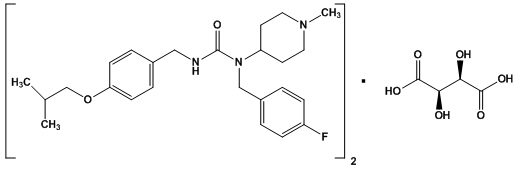
NUPLAZID contains pimavanserin, an atypical antipsychotic, which is present as pimavanserin tartrate salt with the chemical name, urea,
Chemical Structure
The molecular formula of pimavanserin free base is C
NUPLAZID capsules are intended for oral administration only. Each capsule contains 40 mg of pimavanserin tartrate, which is equivalent to 34 mg of pimavanserin free base. Inactive ingredients include magnesium stearate and microcrystalline cellulose. Additionally, the following inactive ingredients are present as components of the capsule shell: black iron oxide, FD&C blue #1, hypromellose, titanium dioxide, and yellow iron oxide.
NUPLAZID tablets are intended for oral administration only. Each round, orange, immediate-release, film coated tablet contains 11.8 mg of pimavanserin tartrate, which is equivalent to 10 mg pimavanserin free base. Inactive ingredients include magnesium stearate, pregelatinized starch, and silicified microcrystalline cellulose. Additionally, the following inactive ingredients are present as components of the film coat: polyethylene glycol, polyvinyl alcohol, red iron oxide, talc, titanium dioxide, and yellow iron oxide.
6CLINICAL STUDIES
The efficacy of NUPLAZID 34 mg as a treatment of hallucinations and delusions associated with Parkinson's disease (PD) psychosis was demonstrated in a 6-week, randomized, placebo-controlled, parallel-group study. In this outpatient study, 199 patients were randomized in a 1:1 ratio to NUPLAZID 34 mg or placebo once daily. Study patients (male or female and aged 40 years or older) had a diagnosis of PD (with or without dementia) established at least 1 year prior to study entry and had psychotic symptoms (hallucinations and/or delusions) that started after the PD diagnosis and that were severe and frequent enough to warrant treatment with an antipsychotic. At entry, patients were required to have a Mini-Mental State Examination (MMSE) score ≥21 and to be able to self-report symptoms. The majority of patients were on PD medications at entry; these medications were required to be stable for at least 30 days prior to study start and throughout the study period.
The PD-adapted Scale for the Assessment of Positive Symptoms (SAPS-PD) was used to evaluate the efficacy of NUPLAZID 34 mg. SAPS-PD is a 9-item scale adapted for PD from the Hallucinations and Delusions domains of the SAPS. Each item is scored on a scale of 0-5, with 0 being none and 5 representing severe and frequent symptoms. Therefore, the SAPS-PD total score can range from 0 to 45 with higher scores reflecting greater severity of illness. A negative change in score indicates improvement. Primary efficacy was evaluated based on change from baseline to Week 6 in SAPS-PD total score.
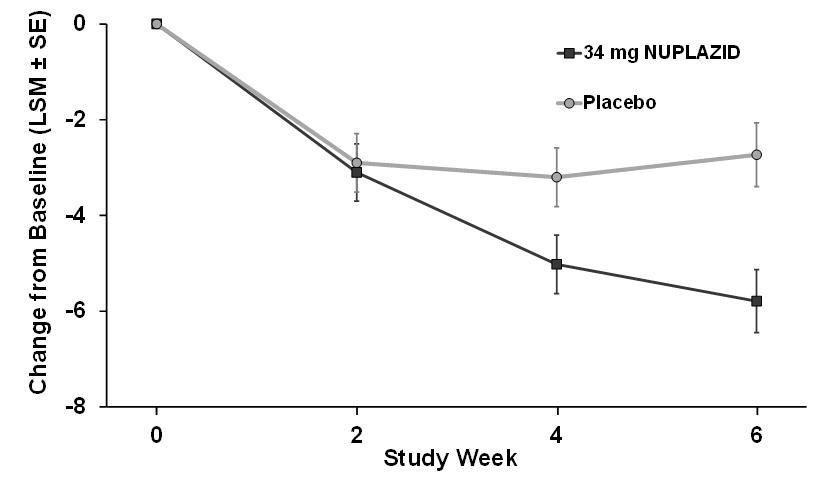
As shown in
The effect of NUPLAZID on SAPS-PD improved through the six-week trial period, as shown in
Figure 3 SAPS-PD Change from Baseline through 6 Weeks Total Study Treatment
Figure 3
Figure 4 Proportion of Patients with SAPS-PD Score Improvement at the End of Week 6 (N=185)
7HOW SUPPLIED/STORAGE AND HANDLING
NUPLAZID (pimavanserin) is available as:
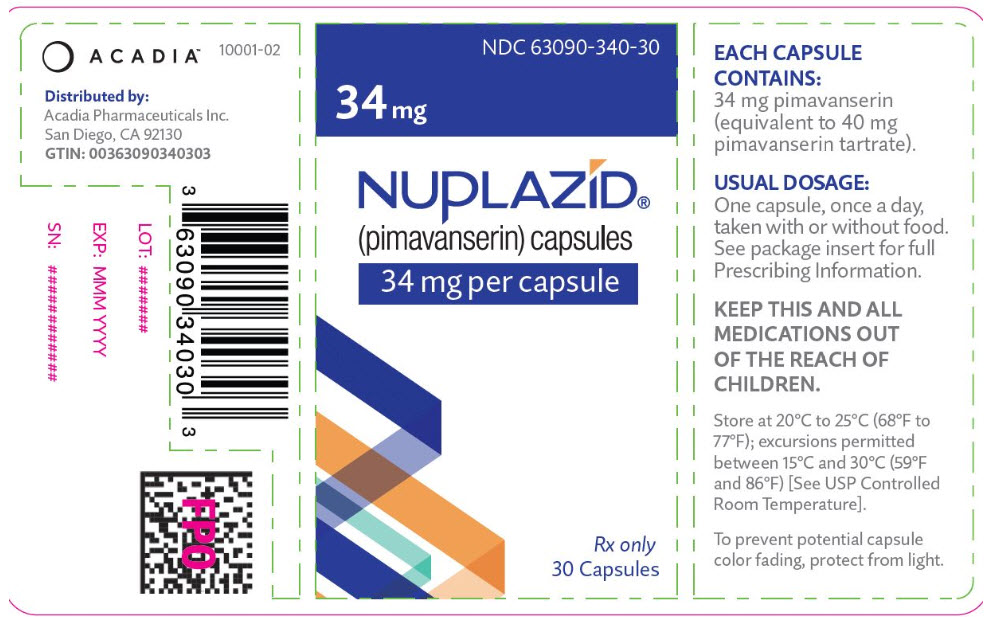
8PRINCIPAL DISPLAY PANEL - 34 mg Capsule Bottle Label
NDC 63090-340-30
34 mg
NUPLAZID
34 mg per capsule
Rx only
PRINCIPAL DISPLAY PANEL - 34 mg Capsule Bottle Label
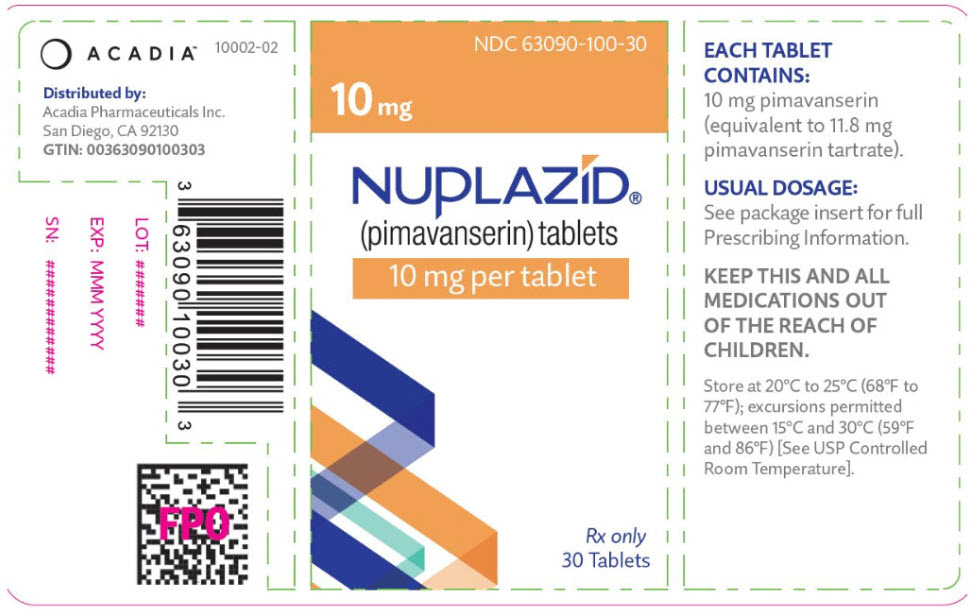
9PRINCIPAL DISPLAY PANEL - 10 mg Tablet Bottle Label
NDC 63090-100-30
10 mg
NUPLAZID
10 mg per tablet
Rx only
PRINCIPAL DISPLAY PANEL - 10 mg Tablet Bottle Label