Brand Name
Uvadex
Generic Name
Methoxsalen
View Brand Information FDA approval date: February 25, 1999
Classification: Photoactivated Radical Generator
Form: Injection, Capsule
What is Uvadex (Methoxsalen)?
III. INDICATIONS AND USAGE Photochemotherapy is indicated for the symptomatic control of severe, recalcitrant, disabling psoriasis not adequately responsive to other forms of therapy and when the diagnosis has been supported by biopsy. Methoxsalen is intended to be administered only in conjunction with a schedule of controlled doses of long wave ultraviolet radiation.
Top Global Experts
There are no experts for this drug
Save this treatment for later
Not sure about your diagnosis?
Related Clinical Trials
There is no clinical trials being done for this treatment
Related Latest Advances
There is no latest advances for this treatment
Brand Information
UVADEX (Methoxsalen)
1DESCRIPTION
Methoxsalen is a naturally occurring photoactive substance found in the seeds of the Ammi majus (Umbelliferae) plant. It belongs to a group of compounds known as psoralens or furocoumarins. The chemical name of methoxsalen is 9-methoxy-7H-furo[3,2-g][1]-benzopyran-7-one; it has the following structure:

Each mL of UVADEX
UVADEX
2CLINICAL STUDIES
Three single-arm studies were performed to evaluate the effectiveness of photopheresis in the treatment of the skin manifestations of Cutaneous T-Cell Lymphoma (CTCL). In the first study (CTCL 1), 39 patients were treated with the oral formulation of methoxsalen in conjunction with the UVAR Photopheresis System. The second study (CTCL 2) was a 5-year post approval follow-up of 57 CTCL patients that was conducted to evaluate long-term safety. This study also used the oral dosage formulation of methoxsalen. In the third study (CTCL 3), 51 patients were treated with the UVADEX
In study CTCL 1, prednisone up to 10 mg/day was permitted in addition to topical steroids. In CTCL 2, there was no concomitant medication restriction. In CTCL 3, topical steroids were permitted only for the treatment of fissures on the soles of the feet and the palms of hands. All other steroids, topical or systemic, were prohibited.
In all three studies, patients were initially treated on two consecutive days every four to five weeks. If the patient did not respond after four cycles, treatment was accelerated to two consecutive days every other week. If the patient did not respond after four cycles at the accelerated schedule, the patient was treated on two consecutive days every week. If the patient still did not respond after four cycles of weekly treatments, the schedule was increased to three consecutive days every week for three cycles. In study CTCL 3, 15 of the 17 responses were seen within six months of treatment. Only two patients responded to treatment after six months. Clinical experience does not extend beyond this treatment frequency and there is no evidence to show that treatment with UVADEX
Overall skin scores were used in the clinical studies of photopheresis to assess the patient's response to treatment. The patient's baseline skin score was used for comparison with subsequent scores. A 25% reduction in skin score maintained for four consecutive weeks was considered a successful response to photopheresis therapy. Table 1 indicates the percent of successful responses within six months of beginning therapy for all patients who received at least one course of photopheresis. Only patients with patch plaque, extensive plaque and erythrodermic disease were enrolled in these studies. No patients with disease in the tumor phase were treated. There are no data available regarding the efficacy of UVADEX
Although the response rate with UVADEX
Retrospective analyses of three clinical benefit parameters from the Body Area Severity Scores in CTCL 3 suggested a correlation between skin score response and improvement in edema, scaling and resolution of fissures.
3INDICATIONS AND USAGE
UVADEX
4CONTRAINDICATIONS
- UVADEX
- UVADEX
- Patients should not receive UVADEX
5ADVERSE REACTIONS
Side effects of photopheresis (UVADEX
5.1POSTMARKETING
Adverse reactions reported from postmarketing experience include nausea, dysgeusia, photosensitivity reaction, pyrexia and hypersensitivity reactions including anaphylaxis and rash.
6OVERDOSAGE
In the event of overdosage, the patient should be kept in a darkened room for at least 24 hours.
7DRUG DOSAGE AND ADMINISTRATION
Each UVADEX
During treatment with the THERAKOS
- The prescribed amount of UVADEX
8REFERENCES
- Recommendations for the Safe Handling of Parenteral Antineoplastic Drugs, NIH Publication No. 83-2621. For sale by the Superintendent of Documents, U.S. Government Printing Office, Washington, DC 20402.
- AMA Council Report, Guidelines for Handling of Parenteral Antineoplastics. JAMA, 1985; 2.53 (11): 1590–1592.
- National Study Commission on Cytotoxic Exposure- Recommendations for Handling Cytotoxic Agents. Available from Louis P. Jeffrey, ScD., Chairman, National Study Commission on Cytotoxic Exposure, Massachusetts College of Pharmacy and Allied Health Sciences, 179 Longwood Avenue, Boston, Massachusetts 02115.
- Clinical Oncological Society of Australia, Guidelines and Recommendations for Safe Handling of Antineoplastic Agents. Med J Australia, 1983; 1:426–428.
- Jones, RB, et al. Safe Handling of Chemotherapeutic Agents: A Report from The Mount Sinai Medical Center. CA- A Cancer Journal for Clinicians, 1983;(Sept/Oct) 258–263.
- American Society of Hospital Pharmacists Technical Assistance Bulletin of Handling Cytotoxic and Hazardous Drugs. Am J. Hosp Pharm, 1990;47:1033–1049.
- Controlling Occupational Exposure to Hazardous Drugs. (OSHA Work-Practice Guidelines), AM J. Health-Syst Pharm, 1996; 53: 1669–1685.
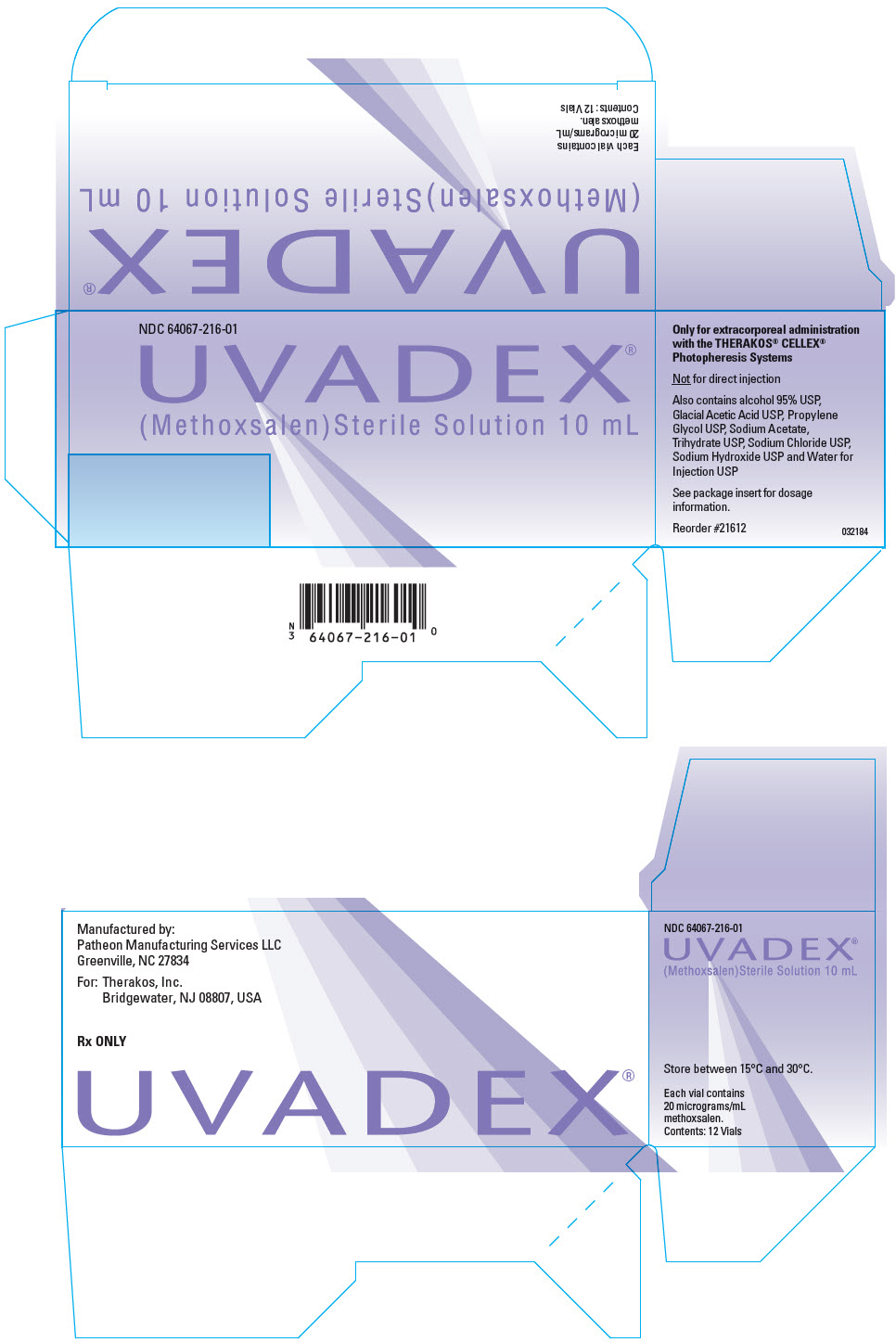
9PRINCIPAL DISPLAY PANEL - 10 mL Vial Carton
NDC 64067-216-01
UVADEX