Brand Name
Ninlaro
Generic Name
Ixazomib
View Brand Information FDA approval date: November 20, 2015
Classification: Proteasome Inhibitor
Form: Capsule
What is Ninlaro (Ixazomib)?
NINLARO is indicated in combination with lenalidomide and dexamethasone for the treatment of patients with multiple myeloma who have received at least one prior therapy. NINLARO is a proteasome inhibitor indicated in combination with lenalidomide and dexamethasone for the treatment of patients with multiple myeloma who have received at least one prior therapy.
Approved To Treat
Top Global Experts


Save this treatment for later
Not sure about your diagnosis?
Related Clinical Trials
An Open-label Phase I/II Trial of Venetoclax-Dexamethasone in Relapsed and/or Refractory t(11;14) Systemic Light-Chain Amyloidosis
Summary: The purpose of this study is assess safety, safest dose, and effectiveness of venetoclax in combination with dexamethasone in participants with t(11;14) positive relapsed (comes back) or refractory (did not get better) light chain amyloidosis.
A Phase 2 Trial of Ixazomib for Kaposi Sarcoma
Summary: This phase II trial studies how well ixazomib works in treating patients with Kaposi sarcoma. Ixazomib may stop the growth of tumor cells by blocking some of the enzymes needed for cell growth.
Exploratory Study of Ixazomib in Combination With Reduced Dose Lenalidomide Versus Ixazomib Alone for Maintenance Treatment of High Risk Multiple Myeloma
Summary: Ixazomib combined with low-dose lenalidomide(10mg) vs Ixazomib alone as maintenance regimen in patients with high-risk multiple myeloma after induction and consolidation of VRD-based regimen.
Related Latest Advances
Brand Information
NINLARO (ixazomib)
1INDICATIONS AND USAGE
NINLARO
2DOSAGE FORMS AND STRENGTHS
NINLARO is available in the following capsules:
- 4 mg ixazomib: Light orange gelatin capsule imprinted with "Takeda" on the cap and "4 mg" on the body in black ink.
- 3 mg ixazomib: Light grey gelatin capsule imprinted with "Takeda" on the cap and "3 mg" on the body in black ink.
- 2.3 mg ixazomib: Light pink gelatin capsule imprinted with "Takeda" on the cap and "2.3 mg" on the body in black ink.
3CONTRAINDICATIONS
None.
4ADVERSE REACTIONS
The following adverse reactions are described in detail in other sections of the prescribing information:
- Thrombocytopenia
- Gastrointestinal Toxicities
- Peripheral Neuropathy
- Peripheral Edema
- Cutaneous Reactions
- Thrombotic Microangiopathy
- Hepatotoxicity
4.1Clinical Trials Experience
Because clinical trials are conducted under widely varying conditions, adverse reaction rates observed in the clinical trials of a drug cannot be directly compared to rates in the clinical trials of another drug and may not reflect the rates observed in practice.
The safety population from the randomized, double-blind, placebo-controlled clinical study included 720 patients with relapsed and/or refractory multiple myeloma, who received NINLARO in combination with lenalidomide and dexamethasone (NINLARO regimen; N=361) or placebo in combination with lenalidomide and dexamethasone (placebo regimen; N=359).
The most frequently reported adverse reactions (≥20% with a difference of ≥5% compared to placebo) in the NINLARO regimen were thrombocytopenia, neutropenia, diarrhea, constipation, peripheral neuropathy, nausea, peripheral edema, rash, vomiting, and bronchitis. Serious adverse reactions reported in ≥2% of patients in the NINLARO regimen included diarrhea (3%), thrombocytopenia (2%) and bronchitis (2%). One or more of the three drugs was permanently discontinued in 4% of patients reporting peripheral neuropathy, 3% of patients reporting diarrhea and 2% of patients reporting thrombocytopenia. Permanent discontinuation of NINLARO due to an adverse reaction occurred in 10% of patients.
Table 4 summarizes the non-hematologic adverse reactions occurring in at least 5% of patients with at least a 5% difference between the NINLARO regimen and the placebo regimen.
Table 5 represents pooled information from adverse event and laboratory data.
4.2Postmarketing Experience
The following adverse reactions have been identified during post-approval use of NINLARO. Because these reactions are reported voluntarily from a population of uncertain size, it is not always possible to reliably estimate their frequency or establish a causal relationship to drug exposure.
Immune system disorders: Angioedema
Skin and subcutaneous tissue disorders: Toxic epidermal necrolysis
5OVERDOSAGE
Overdosage, including fatal overdosage, has been reported in patients taking NINLARO. Manifestations of overdosage include adverse reactions reported at the recommended dosage
In the event of an overdosage, monitor for adverse reactions and provide appropriate supportive care. NINLARO is not dialyzable.
6DESCRIPTION
Ixazomib is a proteasome inhibitor. Ixazomib citrate, a prodrug, rapidly hydrolyzes under physiological conditions to its biologically active form, ixazomib. The chemical name of ixazomib citrate is 1,3,2-dioxaborolane-4,4-diacetic acid, 2-[(1
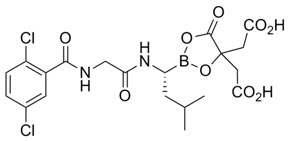
The molecular formula for ixazomib citrate is C
NINLARO (ixazomib) capsules for oral use contain 4, 3 or 2.3 mg of ixazomib equivalent to 5.7, 4.3 or 3.3 mg of ixazomib citrate, respectively. Inactive ingredients include microcrystalline cellulose, magnesium stearate, and talc. Capsule shells contain gelatin and titanium dioxide. The 4 mg capsule shell contains red and yellow iron oxide, the 3 mg capsule shell contains black iron oxide and the 2.3 mg capsule shell contains red iron oxide. The printing ink contains shellac, propylene glycol, potassium hydroxide, and black iron oxide.
7REFERENCES
- OSHA Hazardous Drugs. OSHA. http://www.osha.gov/SLTC/hazardousdrugs/index.html
8PATIENT COUNSELING INFORMATION
Advise the patient to read the FDA-approved patient labeling (Patient Information).
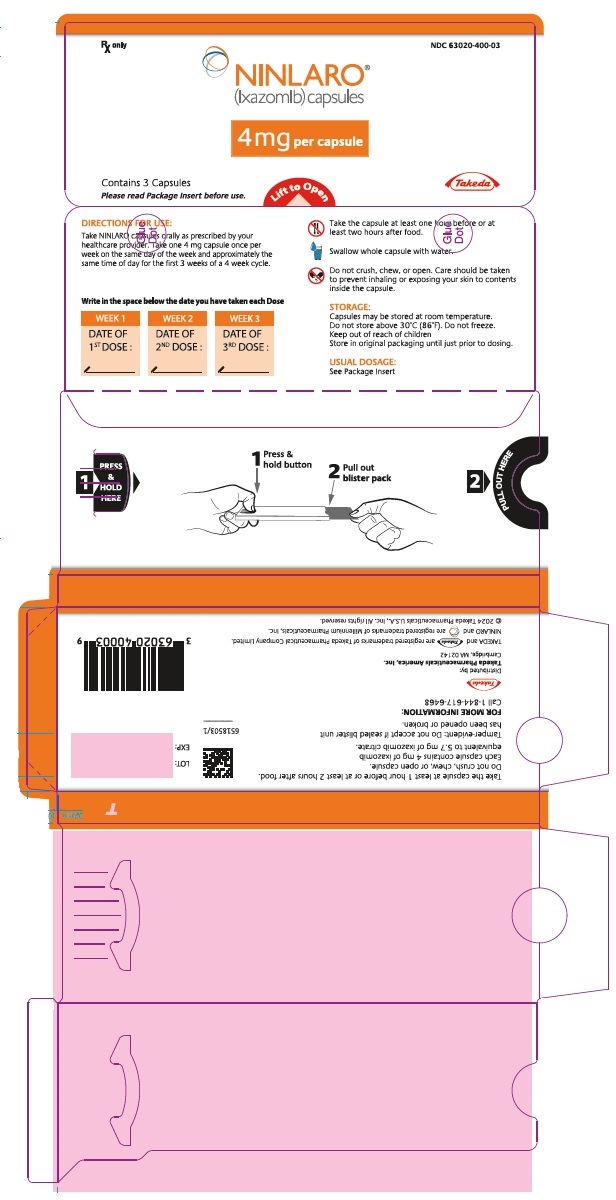
9PRINCIPAL DISPLAY PANEL - 4 mg Capsule Blister Pack
Rx only NDC 63020-400-03
NINLARO®
(ixazomib) capsules
(ixazomib) capsules
4 mg per capsule
Contains 3 Capsules
Please read Package Insert before use.
Lift to Open
Takeda
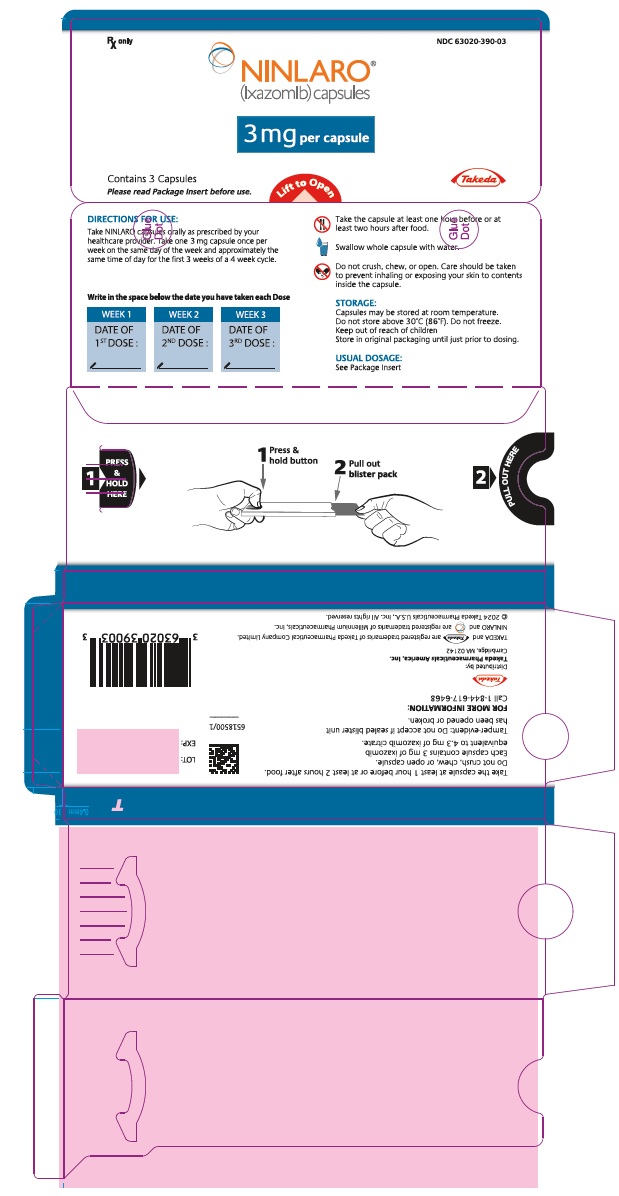
10PRINCIPAL DISPLAY PANEL - 3 mg Capsule Blister Pack
Rx only NDC 63020-390-03
NINLARO®
(ixazomib) capsules
(ixazomib) capsules
3 mg per capsule
Contains 3 Capsules
Please read Package Insert before use.
Lift to Open
Takeda
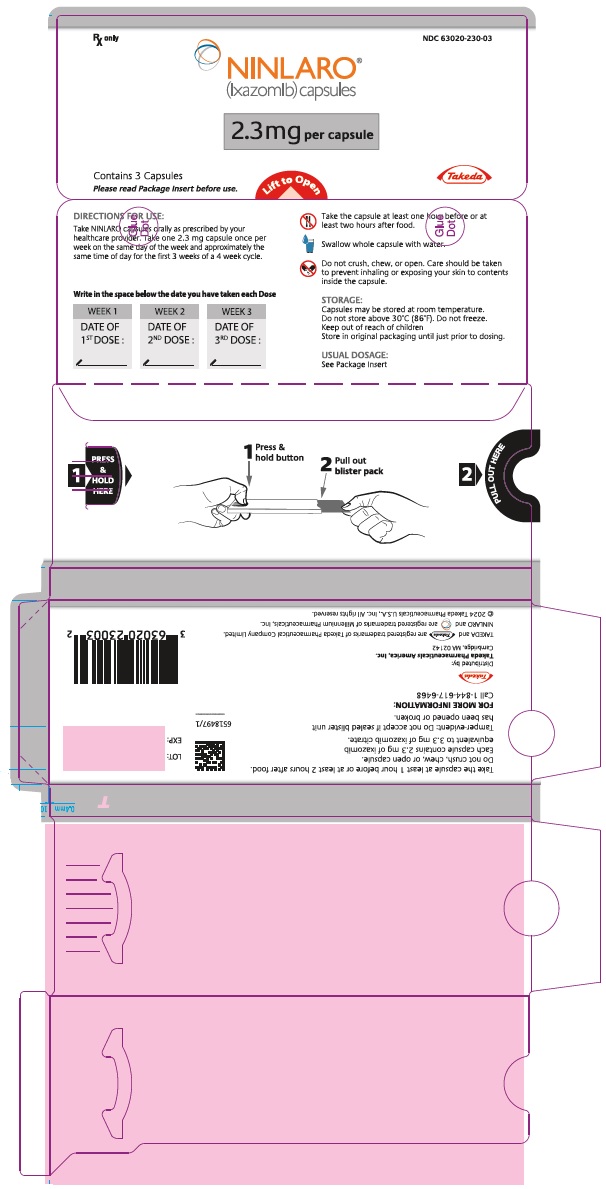
11PRINCIPAL DISPLAY PANEL - 2.3 mg Capsule Blister Pack
Rx only NDC 63020-230-03
NINLARO®
(ixazomib) capsules
(ixazomib) capsules
2.3 mg per capsule
Contains 3 Capsules
Please read Package Insert before use.
Lift to Open
Takeda