Epoetin
What is Epogen (Epoetin)?
Top Global Experts


Related Clinical Trials
Summary: This MyeloMATCH Master Screening and Reassessment Protocol (MSRP) evaluates the use of a screening tool and specific laboratory tests to help improve participants' ability to register to clinical trials throughout the course of their myeloid cancer (acute myeloid leukemia or myelodysplastic syndrome) treatment. This study involves testing patients' bone marrow and blood for certain biomarkers. A b...
Summary: The main aim of this study is to assess how elritercept works in lowering the need for RBC (red blood cell) transfusions and how safe elritercept is when compared with epoetin alfa. Other aims are to learn if elritercept improves tiredness as reported by participants without needing RBC transfusion compared with epoetin alfa, the RBC transfusion burden and quality of life compared with epoetin alf...
Summary: An investigator-blinded, randomized, multicenter, active-controlled Phase III study for the treatment of anemia in patients with CKD on hemodialysis
Related Latest Advances
Brand Information
- In controlled trials, patients with chronic kidney disease (CKD) experienced greater risks for death, serious adverse cardiovascular reactions, and stroke when administered erythropoiesis-stimulating agents (ESAs) to target a hemoglobin level of greater than 11 g/dL[see Warnings and Precautions (5.1)].
- No trial has identified a hemoglobin target level, ESA dose, or dosing strategy that does not increase these risks[see Dosage and Administration (2.2)].
- Use the lowest Epogen dose sufficient to reduce the need for red blood cell (RBC) transfusions [see Warnings and Precautions (5.1)].
- ESAs shortened overall survival and/or increased the risk of tumor progression or recurrence in clinical studies of patients with breast, non-small cell lung, head and neck, lymphoid, and cervical cancers [see Warnings and Precautions (5.2)].
- To decrease these risks, as well as the risk of serious cardiovascular and thromboembolic reactions, use the lowest dose needed to avoid RBCtransfusions [see Dosage and Administration (2.4)].
- Use ESAs only for anemia frommyelosuppressive chemotherapy [see Indications and Usage (1.3)].
- ESAs are not indicated for patients receiving myelosuppressive chemotherapy when the anticipated outcome is cure [see Indications and Usage (1.5)].
- Discontinue following the completion of a chemotherapy course [see Dosage and Administration (2.4)].
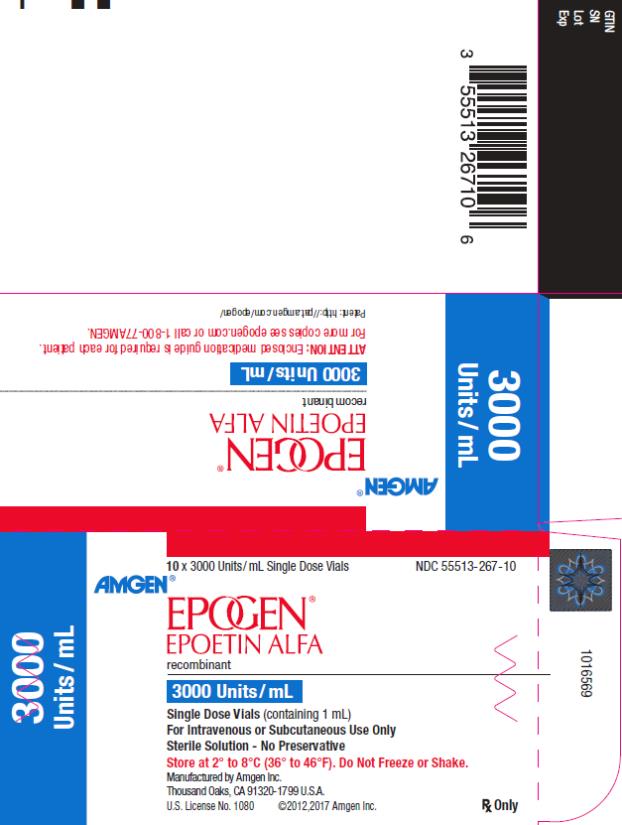
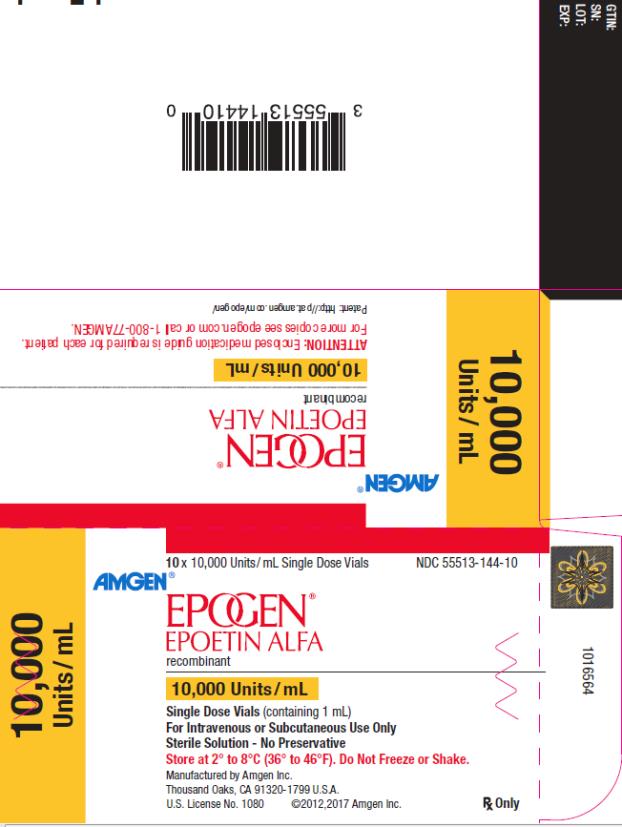
- 2,000 Units/mL, 3,000 Units/mL, 4,000 Units/mL, and 10,000 Units/mL of Epogen as a clear and colorless liquid in single-dose vials.
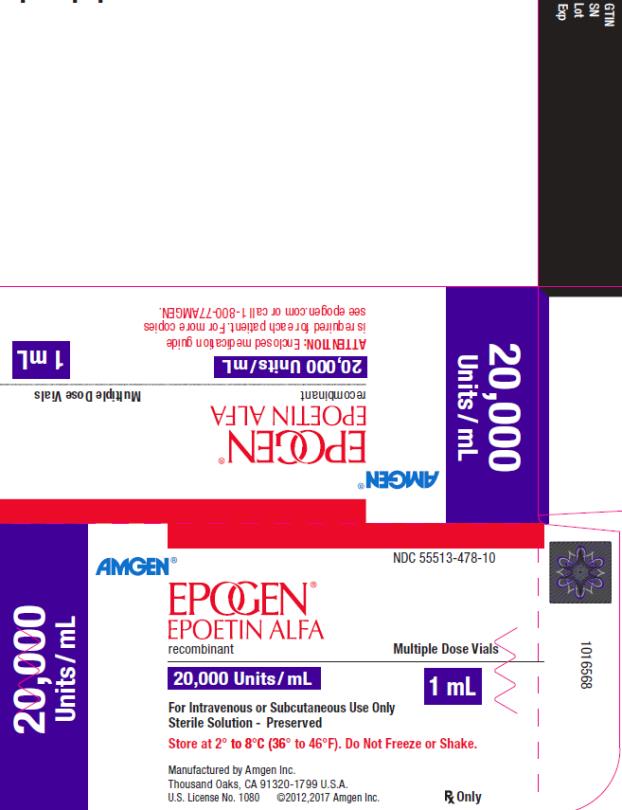
- 20,000 Units/2 mL (10,000 Units/mL) and 20,000 Units/mL of Epogen as a clear and colorless liquid in multiple-dose vials (contains benzyl alcohol).
- Uncontrolled hypertension
- Pure red cell aplasia (PRCA) that begins after treatment with Epogen or other erythropoietin protein drugs
- Serious allergic reactions to Epogen
- Neonates, infants, pregnant women, and lactating women
- Increased Mortality, Myocardial Infarction, Stroke, and Thromboembolism
- Increased Mortality and/or Increased Risk of Tumor Progression or Recurrence in Patients with Cancer
- Hypertension
- Seizures
- PRCA
- Serious Allergic Reactions
- Severe Cutaneous Reactions
- Seizures
- PRCA
- Serious Allergic Reactions
- Injection Site Reactions, including irritation and pain
- Porphyria
- Severe Cutaneous Reactions
- Of the increased risks of mortality, serious cardiovascular reactions, thromboembolic reactions, stroke, and tumor progression
- To undergo regular blood pressure monitoring, adhere to prescribed anti-hypertensive regimen and follow recommended dietary restrictions.
- To contact their healthcare provider for new-onset neurologic symptoms or change in seizure frequency.
- Of the need to have regular laboratory tests for hemoglobin.
- Risks are associated with benzyl alcohol in neonates, infants, pregnant women, and lactating women
- Importance of following the Instructions for Use.
- Dangers of reusing needles, syringes, or unused portions of single-dose vials.
- Proper disposal of used syringes, needles, and unused vials, and of the full container.
Amgen Inc.
One Amgen Center Drive
Thousand Oaks, CA 91320-1799 U.S.A.
U.S. License Number 1080