Brand Name

Incruse Ellipta

Generic Name
Umeclidinium
View Brand Information
FDA approval date: April 30, 2014
Classification: Anticholinergic
Form: Aerosol

What is Incruse Ellipta (Umeclidinium)?

INCRUSE ELLIPTA is indicated for the maintenance treatment of patients with chronic obstructive pulmonary disease . INCRUSE ELLIPTA is an anticholinergic indicated for the maintenance treatment of patients with chronic obstructive pulmonary disease .
Save this treatment for later
Sign Up
Not sure about your diagnosis?
Check Your Symptoms

Related Clinical Trials

Differentiating the Effects of Long-acting Bronchodilators Administered by Nebulizer Versus Dry Powder Inhaler in Symptomatic Patients With Chronic Obstructive Pulmonary Disease

Summary: The purpose of this study is to compare the effectiveness of inhaled bronchodilators delivered via nebulizers vs. dry powder inhalers (DPIs) in symptomatic participants with Chronic Obstructive Pulmonary Disease (COPD) who have airflow obstruction (FEV1/FVC ≤ 70%) and show significant air trapping (RV ≥ 120% of predicted). The investigators hypothesize that, in patients with symptomatic COPD, ther...

Comparative Effects of Triple Inhaled Therapy With Budesonide/Glycopyrronium/Formoterol Versus Fluticasone Furoate/Umeclidinium/Vilanterol on Small Airway Disease in COPD Patients: A Randomized Crossover Study

Summary: The goal of this clinical trial is to determine if triple inhaled therapy with Budesonide/Glycopyrronium/Formoterol (BGF) and Fluticasone Furoate/Umeclidinium/Vilanterol (FUV) are effective in treating patients with stable chronic obstructive pulmonary disease (COPD). It will also assess the safety of both drugs. The main questions it aims to answer are: * Does BGF demonstrate a comparable effect ...

Brand Information

Incruse Ellipta (umeclidinium)
1INDICATIONS AND USAGE
INCRUSE ELLIPTA is indicated for the maintenance treatment of patients with chronic obstructive pulmonary disease (COPD).
2DOSAGE AND ADMINISTRATION
The recommended dosage of INCRUSE ELLIPTA for maintenance treatment of COPD is 1 actuation (umeclidinium 62.5 mcg) once daily by oral inhalation.
  • INCRUSE ELLIPTA should be used at the same time every day. Do not use INCRUSE ELLIPTA more than 1 time every 24 hours.
  • No dosage adjustment is required for geriatric patients, patients with renal impairment, or patients with moderate hepatic impairment
3DOSAGE FORMS AND STRENGTHS
Inhalation powder: 62.5 mcg umeclidinium per actuation.
4CONTRAINDICATIONS
INCRUSE ELLIPTA is contraindicated in the following conditions:
  • Severe hypersensitivity to milk proteins
  • Hypersensitivity to umeclidinium or any of the excipients
5ADVERSE REACTIONS
The following adverse reactions are described in greater detail in other sections:
  • Paradoxical bronchospasm
  • Worsening of narrow-angle glaucoma
  • Worsening of urinary retention
5.1Clinical Trials Experience
Because clinical trials are conducted under widely varying conditions, adverse reaction rates observed in the clinical trials of a drug cannot be directly compared with rates in the clinical trials of another drug and may not reflect the rates observed in practice.
In the 8 clinical trials conducted to support initial approval of INCRUSE ELLIPTA, a total of 1,663 subjects with COPD (mean age: 62.7 years; 89% white; 65% male across all treatments, including placebo) received at least 1 inhalation dose of umeclidinium at doses of 62.5 or 125 mcg. In the 4 randomized, double-blind, placebo- or active-controlled, efficacy clinical trials, 1,185 subjects received umeclidinium for up to 24 weeks, of which 487 subjects received the recommended dose of umeclidinium 62.5 mcg. In a 12-month, randomized, double-blind, placebo-controlled, long-term safety trial, 227 subjects received umeclidinium 125 mcg for up to 52 weeks
The incidence of adverse reactions associated with INCRUSE ELLIPTA in
Other adverse reactions with INCRUSE ELLIPTA observed with an incidence <1% but more common than placebo included atrial fibrillation.
In a long-term safety trial (Trial 3), 336 subjects (n = 227 umeclidinium 125 mcg, n = 109 placebo) were treated for up to 52 weeks with umeclidinium 125 mcg or placebo. The demographic and baseline characteristics of the long-term safety trial were similar to those of the efficacy trials described above. Adverse reactions that occurred with a frequency ≥1% in subjects receiving umeclidinium 125 mcg that exceeded that in placebo in this trial were: nasopharyngitis, upper respiratory tract infection, urinary tract infection, pharyngitis, pneumonia, lower respiratory tract infection, rhinitis, supraventricular tachycardia, supraventricular extrasystoles, sinus tachycardia, idioventricular rhythm, headache, dizziness, sinus headache, cough, back pain, arthralgia, pain in extremity, neck pain, myalgia, nausea, dyspepsia, diarrhea, rash, depression, and vertigo.
The safety and efficacy of INCRUSE ELLIPTA in combination with an inhaled corticosteroid/long-acting beta
5.2Postmarketing Experience
In addition to adverse reactions reported from clinical trials, the following adverse reactions have been identified during postapproval use of INCRUSE ELLIPTA. Because these reactions are reported voluntarily from a population of uncertain size, it is not always possible to reliably estimate their frequency or establish a causal relationship to drug exposure. These events have been chosen for inclusion due to either their seriousness, frequency of reporting, or causal connection to INCRUSE ELLIPTA or a combination of these factors.
Eye Disorders
Eye pain, glaucoma, vision blurred.
Immune System Disorders
Hypersensitivity reactions, including anaphylaxis, angioedema, pruritus, and urticaria.
Renal and Urinary Disorders
Dysuria, urinary retention.
Respiratory, Thoracic and Mediastinal Disorders
Dysphonia, oropharyngeal pain.
6OVERDOSAGE
High doses of umeclidinium may lead to anticholinergic signs and symptoms.
Treatment of overdosage consists of discontinuation of INCRUSE ELLIPTA together with institution of appropriate symptomatic and/or supportive therapy.
7DESCRIPTION
INCRUSE ELLIPTA is an inhalation powder drug product for delivery of umeclidinium (an anticholinergic) to patients by oral inhalation.
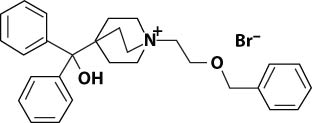
Umeclidinium bromide has the chemical name 1-[2-(benzyloxy)ethyl]-4-(hydroxydiphenylmethyl)-1-azoniabicyclo[2.2.2]octane bromide and the following chemical structure:
incruse-ellipta-spl-graphic-01.jpg
Umeclidinium bromide is a white powder with a molecular weight of 508.5, and the empirical formula is C
INCRUSE ELLIPTA is a light grey and light green plastic inhaler containing a foil blister strip. Each blister on the strip contains a white powder blend of micronized umeclidinium bromide (74.2 mcg equivalent to 62.5 mcg of umeclidinium), magnesium stearate (75 mcg), and lactose monohydrate (to 12.5 mg). The lactose monohydrate contains milk proteins. After the inhaler is activated, the powder within the blister is exposed and ready for dispersion into the airstream created by the patient inhaling through the mouthpiece.
Under standardized in vitro test conditions, INCRUSE ELLIPTA delivers 55 mcg of umeclidinium per dose when tested at a flow rate of 60 L/min for 4 seconds.
In adult subjects with obstructive lung disease and severely compromised lung function (COPD with forced expiratory volume in 1 second/forced vital capacity [FEV
The actual amount of drug delivered to the lung will depend on patient factors, such as inspiratory flow profile.
8CLINICAL STUDIES
The safety and efficacy of umeclidinium 62.5 mcg were evaluated in 3 dose-ranging trials, 2 placebo-controlled clinical trials (one 12-week trial and one 24-week trial), and a 12-month long‑term safety trial. The efficacy of INCRUSE ELLIPTA is based primarily on the dose‑ranging trials in 624 subjects and the 2 placebo-controlled confirmatory trials in 1,738 subjects with COPD, including chronic bronchitis and/or emphysema.
The safety and efficacy of INCRUSE ELLIPTA in combination with an ICS/LABA were also evaluated in four 12-week clinical trials. The efficacy of INCRUSE ELLIPTA in combination with an ICS/LABA is based on 1,637 subjects with COPD.
Evidence of efficacy for INCRUSE ELLIPTA on COPD exacerbations was established by the efficacy of the umeclidinium component as part of a fixed-dose combination with an ICS/LABA, as assessed in a 12-month trial in 10,355 subjects.
8.1Dose-Ranging Trials
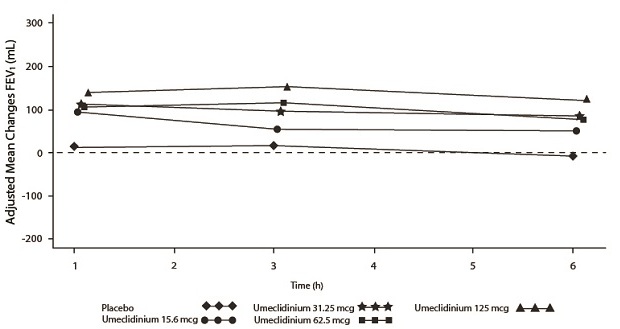
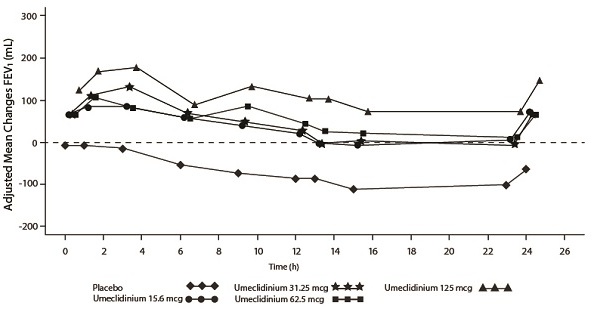
Dose selection for umeclidinium in COPD was supported by a 7-day, randomized, double-blind, placebo-controlled, crossover trial evaluating 4 doses of umeclidinium (15.6 to 125 mcg) or placebo dosed once daily in the morning in 163 subjects with COPD. A dose ordering was observed, with the 62.5- and 125-mcg doses demonstrating larger improvements in FEV
The differences in trough FEV
Evaluations of dosing interval by comparing once- and twice-daily dosing supported selection of a once-daily dosing interval for further evaluation in the confirmatory COPD trials.
Figure 2. Adjusted Mean Change from Baseline in Postdose Serial FEV
Day 1
Figure 2. Adjusted Mean Change from Baseline in Postdose Serial FEV1 (mL) on Days 1 and 7, Day 1
Day 7
Figure 2. Adjusted Mean Change from Baseline in Postdose Serial FEV1 (mL) on Days 1 and 7, Day 7
8.2Maintenance Treatment: Confirmatory Trials
Lung Function
The clinical development program for INCRUSE ELLIPTA included 2 randomized, double‑blind, placebo-controlled, parallel-group trials in subjects with COPD designed to evaluate the efficacy of INCRUSE ELLIPTA on lung function. Trial 1 (NCT01313650) was a 24-week placebo‑controlled trial, and Trial 2 (NCT01387230) was a 12-week placebo‑controlled trial. These trials treated subjects that had a clinical diagnosis of COPD, were 40 years of age or older, had a history of smoking ≥10 pack-years, had a post-albuterol FEV
Trial 1 evaluated umeclidinium 62.5 mcg and placebo. The primary endpoint was change from baseline in trough (predose) FEV
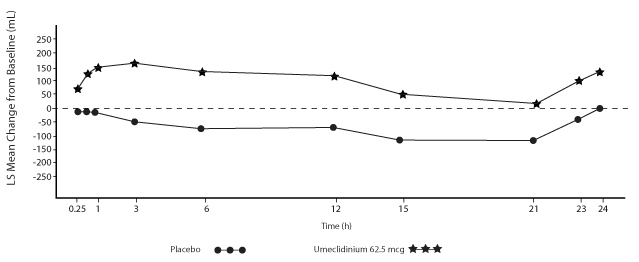
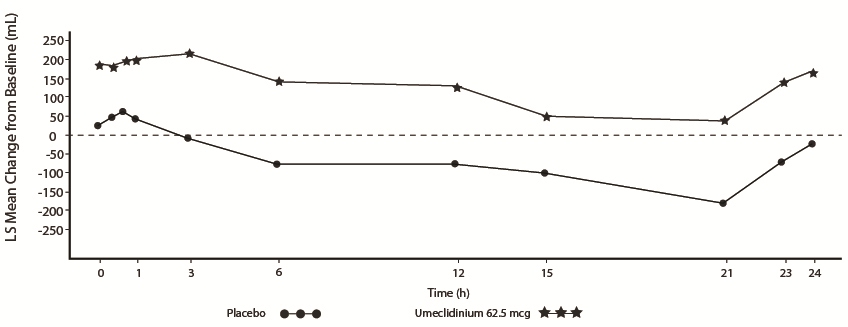
Serial spirometric evaluations throughout the 24-hour dosing interval were performed in a subset of subjects (n = 54, umeclidinium 62.5 mcg; n = 36, placebo) at Days 1, 84, and 168 in Trial 1, and for all patients at Days 1 and 84 in Trial 2. Results from Trial 1 at Day 1 and Day 168 are shown in Figure 3.
Figure 3. Least Squares (LS) Mean Change from Baseline in FEV
Day 1
Figure 3. Least Squares (LS) Mean Change from Baseline in FEV1 (mL) over Time (0-24 h) on Days 1 and 168 (Trial 1 Subset Population), Day 1
Day 168
Figure 3. Least Squares (LS) Mean Change from Baseline in FEV1 (mL) over Time (0-24 h) on Days 1 and 168 (Trial 1 Subset Population), Day 168
In Trial 1, the mean peak FEV
Health-Related Quality of Life
Health-related quality of life was measured using St. George’s Respiratory Questionnaire (SGRQ). Umeclidinium demonstrated an improvement in mean SGRQ total score compared with placebo treatment at Day 168: -4.69 (95% CI: -7.07,-2.31). The proportion of patients with a clinically meaningful decrease (defined as a decrease of at least 4 units from baseline) at Week 24 was greater for INCRUSE ELLIPTA 62.5 mcg (42%; 172/410) compared with placebo (31%; 86/274).
8.3Maintenance Treatment: Combination with an ICS/LABA Trials
Lung Function
The efficacy of INCRUSE ELLIPTA in combination with an ICS/LABA was evaluated in 4 randomized, double-blind, parallel-group trials in subjects with COPD. These trials, all of similar study design, were of 12-weeks’ treatment duration. Subjects were randomized to INCRUSE ELLIPTA 62.5 mcg + ICS/LABA or placebo + ICS/LABA. Entry criteria for subjects enrolled in these trials were similar to those described above in Section 14.2. The primary endpoint for these trials was change from baseline in trough (predose) FEV
Combination with Fluticasone Furoate + Vilanterol
Trial 4 (NCT01957163) and Trial 5 (NCT02119286) randomized subjects to INCRUSE ELLIPTA 62.5 mcg + FF/VI 100 mcg/25 mcg administered once daily or placebo + FF/VI 100 mcg/25 mcg administered once daily. Trial population demographics and results for Trials 4 and 5 were similar; therefore, only Trial 4 results are presented below.
Subjects in Trial 4 across all treatment arms had a mean age of 64 years and an average smoking history of 50 pack-years, with 42% identified as current smokers. At screening, the mean postbronchodilator percent predicted FEV
The primary endpoint was change from baseline in trough (predose) FEV
Combination with Fluticasone Propionate + Salmeterol
Trial 6 (NCT01772134) and Trial 7 (NCT01772147) randomized subjects to INCRUSE ELLIPTA 62.5 mcg + FP/SAL 250 mcg/50 mcg or placebo + FP/SAL 250 mcg/50 mcg. The treatments with INCRUSE ELLIPTA and placebo were administered once daily, while the FP/SAL treatment was administered twice daily. Trial population demographics and results for Trials 6 and 7 were similar; therefore, only Trial 6 results are presented below.
Subjects in Trial 6 across all treatment arms had a mean age of 63 years and an average smoking history of 50 pack-years, with 54% identified as current smokers. At screening, the mean postbronchodilator percent predicted FEV
The primary endpoint was change from baseline in trough (predose) FEV
Exacerbations
In Trial 8 (NCT02164513), a total of 10,355 subjects with COPD with a history of 1 or more moderate or severe exacerbations in the prior 12 months were randomized (2:2:1) to receive fluticasone furoate/umeclidinium/vilanterol 100 mcg/62.5 mcg/25 mcg (n = 4,151), fluticasone furoate/vilanterol 100 mcg/25 mcg (n = 4,133), or umeclidinium/vilanterol 62.5 mcg/25 mcg (n = 2,070) administered once daily in a 12-month trial. The population demographics across all treatments were: mean age of 65 years, 77% white, 66% male, and an average smoking history of 46.6 pack-years, with 35% identified as current smokers. At trial entry, the most common COPD medications were ICS + anticholinergic + LABA (34%), ICS + LABA (26%), anticholinergic + LABA (8%), and anticholinergic (7%). The mean postbronchodilator percent predicted FEV
The primary endpoint was annual rate of on-treatment moderate and severe exacerbations in subjects treated with fluticasone furoate/umeclidinium/vilanterol compared with the fixed-dose combinations of fluticasone furoate/vilanterol and umeclidinium/vilanterol. Exacerbations were defined as worsening of 2 or more major symptoms (dyspnea, sputum volume, and sputum purulence) or worsening of any 1 major symptom together with any 1 of the following minor symptoms: sore throat, colds (nasal discharge and/or nasal congestion), fever without other cause, and increased cough or wheeze for at least 2 consecutive days. Exacerbations were considered to be of moderate severity if treatment with systemic corticosteroids and/or antibiotics was required and were considered to be severe if resulted in hospitalization or death.
Evidence of efficacy for INCRUSE ELLIPTA on COPD exacerbations was established by the efficacy of the umeclidinium component of fluticasone furoate/umeclidinium/vilanterol in Trial 8. Treatment with fluticasone furoate/umeclidinium/vilanterol statistically significantly reduced the on-treatment annual rate of moderate/severe exacerbations by 15% compared with fluticasone furoate/vilanterol (
9HOW SUPPLIED/STORAGE AND HANDLING
INCRUSE ELLIPTA is supplied as a disposable light grey and light green plastic inhaler containing a foil strip with 30 blisters (NDC 0173-0873-10) or 7 blisters (institutional pack) (NDC 0173-0873-06).
The inhaler is packaged in a moisture-protective foil tray with a desiccant and a peelable lid.
Store at room temperature between 68°F and 77°F (20°C and 25°C); excursions permitted from 59°F to 86°F (15°C to 30°C) [See USP Controlled Room Temperature]. Store in a dry place away from direct heat or sunlight. Keep out of reach of children.
INCRUSE ELLIPTA should be stored inside the unopened moisture-protective foil tray and only removed from the tray immediately before initial use. Discard INCRUSE ELLIPTA 6 weeks after opening the foil tray or when the counter reads “0” (after all blisters have been used), whichever comes first. The inhaler is not reusable. Do not attempt to take the inhaler apart.
10PATIENT COUNSELING INFORMATION
Advise the patient to read the FDA-approved patient labeling (Patient Information and Instructions for Use).
Not for Acute Symptoms
Inform patients that INCRUSE ELLIPTA is not meant to relieve acute symptoms of COPD and extra doses should not be used for that purpose. Advise patients to treat acute symptoms with an inhaled, short-acting beta
Instruct patients to seek medical attention immediately if they experience any of the following:
  • Decreasing effectiveness of inhaled, short-acting beta
  • Need for more inhalations than usual of inhaled, short-acting beta
  • Significant decrease in lung function as outlined by the physician
Tell patients they should not stop therapy with INCRUSE ELLIPTA without physician/provider guidance since symptoms may recur after discontinuation.
Paradoxical Bronchospasm
As with other inhaled medicines, INCRUSE ELLIPTA can cause paradoxical bronchospasm. If paradoxical bronchospasm occurs, instruct patients to discontinue INCRUSE ELLIPTA and contact their healthcare provider right away.
Worsening of Narrow-Angle Glaucoma
Instruct patients to be alert for signs and symptoms of acute narrow-angle glaucoma (e.g., eye pain or discomfort, blurred vision, visual halos or colored images in association with red eyes from conjunctival congestion and corneal edema). Instruct patients to consult a physician immediately if any of these signs or symptoms develop.
Worsening of Urinary Retention
Instruct patients to be alert for signs and symptoms of urinary retention (e.g., difficulty passing urine, painful urination). Instruct patients to consult a physician immediately if any of these signs or symptoms develop.
Trademarks are owned by or licensed to the GSK group of companies.
GlaxoSmithKline
©2023 GSK group of companies or its licensor.
INC:10PI