Brand Name

Imlygic

Generic Name
Talimogene Laherparepvec
View Brand Information
FDA approval date: November 02, 2015
Form: Injection

What is Imlygic (Talimogene Laherparepvec)?

IMLYGIC is a genetically modified oncolytic viral therapy indicated for the local treatment of unresectable cutaneous, subcutaneous, and nodal lesions in patients with melanoma recurrent after initial surgery. Limitations of use : IMLYGIC has not been shown to improve overall survival or have an effect on visceral metastases. IMLYGIC is a genetically modified oncolytic viral therapy indicated for the local treatment of unresectable cutaneous, subcutaneous, and nodal lesions in patients with melanoma recurrent after initial surgery. Limitations of use : IMLYGIC has not been shown to improve overall survival or have an effect on visceral metastases.

Approved To Treat

Save this treatment for later
Sign Up
Not sure about your diagnosis?
Check Your Symptoms

Related Clinical Trials

A Postmarketing Prospective Cohort Study of Melanoma Patients Treated With IMLYGIC® in Clinical Practice to Characterize Risk of Herpetic Infection Among Patients, Close Contacts, Health Care Providers & Long-term Safety in Treated Patients

Summary: A postmarketing Cohort study of Melanoma patients treated with IMLYGIC (Talimogene Laherparepvec) in clinical Practice to Characterize the risk of herpetic infection with detection of Talimogene Laherparepvec DNA among patients, close contacts, and health care providers; and long term safety in treated patients for up to 5 years after the first IMLYGIC dose.

The TNT Protocol: A Phase 2 Study Using Talimogene Laherparepvec,Nivolumab and Trabectedin as First, Second/Third Line Therapy for Advanced Sarcoma, Including Desmoid Tumor and Chordoma

Summary: This is a Phase 2 study using talimogene laherparepvec, nivolumab, and trabectedin as first, second or third line therapy for advanced sarcoma, including desmoid tumor and chordoma.

Neoadjuvant Combination Immunotherapy for Stage III Melanoma

Summary: Determine safety and efficacy of pre-operative combination immunotherapy with Talimogene Laherparepvec (T-VEC)/Pembrolizumab given prior to complete lymph node dissection in resectable stage 3 cutaneous melanoma with clinically apparent lymph node metastases.

Brand Information

Imlygic (talimogene laherparepvec)
1INDICATIONS AND USAGE
IMLYGIC is a genetically modified oncolytic viral therapy indicated for the local treatment of unresectable cutaneous, subcutaneous, and nodal lesions in patients with melanoma recurrent after initial surgery.
Limitations of use: IMLYGIC has not been shown to improve overall survival or have an effect on visceral metastases.
2DOSAGE AND ADMINISTRATION
For intralesional injection only. Do not administer intravenously.
2.1Dose
Administer IMLYGIC by injection into cutaneous, subcutaneous, and/or nodal lesions that are visible, palpable, or detectable by ultrasound guidance.
IMLYGIC is provided in single-dose vials of 1 mL each in two different dose strengths:
  • 10
  • 10
Recommended Dose and Schedule
The total injection volume for each treatment visit should not exceed 4 mL for all injected lesions combined. It may not be possible to inject all lesions at each treatment visit or over the full course of treatment. Previously injected and/or uninjected lesion(s) may be injected at subsequent treatment visits. The initial recommended dose is up to 4 mL of IMLYGIC at a concentration of 10
Dose Volume Determination (per Lesion)
Use Table 2 to determine the volume of IMLYGIC injection for each lesion.
When lesions are clustered together, inject them as a single lesion according to Table 2.
Continue IMLYGIC treatment for at least 6 months unless other treatment is required or until there are no injectable lesions to treat.
Reinitiate IMLYGIC treatment if new unresectable cutaneous, subcutaneous, or nodal lesions appear after a complete response.
2.2Preparation and Handling
Healthcare providers who are immunocompromised or pregnant should not prepare or administer IMLYGIC and should not come into direct contact with the IMLYGIC injection sites, dressings, or body fluids of treated patients
Avoid accidental exposure to IMLYGIC and follow below instructions for preparation, administration, and handling of IMLYGIC:
  • Wear personal protective equipment (protective gown or laboratory coat, safety glasses or face shield, and gloves) while preparing or administering IMLYGIC.
  • Avoid accidental exposure to IMLYGIC, especially contact with skin, eyes, and mucous membranes.
  • Clean all surfaces that may have come in contact with IMLYGIC and treat all IMLYGIC spills with a virucidal agent such as 1% sodium hypochlorite or 70% isopropyl alcohol and blot using absorbent materials.
  • Dispose of all materials that may have come in contact with IMLYGIC (e.g., vial, syringe, needle, cotton gauze, gloves, masks, or dressings) as biohazardous waste.
  • Advise patients to place used dressings and cleaning materials into a sealed plastic bag and dispose in household waste.
Thawing IMLYGIC Vials
  • Determine the total volume required for injection, up to 4 mL
  • Thaw frozen IMLYGIC vials at room temperature [20°C to 25°C (68°F to 77°F)] until IMLYGIC is liquid. The time to achieve complete vial thaw is expected to be 30 to 70 minutes, depending on the ambient temperature. Do not expose the vial to higher temperatures. Keep the vial in original carton during thawing.
  • Swirl gently. Do NOT shake.
  • After thawing, administer IMLYGIC immediately or store in its original vial and carton, as follows:
  • Prepare sterile syringes and needles. A detachable 18-26 G needle or nondetachable 22-26 G staked needle (which minimizes hold up volume) may be used for IMLYGIC withdrawal and a detachable or nondetachable staked needle of 22–26 G may be used for injection. Small unit syringes (e.g., 0.5 mL insulin syringes) are recommended for better injection control.
  • Using aseptic technique, remove the vial cap and withdraw the product from the vial into the syringe(s), noting the total volume. Avoid generating aerosols when loading syringes with product and use a biologic safety cabinet if available.
2.3Administration
Follow the steps below to administer IMLYGIC to patients:
3DOSAGE FORMS AND STRENGTHS
  • Initial dose only: 10
  • Subsequent doses: 10
4ADVERSE REACTIONS
The most commonly reported adverse drug reactions (≥ 25%) in IMLYGIC-treated patients were fatigue, chills, pyrexia, nausea, influenza-like illness, and injection site pain.
The following adverse reactions are discussed in greater detail in another section of the label:
  • Herpetic Infection
  • Injection Site Complications 
4.1Clinical Trials Experience
Because clinical trials are conducted under widely varying conditions, adverse reaction rates observed in the clinical trials of a drug cannot be directly compared to rates in the clinical trials of another drug and may not reflect the rates observed in practice.
The safety of IMLYGIC was evaluated in 419 patients who received at least 1 dose of either IMLYGIC (n = 292) or subcutaneously administered granulocyte-macrophage colony-stimulating factor (GM-CSF) (n = 127) in an open-label, randomized clinical study of patients with stage IIIB, IIIC, and IV melanoma that was not considered to be surgically resectable 
Most adverse reactions reported were mild or moderate in severity and generally resolved within 72 hours. The most common grade 3 or higher adverse reaction was cellulitis
Pyrexia, chills, and influenza-like illness can occur any time during IMLYGIC treatment but were more frequent during the first 3 months of treatment. 
Table 4 below lists adverse reactions with a 5% or greater incidence in the IMLYGIC arm compared to the GM-CSF arm in the clinical study
Other adverse reactions associated with IMLYGIC in the open-label, randomized study include rash, dermatitis, glomerulonephritis, vitiligo, worsening psoriasis, cellulitis, pneumonitis, vasculitis, herpetic keratitis, obstructive airway disorder, plasmacytoma at the injection site, deep vein thrombosis, and oral herpes.
4.2Postmarketing Experience
The following adverse reactions have been identified during postapproval use of IMLYGIC. Because these reactions are reported voluntarily from a population of uncertain size, it is not always possible to reliably estimate their frequency or establish a causal relationship to drug exposure.
  • Herpetic infections including disseminated herpetic infections
5DRUG INTERACTIONS
IMLYGIC is sensitive to acyclovir. Acyclovir or other antiherpetic viral agents may interfere with the effectiveness of IMLYGIC. No drug interaction studies have been conducted with IMLYGIC.
6OVERDOSAGE
There is no clinical experience with an overdose with IMLYGIC. Doses up to 4 mL at dose strength of 10
7DESCRIPTION
IMLYGIC (talimogene laherparepvec) is a sterile suspension for intralesional injection. IMLYGIC is a live, attenuated HSV-1 that has been genetically modified to express huGM-CSF. The parental virus for IMLYGIC was a primary isolate, which was subsequently altered using recombinant methods to result in gene deletions and insertions.
Each vial contains 1 mL deliverable volume of IMLYGIC at either 1 x 10
The 10
Each vial of IMLYGIC may also contain residual components of VERO cells including DNA and protein and trace quantities of fetal bovine serum.
The product contains no preservative.
8CLINICAL STUDIES
The safety and efficacy of intralesional injections of IMLYGIC compared with subcutaneously administered GM-CSF was evaluated in a multicenter, open-label, randomized clinical study in patients with stage IIIB, IIIC, and IV melanoma that was considered to be not surgically resectable. IMLYGIC was injected into cutaneous, subcutaneous, or nodal melanoma lesions and was not injected into visceral lesions. Previous systemic treatment for melanoma was allowed. Patients with active cerebral metastases, bony metastases, extensive visceral disease, primary ocular or mucosal melanoma, evidence of immunosuppression, or receiving treatment with a systemic antiherpetic agent were excluded from the study.
The study included 250 (57%) men and 186 (43%) women. The mean age was 63 (range: 22 to 94) years. Most patients (98%) were white. Seventy percent (70%) of patients had baseline Eastern Cooperative Oncology Group (ECOG) performance status of zero. Seventy percent (70%) of patients had stage IV disease (27% M1a; 21% M1b; and 22% M1c), and 30% had stage III disease. Fifty-three percent (53%) of patients had received prior therapy for melanoma (other than or in addition to surgery, adjuvant therapy, or radiation), and 58% were seropositive for wild-type HSV-1 at baseline.
A total of 436 patients were randomized to receive either IMLYGIC (n = 295) or GM-CSF (n = 141). IMLYGIC was administered by intralesional injection at an initial concentration of 10
Patients were to be treated for at least 6 months or until there were no injectable lesions. During this period, treatment could continue despite an increase in size in existing lesion(s) and/or development of new lesion(s), unless the patient developed intolerable toxicity or the investigator believed that it was in the best interest of the patient to stop treatment or to be given other therapy for melanoma. After 6 months of treatment, patients were to continue treatment until clinically relevant disease progression (i.e., disease progression associated with a decline in performance status and/or alternative therapy was required in the opinion of the investigator), up to 12 months. Patients experiencing a response at 12 months after the start of treatment could continue treatment for up to an additional 6 months, unless there were no remaining injectable lesions or disease progression. All patients were to be followed for survival status for at least 36 months.
The major efficacy outcome was durable response rate (DRR), defined as the percent of patients with complete response (CR) or partial response (PR) maintained continuously for a minimum of 6 months. Tumor responses were determined according to World Health Organization (WHO) response criteria modified to allow patients who developed new lesions or disease progression of existing lesions to continue the treatment and be evaluated later for tumor response.
The DRR was 16.3% in the IMLYGIC arm and 2.1% in the GM-CSF arm in the overall study population. The unadjusted relative risk was 7.6 (95% CI: 2.4, 24.1), with a p-value < 0.0001. The median time to response was 4.1 (range: 1.2 to 16.7) months in the IMLYGIC arm.
There was no statistically significant difference in overall survival (OS) between the IMLYGIC and the GM-CSF arms. The median OS in the overall study population was 22.9 months in the IMLYGIC arm and 19.0 months in the GM-CSF arm (p = 0.116).
9HOW SUPPLIED/STORAGEAND HANDLING
How Supplied
  • IMLYGIC is provided as a sterile frozen suspension in a single-dose, cyclic olefin polymer (COP) plastic resin vial with a chlorobutyl elastomer stopper, aluminum seal, and polypropylene cap in two different presentations:
  • Each vial contains a retrievable minimal volume of 1 mL.
  • The vial cap is color coded:
Storage and Handling
  • Store and transport IMLYGIC at −90°C to −70°C (−130°F to −94°F).
  • Protect IMLYGIC from light.
  • Store IMLYGIC in the carton until use.
  • Thaw IMLYGIC immediately prior to administration
  • Do not draw IMLYGIC into a syringe until immediately prior to administration 
10PATIENT COUNSELING INFORMATION
Advise patients and/or close contacts to:
  • Read the FDA-approved patient labeling (Medication Guide).
  • Follow instructions below to prevent viral transmission
  • Female patients of childbearing potential should use an effective method of contraception to prevent pregnancy during treatment with IMLYGIC
  • Close contacts who are pregnant or immunocompromised should not change dressings or clean injection sites
  • In case of accidental exposure to IMLYGIC, clean the exposed area with soap and water and/or a disinfectant. Patients or close contacts with suspected herpetic infections should contact their healthcare provider to evaluate the lesions. Suspected herpetic lesions should be reported to Amgen at 1-855-IMLYGIC (1-855-465-9442); patients or close contacts have the option of follow-up testing for further characterization of the infection 
IMLYGIC
Manufactured by:
BioVex LLC, a subsidiary of Amgen Inc.
One Amgen Center Drive
Thousand Oaks, California 91320-1799
Patent: http://pat.amgen.com/Imlygic/
© 2015-2024 Amgen Inc. All rights reserved.
11Medication Guide
IMLYGIC® (imm-LY-jik)
(talimogene laherparepvec)
Read the Medication Guide before you start treatment with IMLYGIC and before each IMLYGIC treatment. There may be new information. This Medication Guide does not tell you everything about IMLYGIC. Talk with your healthcare provider if you have any questions about treatment with IMLYGIC.
What is IMLYGIC?
IMLYGIC is a prescription medicine used to treat a type of cancer called melanoma when it is on your skin or in your lymph glands. IMLYGIC is a weakened form of Herpes Simplex Virus Type 1, which is commonly called the cold sore virus. Your healthcare provider will inject IMLYGIC directly into your tumor(s).
IMLYGIC may not help you live longer and may not shrink cancer in your organs (for example, lung or liver).
Who should not get IMLYGIC?
You should not get IMLYGIC if you are pregnant or have a weakened immune system (for example, an immune deficiency, blood or bone marrow cancer, steroid use, or HIV/AIDS).
What should I tell my healthcare provider before I get IMLYGIC?
Before getting IMLYGIC, tell your healthcare provider if you:
  • Are taking steroids or other medicines that suppress your immune system.
  • Are taking antiviral medicines to treat or prevent herpes, such as acyclovir.
  • Have or ever had medical conditions such as:
  • Have close contact with someone who has a weakened immune system or is pregnant.
  • Are pregnant or plan to become pregnant.
  • Are breastfeeding or plan to breastfeed.
Tell your healthcare provider about all the medicines you take, including prescription and over-the-counter medicines, vitamins, and herbal supplements. IMLYGIC may affect the way other medicines work and other medicines may affect how IMLYGIC works.
How is IMLYGIC given?
Your healthcare provider will inject IMLYGIC directly into your tumor(s) with a needle and syringe. You will get a second treatment 3 weeks after the first treatment. After that, you will get treatments every 2 weeks for as long as you have tumor(s). You can get treated for 6 months or longer.
Your healthcare provider will decide which tumor(s) to inject and may not inject every one.
It is important to care for the treatment sites properly so that IMLYGIC does not spread to other people. Your healthcare provider will show you how to do this.
What should I avoid while getting IMLYGIC?
IMLYGIC virus can spread to other areas of your body or to your close contacts (household members, caregivers, sex partners, or persons sharing the same bed).
Do the following to avoid spreading IMLYGIC to other areas of your body or to your close contacts:
  • Avoid direct contact between your treatment sites, dressings, or body fluids and close contacts (for example, use condoms when engaging in sexual activity, avoid kissing close contacts if either has an open mouth sore).
  • Wear gloves while putting on or changing your dressings.
  • Keep treatment sites covered with airtight and watertight dressings for at least 1 week after each treatment (or longer if the treatment site is weeping or oozing).
  • If the dressing comes loose or falls off, replace it right away with a clean dressing.
  • Place all used dressings and cleaning materials in a sealed plastic bag and throw them away in the garbage.
  • Do not touch or scratch the treatment sites.
What are possible side effects of IMLYGIC?
The most common side effects of IMLYGIC include:
  • Tiredness
  • Chills
  • Fever
  • Nausea
  • Flu-like symptoms
  • Pain at treatment site
Tell your doctor right away if you get any of the signs and symptoms of herpes infection, including but not limited to:
  • Pain, burning, tingling, or blister formation around the mouth, genitals, or any part of the body, near or far from the injection site
  • Eye pain, light sensitivity, discharge from the eyes, or blurry vision
  • Weakness in arms or legs
  • Extreme drowsiness (feeling sleepy)
  • Mental confusion
If you think you have a herpes infection, inform your healthcare provider. Life threatening-herpes infection and herpes infection spreading to any part of the body far from the injection site (disseminated herpetic infection) may occur in patients treated with IMLYGIC. If you have any new or worsening symptoms, call your healthcare provider right away. You or your healthcare provider should call Amgen at 1-855-IMLYGIC (1-855-465-9442) for follow-up testing if needed.
These are not all the possible side effects of IMLYGIC. Your healthcare provider can give you more detailed information. Tell your healthcare provider if you have any side effects that bother you or that do not go away. You may report side effects to FDA at 1-800-FDA-1088.
What are the ingredients in IMLYGIC?
Active ingredient: talimogene laherparepvec
Inactive ingredients: di-sodium hydrogen phosphate dihydrate, sodium dihydrogen phosphate dihydrate, sodium chloride, myo-inositol, sorbitol, and water for injection
General information about the safe and effective use of IMLYGIC
This Medication Guide summarizes the most important information about IMLYGIC. Medicines are sometimes prescribed for purposes other than those listed in a Medication Guide. If you would like more information, talk with your healthcare provider. You can ask your healthcare provider for information about IMLYGIC that was written for healthcare professionals.
This Medication Guide has been approved by the U.S. Food and Drug Administration.
IMLYGIC
Manufactured by:
BioVex LLC, a subsidiary of Amgen Inc.
One Amgen Center Drive
Thousand Oaks, California 91320-1799
Patent:
© 2015, 2017, 2022-2024 Amgen Inc. All rights reserved.
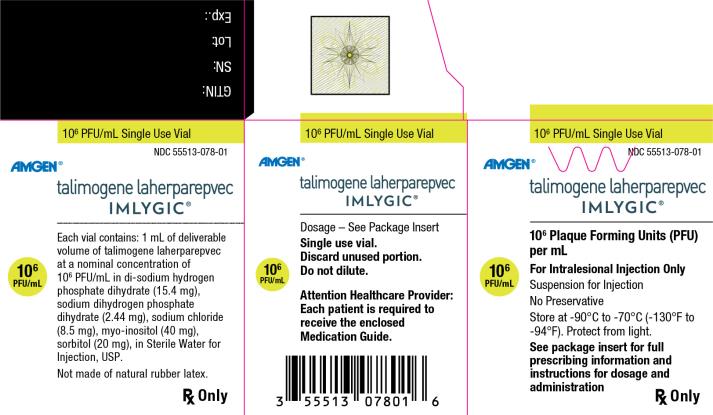
12PRINCIPAL DISPLAY PANEL - 10PFU/mL Vial Carton
10
NDC 55513-078-01
AMGEN
talimogene laherparepvec
10
10
For Intralesional Injection Only
Suspension for Injection
No Preservative
Store at -90°C to -70°C (-130°F to
See package insert for full
Rx Only
PRINCIPAL DISPLAY PANEL - 10 6 PFU/mL Vial Carton
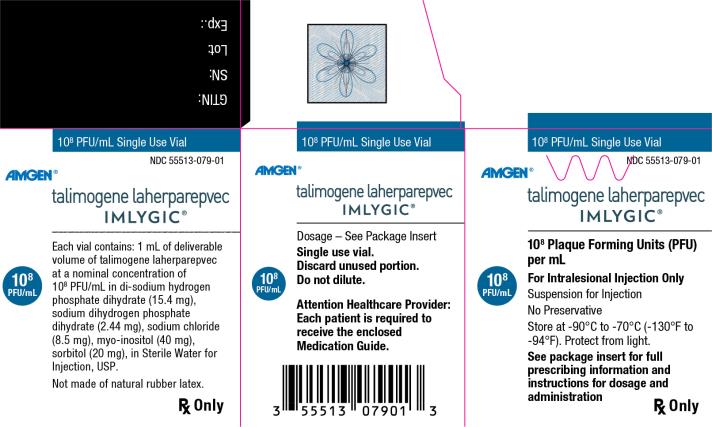
13PRINCIPAL DISPLAY PANEL - 10PFU/mL Vial Carton
10
NDC 55513-079-01
AMGEN
talimogene laherparepvec
10
10
For Intralesional Injection Only
Suspension for Injection
No Preservative
Store at -90°C to -70°C (-130°F to
See package insert for full prescribing
Rx Only
PRINCIPAL DISPLAY PANEL - 10 8 PFU/mL Vial Carton