Brand Name

Condylox

Generic Name
Podofilox
View Brand Information
FDA approval date: March 13, 1997
Form: Solution, Gel

What is Condylox (Podofilox)?

Condylox Gel 0.5% is indicated for the topical treatment of anogenital warts . This product is not indicated in the treatment of mucous membrane warts. Diagnosis Although anogenital warts have a characteristic appearance, histopathologic confirmation should be obtained if there is any doubt of the diagnosis. Differentiating warts from squamous cell carcinoma and "Bowenoid papulosis" is of particular concern. Squamous cell carcinoma may also be associated with human papillomavirus which should not be treated with Condylox Gel 0.5.
Save this treatment for later
Sign Up
Not sure about your diagnosis?
Check Your Symptoms

Related Clinical Trials

Randomized Phase II/III Trial of First Line Platinum/Etoposide With or Without Atezolizumab (NSC#783608) in Patients With Poorly Differentiated Extrapulmonary Small Cell Neuroendocrine Carcinomas (NEC)

Summary: This phase II/III trial compares the effect of immunotherapy with atezolizumab in combination with standard chemotherapy with a platinum drug (cisplatin or carboplatin) and etoposide versus standard therapy alone for the treatment of poorly differentiated extrapulmonary (originated outside the lung) neuroendocrine cancer that may have spread from where it first started to nearby tissue, lymph node...

A UGT1A1 Genotype-Directed Study of Belinostat Pharmacokinetics and Toxicity

Background: High-grade neuroendocrine carcinomas (HGNEC) are cancers that develop in different parts of the body, including the digestive tract, genitals, neck, and head. One drug (belinostat), combined with 2 other drugs (etoposide and cisplatin), is approved to treat HGNEC. But some people may have a gene variant that affects how quickly their body gets rid of the drug; these people may do better with diffe...

A Phase 3 Study of Dinutuximab Added to Intensive Multimodal Therapy for Children With Newly Diagnosed High-Risk Neuroblastoma

Summary: This phase III trial tests how well the addition of dinutuximab to Induction chemotherapy along with standard of care surgical resection of the primary tumor, radiation, stem cell transplantation, and immunotherapy works for treating children with newly diagnosed high-risk neuroblastoma. Dinutuximab is a monoclonal antibody that binds to a molecule called GD2, which is found on the surface of neur...

Brand Information

Condylox (podofilox)
1DESCRIPTION
Podofilox is an antimitotic drug which can be chemically synthesized or purified from the plant families
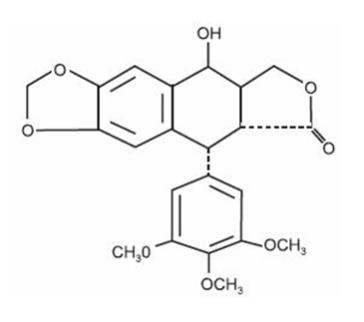
Podofilox has a molecular weight of 414.4 daltons, and is soluble in alcohol and sparingly soluble in water. Its chemical name is [5R
Podofilox has the following structural formula:
structural formula
2CLINICAL STUDIES
In the first multicenter clinical study in 326 patients with anogenital warts, Condylox Gel 0.5% and its vehicle were applied in a double-blind fashion to comparable patient groups. Of the 260 patients with efficacy data, 176 were treated with Condylox Gel 0.5%. Patients applied Condylox Gel 0.5% twice daily for three consecutive days followed by a 4 day “rest” period.
At the end of 4 weeks, 38.4% of the patients had complete clearing of the wart tissue when treated with Condylox Gel 0.5%.
In the second multicenter clinical trial in 108 evaluable patients with anogenital warts, Condylox (podofilox) Topical Solution 0.5% was compared with Condylox Gel 0.5% for efficacy. As in the first clinical trial, patients applied Condylox Gel 0.5% twice daily for three consecutive days followed by a four day “rest” period.
Similar clearance rates were observed. At the end of 4 weeks, 25.6% of the patients had complete clearing of the wart tissue when treated with Condylox Gel 0.5%.
3INDICATIONS AND USAGE
Condylox Gel 0.5% is indicated for the topical treatment of anogenital warts (external genital warts and perianal warts). This product is
3.1Diagnosis
Although anogenital warts have a characteristic appearance, histopathologic confirmation should be obtained if there is any doubt of the diagnosis. Differentiating warts from squamous cell carcinoma and "Bowenoid papulosis" is of particular concern. Squamous cell carcinoma may also be associated with human papillomavirus which should not be treated with Condylox Gel 0.5%.
4CONTRAINDICATIONS
Condylox Gel 0.5% is contraindicated for patients who develop hypersensitivity or intolerance to any components of the formulation.
5WARNINGS
Correct diagnosis of the lesions to be treated is essential. See the
Drug Product is Flammable.
Keep Away from Open Flame.
6ADVERSE REACTIONS
In clinical trials with Condylox Gel 0.5%, the following local adverse reactions were reported during the treatment of anogenital warts. The severity of local adverse reactions were predominantly mild or moderate and did not increase during the treatment period. Severe reactions were most frequent within the first 2 weeks of treatment.
Other local adverse reactions reported included stinging (7%), and erythema (5%); less commonly reported local adverse events included desquamation, scabbing, discoloration, tenderness, dryness, crusting, fissures, soreness, ulceration, swelling/edema, tingling, rash, and blisters.
The most common systemic adverse event reported during the clinical studies was headache (7%).
7OVERDOSAGE
Topically applied podofilox may be absorbed systemically (see
8DOSAGE AND ADMINISTRATION
The prescriber should ensure that the patient is fully aware of the correct method of therapy and identify which specific warts should be treated.
Apply twice daily for 3 consecutive days, then discontinue for 4 consecutive days. This one-week cycle of treatment may be repeated until there is no visible wart tissue or for a maximum of four cycles.
Condylox Gel 0.5% should be applied to the warts with the applicator tip or finger. Application on the surrounding normal tissue should be minimized.
Care should be taken to allow the gel to dry before allowing the return of opposing skin surfaces to their normal positions. Patients should be instructed to wash their hands thoroughly before and after each application.
9HOW SUPPLIED
Condylox Gel 0.5% is supplied as 3.5 grams of clear gel in aluminum tubes with an applicator tip. NDC 0023-6118-03. Store at 20-25°C (68-77°F). [See USP controlled room temperature.]
Keep out of reach of children.
Rx only
10REFERENCES
  1. Von Krogh G. Podophyllotoxin in serum: Absorption subsequent to three day repeated applications of a 0.5% ethanolic preparation on condylomata acuminata. Sex Trans Disease 1982: 9: 26-33.
  2. Berenblum I. The effect of podophyllotoxin on the skin of the mouse, with reference to carcinogenic, cocarcinogenic, and anticarcinogenic action. J Cancer Inst 11:839-841, 1951.
  3. Kaminetzky HA, Swerdlow M. Podophyllin and the mouse cervix: assessment of carcinogenic potential. Am J Obst Gyn 95:486-490, 1965.
  4. McGrew EA, Kaminetzky HA. The genesis of experimental cervical epithelial dysplasia. Am J Clin Path 35:538-545, 1961.
  5. Roe FJC, Salaman MH. Further studies on incomplete carcinogenesis: triethylene melamine (T.E.M.) 1,2 benxanthracene and beta-propiolactone as initiators of skin tumor formation in the mouse. Brit J Cancer, 9:177-203, 1955.
  6. Taper HS. Induction of the deficient acid DNAase activity in mouse interfollicular epidermis by croton oil as a possible tumor promoting mechanism. Zeitschrift fur Krebsforschung and Klinisch Onkologie (Cancer Research and Clinical Oncology, Berlin) 90:197-210, 1977.
  7. Kaminetzky HA, McGrew EA, Phillips RL. Experimental cervical epithelial dysplasia. J Obst Gyn 14:1-10, 1959.
  8. Kaminetzky HA, McGrew EA: Podophyllin and mouse cervix: Effect of long term application. Arch Path 73:481-485, 1962.
  9. Thiersch JB. Effect of podophyllin (P) and podophylotoxine (PT.) on the rat litter in utero. Soc Exptl Biol Med Proc. 113:124-127, 1963.
  10. Savel H.: Clinical experience with intravenous podophyllotoxin. Proc Amer Assoc Cancer Res, 1964; 5: 56.
  11. Cassidy DE, Dewry J and Fanning JP: Podophyllum toxicity: A report of a fatal case and a review of the literature. J Toxicol Clinic Toxicol 1982: 19: 35-44.
For all medical inquiries contact:
Distributed by:
Manufactured by:
© 2024 AbbVie. All rights reserved.
Content Updated: Jan2024
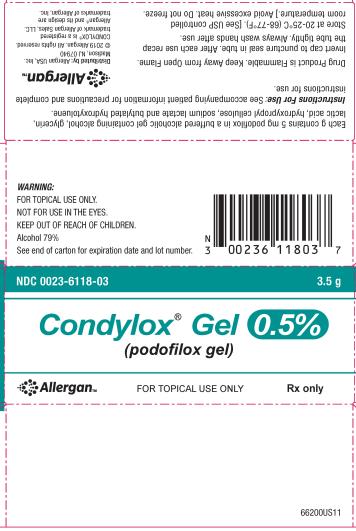
11PRINCIPAL DISPLAY PANEL
NDC 0023-6118-03
NDC 0023-6118-03
3.5 g
Condylox® Gel 0.5%
(podofilox gel)
abbvie
FOR TOPICAL USE ONLY
Rx only