Generic Name
Midazolam
Brand Names
Seizalam, Nayzilam
FDA approval date: June 20, 2000
Classification: Benzodiazepine
Form: Injection, Spray, Syrup
What is Seizalam (Midazolam)?
Midazolam HCl Syrup is indicated for use in pediatric patients for sedation, anxiolysis and amnesia prior to diagnostic, therapeutic or endoscopic procedures or before induction of anesthesia. Midazolam HCl syrup is intended for use in monitored settings only and not for chronic or home use. WARNINGS MIDAZOLAM HCL SYRUP MUST BE USED AS SPECIFIED IN THE LABEL. Midazolam is associated with a high incidence of partial or complete impairment of recall for the next several hours. CLINICAL PHARMACOLOGY.
Approved To Treat
Top Global Experts
There are no experts for this drug
Save this treatment for later
Not sure about your diagnosis?
Related Clinical Trials
There is no clinical trials being done for this treatment
Related Latest Advances
Brand Information
Seizalam (midazolam hydrochloride)
WARNING: RISKS FROM CONCOMITANT USE WITH OPIOIDS
- Concomitant use of benzodiazepines and opioids may result in profound sedation, respiratory depression, coma, and death. Monitor patients for respiratory depression and sedation[see Warnings and Precautions (.
- The use of benzodiazepines, including SEIZALAM, exposes users to risks of abuse, misuse, and addiction, which can lead to overdose or death. Abuse and misuse of benzodiazepines commonly involve concomitant use of other medications, alcohol, and/or illicit substances, which is associated with an increased frequency of serious adverse outcomes. Before prescribing SEIZALAM and throughout treatment, assess each patient's risk for abuse, misuse, and addiction[see Warnings and Precautions (
- The continued use of benzodiazepines may lead to clinically significant physical dependence. The risks of dependence and withdrawal increase with longer treatment duration and higher daily dose. Although SEIZALAM is indicated only for intermittent use[see Indications and Usage (, if used more frequently than recommended, abrupt discontinuation or rapid dosage reduction of SEIZALAM may precipitate acute withdrawal reactions, which can be life-threatening. For patients using SEIZALAM more frequently than recommended, to reduce the risk of withdrawal reactions, use a gradual taper to discontinue SEIZALAM[see Warnings and Precautions (
1INDICATIONS AND USAGE
SEIZALAM is indicated for the treatment of status epilepticus in adults.
2DOSAGE FORMS AND STRENGTHS
Injection: 50 mg/10 mL (5 mg/mL) of a sterile, clear, colorless to light yellow liquid solution in a multiple-dose vial.
3CONTRAINDICATIONS
SEIZALAM is contraindicated in patients with a known hypersensitivity to midazolam.
4ADVERSE REACTIONS
The following serious adverse reactions are discussed in greater detail in other sections:
- Risks from Concomitant Use with Opioids
- Abuse, Misuse, and Addiction
- Dependence and Withdrawal Reactions After Use of SEIZALAM More Frequently Than Recommended
- Risks of Cardiorespiratory Adverse Reactions
- Other Adverse Reactions
- Risks from Concomitant Use of Central Nervous System Depressants
- Impaired Cognitive Function
- Glaucoma
- Neonatal Sedation and Withdrawal Syndrome
- Risk of Serious Adverse Reactions in Infants due to Benzyl Alcohol Preservative
4.1Clinical Trials Experience
Because clinical trials are conducted under widely varying conditions, adverse reaction rates observed in the clinical trials of a drug cannot be directly compared to rates in the clinical trials of another drug and may not reflect the rates observed in practice.
5OVERDOSAGE
Overdosage of benzodiazepines is characterized by central nervous system depression ranging from drowsiness to coma. In mild to moderate cases, symptoms can include drowsiness, confusion, dysarthria, lethargy, hypnotic state, diminished reflexes, ataxia, and hypotonia. Rarely, paradoxical or disinhibitory reactions (including agitation, irritability, impulsivity, violent behavior, confusion, restlessness, excitement, and talkativeness) may occur. In severe overdosage cases, patients may develop respiratory depression and coma. Overdosage of benzodiazepines in combination with other CNS depressants (including alcohol and opioids) may be fatal
In managing benzodiazepine overdosage, employ general supportive measures, including intravenous fluids and airway maintenance. Flumazenil, a specific benzodiazepine receptor antagonist indicated for the complete or partial reversal of the sedative effects of benzodiazepines in the management of benzodiazepine overdosage, can lead to withdrawal and adverse reactions, including seizures, particularly in the context of mixed overdosage with drugs that increase seizure risk (e.g., tricyclic and tetracyclic antidepressants) and in patients with long-term benzodiazepine use and physical dependency. The risk of withdrawal seizures with flumazenil use may be increased in patients with epilepsy. Flumazenil is contraindicated in patients who have received a benzodiazepine for control of a potentially life-threatening condition (e.g., status epilepticus). If the decision is made to use flumazenil, it should be used as an adjunct to, not as a substitute for, supportive management of benzodiazepine overdosage. See the flumazenil injection Prescribing Information.
Consider contacting the Poison Help line (1-800-222-1222) or a medical toxicologist for additional overdosage management recommendations.
6DESCRIPTION
Midazolam is a white to light yellow crystalline compound, insoluble in water. The hydrochloride salt of midazolam, which is formed
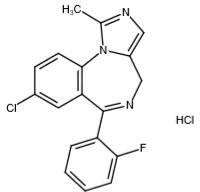
SEIZALAM is a sterile, nonpyrogenic solution for intramuscular injection. Each mL contains 5 mg midazolam (equivalent to 5.6 mg midazolam hydrochloride) compounded with 1% benzyl alcohol as preservative, 0.01% edetate disodium, and 0.8% sodium chloride. The pH is adjusted to approximately 3 with hydrochloric acid and, if necessary, sodium hydroxide.
7CLINICAL STUDIES
The safety and effectiveness of SEIZALAM for the treatment of status epilepticus was established in a multi-center, randomized, double-blind (double-dummy), active-control trial comparing midazolam administered intramuscularly (IM) via an auto-injector to lorazepam administered intravenously (IV). Patients meeting the diagnosis of status epilepticus, with continuing convulsive seizure activity after the arrival of paramedics, were eligible for enrollment. The ITT population consisted of 893 patients who were randomized to receive either IM midazolam (n=448) or IV lorazepam (n=445). Following randomization, each patient received study treatments administered by a healthcare professional (e.g., paramedic) prior to arrival at a hospital. According to the double-dummy design, adult patients received 10 mg IM midazolam followed by IV placebo or received IM placebo followed by 4 mg IV lorazepam. The primary efficacy endpoint was the termination of convulsive seizure activity (without the need for rescue medication) prior to arrival at the emergency department (ED) as determined by the ED attending physician. A statistically significantly higher percentage of midazolam-treated patients met the primary efficacy endpoint, as shown in
8PATIENT COUNSELING INFORMATION
Patients having seizures will likely be unresponsive or may have difficulty in comprehending counseling information.