Brand Name
Oxervate
Generic Name
Cenegermin-Bkbj
View Brand Information FDA approval date: November 26, 2018
Classification: Recombinant Human Nerve Growth Factor
Form: Kit, Solution
What is Oxervate (Cenegermin-Bkbj)?
OXERVATE ® ophthalmic solution.
Approved To Treat
Top Global Experts
Save this treatment for later
Not sure about your diagnosis?
Related Clinical Trials
There is no clinical trials being done for this treatment
Related Latest Advances
Brand Information
1INDICATIONS AND USAGE
OXERVATE
2DOSAGE FORMS AND STRENGTHS
Ophthalmic solution: cenegermin-bkbj 0.002% (20 mcg/mL) as a clear, colorless solution in a multiple dose vial.
3CONTRAINDICATIONS
None.
4USE IN SPECIFIC POPULATIONS
4.1Pregnancy
Risk Summary
There are no data from the use of OXERVATE in pregnant women to inform any drug associated risks.
There are no data from the use of OXERVATE in pregnant women to inform any drug associated risks.
Administration of cenegermin-bkbj to pregnant rats or rabbits during the period of organogenesis did not produce adverse fetal effects at clinically relevant doses. In a pre- and postnatal development study, administration of cenegermin-bkbj to pregnant rats throughout gestation and lactation did not produce adverse effects in offspring at clinically relevant doses.
Data
Animal Data
In embryofetal development studies, daily subcutaneous administration of cenegermin-bkbj to pregnant rats and rabbits throughout the period of organogenesis produced a slight increase in post-implantation loss at doses greater than or equal to 42 mcg/kg/day (267 times the MRHOD). A no observed adverse effect level (NOAEL) was not established for post-implantation loss in either species. In rats, hydrocephaly and ureter anomalies were observed each in one fetuses at 267 mcg/kg/day (1709 times the MRHOD). In rabbits, cardiovascular malformations, including ventricular and atrial septal defects, enlarged heart and aortic arch dilation were observed each in one fetuses at 83 mcg/kg/day (534 times the MRHOD). No fetal malformations were observed in rats and rabbits at doses of 133 mcg/kg/day and 42 mcg/kg/day, respectively.
Animal Data
In embryofetal development studies, daily subcutaneous administration of cenegermin-bkbj to pregnant rats and rabbits throughout the period of organogenesis produced a slight increase in post-implantation loss at doses greater than or equal to 42 mcg/kg/day (267 times the MRHOD). A no observed adverse effect level (NOAEL) was not established for post-implantation loss in either species. In rats, hydrocephaly and ureter anomalies were observed each in one fetuses at 267 mcg/kg/day (1709 times the MRHOD). In rabbits, cardiovascular malformations, including ventricular and atrial septal defects, enlarged heart and aortic arch dilation were observed each in one fetuses at 83 mcg/kg/day (534 times the MRHOD). No fetal malformations were observed in rats and rabbits at doses of 133 mcg/kg/day and 42 mcg/kg/day, respectively.
In a pre- and postnatal development study, daily subcutaneous administration of cenegermin-bkbj to pregnant rats during the period of organogenesis and lactation did not affect parturition and was not associated with adverse toxicity in offspring at doses up to 267 mcg/kg/day.
In parental rats and rabbits, an immunogenic response to cenegermin-bkbj was observed. Given that cenegermin-bkbj is a heterologous protein in animals, this response may not be relevant to humans.
4.2Lactation
Risk Summary
There are no data on the presence of OXERVATE in human milk, the effects on breastfed infant, or the effects on milk production. The developmental and health benefits of breastfeeding should be considered, along with the mother’s clinical need for OXERVATE, and any potential adverse effects on the breastfed infant from OXERVATE.
There are no data on the presence of OXERVATE in human milk, the effects on breastfed infant, or the effects on milk production. The developmental and health benefits of breastfeeding should be considered, along with the mother’s clinical need for OXERVATE, and any potential adverse effects on the breastfed infant from OXERVATE.
4.3Pediatric Use
The safety and effectiveness of OXERVATE have been established in the pediatric population. Use of OXERVATE in this population is supported by evidence from adequate and well-controlled trials of OXERVATE in adults with additional safety data in pediatric patients from 2 years of age and older
4.4Geriatric Use
Of the total number of subjects in clinical studies of OXERVATE, 43.5% were 65 years old and over. No overall differences in safety or effectiveness were observed between elderly and younger adult patients.
5DESCRIPTION
OXERVATE ophthalmic solution contains cenegermin-bkbj, a recombinant form of human nerve growth factor produced in
Cenegermin-bkbj contains 118 amino acids. Cenegermin-bkbj has a relative molecular mass of 13,266 Daltons and the following molecular formula: C
Each mL contains
6CLINICAL STUDIES
The efficacy and safety of OXERVATE for the treatment of neurotrophic keratitis was studied in a total of 151 patients, evaluated in two 8-week, randomized, multi-center, double-masked, vehicle-controlled studies. Patients were randomized to OXERVATE, cenegermin-bkbj 10 mcg/mL, or vehicle in Study NGF0212, and OXERVATE or vehicle in Study NGF0214 dosed 6 times daily in the affected eye(s) for 8 weeks. In study NGF0212, only patients with unilateral disease were enrolled, while in study NGF0214 patients with bilateral disease were treated bilaterally. The mean age was 61 to 65 years (18-95). The majority of patients were female (approximately 61%).
Table 1 below summarizes the results for
Table 1. Percentage of Patients with Complete Corneal Healing at Week 8
In patients who were healed after 8 weeks of treatment with OXERVATE, recurrences occurred in approximately 20% of patients in Study NGF0212 and 14% of patients in Study NGF0214.
The results of the mean change from baseline in corneal sensitivity inside the lesion after 8 weeks of treatment are summarized descriptively in Table 2. The mean changes in corneal sensitivity were not clinically significant in either study.
Table 2. Mean Corneal Sensitivity inside the Lesion: Baseline and Change from Baseline at Week 8
7HOW SUPPLIED/STORAGE AND HANDLING
OXERVATE (cenegermin-bkbj) ophthalmic solution, 0.002% (20 mcg/mL), is a sterile, clear, colorless solution in a multiple-dose vial, closed with a rubber stopper (not made with natural rubber latex), and an aluminum overseal with a polypropylene flip-off cap.
OXERVATE is supplied in weekly cartons containing 7 multiple-dose vials (NDC 71981-020-07). OXERVATE is dispensed to patients in an insulated pack and co-packaged with the Delivery System Kit (NDC 71981-001-01). The Delivery System Kit contains 8 vial adapters, 45 pipettes, 45 sterile disinfectant wipes, and 1 Dose Recording Card.
Pharmacy Storage
Store the weekly cartons containing OXERVATE vials in the freezer at or below -4°F (-20°C). Dispense the weekly carton(s) containing OXERVATE vials in an insulated pack in combination with the Delivery System Kit.
Store the weekly cartons containing OXERVATE vials in the freezer at or below -4°F (-20°C). Dispense the weekly carton(s) containing OXERVATE vials in an insulated pack in combination with the Delivery System Kit.
Patient Storage
Within 5 hours of delivery, store the weekly carton(s) containing OXERVATE vials in the refrigerator between 36°F to 46°F (2°C to 8°C) for up to 14 days. A vial opened for daily use may be stored in the original weekly carton in the refrigerator between 36°F to 46°F (2°C to 8°C) or at room temperature up to 77°F (25°C), for up to 12 hours [see . Do not refreeze the vials. Do not shake the vials. Discard the opened vial after 12 hours even if there is still some solution left inside.
Within 5 hours of delivery, store the weekly carton(s) containing OXERVATE vials in the refrigerator between 36°F to 46°F (2°C to 8°C) for up to 14 days. A vial opened for daily use may be stored in the original weekly carton in the refrigerator between 36°F to 46°F (2°C to 8°C) or at room temperature up to 77°F (25°C), for up to 12 hours [see . Do not refreeze the vials. Do not shake the vials. Discard the opened vial after 12 hours even if there is still some solution left inside.
8PATIENT COUNSELING INFORMATION
Advise the patient to read the FDA-approved patient labeling (
Handling the Vials and the Delivery System
Advise patients that OXERVATE should be administered using the vial adapters, pipettes, and sterile disinfectant wipes provided in the Delivery System Kit and according to the instructions [see . One individual pipette should be used per application.
Advise patients that OXERVATE should be administered using the vial adapters, pipettes, and sterile disinfectant wipes provided in the Delivery System Kit and according to the instructions [see . One individual pipette should be used per application.
Use with Contact Lenses
Advise patients that contact lenses should be removed before applying OXERVATE and to wait 15 minutes after instillation of the dose before reinserting the contact lenses into the eyes [see .
Advise patients that contact lenses should be removed before applying OXERVATE and to wait 15 minutes after instillation of the dose before reinserting the contact lenses into the eyes [see .
Use with other topical products
Advise the patient to administer the eye drops at least 15 minutes apart, if more than one topical ophthalmic product is being used to avoid diluting products. Administer OXERVATE 15 minutes prior to using any eye ointment, gel or other viscous eye drops.
Advise the patient to administer the eye drops at least 15 minutes apart, if more than one topical ophthalmic product is being used to avoid diluting products. Administer OXERVATE 15 minutes prior to using any eye ointment, gel or other viscous eye drops.
Delayed or Missed Dose
If a dose is missed, treatment should be continued as normal, at the next scheduled administration.
If a dose is missed, treatment should be continued as normal, at the next scheduled administration.
Storage Information
Instruct the patient to remove the weekly carton(s) containing 7 OXERVATE vials from the insulated pack within 5 hours of receiving it from the pharmacy and store the weekly carton(s) in the refrigerator [36°F to 46°F (2°C to 8°C)].
Instruct the patient to remove the weekly carton(s) containing 7 OXERVATE vials from the insulated pack within 5 hours of receiving it from the pharmacy and store the weekly carton(s) in the refrigerator [36°F to 46°F (2°C to 8°C)].
Instruct the patient to only remove the number of OXERVATE vials from the weekly carton required for use over the course of a single day. Do not shake the vial.
Once opened, the vial can be kept in the original weekly carton in the refrigerator between 36°F to 46°F (2°C to 8°C) for up to 12 hours or at room temperature up to 77°F (25°C), but must be used within 12 hours. After 12 hours, advise patients to discard the vial with any unused amount.
Manufactured by
Dompé farmaceutici S.p.A.
Via Campo di Pile
67100 L’Aquila, Italy
U.S. License No. 2074
Dompé farmaceutici S.p.A.
Via Campo di Pile
67100 L’Aquila, Italy
U.S. License No. 2074
® 2024. Dompé U.S. Inc.
9INSTRUCTIONS FOR USE
OXERVATE
(cenegermin-bkbj)
(cenegermin-bkbj)
Read this Instructions for Use before you start using OXERVATE
Important:
- OXERVATE is for use in the eye.
- Do not shake the OXERVATE vial.
- Use OXERVATE with the vial adapters, sterile disinfectant wipes, and pipettes that come with your Delivery System Kit.
OXERVATE is supplied in an insulated pack, in weekly cartons containing 7 multiple-dose vials. OXERVATE is supplied with an accompanying Delivery System Kit. The Delivery System Kit will have medical devices for withdrawing and using OXERVATE.
You will receive both the OXERVATE weekly carton(s) and the Delivery System Kit from the pharmacy.
The OXERVATE carton contains:
- 7 multiple-dose vials of OXERVATE (1 vial per day of the week)
The Delivery System Kit contains the following:
- 7 vial adapters
- 42 pipettes
- 42 sterile disinfectant wipes and
- Dose Recording Card (1)
- Extra adapter (1) pipettes (3) and wipes (3) are included as spares.
How should I store OXERVATE?
- Remove the weekly carton(s) of OXERVATE from the insulated pack and store it for up to 14 days in a refrigerator in the original carton as soon as you can.
- Store the weekly carton(s) at 36°F to 46°F (2°C to 8°C)
- OXERVATE is stored in a freezer at the pharmacy. If you start treatment right away after receiving the weekly carton, you will have to wait until the first vial is thawed. Thaw the vial at room temperature up to 77°F (25°C). Thawing the vial could take up to 30 minutes when kept at room temperature.
- Keep all medicines out of the reach of children.
Follow Steps 1 to 19 each day you use OXERVATE.
Gather your supplies:
- Remove 1 vial of OXERVATE from the refrigerator in the morning (always at the same time each morning) to use during the day. If OXERVATE is to be used in both eyes, remove 2 vials from the refrigerator.
- 1 vial adapter
- 1 pipette (if both eyes 2 pipettes)
- 1 sterile disinfectant wipe (if both eyes 2 sterile disinfectant wipes)
- Dose Recording Card
The multiple-dose vial of OXERVATE is now ready for use (1 drop in the affected eye every 2 hours six times a day).
To withdraw and give each dose of OXERVATE, follow
To make sure accurate dosing every 2 hours, you may want to set an alarm as a reminder for dosing.
Call your doctor for medical advice about side effects. You may report side effects to Dompé U.S. Inc. at 1-833-366-7387 or FDA at 1-800-FDA-1088 or www.fda.gov/medwatch.
Manufactured by:
Dompé farmaceutici S.p.A.
Via Campo di Pile
67100 L’Aquila, Italy
U.S. License No. 2074
Dompé farmaceutici S.p.A.
Via Campo di Pile
67100 L’Aquila, Italy
U.S. License No. 2074
Manufactured for: Dompé U.S. Inc.
400 S El Camino Real - Ste. 400, San Mateo, CA 94402
400 S El Camino Real - Ste. 400, San Mateo, CA 94402
® 2024. Dompé U.S. Inc.
This Instructions for Use has been approved by the U.S. Food and Drug Administration.
Revised: December 2024.
10PRINCIPAL DISPLAY PANEL - Carton
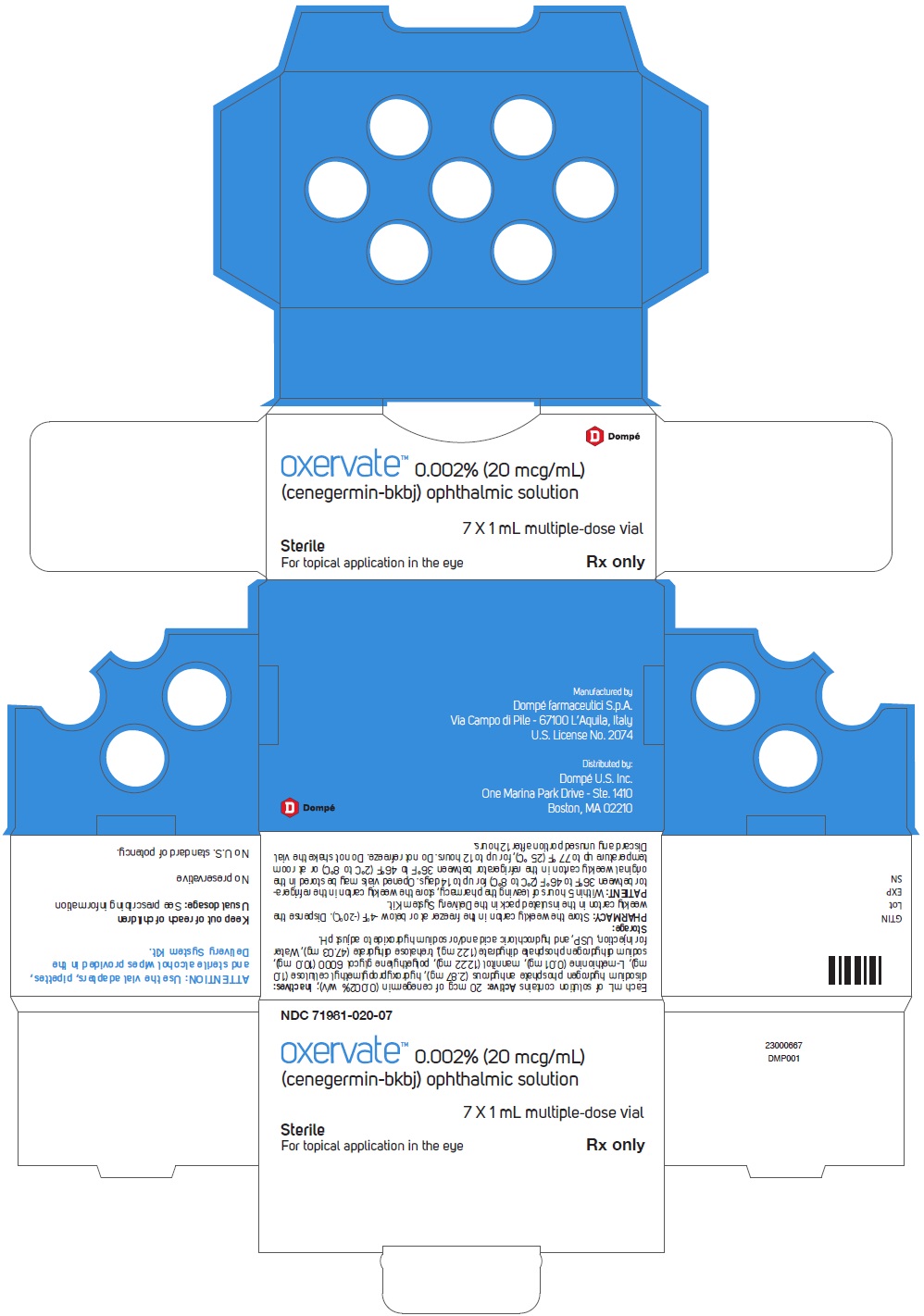
NDC 71981-020-07
Oxervate
7 X 1 mL multiple-dose vial
Sterile
For topical application in the eye
For topical application in the eye
Rx only
11PRINCIPAL DISPLAY PANEL- Delivery System Kit
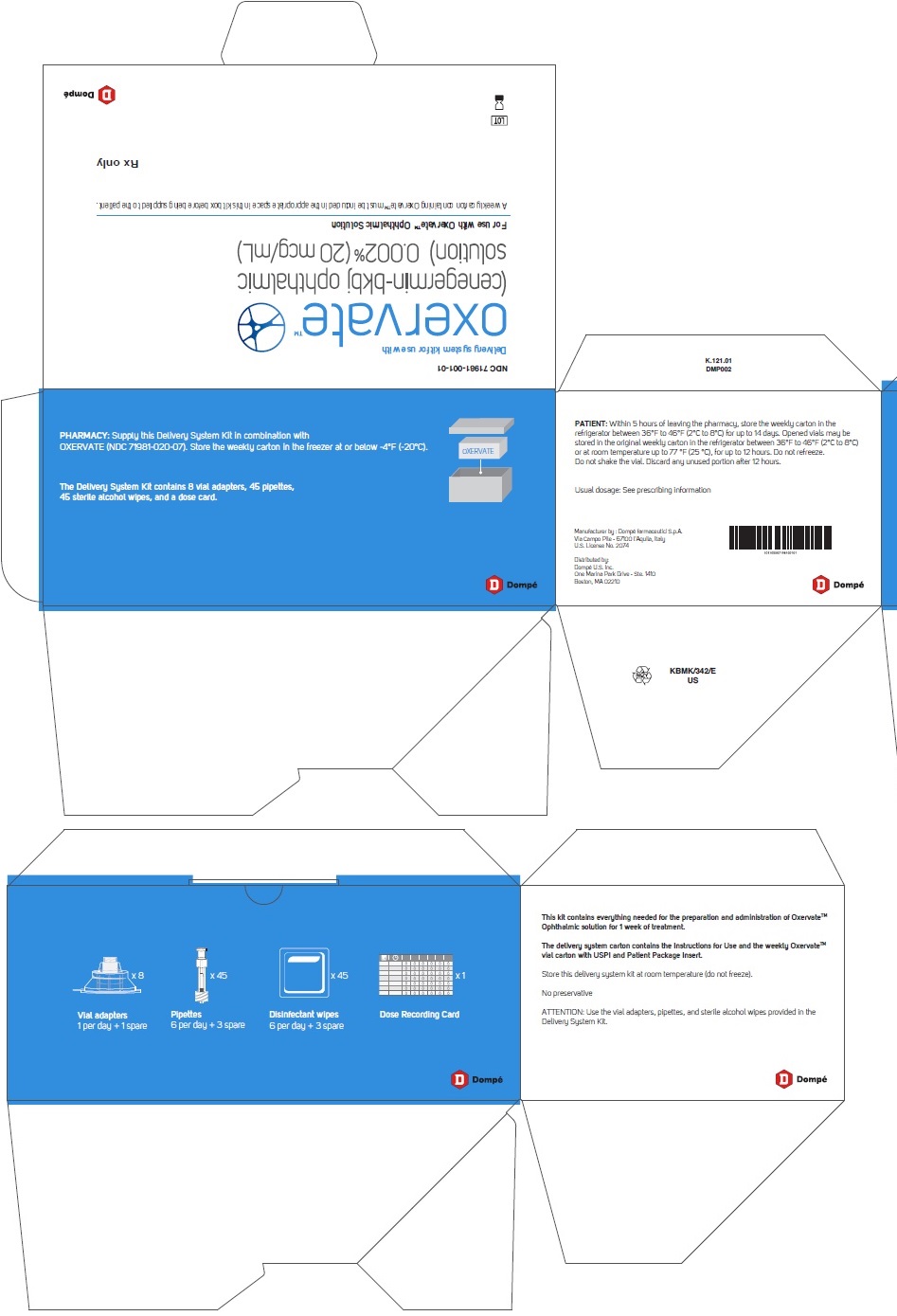
NDC 71981-001-01
Delivery system kit for use with
(cenegermin-bkbj ophthalmic solution)
Rx only
Dompé