Brand Name

Zydelig

Generic Name
Idelalisib
View Brand Information
FDA approval date: July 23, 2014
Classification: Kinase Inhibitor
Form: Tablet

What is Zydelig (Idelalisib)?

Zydelig is indicated, in combination with rituximab, for the treatment of patients with relapsed chronic lymphocytic leukemia for whom rituximab alone would be considered appropriate therapy due to other co-morbidities. Zydelig is a kinase inhibitor indicated for the treatment of patients with: Relapsed chronic lymphocytic leukemia , in combination with rituximab, in patients for whom rituximab alone would be considered appropriate therapy due to other co-morbidities. Limitations of use: Zydelig is not indicated and is not recommended for first-line treatment of any patient, including patients with CLL, small lymphocytic lymphoma , follicular lymphoma , and other indolent non-Hodgkin lymphomas. ( 1.

Related Clinical Trials

A Phase 3, Open-Label, Randomized Study of BGB-16673 Compared to Investigator's Choice (Idelalisib Plus Rituximab or Bendamustine Plus Rituximab or Venetoclax Plus Rituximab Retreatment) in Patients With Chronic Lymphocytic Leukemia or Small Lymphocytic Lymphoma Previously Exposed to Both BTK and BCL2 Inhibitors

Summary: The purpose of this study is to investigate the efficacy and safety of BGB-16673 compared with investigator's choice (idelalisib plus rituximab \[for CLL only\] or bendamustine plus rituximab or venetoclax plus rituximab retreatment) in participants with chronic lymphocytic leukemia (CLL) or small lymphocytic lymphoma (SLL) previously exposed to both BTK inhibitors (BTKi) and BCL2 inhibitors (BCL2...

Study to Investigate Outcome of Individualized Treatment Based on Pharmacogenomic Profiling & Ex Vivo Drug Sensitivity Testing of Patient-derived Organoids in Patients With Metastatic Colorectal Cancer

Summary: The purpose of the study is to investigate the effect and side effects of personalized cancer treatment in patients with metastatic colorectal cancer (bowel cancer). All patients included must have metastatic bowel cancer and receive or have received at least two lines of standard chemotherapy. The cancer must not be available for surgery with curative intent.

Brand Information

Zydelig (idelalisib)
WARNING: FATAL AND SERIOUS TOXICITIES: HEPATIC, SEVERE DIARRHEA, COLITIS, PNEUMONITIS, INFECTIONS, and INTESTINAL PERFORATION
Fatal and/or serious hepatotoxicity occurred in 16% of Zydelig-treated patients. Monitor hepatic function prior to and during treatment. Interrupt and then reduce or discontinue Zydelig as recommended
Fatal and/or serious and severe diarrhea or colitis occurred in 20% of Zydelig-treated patients. Monitor for the development of severe diarrhea or colitis. Interrupt and then reduce or discontinue Zydelig as recommended
Fatal and/or serious pneumonitis occurred in 4% of Zydelig-treated patients. Monitor for pulmonary symptoms and bilateral interstitial infiltrates. Interrupt or discontinue Zydelig as recommended
Fatal and/or serious infections occurred in 48% of Zydelig-treated patients. Monitor for signs and symptoms of infection. Interrupt Zydelig if infection is suspected
Fatal and serious intestinal perforation can occur in Zydelig-treated patients across clinical trials. Discontinue Zydelig for intestinal perforation
1INDICATIONS AND USAGE
Zydelig is indicated, in combination with rituximab, for the treatment of patients with relapsed chronic lymphocytic leukemia (CLL) for whom rituximab alone would be considered appropriate therapy due to other co-morbidities.
2DOSAGE FORMS AND STRENGTHS
Tablets:
  • 100 mg: orange, oval-shaped, film-coated tablet debossed with "GSI" on one side and "100" on the other side.
  • 150 mg: pink, oval-shaped, film-coated tablet debossed with "GSI" on one side and "150" on the other side.
3CONTRAINDICATIONS
Zydelig is contraindicated in patients with a history of serious hypersensitivity reactions to idelalisib, including anaphylaxis, or patients with a history of toxic epidermal necrolysis with any drug
4ADVERSE REACTIONS
The following clinically significant adverse reactions are described elsewhere in the labeling.
  • Hepatotoxicity
  • Severe Diarrhea or Colitis
  • Pneumonitis
  • Infections
  • Intestinal Perforation
  • Severe Cutaneous Reactions
  • Hypersensitivity Reactions
  • Neutropenia
4.1Clinical Trials Experience
Because clinical trials are conducted under widely varying conditions, adverse reaction rates observed in the clinical trials of a drug cannot be directly compared to rates in the clinical trials of another drug and may not reflect the rates observed in practice.
The pooled safety population described in the WARNINGS AND PRECAUTIONS reflect exposure to Zydelig at a dosage of 150 mg twice daily in 110 patients administered in combination with rituximab in Study 312-0116, and in combination with other drugs in 380 patients. Among 490 patients who received Zydelig, 74% were exposed for 6 months or longer and 50% were exposed for one year or longer. In this pooled safety population, the most common (> 30%) adverse reactions were diarrhea, pneumonia, pyrexia, fatigue, rash, cough, and nausea. Common laboratory abnormalities were neutropenia, ALT elevations and AST elevations.
4.2Postmarketing Experience
The following adverse reactions have been identified during postapproval use of Zydelig. Because these reactions are reported voluntarily from a population of uncertain size, it is not always possible to reliably estimate their frequency or establish a causal relationship to drug exposure.
Skin and Subcutaneous Disorders - Stevens-Johnson syndrome (SJS), toxic epidermal necrolysis (TEN), and drug reaction with eosinophilia and systemic symptoms (DRESS)
5DESCRIPTION
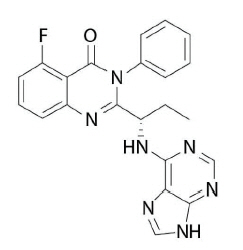
Idelalisib is a kinase inhibitor. The chemical name for idelalisib is 5-fluoro-3-phenyl-2-[(1S)-1-(
Chemical Structure
Idelalisib is a white to off-white solid with a pH-dependent aqueous solubility ranging from <0.1 mg/mL at pH 5–7 to over 1 mg/mL at pH 2 under ambient conditions.
Zydelig (idelalisib) tablets are for oral use. Each tablet contains either 100 mg or 150 mg of idelalisib with the following inactive ingredients: microcrystalline cellulose, hydroxypropyl cellulose, croscarmellose sodium, sodium starch glycolate, magnesium stearate and a tablet coating. The tablet coating consists of polyethylene glycol, talc, polyvinyl alcohol, and titanium dioxide and of FD&C Yellow #6/Sunset Yellow FCF Aluminum Lake (for the 100 mg tablet) and red iron oxide (for the 150 mg tablet).
6CLINICAL STUDIES
Zydelig was evaluated in a randomized, double-blind, placebo-controlled study GS-US-312-0116 (referred to as 312-0116) (NCT01539512) in 220 patients with relapsed CLL who required treatment and were unable to tolerate standard chemoimmunotherapy due to coexisting medical conditions, reduced renal function as measured by creatinine clearance < 60 mL/min, or NCI CTCAE Grade ≥ 3 neutropenia or Grade ≥ 3 thrombocytopenia resulting from myelotoxic effects of prior therapy with cytotoxic agents. Patients were randomized 1:1 to receive 8 doses of rituximab (first dose at 375 mg/m
The median age was 71 years (range 47, 92) with 78% over 65, 66% were male, and 90% were White. The median time since diagnosis was 8.5 years. The median number of prior therapies was 3. Nearly all (96%) patients had received prior anti-CD20 monoclonal antibodies. The most common (>15%) prior regimens were: bendamustine + rituximab (BR) (98 patients, 45%), fludarabine + cyclophosphamide + rituximab (75 patients, 34%), single-agent rituximab (67 patients, 31%), fludarabine + rituximab (37 patients, 17%), and chlorambucil (36 patients, 16%). The median CIRS (Cumulative Illness Rating Scale) score was 8 (range 0–17), and 85% of patients had a score of >6. Median Karnofsky score was 80. Median estimated Creatinine Clearance (eCLcr) was 63.6 mL/min, with 41% of patients having an eCLcr of <60 mL/min. At screening, 19.5% of patients had a platelet count of <50 × 10
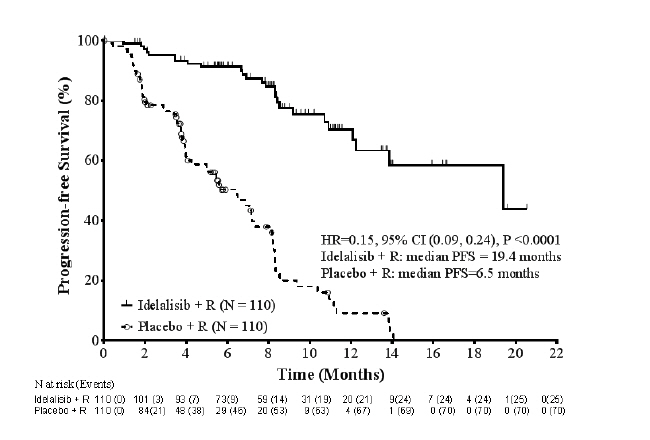
The efficacy of Zydelig was based on progression free survival (PFS), as assessed by an independent review committee (IRC). The trial was stopped for efficacy following the first pre-specified interim analysis. Results of a second interim analysis continued to show a statistically significant improvement for Zydelig + R compared to placebo + R for the major efficacy outcome measure of PFS (HR: 0.18, 95% CI [0.10, 0.32], p <0.0001).
At the final analysis, with a median follow-up of 8.3 months for the Zydelig + R group, and 5.6 months for the placebo + R group, the median PFS for the Zydelig + R group was 19.4 months (95% CI: 12.3, Not Reached) versus 6.5 months (95% CI: 4.0, 7.3) for the placebo + R group (HR: 0.15, 95% CI [0.09, 0.24], p < 0.0001).
Updated efficacy results are shown in Table 7 and the Kaplan-Meier curve for PFS is shown in Figure 1.
Figure 1 Kaplan-Meier Plot of IRC-Assessed PFS for Study 312-0116
Figure 1
7HOW SUPPLIED/STORAGE AND HANDLING
Zydelig tablets supplied as follows:
8PATIENT COUNSELING INFORMATION
Advise the patient to read the FDA-approved patient labeling (Medication Guide).
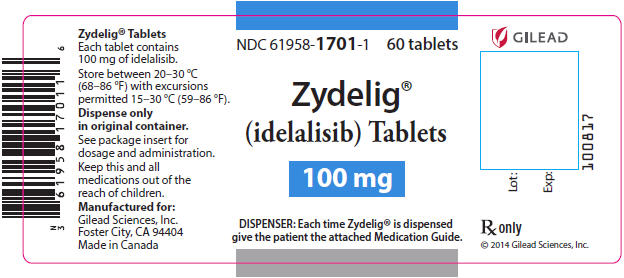
9PRINCIPAL DISPLAY PANEL - 100 mg Tablet Bottle Label
NDC 61958-
Zydelig
100 mg
DISPENSER: Each time Zydelig
PRINCIPAL DISPLAY PANEL - 100 mg Tablet Bottle Label
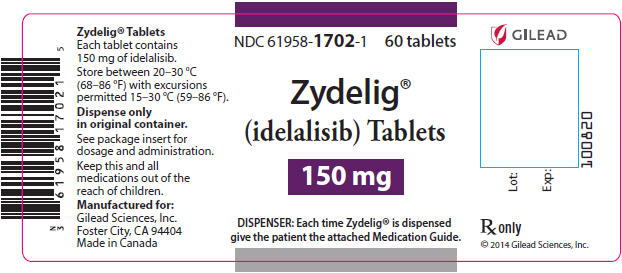
10PRINCIPAL DISPLAY PANEL - 150 mg Tablet Bottle Label
NDC 61958-
Zydelig
150 mg
DISPENSER: Each time Zydelig
PRINCIPAL DISPLAY PANEL - 150 mg Tablet Bottle Label