Generic Name

Lamivudine

Brand Names
SYMFI, Abacavir, Efavirenz, Cimduo, Epzicom, Epivir, Delstrigo, Combivir, Triumeq, Dovato
FDA approval date: October 04, 2010
Classification: Human Immunodeficiency Virus Nucleoside Analog Reverse Transcriptase Inhibitor
Form: Tablet, Kit, Solution

What is SYMFI (Lamivudine)?

Efavirenz, lamivudine and tenofovir disoproxil fumarate tablets are indicated as a complete regimen for the treatment of human immunodeficiency virus type 1 infection in adult and pediatric patients weighing at least 35 kg. Efavirenz, lamivudine and tenofovir disoproxil fumarate tablets are three-drug combination of efavirenz , a non-nucleoside reverse transcriptase inhibitor, and lamivudine and tenofovir disoproxil fumarate , both nucleoside reverse transcriptase inhibitors and are indicated as a complete regimen for the treatment of human immunodeficiency virus type 1 infection in adult and pediatric patients weighing at least 35 kg.
Save this treatment for later
Sign Up
Not sure about your diagnosis?
Check Your Symptoms

Related Clinical Trials

A Clinical Study to Evaluate the Breast Milk and Plasma Pharmacokinetics of MK-8591A in Healthy Lactating Female Participants

Summary: The goal of this study is to learn what happens to doravirine (DOR) and islatravir (ISL) in a healthy lactating female's body over time. Researchers want to learn if DOR and ISL are in breast milk.

Natural History Study of the KSHV Inflammatory Cytokine Syndrome (KICS)

Background: \- KSHV inflammatory cytokine syndrome (KICS) is a newly recognized disease caused by Kaposi sarcoma-associated herpesvirus (KSHV). This virus can cause cancer. People with KICS can have severe symptoms. They include fever, weight loss, and fluid in the legs or abdomen. People with KICS may also be at risk of getting other cancers associated with KSHV. These cancers include Kaposi sarcoma and lymp...

A Phase 1b, Multi-cohort Clinical Trial Assessing Safety and Feasibility of Exercise and Spermidine Administered in Conjunction With Lamivudine (RTi) or Rapamycin (mTORi) to Assess Impact on Dynamic Changes of Inflammation and Aging

Summary: This is a study assessing the feasibility of performing an anti-aging intervention which is a combination of an exercise regimen, spermidine supplementation, and either rapamycin or lamivudine.

Brand Information

    SYMFI (Efavirenz, Lamivudine and Tenofovir Disoproxil Fumarate)
    WARNING: POST TREATMENT ACUTE EXACERBATIONS OF HEPATITIS B
    Severe acute exacerbations of hepatitis B have been reported in patients who are co-infected with hepatitis B virus (HBV) and human immunodeficiency virus (HIV-1) and have discontinued lamivudine or tenofovir disoproxil fumarate, two components of SYMFI. Monitor hepatic function closely in these patients and, if appropriate, initiate anti-hepatitis B treatment Warnings and Precautions (5.1)].
    1INDICATIONS AND USAGE
    SYMFI
    2DOSAGE FORMS AND STRENGTHS
    Tablets: 600 mg of efavirenz, 300 mg of lamivudine, and 300 mg of tenofovir disoproxil fumarate (equivalent to 245 mg of tenofovir disoproxil).
    The tablets are white, film-coated, capsule shaped, debossed with
    3CONTRAINDICATIONS
    SYMFI is contraindicated:
    • in patients with a previous hypersensitivity reaction (e.g., Stevens-Johnson syndrome, erythema multiforme, or toxic skin eruptions) to any of the components contained in the formulation
    • when coadministered with elbasvir and grazoprevir
    4ADVERSE REACTIONS
    The following adverse reactions are discussed in other sections of the labeling:
    • Exacerbations of Hepatitis B
    • Lactic Acidosis/Severe Hepatomegaly with Steatosis
    • New Onset or Worsening Renal Impairment
    • Psychiatric Symptoms
    • Nervous System Symptoms
    • Skin and Systemic Hypersensitivity Reaction
    • Hepatotoxicity
    • Pancreatitis
    • Bone Loss and Mineralization Effects
    • Immune Reconstitution Syndrome
    • Fat Redistribution
    4.1Clinical Trials Experience
    Because clinical studies are conducted under widely varying conditions, the adverse reaction rates observed in clinical trials of a drug cannot be directly compared to rates in the clinical trials of another drug and may not reflect the rates observed in practice.
    4.2Postmarketing Experience
    The following adverse reactions have been identified during post-approval use for each of the individual components of SYMFI (EFV, 3TC, and TDF). Because these reactions are reported voluntarily from a population of unknown size, it is not always possible to reliably estimate their frequency or establish causal relationship to drug exposure. These reactions have been chosen for inclusion due to a combination of their seriousness, frequency of reporting, or potential causal connection to EFV, 3TC, and TDF.
    4.2.1Efavirenz
    Body as a Whole: allergic reactions, asthenia, redistribution/accumulation of body fat [seeWarnings and Precautions (5.15)].
    Central and Peripheral Nervous System: abnormal coordination, ataxia, encephalopathy, cerebellar coordination and balance disturbances, convulsions, hypoesthesia, paresthesia, neuropathy, tremor, vertigo.
    Endocrine: gynecomastia.
    Gastrointestinal: constipation, malabsorption.
    Cardiovascular: flushing, palpitations.
    Liver and Biliary System: hepatic enzyme increase, hepatic failure, hepatitis.
    Metabolic and Nutritional: hypercholesterolemia, hypertriglyceridemia.
    Musculoskeletal: arthralgia, myalgia, myopathy.
    Psychiatric: aggressive reactions, agitation, delusions, emotional lability, mania, neurosis, paranoia, psychosis, suicide, catatonia.
    Respiratory: dyspnea.
    Skin and Appendages: erythema multiforme, photoallergic dermatitis, Stevens-Johnson syndrome.
    Special Senses: abnormal vision, tinnitus.
    4.2.2Lamivudine
    Body as a Whole: redistribution/accumulation of body fat [see Warnings and Precautions (5.15)].
    Endocrine and Metabolic: hyperglycemia.
    General: weakness.
    Hemic and Lymphatic: anemia (including pure red cell aplasia and severe anemias progressing on therapy).
    Hepatic and Pancreatic: lactic acidosis and hepatic steatosis, posttreatment exacerbation of hepatitis B [see .
    Hypersensitivity: anaphylaxis, urticaria.
    Musculoskeletal: muscle weakness, CPK elevation, rhabdomyolysis.
    Skin: Alopecia, pruritus.
    4.2.3Tenofovir Disoproxil Fumarate
    Immune System Disorders: allergic reaction, including angioedema.
    Metabolism and Nutrition Disorders: lactic acidosis, hypokalemia, hypophosphatemia.
    Respiratory, Thoracic, and Mediastinal Disorders: dyspnea.
    Gastrointestinal Disorders: pancreatitis, increased amylase, abdominal pain.
    Renal and Urinary Disorders: renal insufficiency, acute renal failure, renal failure, acute tubular necrosis, Fanconi syndrome, proximal renal tubulopathy, interstitial nephritis (including acute cases), nephrogenic diabetes insipidus, renal insufficiency, increased creatinine, proteinuria, polyuria [see .
    Hepatobiliary Disorders: hepatic steatosis, hepatitis, increased liver enzymes (most commonly AST, ALT gamma GT).
    Skin and Subcutaneous Tissue Disorders: rash.
    Musculoskeletal and Connective Tissue Disorders: rhabdomyolysis, osteomalacia (manifested as bone pain and which may contribute to fractures), muscular weakness, myopathy.
    General Disorders and Administration Site Conditions: asthenia.
    The following adverse reactions, listed under the body system headings above, may occur as a consequence of proximal renal tubulopathy: rhabdomyolysis, osteomalacia, hypokalemia, muscular weakness, myopathy, hypophosphatemia.
    5OVERDOSAGE
    If overdose occurs, the patient must be monitored for evidence of toxicity, and standard supportive treatment applied as necessary.
    Efavirenz: Some patients accidentally taking 600 mg twice daily have reported increased nervous system symptoms. One patient experienced involuntary muscle contractions.
    Treatment of overdose with EFV should consist of general supportive measures, including monitoring of vital signs and observation of the patient’s clinical status. Administration of activated charcoal may be used to aid removal of unabsorbed drug. There is no specific antidote for overdose with efavirenz. Since efavirenz is highly protein bound, dialysis is unlikely to significantly remove the drug from blood.
    Lamivudine: There is no known specific treatment for overdose with 3TC. If overdose occurs, the patient should be monitored and standard supportive treatment applied as required because a negligible amount of 3TC was removed via (4-hour) hemodialysis, continuous ambulatory peritoneal dialysis, and automated peritoneal dialysis, it is not known if continuous hemodialysis would provide clinical benefit in a 3TC overdose event.
    Tenofovir Disoproxil Fumarate: Limited clinical experience at doses higher than the therapeutic dose of TDF 300 mg is available.
    Tenofovir is efficiently removed by hemodialysis with an extraction coefficient of approximately 54%. Following a single 300 mg dose of tenofovir disoproxil fumarate, a 4-hour hemodialysis session removed approximately 10% of the administered tenofovir dose.
    6DESCRIPTION
    SYMFI tablets contain efavirenz (EFV), an HIV-1 specific, non-nucleoside, reverse transcriptase inhibitor (NNRTI), lamivudine (also known as 3TC), a synthetic nucleoside analogue with activity against HIV-1 and tenofovir disoproxil fumarate (TDF) (a prodrug of tenofovir), a fumaric acid salt of bis-isopropoxycarbonyloxymethyl ester derivative of tenofovir. TDF is converted
    SYMFI tablets are for oral administration. Each film-coated tablet contains 600 mg of efavirenz, 300 mg of lamivudine and 300 mg of tenofovir disoproxil fumarate, which is equivalent to 245 mg of tenofovir disoproxil, and the following inactive ingredients: croscarmellose sodium, hydroxypropyl cellulose, lactose monohydrate, magnesium stearate, microcrystalline cellulose, polyethylene glycol, polyvinyl alcohol, sodium chloride, sodium lauryl sulfate, talc and titanium dioxide.
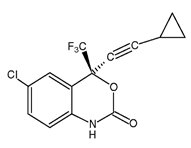
    Efavirenz: The chemical name of efavirenz is (4S)-6-chloro-4-(cyclopropylethynyl)-1,4-dihydro-4-(trifluoromethyl)-2H-3,1-benzoxazin-2-one. Its molecular formula is C14H9ClF3NO2 and its structural formula is:
    Efavirenz Structural Formula
    Efavirenz is a white to slightly pink crystalline powder with a molecular mass of 315.68. It is soluble in methanol and practically insoluble in water (< 10 microgram/mL).
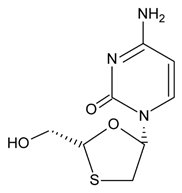
    Lamivudine: The chemical name of lamivudine is (-)-1-[(2R,5S)-2-(Hydroxymethyl)-1,3-oxathiolan-5-yl]cytosine. Lamivudine is the (-)enantiomer of a dideoxy analogue of cytidine. Lamivudine has also been referred to as (-)2′,3′-dideoxy, 3′-thiacytidine. It has a molecular formula of C8H11N3O3S and a molecular weight of 229.26 g per mol. It has the following structural formula:
    Lamivudine Structural Formula
    Lamivudine is a white to off-white solid with a solubility of approximately 70 mg per mL in water at 20°C.
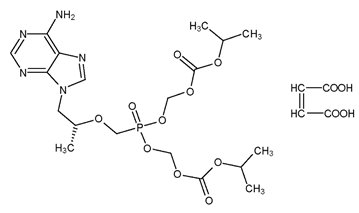
    Tenofovir Disoproxil Fumarate: The chemical name of tenofovir DF is 9-[(R)-2-[[Bis[[(isopropoxycarbonyl)oxy]methoxy]phosphinyl]methoxy]propyl]adenine fumarate (1:1). It has a molecular formula of C19H30N5O10P•C4H4O4 and a molecular weight of 635.51. It has the following structural formula:
    Tenofovir Disoproxil Fumarate Structural Formula
    Tenofovir DF is a white to off-white powder with a solubility of 13.4 mg/mL in distilled water at 25°C. It has an octanol/phosphate buffer (pH 6.5) partition coefficient (log p) of 1.25 at 25°C.
    7HOW SUPPLIED/STORAGE AND HANDLING
    SYMFI (efavirenz, lamivudine and tenofovir disoproxil fumarate) Tablets 600 mg/300 mg/300 mg are white, film-coated, capsule shaped, debossed with
    NDC 49502-475-93
    NDC 49502-475-77
    Store below 30°C (86°F).
    Keep the bottle tightly closed.
    Dispense in original container.
    Do not use if seal over bottle opening is broken or missing.
    8PATIENT COUNSELING INFORMATION
    Advise the patient to read the FDA-approved patient labeling (
    Drug Interactions: SYMFI may interact with many drugs; therefore, advise patients to report to their healthcare provider the use of any other prescription, nonprescription medication, or herbal products, particularly St. John’s wort [see .
    Post Treatment Acute Exacerbation of Hepatitis B in Patients with HBV Co-Infection: Inform patients that severe acute exacerbations of hepatitis have been reported in patients who are infected with HBV or coinfected with HBV and HIV-1 and have discontinued 3TC and TDF, components of SYMFI. Test patients with HIV-1 for hepatitis B virus (HBV) before initiating antiretroviral therapy. In patients with chronic hepatitis B, it is important to obtain HIV antibody testing prior to initiating 3TC and TDF, components of SYMFI [see Warnings and Precautions (5.1)].
    Lactic Acidosis and Severe Hepatomegaly: Inform patients that lactic acidosis and severe hepatomegaly with steatosis, including fatal cases, have been reported. Treatment with SYMFI should be suspended in any patient who develops clinical symptoms suggestive of lactic acidosis or pronounced hepatotoxicity (including nausea, vomiting, unusual or unexpected stomach discomfort, and weakness) [see .
    New Onset or Worsening Renal Impairment: Inform patients that renal impairment, including cases of acute renal failure and Fanconi syndrome, has been reported. Advise patients with impaired renal function (i.e., creatinine clearance less than 50 mL/min) or patients with end-stage renal disease (ESRD) requiring hemodialysis to avoid SYMFI with concurrent or recent use of a nephrotoxic agent (e.g., high-dose or multiple NSAIDs) for patients [see .
    Psychiatric Symptoms: Inform patients that serious psychiatric symptoms including severe depression, suicide attempts, aggressive behavior, delusions, paranoia, psychosis-like symptoms and catatonia have been reported in patients receiving EFV [seeWarnings and Precautions (5.5)]. Advise patients to seek immediate medical evaluation if they experience severe psychiatric adverse experiences. Advise patients to inform their physician of any history of mental illness or substance abuse.
    Nervous System Symptoms: Inform patients that central nervous system symptoms (NSS) including dizziness, insomnia, impaired concentration, drowsiness, and abnormal dreams are commonly reported during the first weeks of therapy with EFV, a component of SYMFI [seeWarnings and Precautions (5.6)]. Dosing at bedtime may improve the tolerability of these symptoms, which are likely to improve with continued therapy. Alert patients to the potential for additive effects when used concomitantly with alcohol or psychoactive drugs. Instruct patients that if they experience NSS they should avoid potentially hazardous tasks such as driving or operating machinery.
    Inform patients that there is a risk of developing late-onset neurotoxicity, including ataxia and encephalopathy, which may occur months to years after beginning efavirenz therapy
    Embryo-Fetal Toxicity: Advise female patients that EFV, a component of SYMFI may cause fetal harm when administered during the first trimester to a pregnant woman. Advise females of reproductive potential to use effective contraception as well as a barrier method during treatment with SYMFI and for 12 weeks after discontinuation of use. Advise patients to contact their healthcare provider if they plan to become pregnant, become pregnant, or if pregnancy is suspected during treatment with SYMFI [see .
    Rash: Inform patients that rash is a common side effect of EFV [seeWarnings and Precautions (5.8)]. Rashes usually go away without any change in treatment. However, since rash may be serious, patients should be advised to contact their physician promptly if rash occurs.
    Hepatotoxicity: Inform patients to watch for early warning signs of liver inflammation or failure, such as fatigue, weakness, lack of appetite, nausea and vomiting, as well as later signs such as jaundice, confusion, abdominal swelling, and discolored feces and to consult their healthcare provider promptly if such symptoms occur [see
    Pancreatitis: Advise patients or guardians to monitor pediatric patients for signs and symptoms of pancreatitis [see Warnings and Precautions (5.10)].
    Convulsions: Advise patients that convulsions have been observed in patients receiving EFV, a component of SYMFI, generally in patients with known medical history of seizures [see Warnings and Precautions (5.11)].
    Lipid Elevations: Advise patients treatment with EFV, a component of SYMFI has resulted in increases in the concentration of total cholesterol and triglycerides [see Warnings and Precautions (5.12)].
    Bone Loss and Mineralization Effects: Inform patients that decreases in bone mineral density have been observed with the use of 3TC and TDF, components of SYMFI, in patients with HIV [see Warnings and Precautions (5.13)].
    Immune Reconstitution Syndrome: Advise patients to inform their healthcare provider immediately of any symptoms of infection, as in some patients with advanced HIV infection, signs and symptoms of inflammation from previous infections may occur soon after anti-HIV treatment is started [see Warnings and Precautions (5.14)].
    Fat Redistribution: Inform patients that redistribution or accumulation of body fat may occur in patients receiving antiretroviral therapy, including SYMFI, and that the cause and long‑term health effects of these conditions are not known at this time [see Warnings and Precautions (5.15)].
    Administration Instructions: Inform patients that it is important to take SYMFI once daily on a regular dosing schedule on an empty stomach, preferably at bedtime, and to avoid missing doses as it can result in development of resistance. Advise patients if a dose is missed, take it as soon as possible unless it is almost time for the next dose. Also advise patients that dosing at bedtime may improve the tolerability of nervous system symptoms [see .
    Pregnancy Registry: Advise patients that there is an antiretroviral pregnancy registry to monitor fetal outcomes in women exposed to SYMFI [see .
    Lactation: Instruct women with HIV-1 infection not to breastfeed because HIV-1 can be passed to the baby in breast milk [see .
    SYMFI
    Other brands listed are the registered trademarks of their respective owners and are not trademarks of Mylan Laboratories Limited or Mylan Pharmaceuticals Inc.
    Rx only
    Manufactured for:
    Manufactured by:
    9Patient Information
    This Patient Information has been approved by the U.S. Food and Drug Administration.     Revised: 10/2019
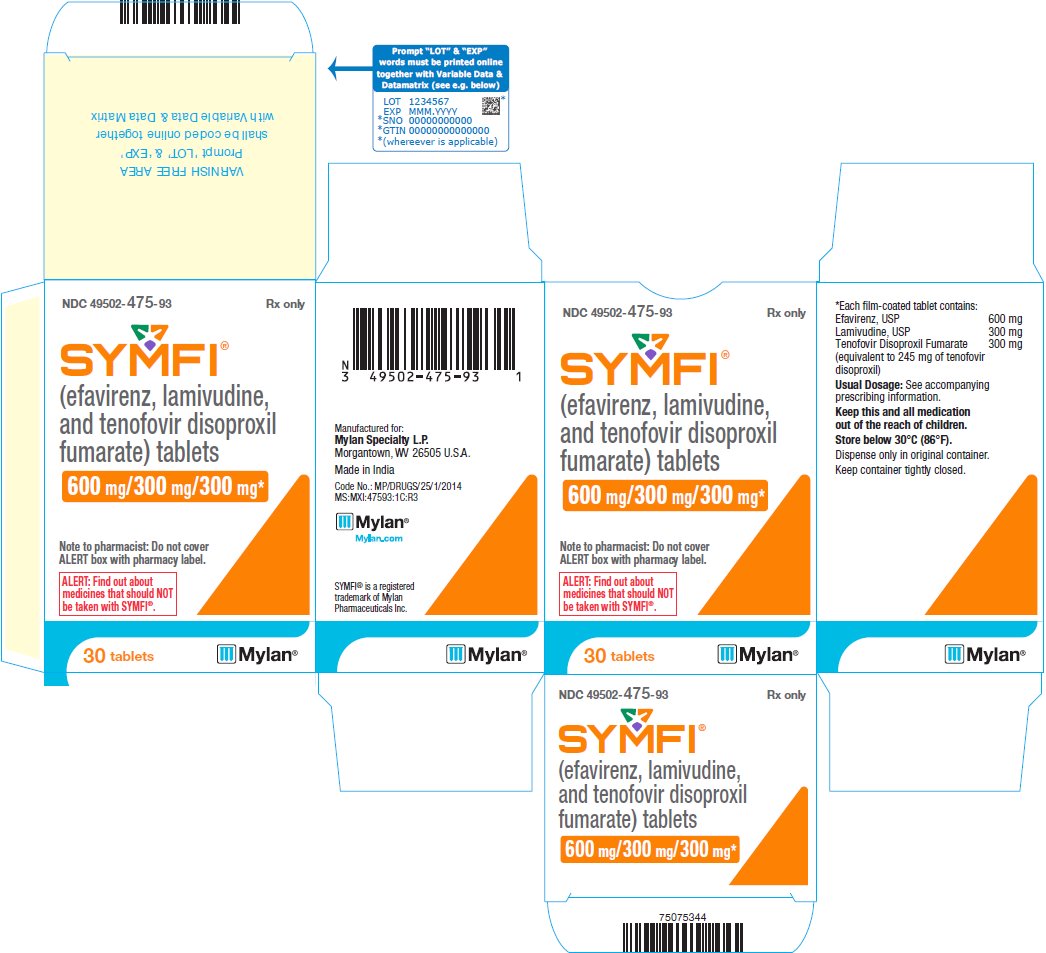
    10PRINCIPAL DISPLAY PANEL - 600 mg/300 mg/300 mg
    NDC 49502-475-93     Rx only
    SYMFI
    Note to pharmacist: Do not cover
    ALERT: Find out about
    30 tablets
    *Each film-coated tablet contains:
    Usual Dosage: See accompanying
    prescribing information.
    Keep this and all medication
    Store below 30°C (86°F).
    Dispense only in original container.
    Manufactured for:
    Made in India
    Code No.: MP/DRUGS/25/1/2014
    MS:MXI:47593:1C:R3
    Mylan.com
    SYMFI
    Symfi Tablets 600 mg/300 mg/300 mg Carton Label
    SYMFI has been selected.