Generic Name

Darunavir

Brand Names
Darunavir 600, Prezista, Symtuza
FDA approval date: March 08, 2008
Classification: Protease Inhibitor
Form: Tablet, Suspension

What is Darunavir 600 (Darunavir)?

Darunavir tablets, co-administered with ritonavir , in combination with other antiretroviral agents, is indicated for the treatment of human immunodeficiency virus infection in adult and pediatric patients 3 years of age and older [see Use in Specific Populations.

Approved To Treat

Save this treatment for later
Sign Up
Not sure about your diagnosis?
Check Your Symptoms

Related Clinical Trials

Early Metabolic Effects of Antiretroviral Drugs in Healthy Volunteers: A Phase 2 Randomized Study

Background: People with HIV take drugs to keep the amount of virus in their body low. One type of these drugs, called integrase strand transfer inhibitors (INSTIs), can cause weight gain over time. Weight gain can cause diabetes, heart disease, and other serious issues. Researchers want to understand how INSTIs cause weight changes.

All Soft Tissue Quadriceps Tendon Autograft Versus Patellar Tendon Autograft in Anterior Cruciate Ligament Reconstruction: a Randomized Controlled Trial

Summary: The choice of autograft for ACL reconstruction continues to be debated. To date, there has only be one completed randomized controlled trial with quad tendon to BTB and the tendon included a bone plug. There has been no study to date comparing an all soft tissue quad tendon to patellar tendon in a randomized controlled trial for ACL reconstruction.

An Open-label, Single-arm Study to Provide Continued Access to Study Drug to Participants Who Have Completed Pediatric Clinical Studies Involving Gilead HIV Treatments

Summary: The goal of this clinical study is to provide continued access to the study drug(s) to children and adolescents with human immunodeficiency virus type 1 (HIV-1) who completed their participation in an applicable parent study and to monitor for adverse events. The primary objectives of this study are as follows: * To provide continued access to the study drug received in the parent protocol or swit...

Brand Information

    Darunavir 600 and 800 mg (darunavir)
    1INDICATIONS AND USAGE
    Darunavir tablets, co-administered with ritonavir (darunavir/ritonavir), in combination with other antiretroviral agents, is indicated for the treatment of human immunodeficiency virus (HIV-1) infection in adult and pediatric patients 3 years of age and older
    2DOSAGE FORMS AND STRENGTHS
    Darunavir Tablets
    • 600 mg: beige, capsule-shaped, biconvex, film coated tablets containing darunavir hydrate equivalent to 600 mg of darunavir. Each tablet is debossed with "C248" on one side and "plain" on the other side.
    • 800 mg: white to off-white, capsule-shaped, biconvex, film coated tablets containing darunavir hydrate equivalent to 800 mg of darunavir. Each tablet is debossed with "C244" on one side and "plain" on the other side.
    3CONTRAINDICATIONS
    Co-administration of darunavir/ritonavir is contraindicated with drugs that are highly dependent on CYP3A for clearance and for which elevated plasma concentrations are associated with serious and/or life-threatening events (narrow therapeutic index). Examples of these drugs and other contraindicated drugs (which may lead to reduced efficacy of darunavir) are listed below [see Drug Interactions (7.3)]. Due to the need for co-administration of darunavir with ritonavir, please refer to ritonavir prescribing information for a description of ritonavir contraindications.
    •        Alpha 1-adrenoreceptor antagonist: alfuzosin
    •        Anti-gout: colchicine, in patients with renal and/or hepatic impairment
    •        Antimycobacterial: rifampin
    •        Antipsychotics: lurasidone, pimozide
    •        Cardiac Disorders: dronedarone, ivabradine, ranolazine
    •        Ergot derivatives, e.g. dihydroergotamine, ergotamine, methylergonovine
    •        Herbal product: St. John’s wort (
    •        Hepatitis C direct acting antiviral: elbasvir/grazoprevir
    •        Lipid modifying agents: lomitapide, lovastatin, simvastatin
    •        Opioid Antagonist: naloxegol
    •        PDE-5 inhibitor: sildenafil when used for treatment of pulmonary arterial hypertension
    •        Sedatives/hypnotics: orally administered midazolam, triazolam
    4ADVERSE REACTIONS
    The following adverse reactions are discussed in other sections of labeling:
    • Hepatotoxicity
    • Severe Skin Reactions
    • Diabetes Mellitus/Hyperglycemia
    • Fat Redistribution
    • Immune Reconstitution Syndrome
    • Hemophilia
    Due to the need for co-administration of darunavir tablets with ritonavir, please refer to ritonavir prescribing information for ritonavir-associated adverse reactions.
    4.1Clinical Trials Experience
    Because clinical trials are conducted under widely varying conditions, adverse reaction rates observed in the clinical trials of a drug cannot be directly compared to rates in the clinical trials of another drug and may not reflect the rates observed in clinical practice.
    Treatment Naïve-Adults: TMC114-C211
    The safety assessment is based on all safety data from the Phase 3 trial TMC114-C211 comparing darunavir/ritonavir 800/100 mg once daily versus lopinavir/ritonavir 800/200 mg per day in 689 antiretroviral treatment-naïve HIV-1-infected adult subjects. The total mean exposure for subjects in the darunavir/ritonavir 800/100 mg once daily arm and in the lopinavir/ritonavir 800/200 mg per day arm was 162.5 and 153.5 weeks, respectively.
    The majority of the adverse drug reactions (ADRs) reported during treatment with darunavir/ritonavir 800/100 mg once daily were mild in severity. The most common clinical ADRs to darunavir/ritonavir 800/100 mg once daily (greater than or equal to 5%) of at least moderate intensity (greater than or equal to Grade 2) were diarrhea, headache, abdominal pain and rash. 2.3% of subjects in the darunavir/ritonavir arm discontinued treatment due to ADRs.
    ADRs to darunavir/ritonavir 800/100 mg once daily of at least moderate intensity (greater than or equal to Grade 2) in antiretroviral treatment-naïve HIV-1-infected adult subjects are presented in Table 6 and subsequent text below the table.
    Less Common Adverse Reactions
    Treatment-emergent ADRs of at least moderate intensity (greater than or equal to Grade 2) occurring in less than 2% of antiretroviral treatment-naïve subjects receiving darunavir/ritonavir 800/100 mg once daily are listed below by body system:
    Gastrointestinal Disorders: acute pancreatitis, dyspepsia, flatulence
    General Disorders and Administration Site Conditions: asthenia
    Hepatobiliary Disorders: acute hepatitis (e.g., acute hepatitis, cytolytic hepatitis, hepatotoxicity)
    Immune System Disorders: (drug) hypersensitivity, immune reconstitution syndrome
    Metabolism and Nutrition Disorders: diabetes mellitus
    Musculoskeletal and Connective Tissue Disorders: myalgia, osteonecrosis
    Psychiatric Disorders: abnormal dreams
    Skin and Subcutaneous Tissue Disorders: angioedema, pruritus, Stevens-Johnson Syndrome, urticaria
    Laboratory Abnormalities
    Selected Grade 2 to 4 laboratory abnormalities that represent a worsening from baseline observed in antiretroviral treatment-naïve adult subjects treated with darunavir/ritonavir 800/100 mg once daily are presented in Table 7.
    Treatment-Experienced Adults: TMC114-C214
    The safety assessment is based on all safety data from the Phase 3 trial TMC114-C214 comparing darunavir/ritonavir 600/100 mg twice daily versus lopinavir/ritonavir 400/100 mg twice daily in 595 antiretroviral treatment-experienced HIV-1-infected adult subjects. The total mean exposure for subjects in the darunavir/ritonavir 600/100 mg twice daily arm and in the lopinavir/ritonavir 400/100 mg twice daily arm was 80.7 and 76.4 weeks, respectively.
    The majority of the ADRs reported during treatment with darunavir/ritonavir 600/100 mg twice daily were mild in severity. The most common clinical ADRs to darunavir/ritonavir 600/100 mg twice daily (greater than or equal to 5%) of at least moderate intensity (greater than or equal to Grade 2) were diarrhea, nausea, rash, abdominal pain and vomiting. 4.7% of subjects in the darunavir/ritonavir arm discontinued treatment due to ADRs.
    ADRs to darunavir/ritonavir 600/100 mg twice daily of at least moderate intensity (greater than or equal to Grade 2) in antiretroviral treatment-experienced HIV-1-infected adult subjects are presented in Table 8 and subsequent text below the table.
    Less Common Adverse Reactions
    Treatment-emergent ADRs of at least moderate intensity (greater than or equal to Grade 2) occurring in less than 2% of antiretroviral treatment-experienced subjects receiving darunavir/ritonavir 600/100 mg twice daily are listed below by body system:
    Gastrointestinal Disorders: acute pancreatitis, flatulence
    Musculoskeletal and Connective Tissue Disorders: myalgia
    Psychiatric Disorders: abnormal dreams
    Skin and Subcutaneous Tissue Disorders: pruritus, urticaria
    Laboratory Abnormalities
    Selected Grade 2 to 4 laboratory abnormalities that represent a worsening from baseline observed in antiretroviral treatment-experienced adult subjects treated with darunavir/ritonavir 600/100 mg twice daily are presented in Table 9.
    Serious ADRs
    The following serious ADRs of at least moderate intensity (greater than or equal to Grade 2) occurred in the Phase 2b and Phase 3 trials with darunavir/ritonavir: abdominal pain, acute hepatitis, acute pancreatitis, anorexia, asthenia, diabetes mellitus, diarrhea, fatigue, headache, hepatic enzyme increased, hypercholesterolemia, hyperglycemia, hypertriglyceridemia, immune reconstitution syndrome, low density lipoprotein increased, nausea, pancreatic enzyme increased, rash, Stevens-Johnson Syndrome, and vomiting.
    Patients Co-Infected with Hepatitis B and/or Hepatitis C Virus
    In subjects co-infected with hepatitis B or C virus receiving darunavir/ritonavir, the incidence of adverse events and clinical chemistry abnormalities was not higher than in subjects receiving darunavir/ritonavir who were not co-infected, except for increased hepatic enzymes
    Clinical Trials Experience: Pediatric Patients
    Darunavir/ritonavir has been studied in combination with other antiretroviral agents in 3 Phase 2 trials. TMC114-C212, in which 80 antiretroviral treatment-experienced HIV-1-infected pediatric subjects 6 to less than 18 years of age and weighing at least 20 kg were included, TMC114-C228, in which 21 antiretroviral treatment-experienced HIV-1-infected pediatric subjects 3 to less than 6 years of age and weighing at least 10 kg were included, and TMC114-C230 in which 12 antiretroviral treatment-naïve HIV-1 infected pediatric patients aged from 12 to less than 18 years and weighing at least 40 kg were included. The TMC114-C212 and C228 trials evaluated darunavir/ritonavir twice daily dosing and the TMC114-C230 trial evaluated darunavir/ritonavir once daily dosing
    Frequency, type, and severity of ADRs in pediatric subjects were comparable to those observed in adults.
    TMC114-C212
    Clinical ADRs to darunavir/ritonavir (all grades, greater than or equal to 3%), were vomiting (13%), diarrhea (11%), abdominal pain (10%), headache (9%), rash (5%), nausea (4%), and fatigue (3%).
    Grade 3 or 4 laboratory abnormalities were ALT increased (Grade 3: 3%; Grade 4: 1%), AST increased (Grade 3: 1%), pancreatic amylase increased (Grade 3: 4%, Grade 4: 1%), pancreatic lipase increased (Grade 3: 1%), total cholesterol increased (Grade 3: 1%), and LDL increased (Grade 3: 3%).
    TMC114-C228
    Clinical ADRs to darunavir/ritonavir (all grades, greater than or equal to 5%), were diarrhea (24%), vomiting (19%), rash (19%), abdominal pain (5%), and anorexia (5%).
    There were no Grade 3 or 4 laboratory abnormalities considered as ADRs in this trial.
    TMC114-C230
    Clinical ADRs to darunavir/ritonavir (all grades, greater than or equal to 3%), were vomiting (33%), nausea (25%), diarrhea (16.7%), abdominal pain (8.3%), decreased appetite (8.3%), pruritus (8.3%), and rash (8.3%).
    There were no Grade 3 or 4 laboratory abnormalities considered as ADRs in this trial.
    4.2Postmarketing Experience
    The following adverse reactions have been identified during post-approval use of darunavir. Because these reactions are reported voluntarily from a population of uncertain size, it is not always possible to reliably estimate their frequency or establish a causal relationship to drug exposure.
    Metabolism and Nutrition Disorders: Redistribution of body fat.
    Musculoskeletal and Connective Tissue Disorders: Rhabdomyolysis (associated with co-administration with HMG-CoA reductase inhibitors and darunavir/ritonavir).
    Skin and Subcutaneous Tissue Disorders: Toxic epidermal necrolysis, acute generalized exanthematous pustulosis, drug rash with eosinophilia and systemic symptoms
    Renal and Urinary Disorders: Crystal nephropathy, crystalluria
    5OVERDOSAGE
    Human experience of acute overdose with darunavir/ritonavir is limited. No specific antidote is available for overdose with darunavir. Treatment of overdose with darunavir consists of general supportive measures including monitoring of vital signs and observation of the clinical status of the patient. Since darunavir is highly protein bound, dialysis is unlikely to be beneficial in significant removal of the active substance.
    6DESCRIPTION
    Darunavir is an inhibitor of the human immunodeficiency virus (HIV-1) protease.
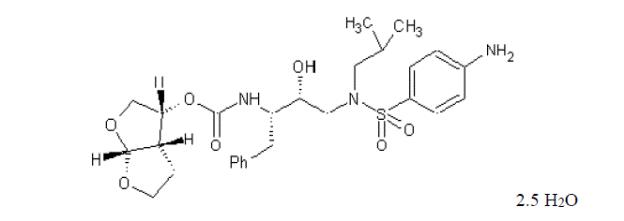
    Darunavir, in the form of darunavir hydrate, has the following chemical name: [(1S,2R)-3-[[(4-aminophenyl)sulfonyl](2-methylpropyl)amino]-2-hydroxy-1-(phenylmethyl)propyl]-carbamic acid (3R,3aS,6aR)-hexahydrofuro[2,3-b]furan-3-yl ester hydrate. Its molecular formula is C
    Image
    Darunavir hydrate is a white to off-white crystalline powder which is soluble in methanol and freely soluble in acetone and dimethylsulfoxide.
    Darunavir 600 mg tablets are available as beige, capsule-shaped, biconvex, film coated tablets for oral administration. Each 600 mg tablet contains darunavir hydrate equivalent to 600 mg of darunavir.
    Darunavir 800 mg tablets are available as white to off-white, capsule-shaped, biconvex, film coated tablets for oral administration. Each 800 mg tablet contains darunavir hydrate equivalent to 800 mg of darunavir.
    Each tablet also contains the inactive ingredients microcrystalline cellulose, crospovidone, colloidal silicon dioxide, and magnesium stearate. The 800 mg tablet also contains povidone. The 600 mg tablets are film coated with OPADRY
    All dosages for darunavir hydrate are expressed in terms of the free form of darunavir.
    7HOW SUPPLIED/STORAGE AND HANDLING
    Darunavir 600 mg tablets are supplied as beige, capsule-shaped, biconvex, film coated tablets containing darunavir hydrate equivalent to 600 mg of darunavir per tablet. Each tablet is debossed with "C248" on one side and "plain" on the other side.
    Darunavir 800 mg tablets are supplied as white to off-white, capsule-shaped, biconvex, film coated tablets containing darunavir hydrate equivalent to 800 mg of darunavir per tablet. Each tablet is debossed with "C244" on one side and "plain" on the other side.
    Darunavir tablets are packaged in bottles in the following configuration:
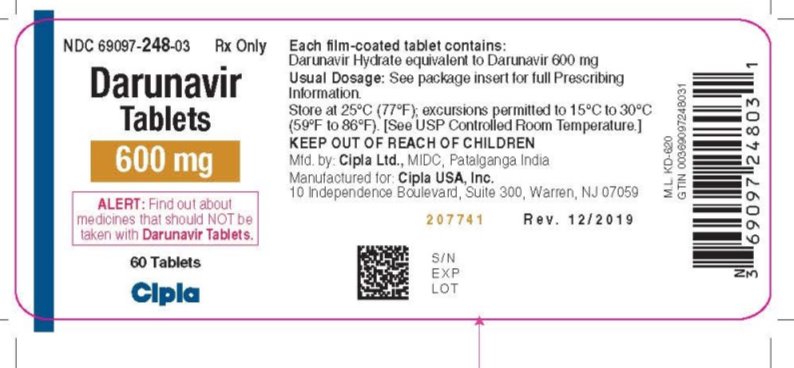
    • 600 mg tablet – bottles of 60 (NDC 69097-248-03)
    • 800 mg tablet – bottles of 30 (NDC 69097-244-02)
    Storage:
    Darunavir tablets
    • Store at 25°C (77°F); with excursions permitted to 15°C-30°C (59°F-86°F). [See USP Controlled Room Temperature.]
    • Keep darunavir tablets out of reach of children.
    8PATIENT COUNSELING INFORMATION
    Advise the patient to read the FDA-approved patient labeling (Patient Information and Instruction for Use).
    Instructions for Use
    Advise patients to take darunavir and ritonavir with food every day on a regular dosing schedule, as missed doses can result in development of resistance. Darunavir must always be used with ritonavir in combination with other antiretroviral drugs. Advise patients not to alter the dose of either darunavir or ritonavir, discontinue ritonavir, or discontinue therapy with darunavir without consulting their physician
    Hepatotoxicity
    Inform patients that drug-induced hepatitis (e.g., acute hepatitis, cytolytic hepatitis) has been reported with darunavir co-administered with 100 mg of ritonavir. Advise patients about the signs and symptoms of liver problems
    Severe Skin Reactions
    Inform patients that skin reactions ranging from mild to severe, including Stevens-Johnson Syndrome, drug rash with eosinophilia and systemic symptoms, and toxic epidermal necrolysis, have been reported with darunavir co-administered with 100 mg of ritonavir. Advise patients to discontinue darunavir/ritonavir immediately if signs or symptoms of severe skin reactions develop. These can include but are not limited to severe rash or rash accompanied with fever, general malaise, fatigue, muscle or joint aches, blisters, oral lesions, conjunctivitis, hepatitis and/or eosinophilia
    Drug Interactions
    Darunavir/ritonavir may interact with many drugs; therefore, advise patients to report to their healthcare provider the use of any other prescription or nonprescription medication or herbal products, including St. John's wort
    Contraception
    Instruct patients receiving combined hormonal contraception or the progestin only pill to use an effective alternative (non-hormonal) contraceptive method or add a barrier method during therapy with darunavir /ritonavir because hormonal levels may decrease
    Fat Redistribution
    Inform patients that redistribution or accumulation of body fat may occur in patients receiving antiretroviral therapy, including darunavir/ritonavir, and that the cause and long-term health effects of these conditions are not known at this time
    Immune Reconstitution Syndrome
    Advise patients to inform their healthcare provider immediately of any symptoms of infection, as in some patients with advanced HIV infection (AIDS), signs and symptoms of inflammation from previous infections may occur soon after anti-HIV treatment is started
    Pregnancy Registry
    Inform patients that there is an antiretroviral pregnancy registry to monitor fetal outcomes of pregnant women exposed to darunavir
    Lactation
    Instruct women with HIV-1 infection not to breastfeed because HIV-1 can be passed to the baby in breast milk
    Manufactured by:
    Cipla Ltd.
    MIDC, Patalganga INDIA
    Manufactured for:
    Cipla USA, Inc.,
    10 Independence Boulevard, Suite 300, Warren
    New Jersey - 07059
    Disclaimer: Other brands listed are the registered trademarks of their respective owners and are not of Cipla Ltd.
    Revised: 08/2023
    9PATIENT MEDICATION INFORMATION SECTION
    PATIENT INFORMATION
    Darunavir (dar-UE-na-vir)
    Tablets
    Read this Patient Information before you start taking darunavir tablets and each time you get a refill. There may be new information. This information does not take the place of talking to your healthcare provider about your medical condition or your treatment.
    Also read the Patient Information leaflet for ritonavir.
    What is the most important information I should know about darunavir tablets?
    • Ask your healthcare provider or pharmacist about medicines that should not be taken with darunavir tablets. For more information, see"Who should not take darunavir tablets?" and "What should I tell my healthcare provider before taking darunavir tablets?"
    • Darunavir tablets may cause liver problems. Some people taking darunavir tablets in combination with ritonavir have developed liver problems, which may be life-threatening. Your healthcare provider should do blood tests before and during your darunavir and ritonavir combination treatment. If you have chronic hepatitis B or C infection, your healthcare provider should check your blood tests more often because you have an increased chance of developing liver problems. Tell your healthcare provider if you have any of the below signs and symptoms of liver problems.
    • dark (tea colored) urine
    • yellowing of your skin or whites of your eyes
    • pale colored stools (bowel movements)
    • nausea
    • vomiting
    • pain or tenderness on your right side below your ribs
    • loss of appetite
    • tiredness
    • Darunavir tablets may cause severe or life-threatening skin reactions or rash. Sometimes these skin reactions and skin rashes can become severe and require treatment in a hospital. Tell your healthcare provider right away if you develop a rash. Stop taking darunavir tablets and ritonavir combination treatment and tell your healthcare provider right away if you have any skin changes with symptoms below:
    • fever
    • tiredness
    • muscle or joint pain
    • blisters or skin lesions
    • mouth sores or ulcers
    • red or inflamed eyes, like "pink eye" (conjunctivitis)
    Rash occurred more often in people taking darunavir tablets and raltegravir together than with either drug separately, but was generally mild.
    See
    What are darunavir tablets?
    Darunavir tablets are prescription HIV-1 (Human Immunodeficiency Virus-type 1) medicine used with ritonavir and other antiretroviral medicines to treat HIV-1 infection in adults and children 3 years of age and older. HIV is the virus that causes AIDS (Acquired Immune Deficiency Syndrome).
    Darunavir should not be used in children under 3 years of age.
    When used with other antiretroviral medicines to treat HIV-1 infection, darunavir tablets may help:
    • reduce the amount of HIV-1 in your blood. This is called "viral load".
    • increase the number of CD4+ (T) cells in your blood that help fight off other infections.
    Reducing the amount of HIV-1 and increasing the CD4+ (T) cells in your blood may improve your immune system. This may reduce your risk of death or getting infections that can happen when your immune system is weak (opportunistic infections).
    Darunavir tablet does not cure HIV-1 infection or AIDS. You must keep taking HIV-1 medicines to control HIV-1 infection and decrease HIV-related illnesses.
    Avoid doing things that can spread HIV-1 infection to others:
    • Do not share or re-use needles or other injection equipment.
    • Do not share personal items that can have blood or body fluids on them, like toothbrushes and razor blades.
    • Do not have any kind of sex without protection. Always practice safe sex by using a latex or polyurethane condom to lower the chance of sexual contact with semen, vaginal secretions, or blood.
    Ask your healthcare provider if you have any questions on how to prevent passing HIV to other people.
    Who should not take darunavir tablets?
    Do not take darunavir tablets with any medicine that contains:
    • Alfuzosin
    • colchicine, if you have liver or kidney problems
    • dronedarone
    • elbasvir and grazoprevir
    • ergot-containing medicines:
    • dihydroergotamine
    • ergotamine tartrate
    • methylergonovine
    • ivabradine
    • lomitapide
    • lovastatin
    • lurasidone
    • midazolam, when taken by mouth
    • naloxegol
    • pimozide
    • ranolazine
    • rifampin
    • sildenafil, when used for the treatment of pulmonary arterial hypertension (PAH)
    • simvastatin
    • St. John's wort
    • triazolam
    Serious problems can happen if you or your child take any of these medicines with darunavir tablets. This is not a complete list of medicines. Therefore, tell your healthcare provider about all medicines you take.
    What should I tell my healthcare provider before taking darunavir tablets?
    Before taking darunavir tablets, tell your healthcare provider if you:
    • have liver problems, including hepatitis B or hepatitis C
    • are allergic to sulfa medicines
    • have high blood sugar (diabetes)
    • have hemophilia
    • have any other medical conditions
    • are pregnant or plan to become pregnant. Tell your healthcare provider if you become pregnant while taking darunavir tablets.
    • PregnancyRegistry: There is a pregnancy registry for women who take antiretroviral medicines during pregnancy. The purpose of this registry is to collect information about the health of you and your baby. Talk to your healthcare provider about how you can take part in this registry.
    • are breastfeeding or plan to breastfeed. Do not breastfeed if you take darunavir tablets.
    • You should not breastfeed if you have HIV-1 because of the risk of passing HIV-1 to your baby.
    • It is not known if darunavir can pass into your breast milk.
    • Talk to your healthcare provider about the best way to feed your baby.
    Tell your healthcare provider about all the medicines you take, including prescription and over-the-counter medicines, topical creams, vitamins, and herbal supplements. Some medicines interact with darunavir. Keep a list of your medicines to show your healthcare provider and pharmacist.
    • You can ask your healthcare provider or pharmacist for a list of medicines that interact with darunavir tablets.
    • Do not start taking a new medicine without telling your healthcare provider. Your healthcare provider can tell you if it is safe to take darunavir tablets with other medicines.
    How should I take darunavir tablets?
    • Take darunavir tablets exactly as your healthcare provider tells you.
    • You must take ritonavir at the same time as darunavir tablets.
    • Do not change your dose or stop treatment with darunavir tablets without talking to your healthcare provider.
    • Take darunavir tablets and ritonavir with food.
    • If you have difficulty swallowing darunavir tablets, darunavir oral suspension is also available. Your healthcare provider will help decide whether darunavir tablets or oral suspension is right for you.
    • If your child is taking darunavir tablets, your child's healthcare provider will decide the right dose based on your child's weight. Your child's healthcare provider will tell you how much darunavir (tablets or oral suspension) and how much ritonavir (capsules, tablets or solution) your child should take. Your child should take darunavir tablets with ritonavir with food. If your child does not tolerate ritonavir oral solution, ask your child's healthcare provider for advice.
    • It is important that you do not miss or skip doses of darunavir tablets during treatment.
    • If you take too much darunavir tablets, call your healthcare provider or go to the nearest hospital emergency room right away.
    What are the possible side effects of darunavir tablets?
    Darunavir tablets may cause serious side effects, including:
    • See "
    • Diabetes and high blood sugar (hyperglycemia). Some people who take protease inhibitors including darunavir can get high blood sugar, develop diabetes, or your diabetes can get worse. Tell your healthcare provider if you notice an increase in thirst or urinate often while taking darunavir tablets.
    • Changes in body fat can happen in people who take HIV-1 medicines. The changes may include an increased amount of fat in the upper back and neck ("buffalo hump"), breast, and around the middle of your body (trunk). Loss of fat from the legs, arms, and face may also happen. The exact cause and long-term health effects of these conditions are not known.
    • Changes in your immune system (Immune Reconstitution Syndrome) can happen when you start taking HIV-1 medicines. Your immune system may get stronger and begin to fight infections that have been hidden in your body for a long time. Tell your healthcare provider right away if you start having new symptoms after starting your HIV-1 medicine.
    • Increased bleeding for hemophiliacs. Some people with hemophilia have increased bleeding with protease inhibitors including darunavir.
    The most common side effects of darunavir include:
    • diarrhea
    • nausea
    • rash
    • headache
    • stomach-area (abdominal) pain
    • vomiting
    Tell your healthcare provider if you have any side effect that bothers you or that does not go away.
    These are not all of the possible side effects of darunavir tablets.
    Call your doctor for medical advice about side effects. You may report side effects to FDA at 1-800-FDA-1088.
    How should I store darunavir tablets?
    • Store darunavir tablets at room temperature 77°F (25°C).
    Keep darunavir tablets and all medicines out of the reach of children.
    General information about the safe and effective use of darunavir tablets.
    Medicines are sometimes prescribed for purposes other than those listed in a Patient Information leaflet. Do not use darunavir tablets for a condition for which it was not prescribed. Do not give darunavir tablets to other people even if they have the same condition you have. It may harm them.
    This leaflet summarizes the most important information about darunavir tablets. If you would like more information, talk to your healthcare provider. You can ask your healthcare provider or pharmacist for information about darunavir tablets that is written for health professionals. For more information, call 1-866-604-3268.
    What are the ingredients in darunavir tablets, USP?
    Active ingredient: darunavir
    Inactive ingredients:
    Darunavir 600 mg tablets: colloidal silicon dioxide, crospovidone, magnesium stearate, microcrystalline cellulose. The film coating contains: OPADRY® II 85F570242 Beige (FD&C Yellow No. 6, polyethylene glycol 3350, polyvinyl alcohol-partially hydrolyzed, talc, and titanium dioxide).
    Darunavir 800 mg tablets: microcrystalline cellulose, crospovidone, colloidal silicon dioxide, povidone, and magnesium stearate. The film coating contains: OPADRY® White 85F28751 (polyethylene glycol 3350, polyvinyl alcohol-partially hydrolyzed, talc, and titanium dioxide).
    This Patient Information has been approved by the U.S Food and Drug Administration.
    Manufactured by:
    Cipla Ltd.
    MIDC, Patalganga, INDIA
    Manufactured for:
    Cipla USA, Inc.,
    10 Independence Boulevard, Suite 300, Warren
    New Jersey - 07059
    Disclaimer: Other brands listed are the registered trademarks of their respective owners and are not of Cipla Ltd.
    Revised: 08/2023
    10PACKAGE LABEL.PRINCIPAL DISPLAY PANEL
    RX ONLY
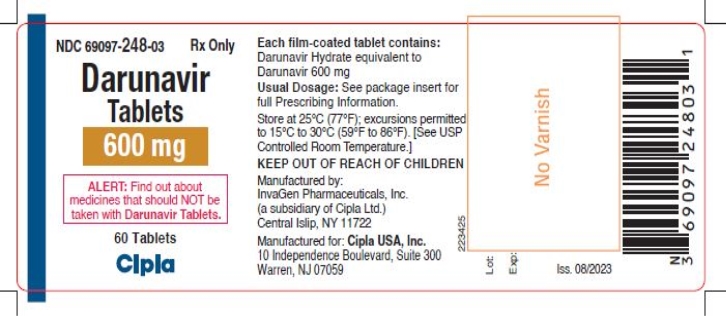
    NDC 69097-248-03
    Darunavir
    Tablets
    600MG
    ALERT: Find out about
    medicines that should NOT be
    taken with Darunavir Tablets.
    Each film-coated tablet contains:
    Darunavir Hydrate equivalent to Darunavir 600 mg
    60 tablets
    Cipla
    600mgBottle Label 600 mg InvaGen
    RX ONLY
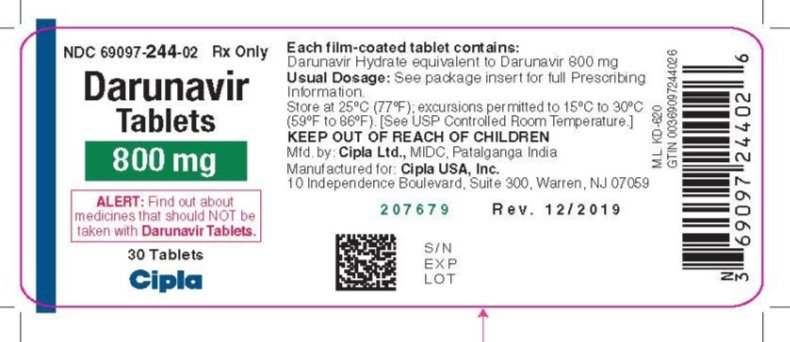
    NDC 69097-244-02
    Darunavir
    Tablets
    800MG
    ALERT: Find out about
    medicines that should NOT be
    taken with Darunavir Tablets.
    Each film-coated tablet contains:
    Darunavir Hydrate equivalent to Darunavir 800 mg
    30 tablets
    Cipla
    800mgBottle  Label 800 mg InvaGen
    Darunavir 600 has been selected.