Brand Name

Idhifa

Generic Name
Enasidenib
View Brand Information
FDA approval date: August 01, 2017
Classification: Isocitrate Dehydrogenase 2 Inhibitor
Form: Tablet

What is Idhifa (Enasidenib)?

IDHIFA is an isocitrate dehydrogenase-2 inhibitor indicated for the treatment of adult patients with relapsed or refractory acute myeloid leukemia with an isocitrate dehydrogenase-2 mutation as detected by an FDA-approved test.
Save this treatment for later
Sign Up
Not sure about your diagnosis?
Check Your Symptoms

Related Clinical Trials

A Randomized Phase II Trial of Enasidenib-Based Therapies Versus Cedazuridine-Decitabine in Higher-Risk IDH2-Mutated Myelodysplastic Syndrome: A MyeloMATCH Sub-Study

Summary: This phase II MyeloMATCH treatment trial compares the usual treatment of cedazuridine-decitabine (ASTX727) to the combination treatment of ASTX727 and enasidenib in treating patients with higher-risk, IDH2-mutated myelodysplastic syndrome (MDS). ASTX727 is a combination of two drugs, decitabine and cedazuridine. Cedazuridine is in a class of medications called cytidine deaminase inhibitors. It pre...

Master Screening and Reassessment Protocol (MSRP) for the NCI MyeloMATCH Clinical Trials

Summary: This MyeloMATCH Master Screening and Reassessment Protocol (MSRP) evaluates the use of a screening tool and specific laboratory tests to help improve participants' ability to register to clinical trials throughout the course of their myeloid cancer (acute myeloid leukemia or myelodysplastic syndrome) treatment. This study involves testing patients' bone marrow and blood for certain biomarkers. A b...

Phase 1b/2 Study of Oral Decitabine/Cedazuridine (ASTX727) and Venetoclax in Combination With the Targeted Mutant IDH1 Inhibitor Ivosidenib or the Targeted Mutant IDH2 Inhibitor Enasidenib

Summary: This phase Ib/II trials studies the side effects of decitabine/cedazuridine (ASTX727) and venetoclax in combination with ivosidenib or enasidenib, and how well they work in treating patients with acute myeloid leukemia that has come back (relapsed) or does not respond to treatment (refractory). ASTX727 is the combination of a fixed dose of 2 drugs, cedazuridine and decitabine. Cedazuridine may slo...

Brand Information

Idhifa (enasidenib mesylate)
WARNING: DIFFERENTIATION SYNDROME
Patients treated with IDHIFA have experienced symptoms of differentiation syndrome, which can be fatal if not treated. Symptoms may include fever, dyspnea, acute respiratory distress, pulmonary infiltrates, pleural or pericardial effusions, rapid weight gain or peripheral edema, lymphadenopathy, bone pain, and hepatic, renal, or multi-organ dysfunction. If differentiation syndrome is suspected, initiate corticosteroid therapy and hemodynamic monitoring until symptom resolution
1DOSAGE FORMS AND STRENGTHS
IDHIFA is available in the following tablet strengths:
  • 50 mg enasidenib tablet: Pale yellow to yellow oval-shaped film-coated tablet debossed "ENA" on one side and "50" on the other side.
  • 100 mg enasidenib tablet: Pale yellow to yellow capsule-shaped film-coated tablet debossed "ENA" on one side and "100" on the other side.
2CONTRAINDICATIONS
None.
3ADVERSE REACTIONS
The following clinically significant adverse reactions are described elsewhere in the labeling:
  • Differentiation Syndrome
3.1Clinical Trials Experience
Because clinical trials are conducted under widely varying conditions, adverse reaction rates observed in the clinical trials of a drug cannot be directly compared to rates in the clinical trials of another drug and may not reflect the rates observed in practice.
The safety evaluation of single-agent IDHIFA is based on 214 patients with relapsed or refractory AML who were assigned to receive 100 mg daily
Serious adverse reactions were reported in 77.1% of patients. The most frequent serious adverse reactions (≥2%) were leukocytosis (10%), diarrhea (6%), nausea (5%), vomiting (3%), decreased appetite (3%), tumor lysis syndrome (5%), and differentiation syndrome (8%). Differentiation syndrome events characterized as serious included pyrexia, renal failure acute, hypoxia, respiratory failure, and multi-organ failure.
Overall, 92 of 214 patients (43%) required a dose interruption due to an adverse reaction; the most frequent adverse reactions leading to dose interruption were differentiation syndrome (4%) and leukocytosis (3%). Ten of 214 patients (5%) required a dose reduction due to an adverse reaction; no adverse reaction required dose reduction in more than 2 patients. Thirty-six of 214 patients (17%) permanently discontinued IDHIFA due to an adverse reaction; the most frequent adverse reaction leading to permanent discontinuation was leukocytosis (1%).
The most common adverse reactions (≥20%) of any grade were nausea, vomiting, diarrhea, elevated bilirubin and decreased appetite.
Adverse reactions reported in the trial are shown in Table 2.
Other clinically significant adverse reactions occurring in <10% of patients included:
  • Respiratory, Thoracic, and Mediastinal Disorders: Pulmonary edema, acute respiratory distress syndrome
Changes in selected post-baseline laboratory values that were observed in patients with relapsed or refractory AML are shown in Table 3.
3.1.1Elevated Bilirubin
IDHIFA may interfere with bilirubin metabolism through inhibition of UGT1A1
3.1.2Noninfectious Leukocytosis
IDHIFA can induce myeloid proliferation resulting in a rapid increase in white blood cell count.
3.1.3Tumor Lysis Syndrome
IDHIFA can induce myeloid proliferation resulting in a rapid reduction in tumor cells which may pose a risk for tumor lysis syndrome.
Other Clinical Trials Experience
The following adverse reactions occurred in other clinical trials of IDHIFA at the recommended dosage: neutropenia, thrombocytopenia, anemia, stomatitis, renal failure, fatigue, dyspnea, and QT prolongation.
4DESCRIPTION
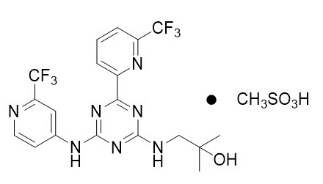
Enasidenib is an inhibitor of isocitrate dehydrogenase-2 (IDH2) enzyme. Enasidenib is available as the mesylate salt with the chemical name:
2-methyl-1-[(4-[6-(trifluoromethyl)pyridin-2-yl]-6-{[2-(trifluoromethyl)pyridin-4-yl]amino}-1,3,5-triazin-2-yl)amino]propan-2-ol methanesulfonate.
Or
2-Propanol, 2-methyl-1-[[4-[6-(trifluoromethyl)-2-pyridinyl]-6-[[2-(trifluoromethyl)-4-pyridinyl]amino-1,3,5-triazin-2-yl]amino]-, methanesulfonate (1:1).
The chemical structure is:
Chemical Structure
The empirical formula is C
IDHIFA (enasidenib) is available as a 50 mg tablet (equivalent to 60 mg enasidenib mesylate) and a 100 mg tablet (equivalent to 120 mg enasidenib mesylate) for oral administration. Each tablet contains inactive ingredients of colloidal silicon dioxide, hydroxypropyl cellulose, hypromellose acetate succinate, iron oxide yellow, magnesium stearate, microcrystalline cellulose, polyethylene glycol, polyvinyl alcohol, sodium lauryl sulfate, sodium starch glycolate, talc, and titanium dioxide.
5HOW SUPPLIED/STORAGE AND HANDLING
How Supplied
50 mg tablet: Pale yellow to yellow oval-shaped film-coated tablet debossed “ENA” on one side and “50” on the other side.
  • 30-count bottles of 50 mg tablets with a desiccant canister (NDC 59572-705-30)
100 mg tablet: Pale yellow to yellow capsule-shaped film-coated tablet debossed “ENA” on one side and “100” on the other side.
  • 30-count bottles of 100 mg tablets with a desiccant canister (NDC 59572-710-30)
Storage
Store at 20°C-25°C (68°F-77°F); excursions permitted between 15°C-30°C (59°F-86°F) [see USP Controlled Room Temperature]. Keep the bottle tightly closed. Store and dispense in the original bottle (with a desiccant canister) to protect from moisture.
6PATIENT COUNSELING INFORMATION
Advise the patient to read the FDA-approved patient labeling (Medication Guide).
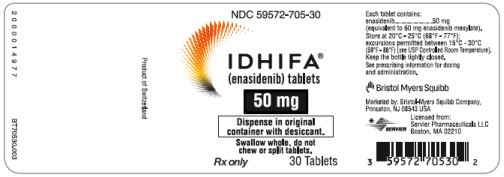
7PRINCIPAL DISPLAY PANEL - 50 mg Tablet Bottle Label
NDC 59572-705-30
IDHIFA
50 mg
Dispense in original
Swallow whole, do not
Rx only
PRINCIPAL DISPLAY PANEL - 50 mg Tablet Bottle Label
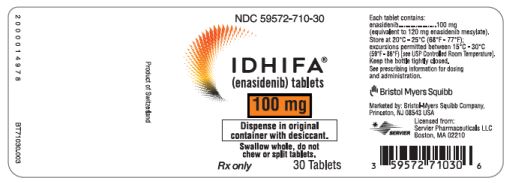
8PRINCIPAL DISPLAY PANEL - 100 mg Tablet Bottle Label
NDC 59572-710-30
IDHIFA
100 mg
Dispense in original
Swallow whole, do not
Rx only
PRINCIPAL DISPLAY PANEL - 100 mg Tablet Bottle Label