Brand Name
Fabrazyme
Generic Name
Agalsidase
View Brand Information FDA approval date: December 17, 2008
Classification: Hydrolytic Lysosomal Neutral Glycosphingolipid-specific Enzyme
Form: Injection
What is Fabrazyme (Agalsidase)?
Fabrazyme ® is indicated for the treatment of adult and pediatric patients 2 years of age and older with confirmed Fabry disease. Fabrazyme is a hydrolytic lysosomal neutral glycosphingolipid-specific enzyme indicated for the treatment of adult and pediatric patients 2 years of age and older with confirmed Fabry disease.
Approved To Treat
Top Global Experts
Save this treatment for later
Not sure about your diagnosis?
Related Clinical Trials
A Prospective, Open-label, Multicentre, Interventional, Single-arm, Phase IV Study to Evaluate the Safety and Efficacy of Replagal (Agalsidase Alfa [r-DNA Origin]) in Indian Children and Adults With Fabry Disease
Summary: The main aim of this study is to learn more about the safety profile of Replagal. Participants will receive Replagal every 2 weeks at the clinic for about 1 year.
Fabry Disease Registry Protocol
Summary: The Fabry Registry is an ongoing, international multi-center, strictly observational program that tracks the routine clinical outcomes for patients with Fabry disease, irrespective of treatment status. No experimental intervention is involved; patients in the Registry undergo clinical assessments and receive care as determined by the patient's treating physician. The primary objectives of the Regi...
A Phase 3 Randomized, Double-blinded, Active-controlled, Multicenter Trial to Evaluate the Safety and Efficacy of Fabagal® (Agalsidase Beta) in Patients With Fabry Disease
Summary: Evaluate the safety and efficacy of Fabagal® developed by ISU ABXIS Co., Ltd., which has similar efficacy to active comparator (Agalsidase beta).
Related Latest Advances
Brand Information
Fabrazyme (AGALSIDASE BETA)
WARNING: HYPERSENSITIVITY REACTIONS INCLUDING ANAPHYLAXIS
Patients treated with enzyme replacement therapies have experienced life-threatening hypersensitivity reactions, including anaphylaxis. Anaphylaxis has occurred during the early course of enzyme replacement therapy and after extended duration of therapy. Initiate FABRAZYME in a healthcare setting with appropriate medical monitoring and support measures, including access to cardiopulmonary resuscitation equipment. If a severe hypersensitivity reaction (e.g., anaphylaxis) occurs, discontinue FABRAZYME and immediately initiate appropriate medical treatment, including use of epinephrine. Inform patients of the symptoms of life-threatening hypersensitivity reactions, including anaphylaxis and to seek immediate medical care should symptoms occur.
1INDICATIONS AND USAGE
FABRAZYME
2DOSAGE FORMS AND STRENGTHS
For injection: 5 mg or 35 mg of agalsidase beta as a white to off-white, lyophilized cake or powder in a single-dose vial for reconstitution.
3CONTRAINDICATIONS
None.
4ADVERSE REACTIONS
The following clinically significant adverse reactions are described elsewhere in labeling:
- Hypersensitivity Reactions Including Anaphylaxis
- Infusion-Associated Reactions
4.1Clinical Trials Experience
Because clinical trials are conducted under widely varying conditions, adverse reaction rates observed in clinical trials of a drug cannot be directly compared to rates in the clinical trial of another drug and may not reflect the rates observed in patients in clinical practice.
The data described below reflect exposure of 80 patients, ages 16 to 61 years, to 1 mg/kg FABRAZYME every two weeks in two separate double-blind, placebo-controlled clinical trials, for periods ranging from 1 to 35 months (mean 15.5 months). All 58 patients enrolled in one of the two studies continued into an open-label extension study of FABRAZYME treatment for up to 54 additional months. Patients were treated with antipyretics and antihistamines prior to the infusions.
4.2Immunogenicity
As with all therapeutic proteins, there is potential for immunogenicity. The detection of antibody formation is highly dependent on the sensitivity and specificity of the assay. Additionally, the observed incidence of antibody (including neutralizing antibody) positivity in an assay may be influenced by several factors including assay methodology, sample handling, timing of sample collection, concomitant medications, and underlying disease. For these reasons, comparison of the incidence of antibodies to FABRAZYME in the studies described below with the incidence of antibodies in other studies or to other agalsidase beta products may be misleading.
Patients with classic Fabry disease in Study 1, Study 2, and extension studies were tested at multiple time points for antibodies to agalsidase beta during the 55 to 58-month period. Approximately 83% (110 of 133) of adult patients receiving agalsidase beta developed antibodies; 77% (102/133) of patients developed neutralizing antibody (NAb) that inhibited
In general, over 90% of adult and pediatric patients treated with agalsidase beta achieved and maintained normalization of plasma globotriaosylceramide (GL-3) levels irrespective of developing antibodies to agalsidase beta.
Study 4 was an open-label, rechallenge study to evaluate the safety of FABRAZYME treatment in patients who had a positive skin test to FABRAZYME or who had tested positive for FABRAZYME-specific IgE antibodies. In this study, six adult male patients, who had experienced multiple or recurrent infusion-associated reactions during previous clinical trials of FABRAZYME, were rechallenged with FABRAZYME administered as a graded infusion for up to 52 weeks of treatment. The initial two rechallenge doses of FABRAZYME were administered as a 0.5 mg/kg dose per week at an initial infusion rate of 0.01 mg/min for the first 30 minutes (1/25
Testing for IgE antibodies was performed in approximately 60 patients in clinical trials who experienced moderate to severe infusion-associated reactions or in whom mast cell activation was suspected. Seven of these patients tested positive for FABRAZYME-specific IgE antibodies or had a positive skin test to FABRAZYME. Patients who have had a positive skin test to FABRAZYME, or who have tested positive for FABRAZYME-specific IgE antibodies in clinical trials with FABRAZYME have been rechallenged
The incidences of hypersensitivity reactions were 51% (41/80) and 60% (25/42) in adult patients with persistent anti-FABRAZYME antibodies and in adult patients with high antibody titer, respectively, compared to 30% (7/23) in antibody-negative adult patients
The incidence of infusion-associated reactions was 76% (84/110) in antibody-positive adult patients compared to 30% (7/23) in antibody-negative adult patients. The incidence of infusion-associated reactions was 46% (5/11) in antibody positive pediatric patients compared to 20% (1/5) in antibody negative pediatric patients
4.3Postmarketing Experience
The following adverse reactions have been identified during postapproval use of FABRAZYME. Because these reactions are reported voluntarily from a population of uncertain size, it is not always possible to reliably estimate their frequency or establish a causal relationship to drug exposure.
- Cardiovascular: cardiorespiratory arrest, cardiac failure, myocardial infarction, palpitations
- Hypersensitivity reactions: anaphylaxis [see , localized angioedema (including auricular swelling, eye swelling, dysphagia, lip swelling, edema, pharyngeal edema, face swelling, and swollen tongue), and bronchospasm
- General: hyperhidrosis, asthenia, infusion site reaction
- Lymphatic: lymphadenopathy
- Musculoskeletal: arthralgia
- Neurologic: cerebrovascular accident, hypoesthesia, oral hypoesthesia
- Pulmonary: respiratory failure, hypoxia
- Renal: renal failure
- Vascular: leukocytoclastic vasculitis
5DESCRIPTION
Agalsidase beta is a recombinant human α-galactosidase A enzyme with the same amino acid sequence as the native enzyme. Purified agalsidase beta is a homodimeric glycoprotein with a molecular weight of approximately 100 kD. The mature protein is comprised of two subunits of 398 amino acids (approximately 51 kD), each of which contains three N-linked glycosylation sites. The enzyme α-galactosidase A catalyzes the hydrolysis of GL-3 and other α-galactyl-terminated neutral glycosphingolipids, such as galabiosylceramide and blood group B substances to ceramide dihexoside and galactose. The specific activity of agalsidase beta is approximately 70 U/mg (one unit is defined as the amount of activity that results in the hydrolysis of 1 µmole of a synthetic substrate, p-nitrophenyl-α-D-galactopyranoside, per minute under the assay conditions).
Agalsidase beta is produced by recombinant DNA technology in a Chinese hamster ovary mammalian cell expression system.
FABRAZYME (agalsidase beta) for injection is intended for intravenous infusion. It is supplied as a sterile, nonpyrogenic, preservative-free, white to off-white, lyophilized cake or powder for reconstitution with Sterile Water for Injection, USP.
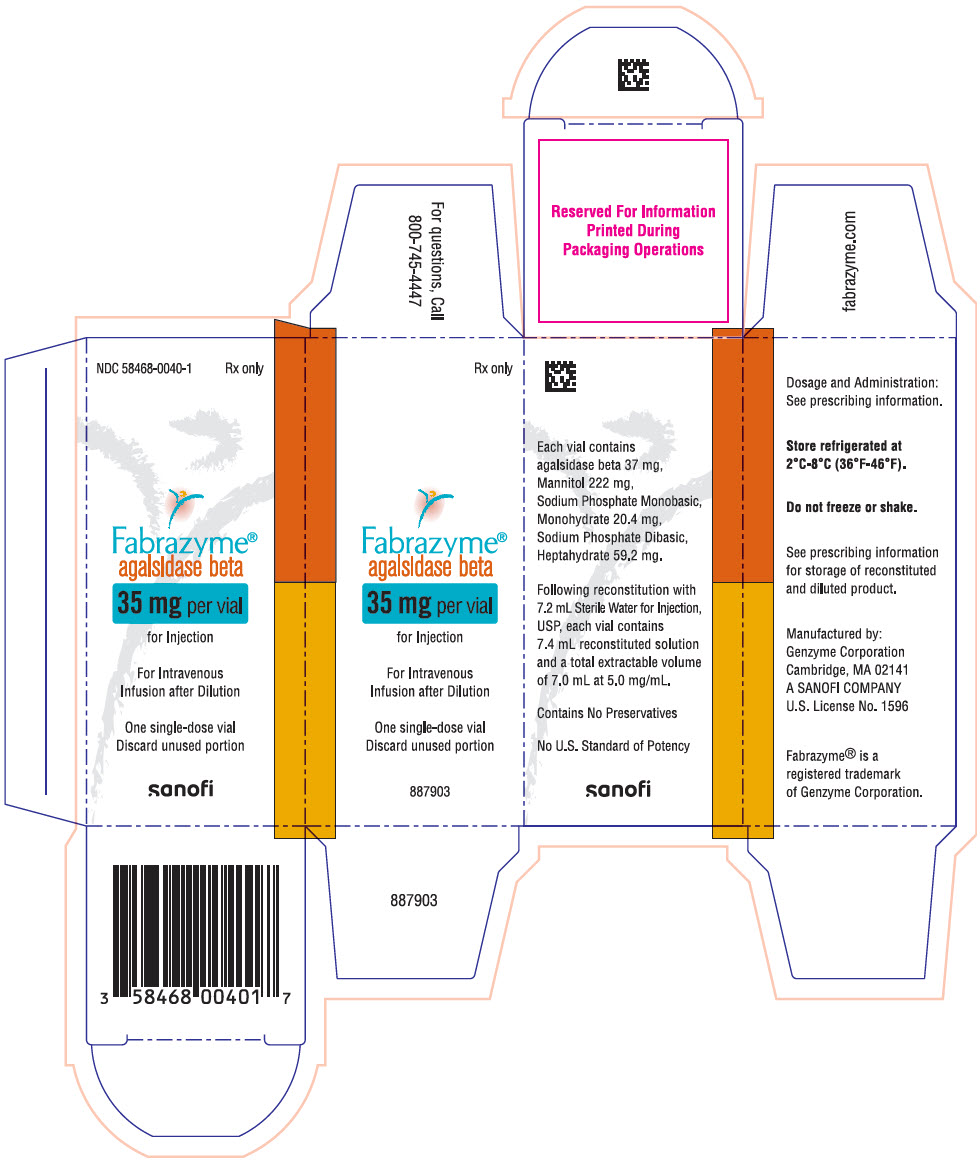
Each 35 mg vial contains 37 mg of agalsidase beta, as well as 222 mg mannitol, 20.4 mg sodium phosphate monobasic monohydrate, and 59.2 mg sodium phosphate dibasic heptahydrate. Following reconstitution as directed, 35 mg of agalsidase beta (7 mL) may be extracted from each 35 mg vial.
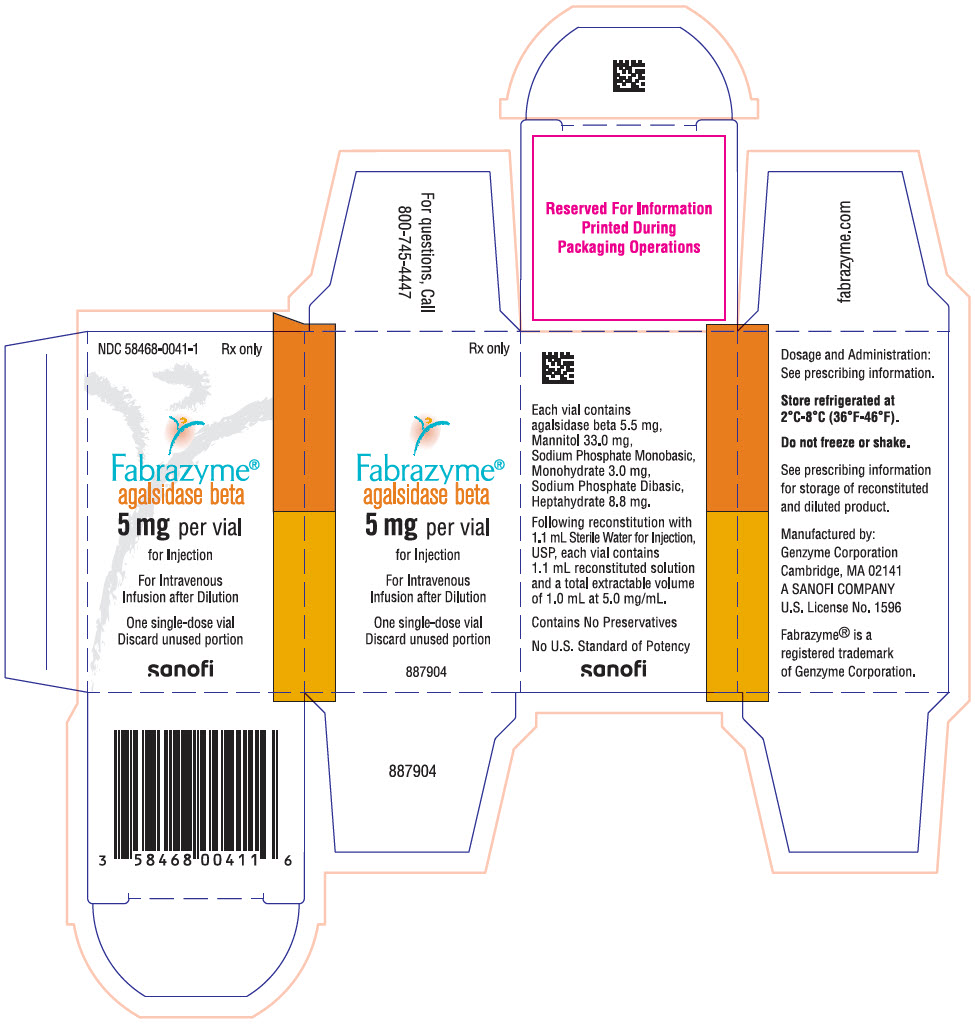
Each 5 mg vial contains 5.5 mg of agalsidase beta, as well as 33.0 mg mannitol, 3.0 mg sodium phosphate monobasic monohydrate, and 8.8 mg sodium phosphate dibasic heptahydrate. Following reconstitution as directed, 5 mg of agalsidase beta (1 mL) may be extracted from each 5 mg vial.
6CLINICAL STUDIES
The safety and efficacy of FABRAZYME were assessed in four clinical studies in patients with Fabry disease and one matched analysis based on data from observational studies.
Study 1 was a randomized, double-blind, placebo-controlled, multinational, multicenter study of 58 patients with Fabry disease (56 males and 2 females), ages 16 to 61 years, all naive to enzyme replacement therapy
Tissue biopsy specimens (kidney, heart, skin) were evaluated at baseline and at week 20 by light microscopy for the presence and number of GL-3 inclusions using a semi-quantitative methodology. Renal interstitial capillaries were scored based on the number of GL-3 inclusions on a scale of 0 to 3 (0 defined as "nearly none" or "trace," 1 defined as "mild," 2 defined as "moderate," and 3 defined as "severe"). The primary endpoint was the proportion of patients in either group with a renal capillary GL-3 inclusion score of zero at week 20. In the FABRAZYME group, 20 of 29 (69%) patients achieved a score of zero while 0 of 29 placebo-treated patients achieved a score of zero (p<0.001). Similar reductions in GL-3 inclusions were observed in the capillary endothelium of the heart and skin (Table 4). All 58 patients who completed Study 1 were subsequently treated with FABRAZYME 1 mg/kg every two weeks in an open-label extension study. After six months of open-label treatment, most patients with available biopsy data achieved a GL-3 inclusion score of 0 in capillary endothelium (Table 4).
Study 2 was a randomized (2:1 FABRAZYME to placebo), double-blind, placebo-controlled, multinational, multicenter study of 82 patients (72 males and 10 females) with Fabry disease, all naive to enzyme replacement therapy
Study 3 (Pediatric Study) was an open-label, single-arm, multinational, multicenter study in 16 pediatric patients with Fabry disease (14 males, 2 females), aged 8 to 16 years (median 12 years)
Study 5 was a long-term, observational study assessing the rate of decline in renal function (eGFR slope) in 122 patients with Fabry disease aged 16 years and older treated with FABRAZYME. Treated patients were matched 1:1 based on age (at FABRAZYME initiation), sex, Fabry disease subtype (classic or non-classic), and baseline eGFR to a historical cohort of untreated patients with Fabry disease. The median follow-up time was 3 years in the untreated group and 4.5 years in the treated group (maximum follow-up time 5 years in both groups). In the matched cohort, the median age (at FABRAZYME initiation) was 35 years, 72% of patients were male, 84% of patients had the classic Fabry disease subtype, and the median baseline eGFR was 93 mL/min/1.73 m
7HOW SUPPLIED/STORAGE AND HANDLING
FABRAZYME (agalsidase beta) for injection is supplied as a sterile, nonpyrogenic, white to off-white lyophilized cake or powder in single-dose vials.
35 mg vial: NDC 58468-0040-1
5 mg vial: NDC 58468-0041-1
8PRINCIPAL DISPLAY PANEL - 5 mg Vial Carton
NDC 58468-0041-1
Fabrazyme
5 mg per vial
for Injection
For Intravenous
One single-dose vial
sanofi

9PRINCIPAL DISPLAY PANEL - 35 mg Vial Carton
NDC 58468-0040-1
Fabrazyme
35 mg per vial
for Injection
For Intravenous
One single-dose vial
sanofi