Generic Name

Norgestimate

Brand Names
Tri-Linyah, Tri-Sprintec, Tri-VyLibra, Sprintec, Tri-Lo-Sprintec, Femynor, Tri-Estarylla, Nymyo, Mili, Tri-Lo- Estarylla, Tri-Lo-Mili, Estarylla, VyLibra, Tri-Mili, Tri-Lo-MARZIA, Tri-Nymyo, Mono-Linyah
FDA approval date: September 26, 2002
Form: Kit

What is Tri-Linyah (Norgestimate)?

Norgestimate and ethinyl estradiol tablets are estrogen/progestin COCs, indicated for use by women to prevent pregnancy.

Approved To Treat

Top Global Experts

There are no experts for this drug

Save this treatment for later
Sign Up
Not sure about your diagnosis?
Check Your Symptoms

Related Clinical Trials

There is no clinical trials being done for this treatment

Related Latest Advances

There is no latest advances for this treatment

Brand Information

    Tri-Linyah (Norgestimate and Ethinyl Estradiol)
    WARNING: CIGARETTE SMOKING and SERIOUS CARDIOVASCULAR EVENTS
    Cigarette smoking increases the risk of serious cardiovascular events from combination oral contraceptive (COC) use. This risk increases with age, particularly in women over 35 years of age, and with the number of cigarettes smoked. For this reason, COCs are contraindicated in women who are over 35 years of age and smoke
    1CONTRAINDICATIONS
    Tri-Linyah is contraindicated in females who are known to have or develop the following conditions:
    • A high risk of arterial or venous thrombotic diseases. Examples include women who are known to:
    • Liver tumors, benign or malignant, or liver disease
    • Undiagnosed abnormal uterine bleeding
    • Pregnancy, because there is no reason to use COCs during pregnancy
    • Current diagnosis of, or history of, breast cancer, which may be hormone-sensitive
    • Use of Hepatitis C drug combinations containing ombitasvir/paritaprevir/ritonavir, with or without dasabuvir, due to the potential for ALT elevations
    2ADVERSE REACTIONS
    The following serious adverse reactions with the use of COCs are discussed elsewhere in labeling:
    • Serious cardiovascular events and stroke
    • Vascular events
    • Liver disease
    Adverse reactions commonly reported by COC users are:
    • Irregular uterine bleeding
    • Nausea
    • Breast tenderness
    • Headache
    2.1Clinical Trial Experience
    Because clinical trials are conducted under widely varying conditions, adverse reaction rates observed in the clinical trials of a drug cannot be directly compared to rates in the clinical trials of another drug and may not reflect the rates observed in clinical practice.
    2.2Postmarketing Experience
    Five studies that compared breast cancer risk between ever-users (current or past use) of COCs and never-users of COCs reported no association between ever use of COCs and breast cancer risk, with effect estimates ranging from 0.90 – 1.12 (Figure 1).
    Three studies compared breast cancer risk between current or recent COC users (<6 months since last use) and never users of COCs (Figure 1). One of these studies reported no association between breast cancer risk and COC use. The other two studies found an increased relative risk of 1.19 – 1.33 with current or recent use. Both of these studies found an increased risk of breast cancer with current use of longer duration, with relative risks ranging from 1.03 with less than one year of COC use to approximately 1.4 with more than 8–10 years of COC use.
    Figure 1: Relevant Studies of Risk of Breast Cancer with Combined Oral Contraceptives
    The following additional adverse drug reactions have been reported from worldwide postmarketing experience with norgestimate/ethinyl estradiol. Because these reactions are reported voluntarily from a population of uncertain size, it is not always possible to reliably estimate their frequency or establish a causal relationship to drug exposure.
    Infections and Infestations: Urinary tract infection;
    Neoplasms Benign, Malignant and Unspecified (Incl. Cysts and Polyps): Breast cancer, benign breast neoplasm, hepatic adenoma, focal nodular hyperplasia, breast cyst;
    Immune System Disorders: Hypersensitivity;
    Metabolism and Nutrition Disorders: Dyslipidemia;
    Psychiatric Disorders: Anxiety, insomnia;
    Nervous System Disorders: Syncope, convulsion, paresthesia, dizziness;
    Eye Disorders: Visual impairment, dry eye, contact lens intolerance;
    Ear and Labyrinth Disorders: Vertigo;
    Cardiac Disorders: Tachycardia, palpitations;
    Vascular Events: Deep vein thrombosis, pulmonary embolism, retinal vascular thrombosis, hot flush, venous thrombosis (including Budd Chiari Syndrome and hepatic vein thrombosis);
    Arterial Events: Arterial thromboembolism, myocardial infarction, cerebrovascular accident;
    Respiratory, Thoracic and Mediastinal Disorders: Dyspnea;
    Gastrointestinal Disorders: Pancreatitis, abdominal distension, diarrhea, constipation;
    Hepatobiliary Disorders: Hepatitis;
    Skin and Subcutaneous Tissue Disorders: Angioedema, erythema nodosum, hirsutism, night sweats, hyperhidrosis, photosensitivity reaction, urticaria, pruritus, acne;
    Musculoskeletal, Connective Tissue, and Bone Disorders: Muscle spasms, pain in extremity, myalgia, back pain;
    Reproductive System and Breast Disorders: Ovarian cyst, suppressed lactation, vulvovaginal dryness;
    General Disorders and Administration Site Conditions: Chest pain, asthenic conditions.
    3DRUG INTERACTIONS
    Consult the labeling of concurrently used drugs to obtain further information about interactions with hormonal contraceptives or the potential for enzyme alterations.
    No drug-drug interaction studies were conducted with Tri-Linyah.
    3.1Effects of Combined Oral Contraceptives on Other Drugs
    • COCs containing EE may inhibit the metabolism of other compounds (e.g., cyclosporine, prednisolone, theophylline, tizanidine, and voriconazole) and increase their plasma concentrations.
    • COCs have been shown to decrease plasma concentrations of acetaminophen, clofibric acid, morphine, salicylic acid, temazepam and lamotrigine. Significant decrease in plasma concentration of lamotrigine has been shown, likely due to induction of lamotrigine glucuronidation. This may reduce seizure control; therefore, dosage adjustments of lamotrigine may be necessary.
    3.2Interference with Laboratory Tests
    The use of contraceptive steroids may influence the results of certain laboratory tests, such as coagulation factors, lipids, glucose tolerance, and binding proteins.
    3.3Concomitant Use with HCV Combination Therapy – Liver Enzyme Elevation
    Do not co-administer Tri-Linyah with HCV drug combinations containing ombitasvir/paritaprevir/ritonavir, with or without dasabuvir, due to potential for ALT elevations
    4OVERDOSAGE
    There have been no reports of serious ill effects from overdosage of oral contraceptives, including ingestion by children. Overdosage may cause withdrawal bleeding in females and nausea.
    5DESCRIPTION
    Tri-Linyah is a combination oral contraceptive containing the progestational compound norgestimate and the estrogenic compound ethinyl estradiol. Norgestimate is designated as (18,19-Dinor-17-pregn-4-en-20-yn-3-one,17-(acetyloxy)-13-ethyl-, oxime,(17α)-(+)-) and ethinyl estradiol is designated as (19-nor-17α-pregna,1,3,5(10)-trien-20-yne-3,17-diol).
    6PATIENT COUNSELING INFORMATION
    See FDA-approved patient labeling (
    Counsel patients about the following information:
    • Cigarette smoking increases the risk of serious cardiovascular events from COC use, and that women who are over 35 years old and smoke should not use COCs
    • Increased risk of VTE compared to non-users of COCs is greatest after initially starting a COC or restarting (following a 4-week or greater pill-free interval) the same or a different COC
    • Tri-Linyah does not protect against HIV infection (AIDS) and other sexually transmitted infections.
    • Tri-Linyah is not to be used during pregnancy; if pregnancy occurs during use of Tri-Linyah  instruct the patient to stop further use
    • Take one tablet daily by mouth at the same time every day. Instruct patients what to do in the event tablets are missed
    • Use a back-up or alternative method of contraception when enzyme inducers are used with Tri-Linyah 
    • COCs may reduce breast milk production; this is less likely to occur if breastfeeding is well established
    • Women who start COCs postpartum, and who have not yet had a period, should use an additional method of contraception until they have taken an active tablet for 7 consecutive days
    • Amenorrhea may occur. Consider pregnancy in the event of amenorrhea at the time of the first missed period. Rule out pregnancy in the event of amenorrhea in two or more consecutive cycles
    7Patient Information TRI-LINYAH [TRI-lin-YAH] (norgestimate and ethinyl estradiol) Tablets
    What is the most important information I should know about TRI-LINYAH?
    Do not use TRI-LINYAH if you smoke cigarettes and are over 35 years old. Smoking increases your risk of serious cardiovascular side effects from hormonal birth control pills, including death from heart attack, blood clots or stroke. This risk increases with age and the number of cigarettes you smoke.
    What is TRI-LINYAH?
    TRI-LINYAH is a birth control pill (oral contraceptive) used by women to prevent pregnancy.
    TRI-LINYAH is also used to treat moderate acne vulgaris in females 15 years of age and older, who have no known history of allergies or problems taking birth control pills, and have started their menstrual cycle ("period"). TRI-LINYAH should only be used to treat acne in women who want to take birth control pills to prevent pregnancy.
    How does TRI-LINYAH work for contraception?
    Your chance of getting pregnant depends on how well you follow the directions for taking your birth control pills. The better you follow the directions, the less chance you have of getting pregnant.
    Based on the results of clinical studies, about 1 out of 100 women may get pregnant during the first year they use TRI-LINYAH.
    The following chart shows the chance of getting pregnant for women who use different methods of birth control. Each box on the chart contains a list of birth control methods that are similar in effectiveness. The most effective methods are at the top of the chart. The box on the bottom of the chart shows the chance of getting pregnant for women who do not use birth control and are trying to get pregnant.
    Who should not take TRI-LINYAH?
    Do not take TRI-LINYAH if you:
    • smoke and are over 35 years of age
    • had blood clots in your arms, legs, lungs, or eyes
    • had a problem with your blood that makes it clot more than normal
    • have certain heart valve problems or irregular heart beat that increases your risk of having blood clots
    • had a stroke
    • had a heart attack
    • have high blood pressure that cannot be controlled by medicine
    • have diabetes with kidney, eye, nerve, or blood vessel damage
    • have certain kinds of severe migraine headaches with aura, numbness, weakness or changes in vision, or any migraine headaches if you are over 35 years of age
    • have liver problems, including liver tumors
    • take any Hepatitis C drug combination containing ombitasvir/paritaprevir/ritonavir, with or without dasabuvir. This may increase levels of the liver enzyme "alanine aminotransferase" (ALT) in the blood.
    • have any unexplained vaginal bleeding
    • are pregnant
    • had breast cancer or any cancer that is sensitive to female hormones
    If any of these conditions happen while you are taking TRI-LINYAH, stop taking TRI-LINYAH right away and talk to your healthcare provider. Use non-hormonal contraception when you stop taking TRI-LINYAH.
    What should I tell my healthcare provider before taking TRI-LINYAH?
    Tell your healthcare provider if you:
    • are pregnant or think you may be pregnant
    • are depressed now or have been depressed in the past
    • had yellowing of your skin or eyes (jaundice) caused by pregnancy (cholestasis of pregnancy)
    • are breastfeeding or plan to breastfeed. TRI-LINYAH may decrease the amount of breast milk you make. A small amount of the hormones in TRI-LINYAH may pass into your breast milk. Talk to your healthcare provider about the best birth control method for you while breastfeeding.
    Tell your healthcare provider about all the medicines you take, including prescription and over-the-counter medicines, vitamins and herbal supplements.
    TRI-LINYAH may affect the way other medicines work, and other medicines may affect how well TRI-LINYAH works.
    Know the medicines you take. Keep a list of them to show your healthcare provider and pharmacist when you get a new medicine.
    How should I take TRI-LINYAH?
    Read the Instructions for Use at the end of this Patient Information.
    What are the possible serious side effects of TRI-LINYAH?
    • Like pregnancy, TRI-LINYAH may cause serious side effects, including blood clots in your lungs, heart attack, or a stroke that may lead to death. Some other examples of serious blood clots include blood clots in the legs or eyes.
    Serious blood clots can happen especially if you smoke, are obese, or are older than 35 years of age. Serious blood clots are more likely to happen when you:
    • first start taking birth control pills
    • restart the same or different birth control pills after not using them for a month or more
    Call your healthcare provider or go to a hospital emergency room right away if you have:
    • leg pain that will not go away
    • sudden severe shortness of breath
    • sudden change in vision or blindness
    • chest pain
    • a sudden, severe headache unlike your usual headaches
    • weakness or numbness in your arm or leg
    • trouble speaking
    Other serious side effects include:
    • liver problems, including:
    • rare liver tumors
    • jaundice (cholestasis), especially if you previously had cholestasis of pregnancy. Call your healthcare provider if you have yellowing of your skin or eyes.
    • high blood pressure. You should see your healthcare provider for a yearly check of your blood pressure.
    • gallbladder problems
    • changes in the sugar and fat (cholesterol and triglycerides) levels in your blood
    • new or worsening headaches including migraine headaches
    • irregular or unusual vaginal bleeding and spotting between your menstrual periods, especially during the first 3 months of taking TRI-LINYAH.
    • depression
    • possible cancer in your breast and cervix
    • swelling of your skin especially around your mouth, eyes, and in your throat (angioedema). Call your healthcare provider if you have a swollen face, lips, mouth tongue or throat, which may lead to difficulty swallowing or breathing. Your chance of having angioedema is higher if you have a history of angioedema.
    • dark patches of skin around your forehead, nose, cheeks and around your mouth, especially during pregnancy (chloasma). Women who tend to get chloasma should avoid spending a long time in sunlight, tanning booths, and under sun lamps while taking TRI-LINYAH. Use sunscreen if you have to be in the sunlight.
    What are the most common side effects of TRI-LINYAH?
    • headache (migraine)
    • breast pain or tenderness, enlargement or discharge
    • stomach pain, discomfort, and gas
    • vaginal infections and discharge
    • mood changes, including depression
    • nervousness
    • changes in weight
    • skin rash
    These are not all the possible side effects of TRI-LINYAH. For more information, ask your healthcare provider or pharmacist.
    You may report side effects to the FDA at 1-800-FDA-1088
    What else should I know about taking TRI-LINYAH?
    • If you are scheduled for any lab tests, tell your healthcare provider you are taking TRI-LINYAH. Certain blood tests may be affected by TRI-LINYAH.
    • TRI-LINYAH does not protect against HIV infection (AIDS) and other sexually transmitted infections.
    How should I store TRI-LINYAH?
    • Store TRI-LINYAH at room temperature between 68°F to 77°F (20°C to 25°C).
    • Keep TRI-LINYAH and all medicines out of the reach of children.
    • Store away from light.
    General information about the safe and effective use of TRI-LINYAH.
    Medicines are sometimes prescribed for purposes other than those listed in a Patient Information leaflet. Do not use TRI-LINYAH for a condition for which it was not prescribed. Do not give TRI-LINYAH to other people, even if they have the same symptoms that you have.
    This Patient Information summarizes the most important information about TRI-LINYAH. You can ask your pharmacist or healthcare provider for information about TRI-LINYAH that is written for health professionals
    For more information, call 1-800-206-7821.
    Do birth control pills cause cancer?
    It is not known if hormonal birth control pills cause breast cancer. Some studies, but not all, suggest that there could be a slight increase in the risk of breast cancer among current users with longer duration of use.
    If you have breast cancer now, or have had it in the past, do not use hormonal birth control because some breast cancers are sensitive to hormones.
    Women who use birth control pills may have a slightly higher chance of getting cervical cancer. However, this may be due to other reasons such as having more sexual partners.
    What if I want to become pregnant?
    You may stop taking the pill whenever you wish. Consider a visit with your healthcare provider for a pre-pregnancy checkup before you stop taking the pill.
    What should I know about my period when taking TRI-LINYAH?
    Your periods may be lighter and shorter than usual. Some women may miss a period. Irregular vaginal bleeding or spotting may happen while you are taking TRI-LINYAH, especially during the first few months of use. This usually is not a serious problem. It is important to continue taking your pills on a regular schedule to prevent a pregnancy.
    What are the ingredients in TRI-LINYAH?
    Active ingredients: Each green, light blue, and blue pill contains norgestimate and ethinyl estradiol.
    Inactive ingredients:
    Green pills: FD&C Blue No.2 Aluminum Lake,FD&C Red No. 40 Aluminum Lake, FD&C Yellow No. 10 Aluminum Lake, titanium dioxide, iron oxide black, iron oxide
    yellow, macrogol/ polyethylene glycol 3350 NF, lecithin, talc, polyvinyl alcohol, lactose monohydrate, magnesium stearate and pregelatinized corn starch.
    Light Blue pills: FD&C Blue #2 Aluminum Lake,FD&C Red #40 Aluminum Lake, titanium dioxide,iron oxide black, polyvinyl alcohol,
    talc, macrogol/polyethylene glycol 3350 NF, lecithin, lactose monohydrate, magnesium stearate and pregelatinized corn starch.
    Blue pills: FD&C Blue No. 2 Aluminium Lake,FD&C Blue No. 1 Aluminum lake, FD&C Red No. 40 Aluminum Lake, FD&C Yellow No. 10 Aluminum Lake, titanium dioxide, polyvinyl alcohol,talc, macrogol/PEG 3350 NF, lecithin, lactose monohydrate, magnesium stearate and pregelatinized corn starch.
    White pills: titanium dioxide, polydextrose, hypromellose, triacetin, macrogol/polyethylene glycol, lactose monohydrate, magnesium stearate and pregelatinized corn starch.
    8Instructions For Use TRI-LINYAH [TRI-lin-YAH] (norgestimate and ethinyl estradiol) Tablets
    Important Information about taking TRI-LINYAH
    • Take
    • Do not skip your pills, even if you do not have sex often. If you miss pills (including starting the pack late)
    • If you have trouble remembering to take TRI-LINYAH, talk to your healthcare provider. When you first start taking TRI-LINYAH, spotting or light bleeding in between your periods may occur. Contact your healthcare provider if this does not go away after a few months.
    • You may feel sick to your stomach (nauseous), especially during the first few months of taking TRI-LINYAH. If you feel sick to your stomach, do not stop taking the pill. The problem will usually go away. If your nausea does not go away, call your healthcare provider.
    • Missing pills can also cause spotting or light bleeding, even when you take the missed pills later. On the days you take 2 pills to make up for missed pills (see
    • It is not uncommon to miss a period. However, if you miss a period and have not taken TRI-LINYAH according to directions, or miss
    • If you have vomiting or diarrhea within
    • If you have vomiting or diarrhea for more than 1 day, your birth control pills may not work as well. Use an additional birth control method, like condoms and a spermicide, until you check with your healthcare provider.
    • Stop taking TRI-LINYAH at least
    Before you start taking TRI-LINYAH:
    • Decide what time of day you want to take your pill. It is important to take it at the same time every day and in the order as directed on your compact blister card.
    • Have backup contraception (condoms and spermicide) available and if possible, an extra full pack of pills as needed.
    When should I start taking TRI-LINYAH?
    If you start taking TRI-LINYAH and you have not used a hormonal birth control method before:
    • There are 2 ways to start taking your birth control pills. You can either start on a Sunday (Sunday Start) or on the first day (Day 1) of your natural menstrual period (Day 1 Start). Your healthcare provider should tell you when to start taking your birth control pill.
    • If you use the Sunday Start, use non-hormonal back-up contraception such as condoms and spermicide for the first
    If you start taking TRI-LINYAH and you are switching from another birth control pill:
    • Start your new TRI-LINYAH pack on the same day that you would start the next pack of your previous birth control method.
    • Do not continue taking the pills from your previous birth control pack.
    If you start taking TRI-LINYAH and previously used a vaginal ring or transdermal patch:
    • Start using TRI-LINYAH on the day you would have reapplied the next ring or patch.
    If you start taking TRI-LINYAH and you are switching from a progestin-only method such as an implant or injection:
    • Start taking TRI-LINYAH on the day of removal of your implant or on the day when you would have had your next injection.
    If you start taking TRI-LINYAH and you are switching from an intrauterine device or system (IUD or IUS):
    • Start taking TRI-LINYAH on the day of removal of your IUD or IUS.
    • You do not need back-up contraception if your IUD or IUS is removed on the first day (Day 1) of your period. If your IUD or IUS is removed on any other day, use non-hormonal back-up contraception such as condoms and spermicide for the first
    Keep a calendar to track your period:
    If this is the first time you are taking birth control pills, read, "When should I start taking TRI-LINYAH?" above.
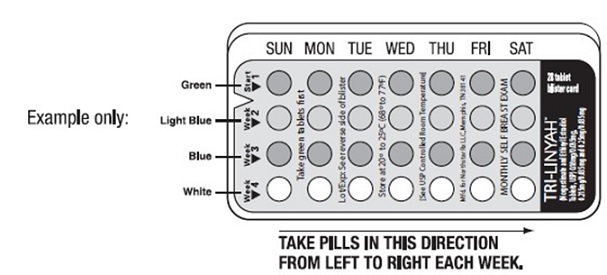
    TRI-LINYAH is available as a blister card placed within a white compact with the days of the week imprinted on the white compact preset for a Sunday start. The TRI-LINYAH blister card has 21 (7 green,7 light blue and 7 blue) "active" pills (with hormones) to take for 3 weeks. This is followed by 1 week of 7 white "reminder" pills (without hormones). The TRI-LINYAH blister card and the imprinted days of the week on the compact is shown in the picture below.
    blister
    On the above blister card find where on the card to start taking pills, in what order to take the pills and the week numbers. Day 1 stickers are also provided.
    Follow these instructions for either a
    Sunday Start:
    You will use a
    • Take pill
    • If your period starts on a Sunday, take pill "
    • Take
    • After taking the last pill on
    • Use non-hormonal back-up contraception such as condoms and spermicide for the first
    Day 1 Start:
    You will use a
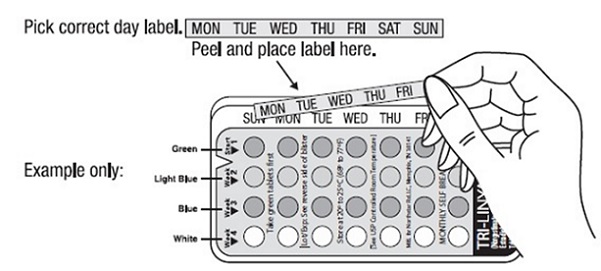
    1. Pick the day label strip that starts with the first day of your period.
    2. Place this day label strip over the area on the plastic compact which already has the days of the week (starting with Sunday) imprinted and press firmly. See the picture below as an example.
    blister with hand
    • Take
    • After taking the last pill on
    What should I do if I miss any TRI-LINYAH pills?
    If you miss 1 pill in Weeks 1, 2, or 3, follow these steps:
    • Take it as soon as you remember. Take the next pill at your regular time. This means you may take
    • Then continue taking
    • You do not need to use a back-up birth control method if you have sex.
    If you miss 2 pills in Week 1 or Week 2 of your pack, follow these steps:
    • Take the 2 missed pills as soon as possible and the next 2 pills the next day.
    • Then continue to take
    • Use a non-hormonal birth control method (such as a condom and spermicide) as a back-up if you have sex during the first
    If you miss 2 pills in a row in Week 3, or you miss 3 or more pills in a row during Weeks 1, 2, or 3 of the pack, follow these steps:
    • If you are a Day 1 Starter:
    • Throw out the rest of the pill pack and start a new pack that same day.
    • You may not have your period this month but this is expected. However, if you miss your period 2 months in a row, call your healthcare provider because you might be pregnant.
    • You could become pregnant if you have sex during the first 7 days after you restart your pills. You MUST use a non-hormonal birth control method (such as a condom and spermicide) as a back-up if you have sex during the first
    • If you are a Sunday Starter:
    • Keep taking
    • Use a non-hormonal birth control method (such as a condom and spermicide) as a back-up if you have sex during the first
    If you have any questions or are unsure about the information in this leaflet, call your healthcare provider.
    Tri-Linyah has been selected.