Brand Name

Rozlytrek

Generic Name
Entrectinib
View Brand Information
FDA approval date: August 15, 2019
Form: Pellet, Capsule

What is Rozlytrek (Entrectinib)?

ROZLYTREK is a kinase inhibitor indicated for the treatment of: Adult patients with metastatic non-small cell lung cancer whose tumors are ROS1 -positive.
Save this treatment for later
Sign Up
Not sure about your diagnosis?
Check Your Symptoms

Related Clinical Trials

An Open-Label, Multicenter Extension Study in Patients Previously Enrolled in a Genentech and/or F. Hoffmann-La Roche Ltd Sponsored Study

Summary: The purpose of this extension study is to provide continued treatment with Roche investigational medicinal product (IMP\[s\]) monotherapy or Roche IMP(s) combined with other agent(s) or comparator agent(s) for eligible participants with cancer who are still on study treatment at the time of roll-over from the parent study and who do not have access to the study treatment locally.

Randomized, Open Label, Multicenter, Phase III Study of Entrectinib Versus Crizotinib in Patients With Locally-Advanced or Metastatic Non-Small Cell Lung Cancer Harboring ROS1 Gene Rearrangements With and Without Central Nervous System Metastases

Summary: The study will compare the efficacy and safety of entrectinib with crizotinib in participants with advanced or metastatic ROS1 non-small cell lung cancer (NSCLC). The participants will self-administer oral entrectinib or crizotinib as described in the protocol and local prescribing information. Treatments will continue until progressive disease, unacceptable toxicity, death, or withdrawal from the...

A Phase I-III, Multicenter Study Evaluating the Efficacy and Safety of Multiple Therapies in Cohorts of Patients Selected According to Biomarker Status, With Locally Advanced, Unresectable, Stage III Non-Small Cell Lung Cancer

Summary: This study will evaluate the efficacy and safety of multiple therapies in participants with locally advanced, unresectable, Stage III NSCLC with eligible biomarker status as determined by Version 8 of the American Joint Committee on Cancer/Union for International Cancer Control NSCLC staging system.

Brand Information

Rozlytrek (ENTRECTINIB)
1DOSAGE FORMS AND STRENGTHS
Capsules:
  • 100 mg: Size 2 yellow opaque body and cap, with "ENT 100" printed in blue ink on body.
  • 200 mg: Size 0 orange opaque body and cap, with "ENT 200" printed in blue ink on body.
Pellets:
  • 50 mg: Supplied as brownish orange or grayish orange pellets in packets.
2CONTRAINDICATIONS
None.
3ADVERSE REACTIONS
The following clinically significant adverse reactions are described elsewhere in the labeling:
  • Congestive Heart Failure
  • Central Nervous System Effects
  • Skeletal Fractures
  • Hepatotoxicity
  • Hyperuricemia
  • QT Interval Prolongation
  • Vision Disorders
3.1Clinical Trial Experience
Because clinical trials are conducted under widely varying conditions, adverse reaction rates observed in the clinical trials of a drug cannot be directly compared to rates in the clinical trials of another drug and may not reflect the rates observed in practice.
Data in WARNINGS AND PRECAUTIONS and below reflect exposure to ROZLYTREK in 355 patients, including 172 (48%) patients exposed for 6 months or longer and 84 (24%) patients exposed for 1 year or longer. ROZLYTREK was studied in one dose-finding trial in adults [ALKA (n = 57)], one dose-finding and activity-estimating trial in adults [STARTRK-1 (n = 76)], one dose-finding and activity-estimating trial in pediatric and adult patients [STARTRK-NG (n = 16)], and one single arm, activity-estimating trial in adults [STARTRK-2 (n = 206)].
The population characteristics were: median age 55 years (range: 4 to 86 years); 5% (n = 17) were less than 18 years of age; 55% were female; and 66% were White, 23% were Asian, and 5% were Black; 3% were Hispanic/Latino. The most common tumors (≥ 5%) were lung (56%), sarcoma (8%), and colon (5%).
Serious adverse reactions occurred in 39% of patients. The most frequent serious adverse reactions (≥ 2%) were pneumonia (3.9%), dyspnea (3.7%), pleural effusion (3.4%), sepsis (2.5%), pulmonary embolism (2.3%), respiratory failure (2%), and pyrexia (2%). Grade 3 or 4 adverse reactions occurred in 60% of patients; the most common (≥ 2%) were lung infection (5%), increased weight (7%), dyspnea (6%), fatigue/asthenia (5%), cognitive disorders (4.5%), syncope (2.5%), pulmonary embolism (3.4%), hypoxia (3.4%), pleural effusion (3.1%), hypotension (2.8%), diarrhea (2%), and urinary tract infection (2.5%). Fatal events included dyspnea (0.6%), pneumonia (0.6%), sepsis (0.6%), completed suicide (0.3%), large intestine perforation (0.3%) and tumor lysis syndrome (0.3%). One patient developed Grade 4 myocarditis after one dose of ROZLYTREK which resolved after discontinuation of ROZLYTREK and administration of high-dose corticosteroids.
Permanent discontinuation due to an adverse reaction occurred in 9% of patients who received ROZLYTREK. The most frequent adverse reactions (< 1% each) that resulted in permanent discontinuation were pneumonia, cardio-respiratory arrest, dyspnea, and fatigue.
Dose interruptions due to adverse reactions occurred in 46% of patients. The most frequent adverse reactions (≥ 2%) that resulted in interruption were increased blood creatinine (4%), fatigue (3.7%), anemia (3.1%), diarrhea (2.8%), pyrexia (2.8%), dizziness (2.5%), dyspnea (2.3%), nausea (2.3%), pneumonia (2.3%), cognitive disorder (2%) and neutropenia (2%).
Dose reductions due to adverse reactions occurred in 29% of patients who received ROZLYTREK. The most frequent adverse reactions resulting in dose reductions (≥ 1%) were dizziness (3.9%), increased blood creatinine (3.1%), fatigue (2.3%), anemia (1.7%), and increased weight (1.4%).
The most common adverse reactions (≥ 20%) were fatigue, constipation, dysgeusia, edema, dizziness, diarrhea, nausea, dysesthesia, dyspnea, myalgia, cognitive impairment, increased weight, cough, vomiting, pyrexia, arthralgia and vision disorders.
Table 7 summarizes the adverse reactions observed in these 355 patients.
Clinically relevant adverse reactions occurring in ≤ 10% of patients include dysphagia (10%), fall (8%), pleural effusion (8%), fractures (6%), hypoxia (4.2%), pulmonary embolism (3.9%), syncope (3.9%), congestive heart failure (3.4%), and QT prolongation (3.1%)
Table 8 summarizes the laboratory abnormalities.
4DESCRIPTION
Entrectinib is a kinase inhibitor. The molecular formula for entrectinib is C
Chemical Structure
Entrectinib is white to pale pink powder.
5PATIENT COUNSELING INFORMATION
Advise the patient to read the FDA-approved patient labeling (
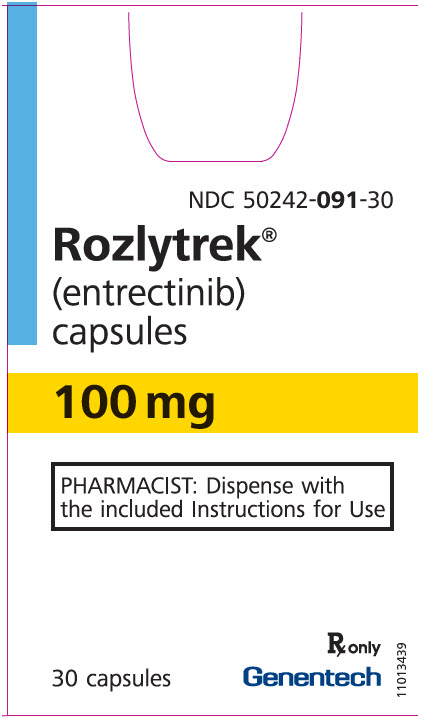
6PRINCIPAL DISPLAY PANEL - 100 mg Capsules Bottle Carton
NDC 50242-091-30
Rozlytrek
100 mg
PHARMACIST: Dispense with
30 capsules
Rx only
Genentech
11013439
PRINCIPAL DISPLAY PANEL - 100 mg Capsules Bottle Carton
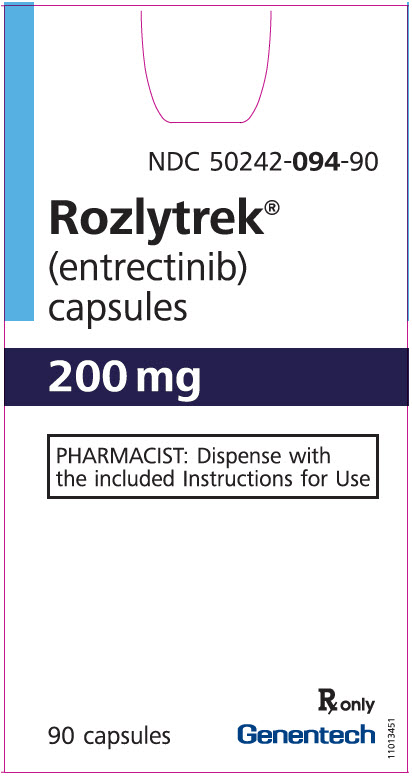
7PRINCIPAL DISPLAY PANEL - 200 mg Capsules Bottle Carton
NDC 50242-094-90
Rozlytrek
200 mg
PHARMACIST: Dispense with
90 capsules
Rx only
Genentech
11013451
PRINCIPAL DISPLAY PANEL - 200 mg Capsules Bottle Carton
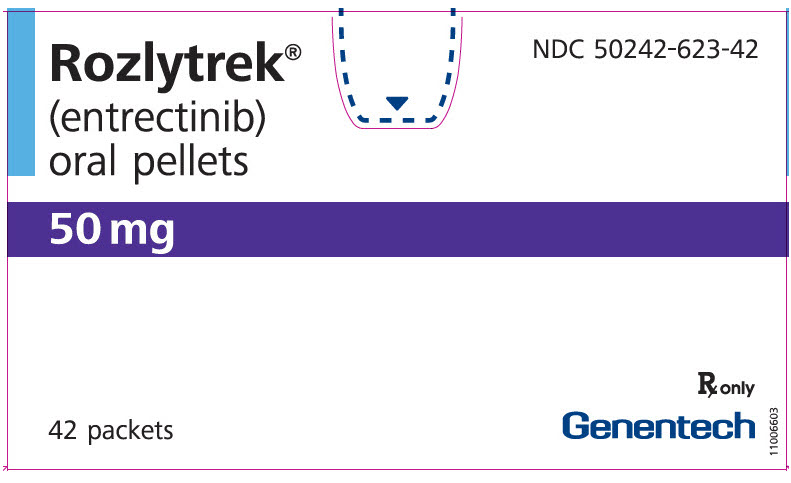
8PRINCIPAL DISPLAY PANEL - 50 mg Pellets Packet Carton
NDC 50242-623-42
Rozlytrek
50 mg
42 packets
Rx only
Genentech
11006603
PRINCIPAL DISPLAY PANEL - 50 mg Pellets Packet Carton