Brand Name
Fasenra
Generic Name
Benralizumab
View Brand Information FDA approval date: November 14, 2017
Classification: Interleukin-5 Receptor alpha-directed Cytolytic Antibody
Form: Injection
What is Fasenra (Benralizumab)?
FASENRA is an interleukin-5 receptor alpha-directed cytolytic monoclonal antibody indicated for: add-on maintenance treatment of adult and pediatric patients aged 6 years and older with severe asthma, and with an eosinophilic phenotype.
Approved To Treat
Top Global Experts


Save this treatment for later
Not sure about your diagnosis?
Related Clinical Trials
A Non-interventional, Prospective Study With Benralizumab to Investigate Clinical Outcome Based on Standard of Care Medication in Real-life
Summary: This is a prospective, non-interventional, single-arm, multicenter study to investigate asthma control, and health-related quality of life (HRQL), lung function and asthma medication intake in severe eosinophilic asthma patients treated with benralizumab in a real-life setting in Germany.
ItAlian, Multicenter, Observational, Prospective sTudy to Evaluate the acHievement of Clinical rEmission and immuNomodulation in Severe Eosinophilic Asthma Patients Treated With Benralizumab - the ATHENA Study
Summary: This is an observational, multicenter, prospective study on patients with severe eosinophilic asthma treated with benralizumab aimed at evaluating the achievement of partial and complete clinical remission.
Phase 3, Open-label Trial to Evaluate Safety, Pharmacokinetics, and Efficacy of Benralizumab in Children With Eosinophilic Diseases (CLIPS)
Summary: The main purpose of study is to assess the safety, tolerability, pharmacokinetics (PK), and efficacy of benralizumab.
Related Latest Advances
Brand Information
FASENRA (Benralizumab)
1DOSAGE FORMS AND STRENGTHS
Injection: clear to opalescent, colorless to slightly yellow solution and may contain a few translucent or white to off‑white particles available as:
- 10 mg/0.5 mL solution in a single-dose prefilled syringe.
- 30 mg/mL solution in a single-dose prefilled syringe.
- 30 mg/mL solution in a single-dose autoinjector FASENRA PEN.
2CONTRAINDICATIONS
FASENRA is contraindicated in patients who have known hypersensitivity to benralizumab or any of its excipients
3ADVERSE REACTIONS
The following adverse reactions are described in greater detail in other sections:
- Hypersensitivity Reactions
3.1Clinical Trials Experience
Because clinical trials are conducted under widely varying conditions, adverse reaction rates observed in the clinical trials of a drug cannot be directly compared to rates in the clinical trials of another drug and may not reflect the rates observed in practice.
Adult and Pediatric Patients 12 Years of Age and Older with Asthma
Across three clinical trials (SIROCCO, CALIMA, and ZONDA) for asthma, 1,808 patients received at least 1 dose of FASENRA
Adverse reactions that occurred at greater than or equal to 3% incidence are shown in
28-Week Trial
Adverse reactions from ZONDA with 28 weeks of treatment with FASENRA (n=73) or placebo (n=75) in which the incidence was more common in FASENRA than placebo include headache (8.2% compared to 5.3%, respectively) and pyrexia (2.7% compared to 1.3%, respectively)
Injection Site Reactions in Patients with Asthma
In SIROCCO and CALIMA, the FASENRA 30 mg prefilled syringe was administered at the recommended dosage and injection site reactions (e.g., pain, erythema, pruritus, papule) occurred at a rate of 2.2% in patients treated with FASENRA compared with 1.9% in patients treated with placebo.
Pediatric Patients 6 to 11 Years of Age with Asthma
The safety data for FASENRA is based on a 48-week, open-label, parallel group, pharmacokinetic and pharmacodynamic trial (TATE) of 28 pediatric patients aged 6 to 11 years with severe asthma, and with an eosinophilic phenotype
Adult Patients with EGPA
The safety of FASENRA is based on 70 adult patients who received at least 1 dose of FASENRA 30 mg administered subcutaneously every 4 weeks in an active-controlled study of 52 weeks duration (MANDARA)
Adult and Pediatric Patients 12 Years of Age and Older with HES
The safety of FASENRA is based on 67 adult and pediatric patients aged 12 years and older with HES who received at least 1 dose of FASENRA 30 mg administered subcutaneously every 4 weeks in a randomized, placebo-controlled, multicenter study of 24 weeks duration (NATRON)
3.2Postmarketing Experience
In addition to adverse reactions reported from clinical trials, the following adverse reactions have been identified during post-approval use of FASENRA. Because these reactions are reported voluntarily from a population of uncertain size, it is not always possible to reliably estimate their frequency or establish a causal relationship to drug exposure. These events have been chosen for inclusion due to either their seriousness, frequency of reporting, or causal connection to FASENRA or a combination of these factors.
Immune System Disorders: Hypersensitivity reactions, including anaphylaxis.
4OVERDOSAGE
There is no specific treatment for an overdosage with benralizumab. If overdose occurs, the patient should be treated supportively with appropriate monitoring as necessary.
Consider contacting the Poison Help line (1-800-222-1222) or a medical toxicologist for additional overdose management recommendations.
5DESCRIPTION
Benralizumab is a humanized monoclonal antibody (IgG1/κ-class) selective for interleukin-5 receptor alpha subunit (IL-5Rα). Benralizumab is produced in Chinese hamster ovary cells by recombinant DNA technology. Benralizumab has a molecular weight of approximately 150 kDa.
FASENRA (benralizumab) injection is a sterile, preservative-free, clear to opalescent, colorless to slightly yellow solution for subcutaneous injection. Since benralizumab is a protein, a few translucent or white to off-white particles may be present in the solution.
Each 10 mg single-dose prefilled syringe delivers 0.5 mL containing 10 mg benralizumab, L-histidine (0.7 mg); L-histidine hydrochloride monohydrate (1.2 mg); polysorbate 20 (0.03 mg); α,α‑trehalose dihydrate (47 mg); and Water for Injection, USP, at pH of 5.5 – 6.5. The single-dose prefilled syringe contains a 1 mL glass syringe with a staked 29-gauge ½ inch stainless steel needle.
Each 30 mg single-dose prefilled syringe or single-dose autoinjector delivers 1 mL containing 30 mg benralizumab, L-histidine (1.4 mg); L-histidine hydrochloride monohydrate (2.3 mg); polysorbate 20 (0.06 mg); α,α‑trehalose dihydrate (95 mg); and Water for Injection, USP, at pH of 5.5 – 6.5. The single-dose prefilled syringe or single-dose autoinjector contains a 1 mL glass syringe with a staked 29-gauge ½ inch stainless steel needle.
6HOW SUPPLIED/STORAGE AND HANDLING
How Supplied
FASENRA (benralizumab) injection is a sterile, preservative-free, clear to opalescent, colorless to slightly yellow solution and may contain a few translucent or white to off-white particles, for subcutaneous injection supplied as a single-dose prefilled syringe or single-dose autoinjector. The prefilled syringe (including stopper and cap) and autoinjector are not made with natural rubber latex.
FASENRA is available as:
Single-Dose Prefilled Syringe
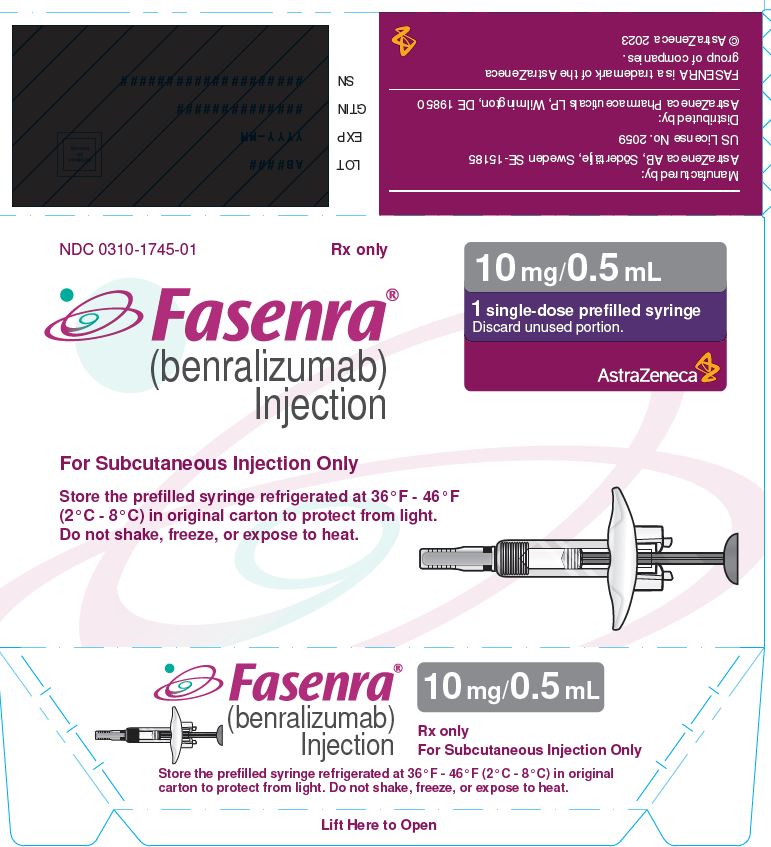
- Carton contains one 10 mg/0.5 mL single-dose prefilled syringe with a gray plunger rod: NDC 0310-1745-01
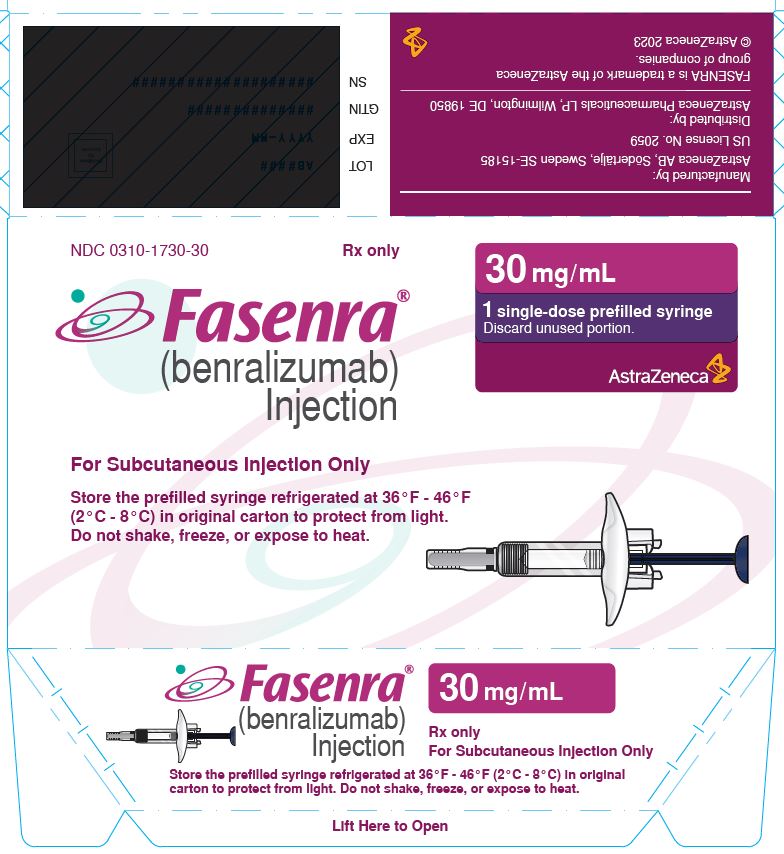
- Carton contains one 30 mg/mL single-dose prefilled syringe with a blue plunger rod: NDC 0310-1730-30
Single-Dose Autoinjector FASENRA PEN
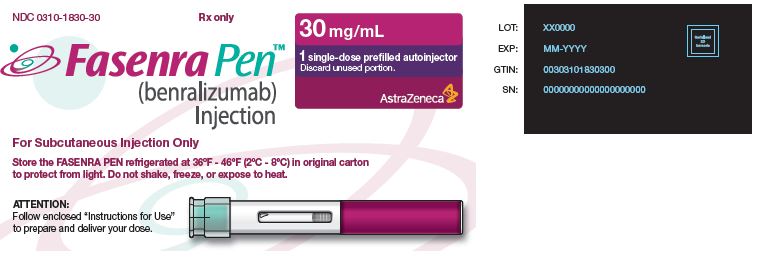
- Carton contains one 30 mg/mL single-dose autoinjector: NDC 0310-1830-30
Storage and Handling
Store refrigerated at 36°F to 46°F (2°C to 8°C) in the original carton to protect from light.
If needed, the prefilled syringe and autoinjector may be stored at room temperature up to 77°F (25°C) for a maximum of 14 days in the original carton to protect from light. Once removed from the refrigerator and brought to room temperature (up to 77°F [25°C]), the prefilled syringe and autoinjector must be used within 14 days or discarded.
Do not freeze. Do not shake. Do not expose to heat.
7PATIENT COUNSELING INFORMATION
Advise the patients and/or caregivers to read the FDA-approved patient labeling (Patient Information and Instructions for Use for FASENRA PEN) before the patient starts using FASENRA and each time the prescription is renewed as there may be new information they need to know.
Administration Instructions
Instruct patients and/or caregivers on proper subcutaneous injection technique using the FASENRA PEN, including aseptic technique, and the preparation and administration of FASENRA PEN prior to use. Advise patients to follow sharps disposal recommendations
Hypersensitivity Reactions
Inform patients that hypersensitivity reactions (e.g., anaphylaxis, angioedema, urticaria, rash) have occurred after administration of FASENRA. These reactions generally occurred within hours of FASENRA administration, but in some instances had a delayed onset (i.e., days). Instruct patients to contact their healthcare provider if they experience symptoms of an allergic reaction
Not for Acute Symptoms or Deteriorating Disease
Inform patients that FASENRA does not treat acute asthma symptoms or acute exacerbations. Inform patients to seek medical advice if their asthma remains uncontrolled or worsens after initiation of treatment with FASENRA
Reduction of Corticosteroid Dosage
Inform patients to not discontinue systemic or inhaled corticosteroids except under the direct supervision of a physician. Inform patients that reduction in corticosteroid dose may be associated with systemic withdrawal symptoms and/or unmask conditions previously suppressed by systemic corticosteroid therapy
Manufactured by
AstraZeneca AB
Södertälje, Sweden SE-15185
US License No. 2059
Distributed by
AstraZeneca Pharmaceuticals LP,
Wilmington, DE 19850
FASENRA is a registered trademark of the AstraZeneca group of companies.
©AstraZeneca 2026
8PACKAGE/LABEL PRINCIPAL DISPLAY PANEL
NDC 0310-1730-30 Rx only
9PACKAGE/LABEL PRINCIPAL DISPLAY PANEL
NDC 0310-1745-01 Rx only
10Package/Label Display Panel
NDC 0310-1830-30 Rx only