Brand Name

Xospata

Generic Name
Gilteritinib
View Brand Information
FDA approval date: November 29, 2018
Form: Tablet

What is Xospata (Gilteritinib)?

XOSPATA is a kinase inhibitor indicated for the treatment of adult patients who have relapsed or refractory acute myeloid leukemia with a FLT3 mutation as detected by an FDA-approved test.
Save this treatment for later
Sign Up
Not sure about your diagnosis?
Check Your Symptoms

Related Clinical Trials

A Phase I/II Study of Azacitidine, Venetoclax, and Gilteritinib for Patients With Acute Myeloid Leukemia or High-Risk Myelodysplastic Syndrome With an Activating FLT3 Mutation

Summary: This phase I/II trial studies the side effects and best dose of gilteritinib and to see how well it works in combination with azacitidine and venetoclax in treating patients with FLT3-mutation positive acute myeloid leukemia, chronic myelomonocytic leukemia, or high-risk myelodysplastic syndrome/myeloproliferative neoplasm that has come back (recurrent) or has not responded to treatment (refractor...

Olutasidenib Combined With Co-targeted Therapy in Relapsed or Refractory IDH1-mutated Myeloid Malignancies Harboring Activated Signaling Pathway Mutations

Summary: To learn about the safety and tolerability of study drug combinations in patients with relapsed/refractory, IDH1-mutated myeloid malignancies with a co-signaling mutation.

A Randomized Phase II Study of Venetoclax and HMA-Based Therapies for the Treatment of Older and Unfit Adults With Newly Diagnosed FLT3-Mutated Acute Myeloid Leukemia (AML): A MyeloMATCH Treatment Trial

Summary: This phase II MyeloMATCH treatment trial compares the usual treatment of azacitidine and venetoclax to the combination treatment of azacitidine, venetoclax and gilteritinib in treating older and unfit patients with acute myeloid leukemia and FLT3 mutations. Azacitidine is a drug that is absorbed into DNA and leads to the activation of cancer suppressor genes, which are genes that help control cell...

Brand Information

Xospata (gilteritinib)
WARNING: DIFFERENTIATION SYNDROME
Patients treated with XOSPATA have experienced symptoms of differentiation syndrome, which can be fatal or life-threatening if not treated. Symptoms may include fever, dyspnea, hypoxia, pulmonary infiltrates, pleural or pericardial effusions, rapid weight gain or peripheral edema, hypotension, or renal dysfunction. If differentiation syndrome is suspected, initiate corticosteroid therapy and hemodynamic monitoring until symptom resolution 
1DOSAGE FORMS AND STRENGTHS
Tablets: 40 mg as light yellow, round-shaped, film-coated tablets debossed with the Astellas logo and ‘235’ on the same side.
2CONTRAINDICATIONS
XOSPATA is contraindicated in patients with hypersensitivity to gilteritinib or any of the excipients. Anaphylactic reactions have been observed in clinical trials
3ADVERSE REACTIONS
The following clinically significant adverse reactions are described elsewhere in the labeling:
  • Differentiation syndrome
  • Posterior reversible encephalopathy syndrome
  • Prolonged QT interval
  • Pancreatitis
3.1Clinical Trials Experience
Because clinical trials are conducted under widely varying conditions, adverse reaction rates observed in the clinical trials of a drug cannot be directly compared to rates in the clinical trials of another drug and may not reflect the rates observed in practice.
The safety profile of XOSPATA is based on 319 patients with relapsed or refractory AML treated with gilteritinib 120 mg daily in three clinical trials. The median duration of exposure to XOSPATA was 3.6 months (range 0.1 to 43.4 months).
Fatal adverse reactions occurred in 2% of patients receiving XOSPATA. These included cardiac arrest (1%) and one case each of differentiation syndrome and pancreatitis. The most frequent (≥5%) nonhematological serious adverse reactions reported in patients were fever (13%), dyspnea (9%), renal impairment (8%), transaminase increased (6%) and noninfectious diarrhea (5%).
Of the 319 patients, 91 (29%) required a dose interruption due to an adverse reaction; the most common adverse reactions leading to dose interruption were aspartate aminotransferase increased (6%), alanine aminotransferase increased (6%) and fever (4%). Twenty patients (6%) required a dose reduction due to an adverse reaction. Twenty-two (7%) discontinued XOSPATA treatment permanently due to an adverse reaction. The most common (>1%) adverse reactions leading to discontinuation were aspartate aminotransferase increased (2%) and alanine aminotransferase increased (2%).
Overall, for the 319 patients, the most frequent (≥10%) all-grade nonhematological adverse reactions reported in patients were transaminase increased (51%), myalgia/arthralgia (50%), fatigue/malaise (44%), fever (41%), mucositis (41%), edema (40%), rash (36%), noninfectious diarrhea (35%), dyspnea (35%), nausea (30%), cough (28%), constipation (28%), eye disorders (25%), headache (24%), dizziness (22%), hypotension (22%), vomiting (21%), renal impairment (21%), abdominal pain (18%), neuropathy (18%), insomnia (15%) and dysgeusia (11%). The most frequent (≥5%) grade ≥3 nonhematological adverse reactions reported in patients were transaminase increased (21%), dyspnea (12%), hypotension (7%), mucositis (7%), myalgia/arthralgia (7%), and fatigue/malaise (6%). Shifts to grades 3-4 nonhematologic laboratory abnormalities included phosphate decreased 42/309 (14%), alanine aminotransferase increased 41/317 (13%), sodium decreased 37/314 (12%), aspartate aminotransferase increased 33/317 (10%), calcium decreased 19/312 (6%), creatine kinase increased 20/317 (6%), triglycerides increased 18/310 (6%), creatinine increased 10/316 (3%), and alkaline phosphatase increased 5/317 (2%).
Adverse reactions reported in the first 30 days of therapy on the ADMIRAL Study
Other clinically significant adverse reactions occurring in ≤10% of patients included: electrocardiogram QT prolonged (9%), hypersensitivity* (8%), pancreatitis* (5%), cardiac failure* (4%), pericardial effusion (4%), acute febrile neutrophilic dermatosis (3%), differentiation syndrome (3%), pericarditis/myocarditis* (2%), large intestine perforation (1%), and posterior reversible encephalopathy syndrome (1%).
*Grouped terms: cardiac failure (cardiac failure, cardiac failure congestive, cardiomegaly, cardiomyopathy, chronic left ventricular failure, and ejection fraction decreased), hypersensitivity (anaphylactic reaction, angioedema, dermatitis allergic, drug hypersensitivity, erythema multiforme, hypersensitivity, and urticaria), pancreatitis (amylase increased, lipase increased, pancreatitis, pancreatitis acute), pericarditis/myocarditis (myocarditis, pericardial hemorrhage, pericardial rub, and pericarditis).
Selected post-baseline laboratory values that were observed in patients with relapsed or refractory AML are shown in
4DESCRIPTION
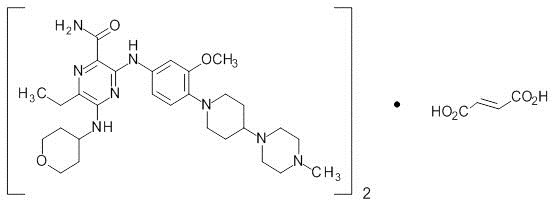
Gilteritinib is a kinase inhibitor. The chemical name is 2-Pyrazinecarboxamide, 6-ethyl-3-[[3-methoxy-4-[4-(4-methyl-1-piperazinyl)-1-piperidinyl] phenyl] amino]-5-[(tetrahydro-2
Structural Formula of Gilteritinib
Gilteritinib fumarate is a light yellow to yellow powder or crystals that is sparingly soluble in water and very slightly soluble in anhydrous ethanol.
XOSPATA (gilteritinib) is provided as a tablet for oral administration. Each tablet contains 40 mg of gilteritinib active ingredient as free base (corresponding to 44.2 mg gilteritinib fumarate). The inactive ingredients are ferric oxide, hydroxypropyl cellulose, hypromellose, low-substituted hydroxypropyl cellulose, mannitol, magnesium stearate, polyethylene glycol, talc, and titanium dioxide.
5HOW SUPPLIED/STORAGE AND HANDLING
How Supplied
XOSPATA (gilteritinib) 40 mg tablets are supplied as light yellow, round-shaped, film-coated tablets debossed with the Astellas logo and ‘235’ on the same side. XOSPATA tablets are available in the following package size:
  • Bottles of 90 tablets with Child Resistant Closure (NDC 0469-1425-90)
Storage
Store XOSPATA tablets at 20ºC to 25ºC (68°F to 77°F); excursions permitted between 15ºC to 30ºC (59°F to 86°F) [See USP Controlled Room Temperature]. Keep in original container until dispensed. Protect from light, moisture and humidity.
6PATIENT COUNSELING INFORMATION
Advise the patient to read the FDA-approved patient labeling (Medication Guide).
Differentiation Syndrome
Advise patients of the risks of developing differentiation syndrome as early as 1 day after the start of therapy and during the first 3 months on treatment. Ask patients to immediately report any symptoms suggestive of differentiation syndrome, such as fever, cough or difficulty breathing, rash, low blood pressure, rapid weight gain, swelling of their arms or legs, or decreased urinary output, to their healthcare provider for further evaluation
Posterior Reversible Encephalopathy Syndrome
Advise patients of the risk of developing posterior reversible encephalopathy syndrome (PRES). Ask patients to immediately report any symptoms suggestive of PRES, such as seizure and altered mental status, to their healthcare provider for further evaluation
Prolonged QT Interval
Advise patients to consult their healthcare provider immediately if they feel faint, lose consciousness, or have signs or symptoms suggestive of arrhythmia. Advise patients with a history of hypokalemia or hypomagnesemia of the importance of monitoring their electrolytes
Pancreatitis
Advise patients of the risk of pancreatitis and to contact their healthcare provider for signs or symptoms of pancreatitis, which include severe and persistent stomach pain, with or without nausea and vomiting
Use of Contraceptives
  • Advise female patients with reproductive potential to use effective contraceptive methods while receiving XOSPATA and for 6 months after completion of treatment.
  • Advise patients to notify their healthcare provider immediately in the event of a pregnancy or if pregnancy is suspected during XOSPATA treatment.
  • Advise males with female partners of reproductive potential to use effective contraception during treatment with XOSPATA and for 4 months after the last dose of XOSPATA
Lactation
Advise women not to breastfeed during treatment with XOSPATA for 2 months after the last dose
Dosing Instructions
  • Advise patients not to break, crush or chew the tablets but to swallow them whole with a cup of water.
  • Instruct patients that, if they miss a dose of XOSPATA, to take it as soon as possible on the same day, and at least 12 hours prior to the next scheduled dose, and return to the normal schedule the following day. Instruct patients to not take 2 doses within 12 hours
Distributed by:
XOSPATA is a registered trademark of Astellas Pharma Inc.
7PACKAGE/LABEL PRINCIPAL DISPLAY PANEL – 40 mg Tablet Bottle Carton
Xospata (gilteritinib) tablets 40 mg label
NDC 0469-1425-90
XOSPATA