Brand Name
Tradjenta
Generic Name
Linagliptin
View Brand Information FDA approval date: May 09, 2011
Classification: Dipeptidyl Peptidase 4 Inhibitor
Form: Tablet
What is Tradjenta (Linagliptin)?
TRADJENTA is indicated as an adjunct to diet and exercise to improve glycemic control in adults with type 2 diabetes mellitus. TRADJENTA is a dipeptidyl peptidase-4 inhibitor indicated as an adjunct to diet and exercise to improve glycemic control in adults with type 2 diabetes mellitus Limitations of Use Not recommended in patients with type 1 diabetes mellitus as it would not be effective Has not been studied in patients with a history of pancreatitis Limitations of Use TRADJENTA is not recommended in patients with type 1 diabetes mellitus as it would not be effective. TRADJENTA has not been studied in patients with a history of pancreatitis. It is unknown whether patients with a history of pancreatitis are at an increased risk for the development of pancreatitis while using TRADJENTA [see Warnings and Precautions.
Approved To Treat


Save this treatment for later
Not sure about your diagnosis?
Related Clinical Trials
A Multicenter Study to Evaluate Efficacy and Safety
Summary: Glycemic Variability of Combination Therapies in T2DM
National, Multicenter, Randomized, Double-blind, Triple-dummy, Phase III Clinical Trial to Evaluate the Efficacy and Safety of Madalena Association in the Treatment of Type II Diabetes Mellitus.
Summary: The purpose of this study is to evaluate the efficacy and safety of Madalena association in the treatment of type 2 diabetes mellitus.
Cofrogliptin Once Every 2 Weeks as Add-on Therapy to Metformin and Dapagliflozin Versus Daily Linagliptin in Patients With Type 2 Diabetes: A Multicenter, Randomized, Open-Label, Active-Controlled, Non-inferiority Trial
Summary: This study is designed to evaluate the change in glycated hemoglobin (HbA1c) levels from baseline to 24 weeks after the combination therapy of cofrogliptin, metformin and SGLT2i (dapagliflozin) in type 2 diabetes mellitus (T2DM) patients with poor control of glucose level by metformin and SGLT2i combination therapy.
Related Latest Advances
Brand Information
Tradjenta (linagliptin)
1INDICATIONS AND USAGE
TRADJENTA is indicated as an adjunct to diet and exercise to improve glycemic control in adults with type 2 diabetes mellitus
2DOSAGE FORMS AND STRENGTHS
Tablets: 5 mg, light red, round, biconvex, bevel-edged, film-coated tablets with "D5" debossed on one side and the Boehringer Ingelheim symbol debossed on the other side.
3CONTRAINDICATIONS
TRADJENTA is contraindicated in patients with hypersensitivity to linagliptin or any of the excipients in TRADJENTA, reactions such as anaphylaxis, angioedema, exfoliative skin conditions, urticaria, or bronchial hyperreactivity have occurred
4ADVERSE REACTIONS
The following serious adverse reactions are described below or elsewhere in the prescribing information:
- Pancreatitis
- Hypoglycemia with Concomitant Use with Insulin and Insulin Secretagogues
- Hypersensitivity Reactions
- Severe and Disabling Arthralgia
- Bullous Pemphigoid
- Heart Failure
4.1Clinical Trials Experience
Because clinical trials are conducted under widely varying conditions, adverse reaction rates observed in the clinical trials of a drug cannot be directly compared to rates in the clinical trials of another drug and may not reflect the rates observed in practice.
The safety evaluation of TRADJENTA 5 mg once daily in patients with type 2 diabetes mellitus is based on 14 placebo-controlled trials, 1 active-controlled trial, and one trial in patients with severe renal impairment. In the 14 placebo-controlled studies, a total of 3,625 patients were randomized and treated with TRADJENTA 5 mg daily and 2,176 with placebo. The mean exposure in patients treated with TRADJENTA across studies was 29.6 weeks. The maximum follow-up was 78 weeks.
TRADJENTA 5 mg once daily was studied as monotherapy in three placebo-controlled trials of 18 and 24 weeks' duration and in five additional placebo-controlled studies lasting ≤18 weeks. The use of TRADJENTA in combination with other antihyperglycemic agents was studied in six placebo-controlled trials: two with metformin (12 and 24 weeks' treatment duration); one with a sulfonylurea (18 weeks' treatment duration); one with metformin and sulfonylurea (24 weeks' treatment duration); one with pioglitazone (24 weeks' treatment duration); and one with insulin (primary endpoint at 24 weeks).
In a pooled dataset of 14 placebo-controlled clinical trials, adverse reactions that occurred in ≥2% of patients receiving TRADJENTA (n = 3,625) and more commonly than in patients given placebo (n = 2,176), are shown in Table 1.
Rates for other adverse reactions for TRADJENTA 5 mg vs placebo when TRADJENTA was used in combination with specific antidiabetic agents were: urinary tract infection (3.1% vs 0%) and hypertriglyceridemia (2.4% vs 0%) when TRADJENTA was used as add-on to sulfonylurea; hyperlipidemia (2.7% vs 0.8%) and weight increased (2.3% vs 0.8%) when TRADJENTA was used as add-on to pioglitazone; and constipation (2.1% vs 1%) when TRADJENTA was used as add-on to basal insulin therapy. Other adverse reactions reported in clinical studies with treatment of TRADJENTA were hypersensitivity (e.g., urticaria, angioedema, localized skin exfoliation, or bronchial hyperreactivity) and myalgia.
Following 104 weeks' treatment in a controlled trial comparing TRADJENTA with glimepiride in which all patients were also receiving metformin, adverse reactions reported in ≥5% of patients treated with TRADJENTA (n = 776) and more frequently than in patients treated with a sulfonylurea (n = 775) were back pain (9.1% vs 8.4%), arthralgia (8.1% vs 6.1%), upper respiratory tract infection (8.0% vs 7.6%), headache (6.4% vs 5.2%), cough (6.1% vs 4.9%), and pain in extremity (5.3% vs 3.9%).
In the clinical trial program, pancreatitis was reported in 15.2 cases per 10,000 patient year exposure while being treated with TRADJENTA compared with 3.7 cases per 10,000 patient year exposure while being treated with comparator (placebo and active comparator, sulfonylurea). Three additional cases of pancreatitis were reported following the last administered dose of linagliptin.
4.2Postmarketing Experience
Additional adverse reactions have been identified during postapproval use of TRADJENTA. Because these reactions are reported voluntarily from a population of uncertain size, it is generally not possible to reliably estimate their frequency or establish a causal relationship to drug exposure.
- Gastrointestinal Disorders: Acute pancreatitis, including fatal pancreatitis [see mouth ulceration, stomatitis
- Immune System Disorders: Hypersensitivity reactions including anaphylaxis, angioedema, and exfoliative skin conditions
- Musculoskeletal and Connective Tissue Disorders: Rhabdomyolysis, severe and disabling arthralgia
- Skin and Subcutaneous Tissue Disorders: Bullous pemphigoid, rash
5OVERDOSAGE
In the event of an overdose with TRADJENTA, consider contacting the Poison Help Line (1-800-222-1222) or a medical toxicologist for additional overdosage management recommendations. Removal of linagliptin by hemodialysis or peritoneal dialysis is unlikely.
6DESCRIPTION
TRADJENTA tablets for oral use contain linagliptin, an inhibitor of the DPP-4 enzyme.
The chemical name of linagliptin is 1H-Purine-2,6-dione, 8-[(3R)-3-amino-1-piperidinyl]-7-(2-butyn-1-yl)-3,7-dihydro-3-methyl-1-[(4-methyl-2-quinazolinyl)methyl]-
The molecular formula is C
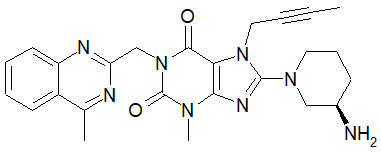
Linagliptin is a white to yellowish, not or only slightly hygroscopic solid substance. It is very slightly soluble in water (0.9 mg/mL). Linagliptin is soluble in methanol (ca. 60 mg/mL), sparingly soluble in ethanol (ca. 10 mg/mL), very slightly soluble in isopropanol (<1 mg/mL), and very slightly soluble in acetone (ca. 1 mg/mL).
Each film-coated tablet of TRADJENTA contains 5 mg of linagliptin free base and the following inactive ingredients: copovidone, corn starch, magnesium stearate, mannitol, and pregelatinized starch. In addition, the film coating contains the following inactive ingredients: hypromellose, polyethylene glycol, red ferric oxide, talc, and titanium dioxide.
7HOW SUPPLIED/STORAGE AND HANDLING
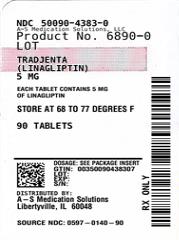
Product: 50090-4383
NDC: 50090-4383-0 90 TABLET, FILM COATED in a BOTTLE
8PATIENT COUNSELING INFORMATION
Advise the patient to read the FDA-approved patient labeling (Medication Guide).
9Storage
Store at 25°C (77°F); excursions permitted to 15°-30°C (59°-86°F) [see USP Controlled Room Temperature].
10linagliptin