Brand Name

Sylvant

Generic Name
Siltuximab
View Brand Information
FDA approval date: April 23, 2014
Classification: Interleukin-6 Antagonist
Form: Injection

What is Sylvant (Siltuximab)?

SYLVANT is indicated for the treatment of patients with multicentric Castleman's disease who are human immunodeficiency virus negative and human herpesvirus-8 negative. SYLVANT is an interleukin-6 antagonist indicated for the treatment of patients with multicentric Castleman's disease who are human immunodeficiency virus negative and human herpesvirus-8 negative. Limitations of Use SYLVANT was not studied in patients with MCD who are HIV positive or HHV-8 positive because SYLVANT did not bind to virally produced IL-6 in a nonclinical study. Limitations of Use SYLVANT was not studied in patients with MCD who are HIV positive or HHV-8 positive because SYLVANT did not bind to virally produced IL-6 in a nonclinical study.

Approved To Treat

Save this treatment for later
Sign Up
Not sure about your diagnosis?
Check Your Symptoms

Related Clinical Trials

A Phase II, Single-Arm Open-Label Multi-Center Study of Ruxolitinib in Previously Treated Idiopathic Multicentric Castleman Disease

Summary: The research study is being done to look at the effects of ruxolitinib in adults with idiopathic Multicentric Castleman Disease (iMCD) that has not gotten better from taking siltuximab or tocilizumab, or who cannot take those medications.

Pilot Safety-feasibility Study of Cytokine Release Syndrome Prophylaxis and Treatment With Siltuximab Prior to Epcoritamab

Summary: The goal of this clinical trial is to is to determine the safety, feasibility and efficacy of siltuximab prophylaxis of cytokine release syndrome and neurotoxicity occurring after epcoritamab subcutaneous administration for participants with large b-cell lymphoma (DLBCL) or follicular lymphoma (FL). Participants will receive siltuximab, prior to the injection of epcoritamab. Epcoritamab is adminis...

Brand Information

Sylvant (Siltuximab)
1INDICATIONS AND USAGE
SYLVANT is indicated for the treatment of patients with multicentric Castleman's disease (MCD) who are human immunodeficiency virus (HIV) negative and human herpesvirus-8 (HHV-8) negative.
2DOSAGE FORMS AND STRENGTHS
SYLVANT (siltuximab) for injection is available as:
  • 100 mg of lyophilized powder in a single-dose vial for intravenous infusion.
  • 400 mg of lyophilized powder in a single-dose vial for intravenous infusion.
3CONTRAINDICATIONS
Severe hypersensitivity reaction to siltuximab or any of the excipients in SYLVANT
4ADVERSE REACTIONS
The following clinically significant adverse reactions are also discussed in other sections of the labeling:
  • Concurrent active severe infections
  • Infusion-related reactions and hypersensitivity
  • Gastrointestinal perforation
4.1Clinical Trials Experience
Because clinical trials are conducted under widely varying conditions, adverse reaction rates observed in the clinical trials of a drug cannot be directly compared to rates in the clinical trials of another drug and may not reflect the rates observed in clinical practice.
Study 1, in MCD, was an international, multicenter, randomized Phase 2 study of every 3 week infusions comparing SYLVANT and best supportive care (BSC) to placebo and BSC. There were 53 patients randomized to the SYLVANT arm at a dosage of 11 mg/kg and 26 patients randomized to the placebo arm. Of the 26 placebo-treated patients, 13 patients subsequently crossed-over to receive SYLVANT. The median age was 48 years (range 20 to 78), 66% male, 48% Asian, 39% White, 4% Black or African American, 7% other. The patients randomized to SYLVANT received a median of 19 infusions (range 1 to 50) compared to patients randomized to placebo who received a median of 8 infusions (range 2 to 32). To control for disparate exposure between arms, Table 3 reports the per patient incidence of adverse reactions that occurred during the first 8 infusions. Adverse reactions that occurred >3% in the SYLVANT arm are presented.
The most common adverse reactions (> 10% compared to placebo) during treatment with SYLVANT in the MCD clinical trial were rash, pruritus, upper respiratory tract infection, increased weight, and hyperuricemia.
Study CNTO328MCD2002 (referred to as Study 2) (NCT01400503) was an open label, long term extension study of patients with MCD treated on prior trials. The median duration of siltuximab treatment was 5.52 years (range: 0.8 to 10.8 years); more than 50% of patients received siltuximab treatment for ≥5 years. The rate of serious or Grade ≥3 adverse events did not increase over time as a function of cumulative exposure.
Other important adverse reactions reported in MCD clinical studies, all of which were very common, were:
Infections and infestations: nasopharyngitis, urinary tract infection
Blood and lymphatic system disorders: neutropenia
Nervous system disorders: dizziness
Vascular disorders: hypertension
Gastrointestinal disorders: nausea, abdominal pain, vomiting, diarrhea, gastroesophageal reflux disease, mouth ulceration
4.2Immunogenicity
Immunogenicity data are highly dependent on the sensitivity and specificity of the test methods used. Additionally, the observed incidence of a positive result in a test method may be influenced by several factors, including sample handling, timing of sample collection, drug interference, concomitant medication and the underlying disease. Therefore, comparison of the incidence of antibodies to SYLVANT with the incidence of antibodies to other products may be misleading. The clinical significance of anti-siltuximab antibodies following treatment with SYLVANT is not known.
The immunogenicity of siltuximab has been evaluated using antigen-bridging enzyme immunoassay (EIA) and electrochemiluminescence-based immunoassay (ECLIA) methods. A total of 432 patients across the clinical studies were evaluated at multiple time points for anti-therapeutic antibody (ATA) responses to siltuximab after treatment with SYLVANT. Following SYLVANT dosing, 0/243 (0%) patients tested positive for anti-siltuximab antibodies by EIA and 4/189 (2%) patients tested positive by ECLIA. Further immunogenicity analyses were conducted for all positive samples from the 4 patients with detectable anti-siltuximab antibodies. None of these patients had neutralizing antibodies.
5DESCRIPTION
Siltuximab is a human-mouse chimeric monoclonal antibody that binds human interleukin-6 (IL-6) and is produced by Chinese hamster ovary cells.
SYLVANT (siltuximab) for injection is supplied as a sterile, white, preservative free, lyophilized powder in single-dose vials.
Each SYLVANT 100 mg single-dose vial contains 100 mg siltuximab, 3.7 mg L-histidine (from L-histidine and L-histidine monohydrochloride monohydrate), 0.8 mg polysorbate 80, and 169 mg sucrose.
Each SYLVANT 400 mg single-dose vial contains 400 mg siltuximab, 14.9 mg L-histidine (from L-histidine and L-histidine monohydrochloride monohydrate), 3.2 mg polysorbate 80, and 677 mg sucrose.
Following reconstitution with Sterile Water for Injection, USP (per section 2.2), the resulting pH is approximately 5.2. The resulting solution contains 20 mg/mL siltuximab to be administered by intravenous infusion following dilution
6PATIENT COUNSELING INFORMATION
Advise the patient to read the FDA-approved patient labeling (Patient Information).
Instruct the patient of the risks of SYLVANT treatment.
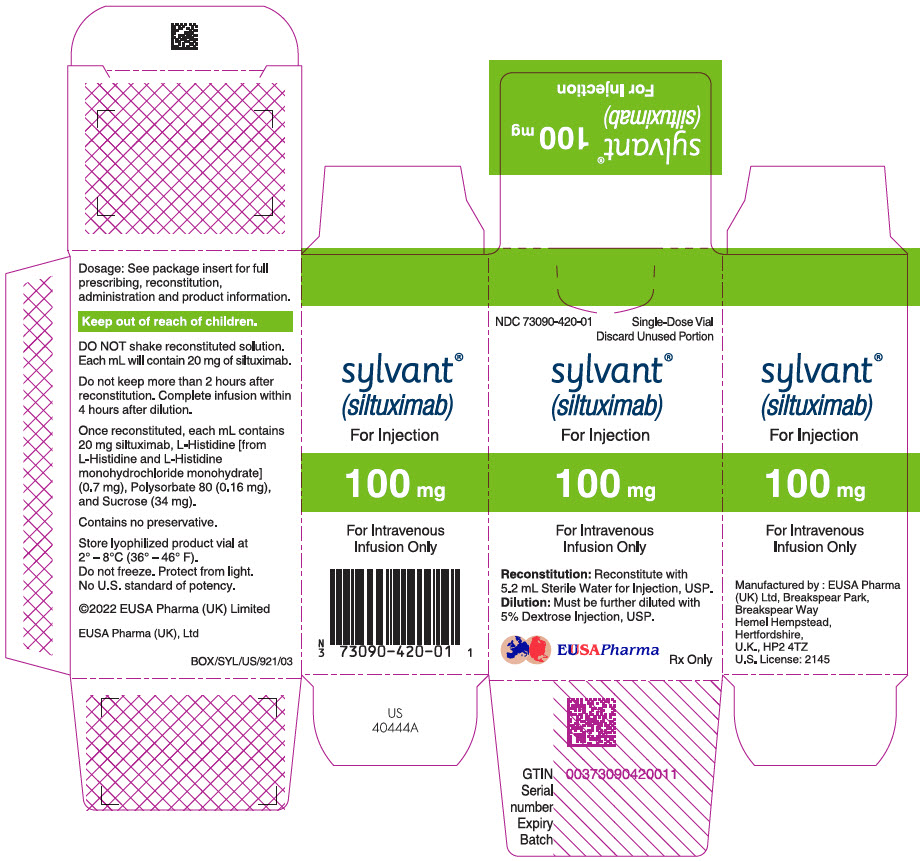
7PRINCIPAL DISPLAY PANEL - 100 mg Vial Box
NDC 73090-420-01
Single-Dose Vial
sylvant
100 mg
For Intravenous
Reconstitution: Reconstitute with
RECORDATI
Rx Only
PRINCIPAL DISPLAY PANEL - 100 mg Vial Box
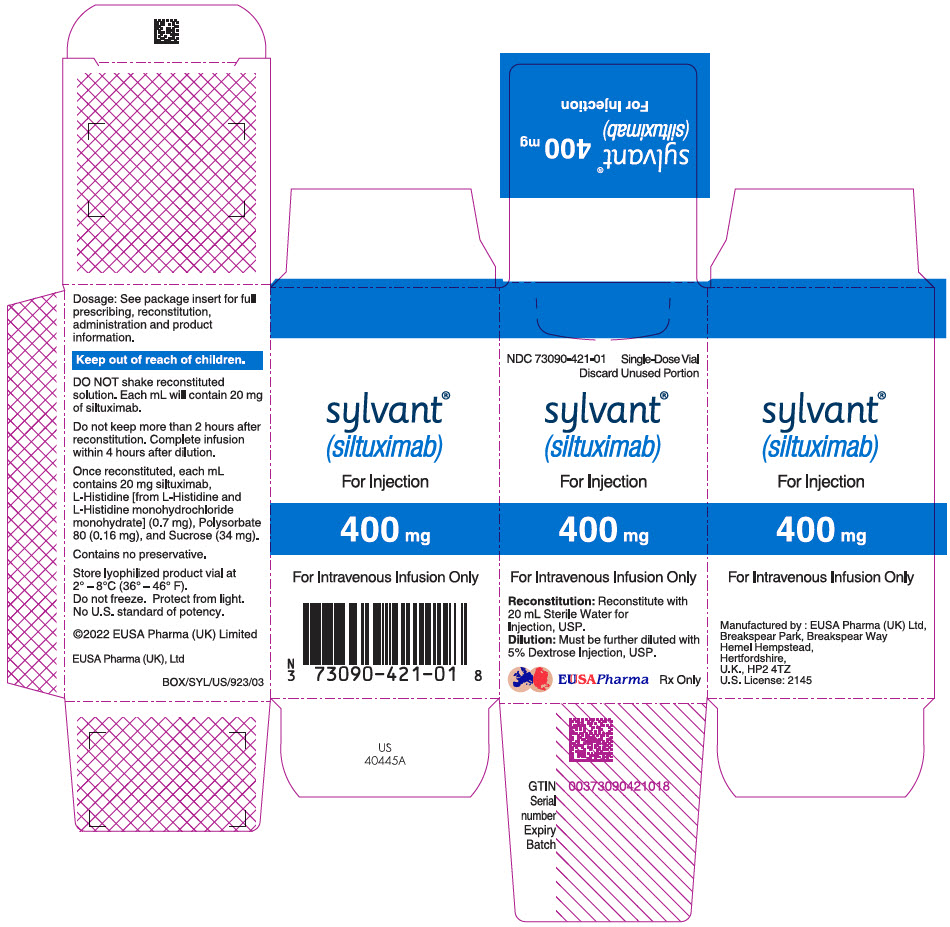
8PRINCIPAL DISPLAY PANEL - 400 mg Vial Box
NDC 73090-421-01
Single-Dose Vial
sylvant
400 mg
For Intravenous Infusion Only
Reconstitution: Reconstitute with
RECORDATI
PRINCIPAL DISPLAY PANEL - 400 mg Vial Box