Brand Name
Octreoscan
Generic Name
-111 Pentetreotide
View Brand Information FDA approval date: October 14, 2015
Form: Kit
What is Octreoscan (-111 Pentetreotide)?
Octreoscan, after radiolabeling, is an agent for the scintigraphic localization of primary and metastatic neuroendocrine tumors bearing somatostatin receptors.
Approved To Treat


Save this treatment for later
Not sure about your diagnosis?
Related Clinical Trials
Prospective Evaluation of 68Ga-DOTATATE PET/CT, Octreotide and F-DOPA PET Imaging in Ectopic Cushing Syndrome
Summary: Between 10% and 15% of patients with endogenous hypercortisolism (Cushing syndrome) have ectopic (non-pituitary) production of adrenocorticotropin hormone (ACTH) that causes cortisol excess. In approximately 50% of these patients, the tumoral source of ACTH cannot be found initially despite very detailed and extensive imaging, including studies such as computed tomography, magnetic resonance imagi...
Related Latest Advances
Brand Information
OCTREOSCAN (Indium In -111 Pentetreotide)
1DESCRIPTION
Octreoscan
1) A 10-mL Octreoscan Reaction Vial which contains a lyophilized mixture of:
Pentetreotide has the following structural formula:
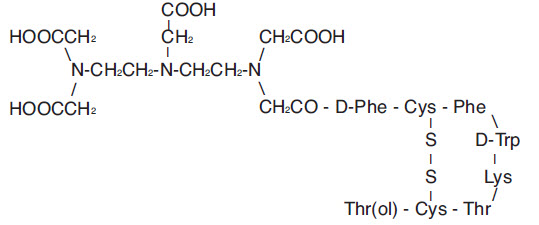
Prior to lyophilization, sodium hydroxide or hydrochloric acid may have been added for pH adjustment. The vial contents are sterile and nonpyrogenic. No bacteriostatic preservative is present.
2) A 10-mL vial of Indium In 111 Chloride Solution, which contains: 1.1 mL or 111 MBq/mL (3 mCi/mL) indium In 111 chloride in 0.02N HCl at time of calibration. The vial also contains ferric chloride at a concentration of 3.5 mcg/mL (ferric ion, 1.2 mcg/mL). The vial contents are sterile and nonpyrogenic. No bacteriostatic preservative is present.
Indium In 111 Pentetreotide Injection is prepared by combining the two kit components (
The Indium In 111 Pentetreotide Injection is suitable for intravenous administration as is, or it may be diluted to a maximum volume of 3 mL with 0.9% Sodium Chloride Injection, USP, immediately before intravenous administration. In either case, the radiolabeling yield of Indium In 111 Pentetreotide Injection should be determined before administration to the patient. A method recommended for determining the radiolabeling yield is presented at the end of this package insert (see
1.1Physical Characteristics
Indium In-111 decays by electron capture to cadmium-111 (stable) and has a physical half-life of 2.805 days (67.32 hours) (
The specific gamma ray constant for In-111 is 3.21 R/hr-mCi at 1 cm
Table 3 lists fractions remaining at selected time intervals before and after calibration. This information may be used to correct for physical decay of the radionuclide.
2INDICATIONS AND USAGE
Octreoscan, after radiolabeling, is an agent for the scintigraphic localization of primary and metastatic neuroendocrine tumors bearing somatostatin receptors.
3CONTRAINDICATIONS
None known.
4WARNINGS
DO NOT ADMINISTER IN TOTAL PARENTERAL NUTRITION (TPN) ADMIXTURES OR INJECT INTO TPN INTRAVENOUS ADMINISTRATION LINES; IN THESE SOLUTIONS, A COMPLEX GLYCOSYL OCTREOTIDE CONJUGATE MAY FORM.
The sensitivity of scintigraphy with indium In 111 pentetreotide may be reduced in patients concurrently receiving therapeutic doses of octreotide acetate. Consideration should be given to temporarily suspending octreotide acetate therapy before the administration of Indium In 111 Pentetreotide Injection and to monitoring the patient for any signs of withdrawal.
Hypersensitivity reactions following administration of somatostatin receptor imaging agents predominantly consisted of cutaneous reactions such as rash and pruritus. Reactions reversed either spontaneously or with routine symptomatic management. Less frequently hypersensitivity reactions included angioedema or cases with features of anaphylaxis.
5ADVERSE REACTIONS
The following adverse effects were observed in clinical trials at a frequency of less than 1% of 538 patients: dizziness, fever, flush, headache, hypotension, changes in liver enzymes, joint pain, nausea, sweating, and weakness. These adverse effects were transient. Also in clinical trials, there was one reported case of bradycardia and one case of decreased hematocrit and hemoglobin.
Pentetreotide is derived from octreotide which is used as a therapeutic agent to control symptoms from certain tumors. The usual dose for Indium In 111 Pentetreotide Injection is approximately 5 to 20 times less than for octreotide and is subtherapeutic. The following adverse reactions have been associated with octreotide in 3% to 10% of patients: nausea, injection site pain, diarrhea, abdominal pain/discomfort, loose stools, and vomiting. Hypertension and hyper- and hypoglycemia have also been reported with the use of octreotide.
The following adverse reactions have been identified during postapproval use of Octreoscan. Because these reactions are reported voluntarily from a population of uncertain size, it is not always possible to reliably estimate their frequency or establish a causal relationship to drug exposure.
Immune System Disorders: Hypersensitivity reactions, predominantly rash, pruritus, less frequently angioedema or features of anaphylaxis.
6DOSAGE AND ADMINISTRATION
Before administration, a patient should be well hydrated. After administration, the patient must be encouraged to drink fluids liberally. Elimination of extra fluid intake will help reduce the radiation dose by flushing out unbound, labelled pentetreotide by glomerular filtration. It is also recommended that a mild laxative (e.g., bisacodyl or lactulose) be given to the patient starting the evening before the radioactive drug is administered, and continuing for 48 hours. Ample fluid uptake is necessary during this period as a support both to renal elimination and the bowel-cleansing process. In a patient with an insulinoma, bowel-cleansing should be undertaken only after consultation with an endocrinologist.
The recommended intravenous dose for
The dose should be confirmed by a suitably calibrated radioactivity ionization chamber immediately before administration.
As with all intravenously administered products, Octreoscan should be inspected visually for particulate matter and discoloration prior to administration, whenever solution and container permit. Preparations containing particulate matter or discoloration should not be administered. They should be disposed of in a safe manner, in compliance with applicable regulations.
Aseptic techniques and effective shielding should be employed in withdrawing doses for administration to patients. Waterproof gloves should be worn during the administration procedure.
Do not administer Octreoscan in TPN solutions or through the same intravenous line.
6.1Radiation Dosimetry
The estimated radiation doses
7HOW SUPPLIED
The Octreoscan kit (NDC 69945-050-40) is supplied with the following components:
- A 10-mL Octreoscan Reaction Vial which contains a lyophilized mixture of:
- A 10-mL vial of Indium In 111 Chloride Solution, which contains 1.1 mL or 111 MBq/mL (3 mCi/mL) Indium In 111 chloride in 0.02 N HCl at time of calibration. The vial also contains ferric chloride at a concentration of 3.5 mcg/mL (ferric ion, 1.2 mcg/mL). The vial contents are sterile and nonpyrogenic. No bacteriostatic preservative is present.
In addition, the kit also contains the following items: (1) a 25 G x 5/8” needle (B-D, Monoject) used to transfer Indium In 111 Chloride Solution to the Octreoscan Reaction Vial, (2) pressure sensitive label, and (3) a package insert.
7.1Storage
The Octreoscan kit should be stored refrigerated at 2° to 8°C (36° to 46°F).
After reconstitution, store at controlled room temperature 20° to 25°C (68° to 77°F). Indium In 111 Pentetreotide Injection must be used within 6 hours of preparation.
8INSTRUCTIONS FOR THE PREPARATION OF INDIUM In 111 PENTETREOTIDE INJECTION
Note: Read complete directions thoroughly before starting preparation.
8.1Procedure Precautions and Notes
- All transfers and penetrations of the vial stoppers by a needle must use aseptic technique.
- Wear waterproof gloves during the entire procedure and while withdrawing the patient-dose from the Octreoscan Reaction Vial.
- Transfer Indium In 111 Chloride Solution with an adequately shielded, sterile syringe using the transfer needle in the kit.
- Adequate shielding should be maintained at all times until the preparation is administered to the patient, disposed of in an approved manner, or allowed to decay to safe levels of radioactivity. A shielded, sterile syringe should be used for withdrawing and injecting the preparation.
- Do not inject into TPN administration bags or their intravenous lines.
8.2Procedure for the Preparation of Indium In 111 Pentetreotide Injection
- Place the Octreoscan Reaction Vial in a lead dispensing shield (of minimum wall thickness 1/4 inch) fitted with a lid.
- Swab the rubber stopper of the reaction vial with an appropriate antiseptic and allow the vial to dry.
- Aseptically remove the contents of the Indium In 111 Chloride Solution vial using the needle provided and a shielded, sterile syringe.
- Inject the Indium In 111 Chloride Solution into the Octreoscan Reaction Vial.
- Gently swirl the Octreoscan Reaction Vial until the lyophilized pellet is completely dissolved.
- Incubate the Indium In 111 Pentetreotide Injection at or below 25°C (77°F) for a minimum of 30 minutes. Note: A 30 minute incubation time is required. Shorter incubation periods may result in inadequate radiolabeling.
- Using proper shielding, visually inspect the vial contents. The solution should be clear, colorless, and free of particulate matter. If not, the solution should not be used. It should be disposed in a safe and approved manner.
- Assay the Indium In 111 Pentetreotide Injection using a suitably calibrated ionization chamber. Record the date, time, total activity, and patient identifier (e.g., patient name and number) on the radioassay information label and affix the label to the lead dispensing shield.
- The radiolabeling yield of the reconstituted solution should be checked before administration to the patient, according to the instructions given below. If the radiochemical purity is less than 90%, the product should not be used.
- Store the reaction vial containing the Indium In 111 Pentetreotide Injection at controlled room temperature 20° to 25°C (68° to 77°F) until use. The Indium In 111 Pentetreotide Injection must be used within 6 hours of preparation.
- If desired, the preparation can be diluted to a maximum volume of 3 mL with 0.9% Sodium Chloride Injection, USP immediately prior to injection. The sample should be drawn up into a shielded, sterile syringe and administered to the patient.
9PRINCIPAL DISPLAY PANEL - A050V0
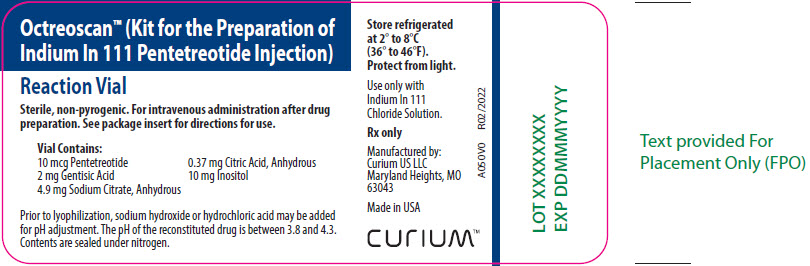
Octreoscan
Reaction Vial
Vial Contains:
10 mcg Pentetreotide
2 mg Gentisic Acid
4.9 mg Sodium Citrate, Anhydrous
0.37 mg Citric Acid, Anhydrous
10 mg Inositol
Prior to lyophilization, sodium hydroxide or hydrochloric acid may be added for pH adjustment. The pH of the reconstituted drug is between 3.8 and 4.3. Contents are sealed under nitrogen.
Store refrigerated at 2° to 8°C (36° to 46°F). Protect from light.
Use only with Indium In 111 Chloride Solution.
Rx only
Manufactured by:
Made in USA
R02/2022
LOT XXXXXXXX
EXP DDMMMYYYY
10PRINCIPAL DISPLAY PANEL - A117C0
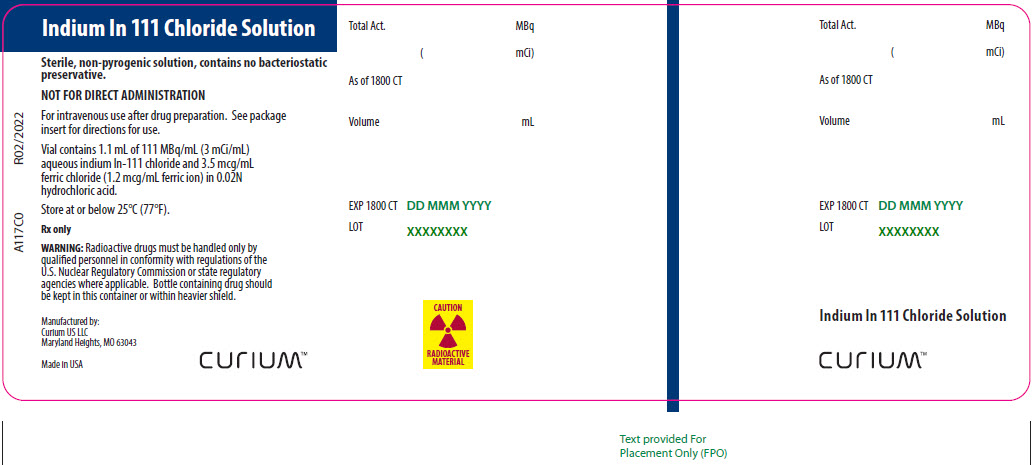
Indium In 111 Chloride Solution
For intravenous use after drug preparation. See package insert for directions for use.
Vial contains 1.1 mL of 111 MBq/mL (3 mCi/mL) aqueous indium In-111 chloride and 3.5 mcg/mL ferric chloride (1.2 mcg/mL ferric ion) in 0.02N hydrochloric acid.
Store at or below 25°C (77°F).
Rx only
WARNING: Radioactive drugs must be handled only by qualified personnel in conformity with regulations of the U.S. Nuclear Regulatory Commission or state regulatory agencies where applicable. Bottle containing drug should be kept in this container or within heavier shield.
Manufactured by:
Curium US LLC
Maryland Heights, MO 63043
Made in USA
R02/2022
Total Act. MBq
( mCi)
As of 1800 CT
Volume mL
EXP 1800 CT DD MMM YYYY
LOT XXXXXXXX