Generic Name
Ozanimod
Brand Names
Zeposia, ZEPOSIA 7-Day
FDA approval date: March 27, 2020
Classification: Sphingosine 1-phosphate Receptor Modulator
Form: Kit, Capsule
What is Zeposia (Ozanimod)?
ZEPOSIA is indicated for the treatment of: relapsing forms of multiple sclerosis , to include clinically isolated syndrome, relapsing-remitting disease, and active secondary progressive disease, in adults. moderately to severely active ulcerative colitis in adults. ZEPOSIA is a sphingosine 1-phosphate receptor modulator indicated for the treatment of: Relapsing forms of multiple sclerosis , to include clinically isolated syndrome, relapsing-remitting disease, and active secondary progressive disease, in adults. Moderately to severely active ulcerative colitis in adults.
Approved To Treat


Save this treatment for later
Not sure about your diagnosis?
Related Clinical Trials
ZEPOSIA® (Ozanimod) Ulcerative Colitis Pregnancy Registry: a Prospective, Observational Study on the Safety of Ozanimod Exposure in Pregnant Women With Ulcerative Colitis and Their Offspring
Summary: The purpose of this study is to evaluate association between ozanimod exposure during pregnancy and subsequent maternal, fetal, and infant outcomes.
A Phase 2/3, Multicenter, Randomized, Double-Blind Study to Evaluate the Efficacy, Safety, Pharmacokinetics and Pharmacodynamics of Oral Ozanimod (RPC1063) in Pediatric Subjects With Moderately to Severely Active Ulcerative Colitis With an Inadequate Response to Conventional Therapy
Summary: The purpose of this study is to evaluate the effectiveness and safety of ozanimod (RPC1063) in achieving and maintaining clinical remission. Ozanimod will be administered orally to pediatric participants with moderate to severe active ulcerative colitis (UC) who have had an inadequate response to conventional therapy.
Real-world Effectiveness of Ozanimod in Patients With Steroid-Dependent Ulcerative Colitis: A Chart Review Study
Summary: The purpose of this study is to evaluate the effectiveness and safety of ozanimod vs azathioprine for the treatment of ulcerative colitis (UC) in real-world clinical practice in Japan
Related Latest Advances
Brand Information
ZEPOSIA (ozanimod hydrochloride)
1INDICATIONS AND USAGE
ZEPOSIA is indicated for the treatment of:
- relapsing forms of multiple sclerosis (MS), to include clinically isolated syndrome, relapsing-remitting disease, and active secondary progressive disease, in adults.
- moderately to severely active ulcerative colitis (UC) in adults.
2DOSAGE FORMS AND STRENGTHS
Capsules:
- 0.23 mg ozanimod: light grey opaque body/light grey opaque cap imprinted with black ink "OZA" on the cap and "0.23 mg" on the body
- 0.46 mg ozanimod: light grey opaque body/orange opaque cap imprinted with black ink "OZA" on the cap and "0.46 mg" on the body
- 0.92 mg ozanimod: orange opaque body/orange opaque cap imprinted with black ink "OZA" on the cap and "0.92 mg" on the body
3CONTRAINDICATIONS
ZEPOSIA is contraindicated in patients who:
- In the last 6 months, have experienced a myocardial infarction, unstable angina, stroke, transient ischemic attack (TIA), decompensated heart failure requiring hospitalization, or Class III or IV heart failure
- Have the presence of Mobitz type II second-degree or third degree atrioventricular (AV) block, sick sinus syndrome, or sino-atrial block, unless the patient has a functioning pacemaker
- Have severe untreated sleep apnea
- Are taking a monoamine oxidase (MAO) inhibitor
4ADVERSE REACTIONS
The following serious adverse reactions are described elsewhere in the labeling:
- Infections
- Progressive Multifocal Leukoencephalopathy
- Bradyarrhythmia and Atrioventricular Conduction Delays
- Liver Injury
- Fetal Risk
- Increased Blood Pressure
- Respiratory Effects
- Macular Edema
- Cutaneous Malignancies
- Posterior Reversible Encephalopathy Syndrome
- Unintended Additive Immunosuppressive Effects from Prior Treatment with Immunosuppressive or Immune-Modulating Drugs
- Severe Increase in Multiple Sclerosis Disability after Stopping ZEPOSIA
- Immune System Effects after Stopping ZEPOSIA
4.1Clinical Trials Experience
Because clinical trials are conducted under widely varying conditions, adverse reaction rates observed in the clinical trials of a drug cannot be directly compared to rates in the clinical trials of another drug and may not reflect the rates observed in clinical practice.
4.2Postmarketing Experience
The following adverse reactions have been identified during postapproval use of ZEPOSIA. Because these reactions are reported voluntarily from a population of uncertain size, it is not always possible to reliably estimate their frequency or establish a causal relationship to drug exposure.
Hepatobiliary Disorders: Liver injury
5DRUG INTERACTIONS
Tables 5 and 6 include drugs with clinically important drug and vaccine interactions when administered concomitantly with ZEPOSIA and instructions for preventing or managing them.
6DESCRIPTION
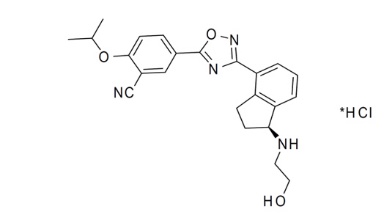
ZEPOSIA contains ozanimod, a sphingosine 1-phosphate receptor modulator and is supplied as ozanimod hydrochloride (HCl).
The chemical name of ozanimod HCl is 5-(3-{(1S)-1-[(2-hydroxyethyl)amino]-2,3-dihydro-1
Ozanimod HCl is a white to off-white solid that is freely soluble in water and alcohol with a molecular weight of 440.92 g/mol.
The chemical structure is:
ZEPOSIA capsules are provided as hard gelatin capsules for oral administration, containing 0.23, 0.46, or 0.92 mg of ozanimod (equivalent to 0.25, 0.5, and 1 mg ozanimod HCl, respectively). ZEPOSIA capsules consist of the following inactive ingredients: colloidal silicon dioxide, croscarmellose sodium, magnesium stearate, and microcrystalline cellulose. The capsule shell, imprinted with black ink, contains the following inactive ingredients: black iron oxide, gelatin, red iron oxide, titanium dioxide, and yellow iron oxide.
7PATIENT COUNSELING INFORMATION
Advise the patient to read the FDA-approved patient labeling (Medication Guide).
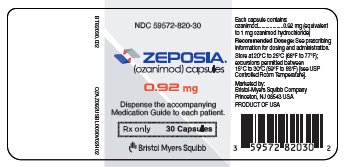
8PRINCIPAL DISPLAY PANEL - 0.92 mg Capsule Bottle Label
NDC 59572-820-30
ZEPOSIA
0.92 mg
Dispense the accompanying
Rx only
Bristol-Myers Squibb
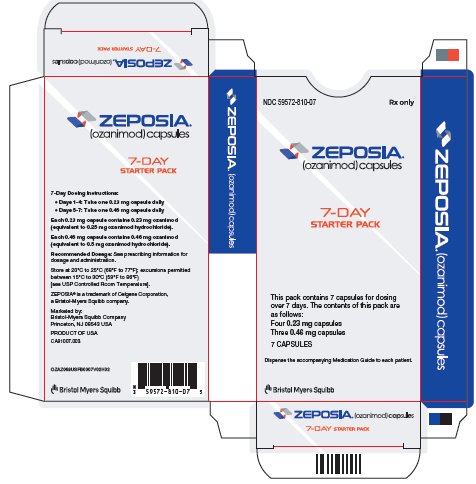
9PRINCIPAL DISPLAY PANEL - 7 Capsule Starter Pack Kit Carton
NDC 59572-810-07
ZEPOSIA
7-DAY
This pack contains 7 capsules for dosing
Four 0.23 mg capsules
7 CAPSULES
Dispense the accompanying Medication Guide to each patient.
Bristol-Myers Squibb
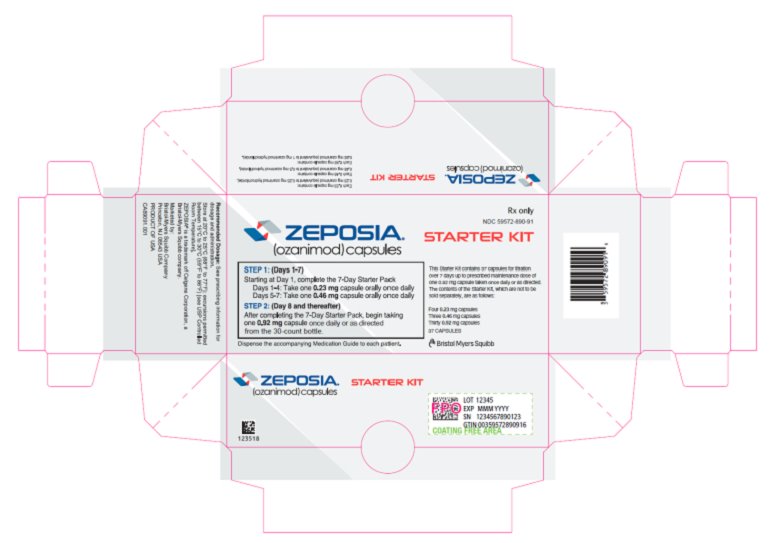
10PRINCIPAL DISPLAY PANEL - Kit Carton
Rx only
NDC 59572-890-91
ZEPOSIA
STARTER KIT
STEP 1: (Days 1-7)
Starting at Day 1, complete the 7-Day Starter Pack
STEP 2: (Day 8 and thereafter)
After completing the 7-Day Starter Pack, begin taking
This Starter Kit contains 37 capsules for titration
Four 0.23 mg capsules
37 CAPSULES
Dispense the accompanying Medication Guide to each patient.
Bristol Myers Squibb
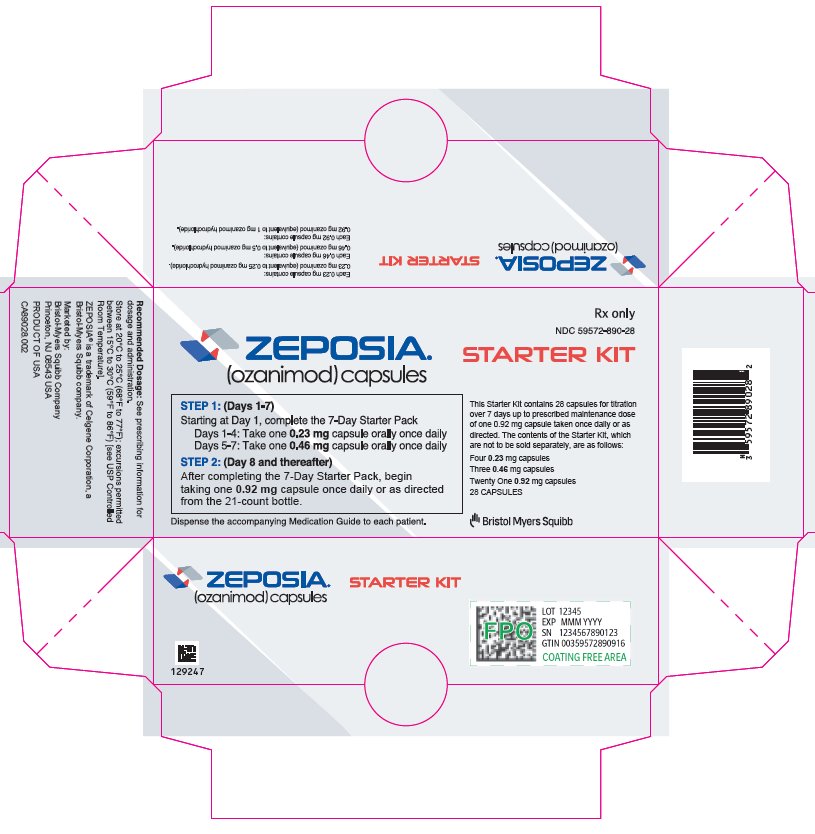
11Package/Label Display Panel
Rx only
NDC 59572-890-28
ZEPOSIA
STARTER KIT
STEP 1: (Days 1-7)
Starting at Day 1, complete the 7-Day Starter Pack
STEP 2: (Day 8 and thereafter)
After completing the 7-Day Starter Pack, begin
This Starter Kit contains 28 capsules for titration
Four 0.23 mg capsules
28 CAPSULES
Dispense the accompanying Medication Guide to each patient.
Bristol Myers Squibb