Brand Name

Nplate

Generic Name
Romiplostim
View Brand Information
FDA approval date: August 25, 2008
Classification: Thrombopoietin Receptor Agonist
Form: Injection

What is Nplate (Romiplostim)?

Nplate is a thrombopoietin receptor agonist indicated for the treatment of thrombocytopenia in: Adult patients with immune thrombocytopenia who have had an insufficient response to corticosteroids, immunoglobulins, or splenectomy.

Related Clinical Trials

PROCLAIM: A Phase 3 Randomized Placebo-controlled Double-blind Study of Romiplostim for the Treatment of Chemotherapy-induced Thrombocytopenia in Patients Receiving Chemotherapy for Treatment of Non-small Cell Lung Cancer (NSCLC), Ovarian Cancer, or Breast Cancer

Summary: To evaluate the efficacy of romiplostim for the treatment of CIT in patients receiving chemotherapy for the treatment of NSCLC, ovarian cancer, or breast cancer measured by the ability to administer on-time, full-dose chemotherapy

An Open-label, Single-arm, Single-center Study to Evaluate the Efficacy and Safety of Romiplostim N01 in Combination With Rituximab in Patients With Primary Immune Thrombocytopenia Refractory to Oral TPO-RAs

Summary: The primary objective of this trial is to assess the efficacy and safety of combining Romiplostim N01 with Rituximab for the treatment of adult patients with primary immune thrombocytopenia (ITP) whose disease is refractory to oral TPO-RAs. All participants in this study will receive the same combination treatment: Rituximab: Given once a week through an intravenous infusion for 4 weeks. Romiplost...

High Dose Ruxolitinib and Allogeneic Stem Cell Transplantation in Myelofibrosis Patients With Splenomegaly

Summary: To learn if giving ruxolitinib and busulfan before a stem cell transplant can help to reduce spleen size and help the transplant to succeed.

Brand Information

Nplate (romiplostim)
1DOSAGE FORMS AND STRENGTHS
For injection: 125 mcg, 250 mcg or 500 mcg of Nplate as a sterile, lyophilized, solid white powder in single-dose vials.
2CONTRAINDICATIONS
None.
3ADVERSE REACTIONS
The following clinically significant adverse reactions are discussed in greater detail in other sections:
  • Progression of Myelodysplastic Syndromes
  • Thrombotic/Thromboembolic Complications
  • Loss of Response to Nplate
3.1Clinical Trials Experience
Because clinical trials are conducted under widely varying conditions, adverse reaction rates observed in the clinical trials of a drug cannot be directly compared to rates in the clinical trials of another drug and may not reflect the rates observed in practice.
Adults
The data described below reflect Nplate exposure to 271 adult patients with ITP, aged 18 to 88, of whom 62% were female. Nplate was studied in two randomized, placebo-controlled, double-blind studies that were identical in design, with the exception that Study 1 evaluated non-splenectomized patients with ITP and Study 2 evaluated splenectomized patients with ITP. Data are also reported from an open-label, single-arm study in which patients received Nplate over an extended period of time. Overall, Nplate was administered to 114 patients for at least 52 weeks and 53 patients for at least 96 weeks.
In the placebo-controlled studies, headache was the most commonly reported adverse drug reaction, occurring in 35% of patients receiving Nplate and 32% of patients receiving placebo. For those patients receiving Nplate, 14 (48%) of headaches were mild, 9 (31%) were moderate, and 6 (21%) were severe. Table 3 presents adverse drug reactions from Studies 1 and 2 with a ≥ 5% higher patient incidence in Nplate versus placebo.
Among 291 adult patients with ITP who received Nplate in the single-arm extension study, the incidence rates of the adverse reactions occurred in a pattern similar to those reported in the placebo-controlled clinical studies.
The safety profile of Nplate was similar across patients, regardless of ITP duration. The following adverse reactions (at least 5% incidence and at least 5% more frequent with Nplate compared with placebo or standard of care) occurred in Nplate patients with ITP duration up to 12 months: bronchitis, sinusitis, vomiting, arthralgia, myalgia, headache, dizziness, diarrhea, upper respiratory tract infection, cough, nausea and oropharyngeal pain. The adverse reaction of thrombocytosis occurred with an incidence of 2% in adults with ITP duration up to 12 months.
Bone Marrow Reticulin Formation and Collagen Fibrosis
Nplate administration may increase the risk for development or progression of reticulin fiber formation within the bone marrow. This formation may improve upon discontinuation of Nplate. In a clinical trial, one patient with ITP and hemolytic anemia developed marrow fibrosis with collagen during Nplate therapy.
An open-label clinical trial prospectively evaluated changes in bone marrow reticulin formation and collagen fibrosis in adult patients with ITP treated with Nplate or a non-US approved romiplostim product. Patients were administered romiplostim by SC injection once weekly for up to 3 years. Based on cohort assignment at time of study enrollment, patients were evaluated for bone marrow reticulin and collagen at year 1 (cohort 1), year 2 (cohort 2), or year 3 (cohort 3) in comparison to the baseline bone marrow at start of the trial. Patients were evaluated for bone marrow reticulin formation and collagen fibrosis using the modified Bauermeister grading scale. From the total of 169 patients enrolled in the 3 cohorts, 132 (78%) patients were evaluable for bone marrow collagen fibrosis and 131 (78%) patients were evaluable for bone marrow reticulin formation. Two percent (2/132) of patients (both from cohort 3) developed Grade 4 findings (presence of collagen). There was no detectable bone marrow collagen in one patient on repeat testing 12 weeks after discontinuation of romiplostim. Progression of bone marrow reticulin formation (increase greater than or equal to 2 grades or more) or an increase to Grade 4 (presence of collagen) was reported in 7% (9/131) of patients.
Pediatric Patients
The data described below reflect median exposure to Nplate of 168 days for 59 pediatric patients (aged 1 to 17 years) with ITP for at least 6 months, of whom 47.5% were female, across the randomized phase of two placebo-controlled trials. Table 4 presents the most common adverse reactions experienced by at least 5% of the pediatric patients (1 year and older) receiving Nplate across the two placebo-controlled trials with at least a 5% higher incidence in patients who received Nplate compared to those who received placebo.
Among 203 pediatric patients with ITP who received Nplate in a single arm, open-label, long-term (median duration of 3 years on therapy) study, the incidence rates of the adverse reactions occurred in a pattern similar to those reported in the placebo-controlled clinical studies. In this single arm, open-label, long-term study, headache occurred in 78 patients (38%), 3% (n=6) being severe and 1% (n=2) resulting in discontinuation of drug.
3.2Postmarketing Experience
The following adverse reactions have been identified during post approval use of Nplate. Because these reactions are reported voluntarily from a population of uncertain size, it is not always possible to reliably estimate their frequency or establish a causal relationship to drug exposure.
  • Erythromelalgia
  • Hypersensitivity reactions including angioedema and anaphylaxis
3.3Immunogenicity
As with all therapeutic proteins, there is a potential for immunogenicity. The detection of antibody formation is highly dependent on the sensitivity and specificity of the assay. Additionally, the observed incidence of antibody (including neutralizing antibody) positivity in an assay may be influenced by several factors including assay methodology, sample handling, timing of sample collection, concomitant medications, and underlying disease. For these reasons, comparison of the incidence of antibodies to Nplate in the studies described below with the incidence of antibodies in other studies or to other products may be misleading. Patients were screened for immunogenicity to romiplostim using a BIAcore-based biosensor immunoassay. This assay is capable of detecting both high- and low-affinity binding antibodies that bind to romiplostim and cross-react with TPO. The samples from patients that tested positive for binding antibodies were further evaluated for neutralizing capacity using a cell-based bioassay.
In adult clinical studies in adult patients with ITP, the incidence of pre-existing antibodies to romiplostim was 3.3% (35/1046) and the incidence of binding antibody development during treatment with Nplate or a non-US approved romiplostim product was 5.7% (60/1046). The incidence of pre-existing antibodies to endogenous TPO was 3% (31/1046) and the incidence of binding antibody development to endogenous TPO during treatment was 3.2% (33/1046). Of the patients with positive binding antibodies that developed to romiplostim or to TPO, four patients had neutralizing activity to romiplostim and none had neutralizing activity to TPO. No apparent correlation was observed between antibody activity and clinical effectiveness or safety.
In pediatric studies, data on antibody formation was collected from 282 patients (20 from early phase studies, 59 from phase 3 studies with duration of 6 months and 203 from a long-term study with median duration of 3 years). The incidence of binding antibodies to Nplate at any time was 9.6% (27/282), of which 2 patients (0.7%) had pre-existing binding non-neutralizing Nplate antibodies at baseline and 11 patients (3.9%) had persistent binding antibody positivity at end of study. Additionally, 2.8% (8/282) developed neutralizing antibodies to Nplate, with 4 patients (1.4%) having persistent neutralizing antibody positivity at end of study, despite discontinuation of Nplate. The incidence of binding antibodies to TPO at any time was 3.9% (11/282), of which 2 patients (0.7%) had pre-existing binding non-neutralizing antibodies to TPO at baseline and 1 patient (0.4%) had binding persistent antibody positivity at end of study. One patient (0.4%) had a weakly positive postbaseline result for neutralizing antibodies against TPO while on study (with positive non-neutralizing antibodies to Nplate) with a negative result at baseline for both antibodies. The patient showed a transient antibody response for neutralizing antibodies against TPO, with a negative result at the patient's last timepoint tested within the study period after discontinuation of Nplate.
A postmarketing registry study involving patients with thrombocytopenia on Nplate or a non-US approved romiplostim product was conducted to assess the long-term consequences of the anti-romiplostim antibodies. Adult patients who lacked response or lost response to Nplate or a non-US approved romiplostim product were enrolled. The incidence of new binding antibody development was 3.8% (7/184) to romiplostim and 2.2% (4/184) were positive for binding, non-neutralizing antibodies to TPO; two patients were positive for binding antibodies to both romiplostim and TPO. Of the seven patients with positive binding antibodies to romiplostim, one patient (0.5%; 1/184) was positive for neutralizing antibodies to romiplostim only.
Nineteen confirmed pediatric patients were included in the postmarketing registry study. The incidence of binding antibody post treatment was 16% (3/19) to romiplostim, of which 5.3% (1/19) were positive for neutralizing antibodies to romiplostim. There were no antibodies detected to TPO.
Immunogenicity assay results are highly dependent on the sensitivity and specificity of the assay used in detection and may be influenced by several factors, including sample handling, concomitant medications, and underlying disease. For these reasons, comparison of incidence of antibodies to romiplostim with the incidence of antibodies to other products may be misleading.
4DRUG INTERACTIONS
Nplate may be used with other medical ITP therapies, such as corticosteroids, danazol, azathioprine, intravenous immunoglobulin (IVIG), and anti-D immunoglobulin 
5OVERDOSAGE
Overdoses due to medication errors have been reported in patients receiving Nplate. In the event of overdose, platelet counts may increase excessively and result in thrombotic/thromboembolic complications. In this case, discontinue Nplate and monitor platelet counts. Reinitiate treatment with Nplate in accordance with dosing and administration recommendations
6DESCRIPTION
Romiplostim is a thrombopoietin receptor agonist (TPO-RA). Romiplostim, a member of the TPO mimetic class, is an Fc-peptide fusion protein (peptibody). The peptibody molecule contains two identical single-chain subunits, each consisting of human immunoglobulin IgG1 Fc domain, covalently linked at the C-terminus to a peptide containing two thrombopoietin receptor-binding domains. Romiplostim has no amino acid sequence homology to endogenous TPO. Romiplostim is produced by recombinant DNA technology in
Nplate (romiplostim) for injection is supplied as a sterile, preservative-free, lyophilized, solid white powder for subcutaneous use. Nplate is supplied as either 125 mcg per vial, 250 mcg per vial or 500 mcg per vial of romiplostim and requires reconstitution with Sterile Water for Injection to obtain a concentration of 500 mcg/mL.
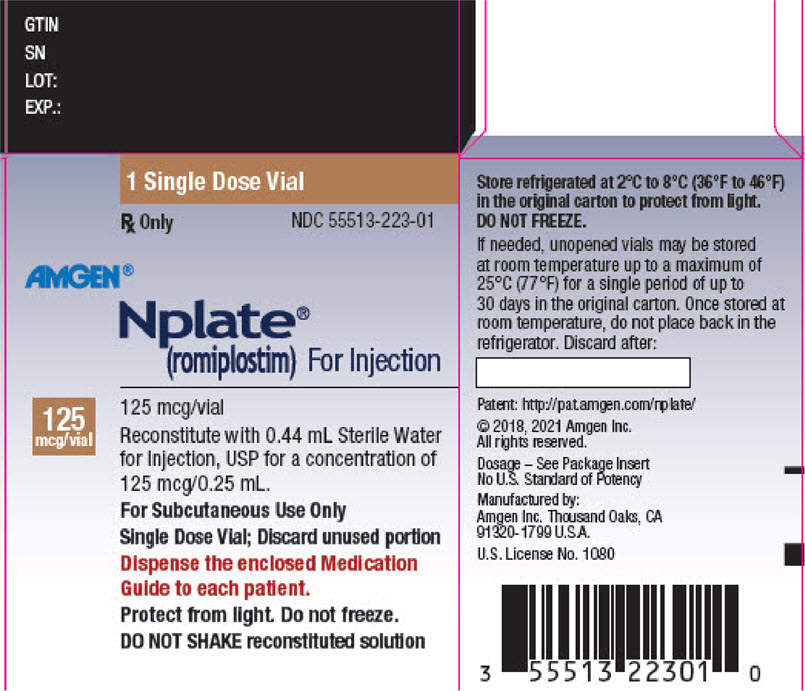
Each single-dose 125 mcg vial of Nplate contains the following: 125 mcg of romiplostim, L-histidine (0.7 mg), mannitol (18 mg), polysorbate 20 (0.02 mg), sucrose (9 mg), and sufficient HCl to adjust the pH to a target of 5. Reconstitution with 0.44 mL of Sterile Water for Injection provides a resulting concentration of 125 mcg/0.25 mL.
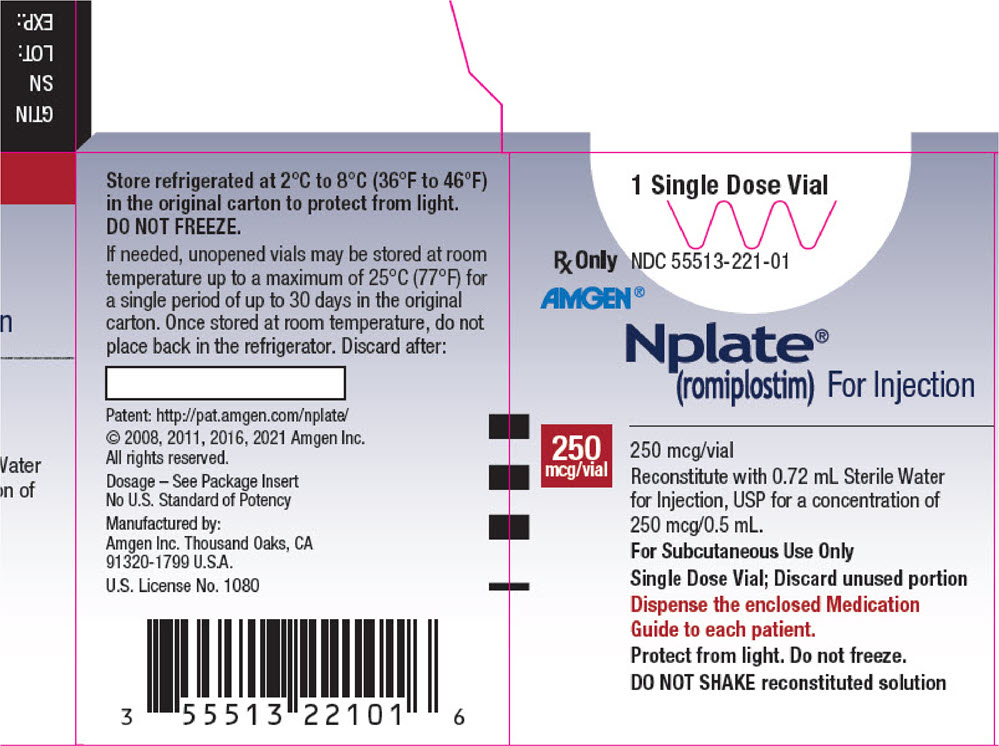
Each single-dose 250 mcg vial of Nplate contains the following: 250 mcg romiplostim, L-histidine (1.2 mg), mannitol (30 mg), polysorbate 20 (0.03 mg), sucrose (15 mg), and sufficient HCl to adjust the pH to a target of 5. Reconstitution with 0.72 mL of Sterile Water for Injection provides a resulting concentration of 250 mcg/0.5 mL.
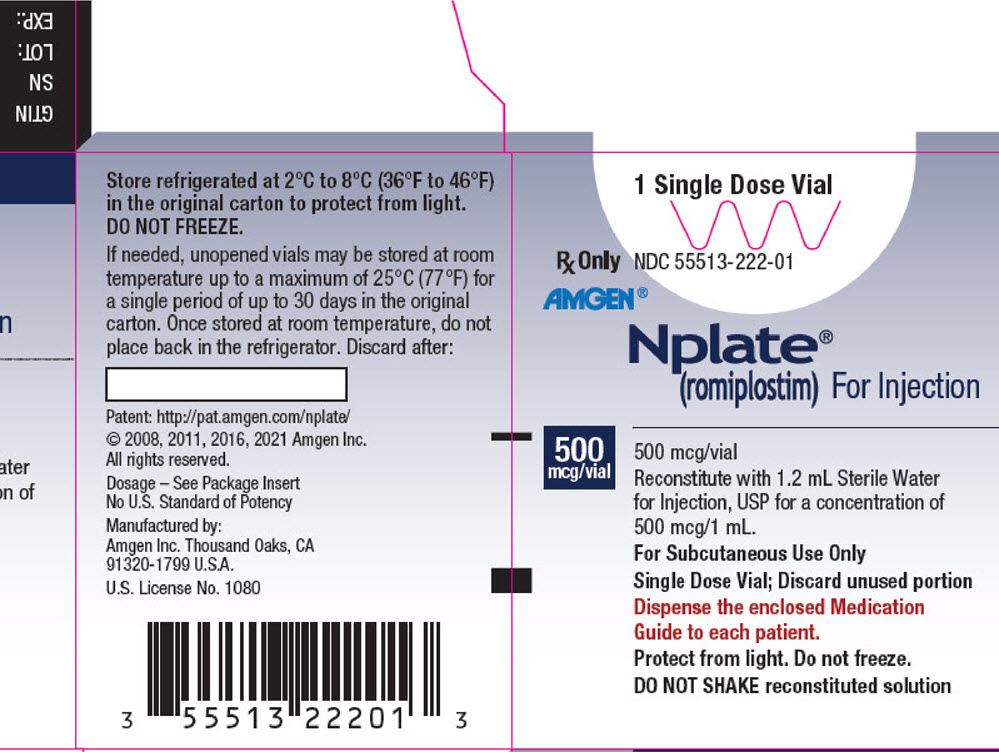
Each single-dose 500 mcg vial of Nplate contains the following: 500 mcg romiplostim, L-histidine (1.9 mg), mannitol (50 mg), polysorbate 20 (0.05 mg), sucrose (25 mg), and sufficient HCl to adjust the pH to a target of 5. Reconstitution with 1.2 mL of Sterile Water for Injection provides a resulting concentration of 500 mcg/mL.
7HOW SUPPLIED/STORAGE AND HANDLING
Nplate (romiplostim) for injection is supplied as a sterile, preservative-free, solid white lyophilized powder in single-dose vials of 125 mcg (NDC-55513-223-01, NDC-55513-223-21), 250 mcg (NDC 55513-221-01, NDC 55513-221-21) and 500 mcg (NDC 55513-222-01, NDC 55513-222-21) of romiplostim.
Store Nplate vials in the refrigerator at 2°C to 8°C (36°F  to 46°F) in the original carton to protect from light. Do not freeze.
If needed, unopened Nplate vials may be stored in the original carton at room temperature up to a maximum of 25°C (77°F) for a single period of up to 30 days. The new expiration date must be written in the space provided on the carton. Once stored at room temperature, do not place back in the refrigerator. If not used within the 30 days, discard Nplate.
8PATIENT COUNSELING INFORMATION
Advise the patient to read the FDA-approved patient labeling (
Advise patients acutely exposed to myelosuppressive doses of radiation (Hematopoietic Syndrome of Acute Radiation Syndrome) that efficacy studies of Nplate for this indication could not be conducted in humans for ethical and feasibility reasons and that, therefore, approval of this use was based on efficacy studies conducted in animals
Inform patients of the following risks and considerations for Nplate:
  • Nplate therapy is administered to achieve and maintain a platelet count ≥ 50 × 10
  • Following discontinuation of Nplate, thrombocytopenia and risk of bleeding may develop that is worse than that experienced prior to the Nplate therapy.
  • Nplate therapy may increase the risk of reticulin fiber formation within the bone marrow. This formation may improve upon discontinuation. Detection of peripheral blood cell abnormalities may necessitate a bone marrow examination.
  • Too much Nplate may result in excessive platelet counts and a risk for thrombotic/thromboembolic complications.
  • Nplate stimulates certain bone marrow cells to make platelets and increases the risk of progression to acute myelogenous leukemia in patients with myelodysplastic syndromes.
  • Platelet counts and CBCs must be performed weekly until a stable Nplate dose has been achieved; thereafter, platelet counts and CBCs must be performed monthly while taking Nplate.
  • Patients must be closely monitored with weekly platelet counts and CBCs for at least 2 weeks following Nplate discontinuation.
  • Even with Nplate therapy, patients should continue to avoid situations or medications that may increase the risk for bleeding.
Pregnancy:
  • Advise pregnant women of the potential risk to a fetus. Advise females of reproductive potential to inform their prescriber of a known or suspected pregnancy
Lactation:
  • Advise women not to breastfeed during treatment with Nplate
Nplate
Manufactured by:
Amgen Inc.
One Amgen Center Drive
Thousand Oaks, California 91320-1799
U.S. License No. 1080
Patent: http://pat.amgen.com/nplate/
© 2008-2025 Amgen Inc. All rights reserved.
www.nplate.com
1xxxxx
V21
9PRINCIPAL DISPLAY PANEL - 500 mcg Vial Carton
1 Single Dose Vial
Rx Only
AMGEN
Nplate
500
500 mcg/vial
Principal Display Panel - 500 mcg Vial Carton
10PRINCIPAL DISPLAY PANEL - 125 mcg Vial Carton
1 Single Dose Vial
Rx Only
AMGEN
Nplate
125
125 mcg/vial
Principal Display Panel - 125 mcg Vial Carton
11PRINCIPAL DISPLAY PANEL - 250 mcg Vial Carton
1 Single Dose Vial
Rx Only
AMGEN
Nplate
250
250 mcg/vial
Principal Display Panel - 250 mcg Vial Carton