Votrient
What is Votrient (Pazopanib)?
Hearing the word “cancer” changes everything, from daily routines to long-term plans. Treatments like Votrient (pazopanib) offer hope by helping slow disease progression and extending quality of life for people living with advanced cancers. This medication represents one of the modern, targeted therapies designed to control tumor growth at the cellular level, giving patients and their families more time and better outcomes.
Approved by the U.S. Food and Drug Administration (FDA) in 2009, Votrient belongs to a class of cancer medicines known as tyrosine kinase inhibitors (TKIs). It’s primarily used when surgery or other treatments are not enough, offering a scientifically precise way to target cancer cells while minimizing harm to healthy tissue.
What does Votrient do?
Votrient is prescribed for adults with:
- Advanced renal cell carcinoma (RCC): a type of kidney cancer that has spread beyond the kidney.
- Advanced soft tissue sarcoma (STS): a group of rare cancers that begin in muscles, fat, or other soft tissues, typically after chemotherapy has failed.
For patients with these cancers, Votrient works to slow tumor growth, reduce the spread of cancer cells, and sometimes shrink existing tumors. While it may not cure the disease, it can significantly delay progression and help manage symptoms, allowing patients to maintain independence and daily activities longer.
Clinical studies have shown that Votrient can extend the time patients live without their cancer worsening with many experiencing improved overall well-being and physical performance (FDA, 2024; Mayo Clinic, 2024).
How does Votrient work?
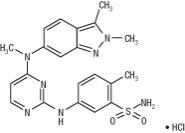
Votrient works by blocking specific enzymes called tyrosine kinases that signal cancer cells to grow and form new blood vessels, a process known as angiogenesis. By inhibiting these enzymes, particularly those related to vascular endothelial growth factor receptors (VEGFRs), Votrient effectively starves the tumor of the oxygen and nutrients it needs to grow.
Here’s what that means in simpler terms:
- It slows tumor growth by cutting off the blood supply that feeds cancer cells.
- It prevents new cancer blood vessels from forming, limiting tumor expansion.
- It may also reduce tumor size in some patients, especially those with responsive disease subtypes.
Clinically, this mechanism is significant because it allows for ongoing disease control in cancers that don’t respond well to traditional chemotherapy, offering patients a better-tolerated and targeted option.
Votrient side effects
Like many cancer medicines, Votrient can cause side effects, but most are manageable with careful monitoring and supportive care.
Common side effects include:
- Fatigue
- Nausea or vomiting
- Diarrhea
- Changes in hair or skin color
- Loss of appetite
- High blood pressure
Less common but potentially serious side effects:
- Liver toxicity (elevated liver enzymes)
- Heart rhythm changes or heart failure
- Bleeding problems
- Protein in the urine (a sign of kidney stress)
- Slow wound healing
Patients should contact their healthcare provider right away if they experience yellowing of the skin or eyes, dark urine, chest pain, or severe fatigue, as these could indicate serious complications.
Who should avoid or use Votrient with caution:
- Patients with severe liver disease or uncontrolled high blood pressure.
- Pregnant women, as the drug can cause fetal harm.
- Those scheduled for surgery, since the drug may delay wound healing.
Doctors often perform regular blood and heart tests to ensure early detection of any side effects and adjust treatment accordingly (NIH, 2024).
Votrient dosage
Votrient is available as an oral tablet taken once daily, usually on an empty stomach. The exact dose is individualized based on the patient’s condition, liver function, and response to treatment.
Because Votrient affects multiple body systems, close medical monitoring is essential. Your healthcare team will regularly:
- Check liver enzymes to prevent toxicity.
- Monitor blood pressure and heart rhythm.
- Evaluate kidney function and protein levels in the urine.
If you miss a dose, it’s generally advised not to double up; your doctor will guide you on how to proceed safely.
Special considerations:
- Older adults may need additional monitoring for heart or liver-related side effects.
- If you’re taking medications for stomach acid, thyroid, or infections, inform your doctor; these may interact with Votrient’s absorption or effectiveness.
Does Votrient have a generic version?
Yes. The generic form of Votrient is called pazopanib, which has been approved by the FDA. The generic version contains the same active ingredient and offers equal effectiveness, safety, and quality as the brand name drug.
Patients may find the generic pazopanib more affordable, which can help improve adherence to long-term treatment. Both the brand and generic versions come in oral tablet form, with similar dosing and side effect profiles (FDA, 2024).
Conclusion
Votrient (pazopanib) represents a major step forward in targeted cancer therapy, providing patients with a more precise and manageable option for controlling advanced kidney cancer and soft tissue sarcoma. By inhibiting tumor growth at its source, it helps extend progression-free survival and maintain daily function during treatment.
While side effects can occur, regular medical monitoring allows most patients to continue therapy safely and effectively.
Patient experiences with Votrient may vary. Some notice early improvements in symptoms or energy levels, while others experience a more gradual benefit. What’s consistent is the importance of ongoing communication with your oncology team, managing side effects, optimizing results, and maintain quality of life.
When used under professional supervision, Votrient is a trusted, evidence-based option for slowing the progression of certain cancers and helping patients live more fully despite advanced disease.
References
- U.S. Food and Drug Administration. (2024). Votrient (pazopanib) prescribing information. Retrieved from https://www.fda.gov
- Mayo Clinic. (2024). Pazopanib (oral route): Description and precautions. Retrieved from https://www.mayoclinic.org
- National Institutes of Health. (2024). Pazopanib: Drug information. Retrieved from https://medlineplus.gov
Approved To Treat
Top Global Experts
There are no experts for this drug
Related Clinical Trials
There is no clinical trials being done for this treatment
Related Latest Advances
There is no latest advances for this treatment
Brand Information
- Hepatic Toxicity
- QT Prolongation and Torsades de Pointes
- Cardiac Dysfunction
- Hemorrhagic Events
- Arterial Thromboembolic Events
- Venous Thromboembolic Events
- Thrombotic Microangiopathy (TMA)
- Gastrointestinal Perforation and Fistula
- Interstitial Lung Disease (ILD)/Pneumonitis
- Posterior Reversible Encephalopathy Syndrome (PRES)
- Hypertension
- Hypothyroidism
- Proteinuria
- Tumor Lysis Syndrome
- Infection
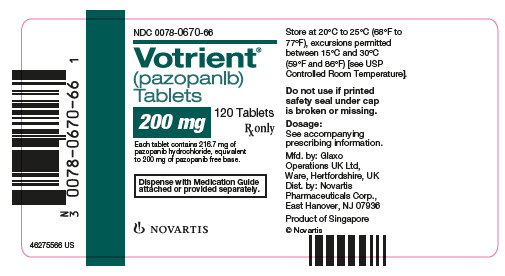
- Bottles of 120 tablets: NDC 0078-0670-66 (gray tablets), NDC 0078-1077-66 (pink tablets)
- Hepatic Toxicity: Inform patients that periodic laboratory testing will be performed. Advise patients to report signs and symptoms of liver dysfunction to their healthcare provider right away [see Warnings and Precautions (5.1)].
- QT Prolongation and Torsades de Pointes: Inform patients that ECG monitoring may be performed. Advise patients to inform their physicians of concomitant medications [see Warnings and Precautions (5.2)].
- Interstitial Lung Disease/Pneumonitis: Advise patients to report pulmonary signs or symptoms indicative of interstitial lung disease (ILD) or pneumonitis [see Warnings and Precautions (5.9)].
- Cardiac Dysfunction: Advise patients to report hypertension or signs and symptoms of congestive heart failure [see Warnings and Precautions (5.3)].
- Hemorrhagic Events: Advise patients to report unusual bleeding [see Warnings and Precautions (5.4)].
- Arterial Thromboembolic Events: Advise patients to report signs or symptoms of an arterial thrombosis [see Warnings and Precautions (5.5)].
- Pneumothorax and Venous Thromboembolic Events: Advise patients to report new onset of dyspnea, chest pain, or localized limb edema [see Warnings and Precautions (5.6), Adverse Reactions (6.1)].
- Posterior Reversible Encephalopathy Syndrome: Advise patients to inform their doctor if they have worsening of neurological function consistent with PRES (headache, seizure, lethargy, confusion, blindness, and other visual and neurologic disturbances) [see Warnings and Precautions (5.10)].
- Hypertension: Advise patients to monitor blood pressure early in the course of therapy and frequently thereafter and report increases of blood pressure or symptoms, such as blurred vision, confusion, severe headache, or nausea and vomiting [see Warnings and Precautions (5.11)].
- Gastrointestinal Perforation and Fistula: Advise patients to report signs and symptoms of a GI perforation or fistula [see Warnings and Precautions (5.8)].
- Risk of Impaired Wound Healing: Advise patients that VOTRIENT may impair wound healing. Advise patients to inform their healthcare provider of any scheduled surgical procedure [see Warnings and Precautions (5.12)].
- Hypothyroidism and Proteinuria: Inform patients that thyroid function testing and urinalysis will be performed during treatment [see Warnings and Precautions (5.13, 5.14)].
- Tumor Lysis Syndrome: Advise patients to contact their healthcare provider promptly to report any signs and symptoms of TLS, such as abnormal heart rhythm, seizure, confusion, muscle cramps or spasms, or a decrease in urine output [see Warnings and Precautions (5.15)].
- Infection: Advise patients to promptly report any signs or symptoms of infection [see Warnings and Precautions (5.16)].
- Embryo-Fetal Toxicity: Advise female patients to inform their healthcare provider of a known or suspected pregnancy during treatment with VOTRIENT. Inform female patients of the risk to a fetus and the potential loss of the pregnancy [see Warnings and Precautions (5.19), Use in Specific Populations (8.1)].
Advise females of reproductive potential to use effective contraception during treatment and for at least 2 weeks after the last dose of VOTRIENT. Advise male patients with female partners of reproductive potential to use condoms during treatment with VOTRIENT and for at least 2 weeks after the last dose [see Warnings and Precautions (5.19), Use in Specific Populations (8.3)]. - Lactation: Advise women not to breastfeed during treatment with VOTRIENT and for 2 weeks after the last dose [see Use in Specific Populations (8.2)].
- Infertility: Advise males and females of reproductive potential that VOTRIENT may impair fertility [see Use in Specific Populations (8.3)].
- Gastrointestinal Adverse Reactions: Advise patients on how to manage nausea, vomiting, and diarrhea and to notify their healthcare provider if moderate-to-severe vomiting or diarrhea occurs or if there is a decrease in oral intake [see Adverse Reactions (6.1)].
- Depigmentation: Advise patients that depigmentation of the hair or skin may occur during treatment with VOTRIENT [see Adverse Reactions (6.1)].
- Drug Interactions: Advise patients to inform their healthcare providers of all concomitant medications, vitamins, or dietary and herbal supplements [see Drug Interactions (7)].
- Dosage and Administration: Advise patients to take VOTRIENT without food (at least 1 hour before or 2 hours after a meal) [see Dosage and Administration (2.1)].