Brand Name

Tukysa

Generic Name
Tucatinib
View Brand Information
FDA approval date: April 17, 2020
Classification: Kinase Inhibitor
Form: Tablet

What is Tukysa (Tucatinib)?

TUKYSA is indicated in combination with trastuzumab and capecitabine for treatment of adult patients with advanced unresectable or metastatic HER2-positive breast cancer, including patients with brain metastases, who have received one or more prior anti-HER2-based regimens in the metastatic setting. TUKYSA is a kinase inhibitor indicated in combination with trastuzumab and capecitabine for treatment of adult patients with advanced unresectable or metastatic HER2-positive breast cancer, including patients with brain metastases, who have received one or more prior anti-HER2-based regimens in the metastatic setting.
Save this treatment for later
Sign Up
Not sure about your diagnosis?
Check Your Symptoms

Related Clinical Trials

HERTHENA-Breast-01: A Phase 1b/2, Multicenter, Open-label, Dose-Finding Study to Evaluate the Safety and Antitumor Activity of Patritumab Deruxtecan in Participants With HER2 Positive Unresectable Locally Advanced Breast Cancer or Metastatic Breast Cancer

Summary: Researchers want to learn if patritumab deruxtecan (MK-1022) can treat certain breast cancers. The breast cancers being studied are HER2 positive unresectable locally advanced or metastatic (the cancer has spread to other parts of the body). The goals of this study are to learn: * About the safety and how well people tolerate of patritumab deruxtecan * How many people have the cancer respond (get ...

A Phase II Study of the Safety, Tolerability and Antitumor Activity of Tucatinib in Combination With Eribulin and Trastuzumab in Patients With Pretreated Unresectable Locally Advanced or Metastatic HER2+ Breast Cancer

Summary: The purpose of this study is to evaluate the safety and efficacy of the three-drug combination of tucatinib, trastuzumab, and eribulin in patients with de novo and recurrent unresectable metastatic HER-2/neu positive breast cancer as assessed by ORR, PFS and OS after prior treatment with a taxane, trastuzumab, and T-DM1.

Canadian Profiling and Targeted Agent Utilization Trial (CAPTUR): A Phase II Basket Trial

Summary: Cancer drugs which target the effects of abnormal gene changes are called 'targeted therapies'. This study, called PM.1 or CAPTUR, will include some targeted therapies that are currently available. The purpose of this study is to find out what are the effects on a patient and their cancer when they are given a targeted therapy drug that is specific to an abnormal gene change in their cancer.

Brand Information

TUKYSA (tucatinib)
1DOSAGE FORMS AND STRENGTHS
Tablets:
  • 50 mg: round, yellow, film-coated, debossed with “TUC” on one side and “50” on the other side.
  • 150 mg: oval-shaped, yellow, film-coated, debossed with “TUC” on one side and “150” on the other side.
2CONTRAINDICATIONS
None.
3ADVERSE REACTIONS
The following clinically significant adverse reactions are described elsewhere in the labeling:
  • Diarrhea
  • Hepatotoxicity
3.1Clinical Trials Experience
Because clinical trials are conducted under widely varying conditions, adverse reaction rates observed in the clinical trials of a drug cannot be directly compared to rates in the clinical trials of another drug and may not reflect the rates observed in practice.
HER2-Positive Metastatic Breast Cancer
The safety of TUKYSA in combination with trastuzumab and capecitabine was evaluated in HER2CLIMB
Serious adverse reactions occurred in 26% of patients who received TUKYSA. Serious adverse reactions in ≥ 2% of patients who received TUKYSA were diarrhea (4%), vomiting (2.5%), nausea (2%), abdominal pain (2%), and seizure (2%). Fatal adverse reactions occurred in 2% of patients who received TUKYSA including sudden death, sepsis, dehydration, and cardiogenic shock.
Adverse reactions leading to treatment discontinuation occurred in 6% of patients who received TUKYSA. Adverse reactions leading to treatment discontinuation of TUKYSA in ≥1% of patients were hepatotoxicity (1.5%) and diarrhea (1%).
Adverse reactions leading to dose reduction occurred in 21% of patients who received TUKYSA. Adverse reactions leading to dose reduction of TUKYSA in ≥2% of patients were hepatotoxicity (8%) and diarrhea (6%).
The most common adverse reactions in patients who received TUKYSA (≥20%) were diarrhea, palmar-plantar erythrodysesthesia, nausea, hepatotoxicity, vomiting, stomatitis, decreased appetite, anemia, and rash.
Table 3 summarizes the adverse reactions in HER2CLIMB.
Increased Creatinine
The mean increase in serum creatinine was 32% within the first 21 days of treatment with TUKYSA. The serum creatinine increases persisted throughout treatment and were reversible upon treatment completion. Consider alternative markers of renal function if persistent elevations in serum creatinine are observed
RAS Wild-Type, HER2-Positive Unresectable or Metastatic Colorectal Cancer
The safety of TUKYSA in combination with trastuzumab or a non-US approved trastuzumab product was evaluated in 86 patients enrolled in MOUNTAINEER with unresectable or metastatic colorectal cancer
Serious adverse reactions occurred in 22% of patients. Serious adverse reactions that occurred in ≥ 2% of patients were intestinal obstruction (7%), urinary tract infection (3.5%), pneumonia (2.3%), abdominal pain (2.3%) and rectal perforation (2.3%).
Permanent discontinuation of TUKYSA due to an adverse reaction occurred in 6% of patients. The adverse reaction which resulted in permanent discontinuation of TUKYSA in ≥2% of patients was increased ALT (2.3%). Dosage interruptions of TUKYSA due to an adverse reaction occurred in 23% of patients. Adverse reactions which required dosage interruption in ≥3% of patients were increased ALT (3.5%) and diarrhea (3.5%). Dose reductions of TUKYSA due to an adverse reaction occurred in 9% of patients. Adverse reactions which required dose reductions in ≥2% of patients were increased ALT (2.3%) and diarrhea (2.3%).
The most common adverse reactions reported in ≥ 20% of patients treated with TUKYSA and trastuzumab were diarrhea, fatigue, rash, nausea, abdominal pain, infusion related reactions, and pyrexia. The most common laboratory abnormalities reported in ≥ 20% of patients were increased creatinine, increased glucose, increased ALT, decreased hemoglobin, increased AST, increased bilirubin, increased alkaline phosphatase, decreased lymphocytes, decreased albumin, decreased leukocytes, and decreased sodium.
Table 5 summarizes the adverse reactions in MOUNTAINEER.
Other adverse reactions (<10%) include epistaxis (7%), weight decreased (7%), oropharyngeal pain (5%), oral dysesthesia (1%), and stomatitis (1%).
Increased Creatinine
The mean increase in serum creatinine was 32% within the first 21 days of treatment with TUKYSA. The serum creatinine increases persisted throughout treatment and were reversible in 87% of patients with values outside normal lab limits upon treatment completion. Consider alternative markers of renal function if persistent elevations in serum creatinine are observed
4DESCRIPTION
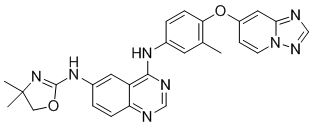
Tucatinib is a kinase inhibitor. The chemical name is (N4-(4-([1,2,4]triazolo[1,5-a]pyridin-7-yloxy)-3-methylphenyl)-N6-(4,4-dimethyl-4,5-dihydrooxazol-2-yl)quinazoline-4,6-diamine. The molecular formula is C
structural formula
TUKYSA (tucatinib) is supplied as 50 mg and 150 mg film-coated tablets for oral use and contain the following inactive ingredients:
Tablet core: copovidone, crospovidone, sodium chloride, potassium chloride, sodium bicarbonate, colloidal silicon dioxide, magnesium stearate, and microcrystalline cellulose.
Coating: yellow film coat: polyvinyl alcohol, titanium dioxide, macrogol/polyethylene glycol, talc, and yellow iron oxide non-irradiated.
Each TUKYSA 50 mg tablet contains 10.10 mg (0.258 mEq) potassium and 9.21 mg (0.401 mEq) sodium.
Each TUKYSA 150 mg tablet contains 30.29 mg (0.775 mEq) potassium and 27.64 mg (1.202 mEq) sodium.
5PATIENT COUNSELING INFORMATION
Advise the patient to read the FDA-approved patient labeling (Patient Information).
Diarrhea
  • Inform patients that TUKYSA has been associated with severe diarrhea. Instruct patients on how to manage diarrhea and to inform their healthcare provider immediately if there is any change in bowel patterns
Hepatotoxicity
  • Inform patients that TUKYSA has been associated with severe hepatotoxicity and that they should report signs and symptoms of liver dysfunction to their healthcare provider immediately
Embryo-Fetal Toxicity
  • Inform pregnant women and females of reproductive potential of the risk to a fetus. Advise females to inform their healthcare provider of a known or suspected pregnancy
  • Advise females of reproductive potential to use effective contraception during treatment with TUKYSA and for 1 week after the last dose
  • Advise male patients with female partners of reproductive potential to use effective contraception during treatment with TUKYSA and for 1 week after the last dose
  • Refer to the Full Prescribing Information of trastuzumab and capecitabine for pregnancy and contraception information.
Lactation
  • Advise women not to breastfeed during treatment with TUKYSA and for 1 week after the last dose
Infertility
  • Advise males and females of reproductive potential that TUKYSA may impair fertility

logo
Manufactured for:
TUKYSA, Seagen, and 
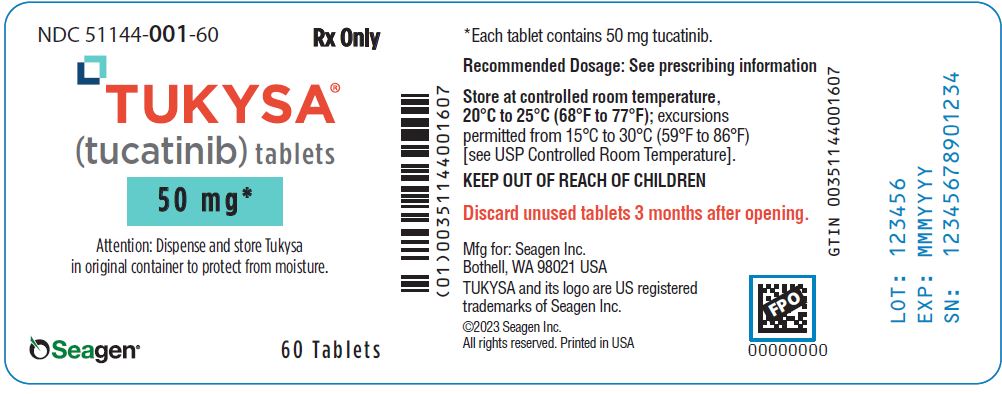
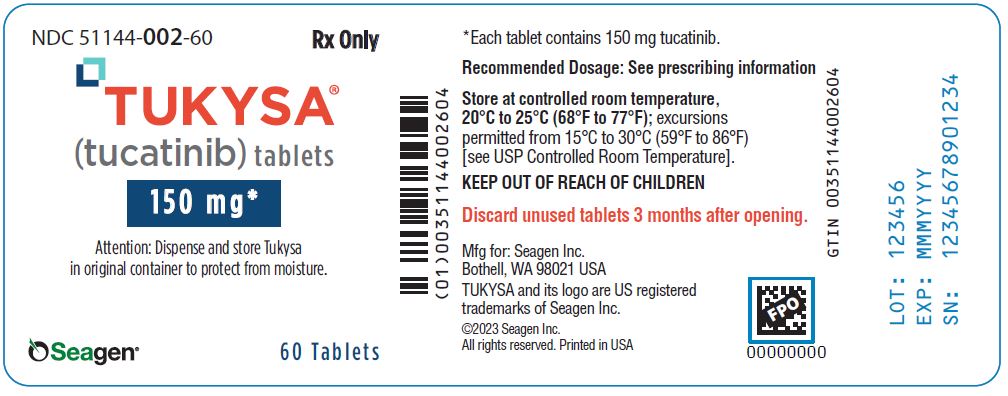
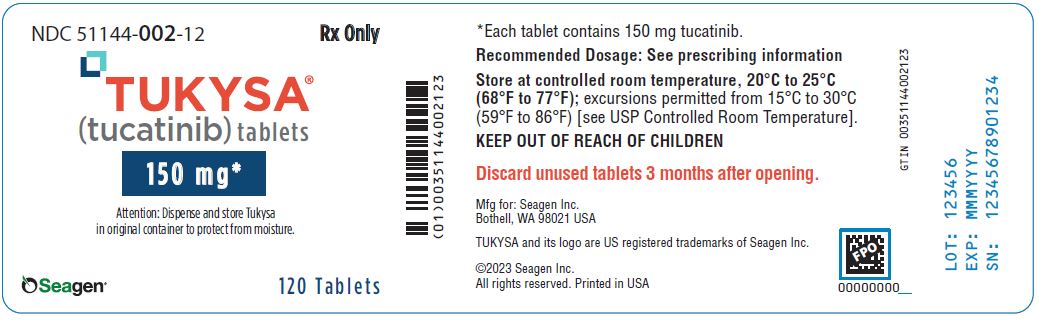
6PRINCIPAL DISPLAY PANEL
NDC 51144-
50 mg Label
NDC 51144-
150 mg Label 60 count
NDC 51144-
150 mg Label 120 count