Brand Name

Cimzia

Generic Name
Certolizumab Pegol
View Brand Information
FDA approval date: April 20, 2008
Classification: Tumor Necrosis Factor Blocker
Form: Injection, Kit

What is Cimzia (Certolizumab Pegol)?

CIMZIA is a tumor necrosis factor blocker indicated for: Reducing signs and symptoms of Crohn's disease and maintaining clinical response in adult patients with moderately to severely active disease who have had an inadequate response to conventional therapy.
Save this treatment for later
Sign Up
Not sure about your diagnosis?
Check Your Symptoms

Related Clinical Trials

Multicenter, Open Label or Double-Blind, Placebo-Controlled Study to Evaluate the Pharmacokinetics, Safety, and Effectiveness of Certolizumab Pegol in Pediatric Study Participants With Moderate to Severe Chronic Plaque Psoriasis

Summary: The purpose of the study is to evaluate the pharmacokinetic (PK) of certolizumab pegol (CZP) in study participants aged 6 to 17 years with moderate to severe chronic plaque psoriasis (PSO) in order to support extrapolation of efficacy.

Certolizumab to Prevent Pregnancy Complications in High-Risk Patients With APS or SLE - (IMPACT Study: IMProve Pregnancy in APS With Certolizumab Therapy)

Summary: This treatment trial evaluates the addition of an anti-tumor necrosis factor-alpha drug, certolizumab, to usual treatment (a heparin agent and low-dose aspirin) in pregnant women with antiphospholipid syndrome (APS) and repeatedly positive tests for lupus anticoagulant (LAC) to determine if this regimen will improve pregnancy outcomes. All enrolled patients will receive certolizumab, and pregnancy...

Efficacy of Certolizumab in Women With Unexplained Recurrent Implantation Failure: a Double-blind Randomized Controlled Trial

Summary: Recurrent implantation failure (RIF), defined as the absence of clinical pregnancy after the transfer of three good-quality embryos, concerns up to 40% of IVF couples and is associated with a low success rate. The causes remain unexplained in over 50% of cases. Various dysimmune changes (related to immune T cells profiles, pro-inflammatory cytokines levels) have been described in unexplained RIF a...

Brand Information

Cimzia (certolizumab pegol)
WARNING: SERIOUS INFECTIONS and MALIGNANCY
SERIOUS INFECTIONS
Patients treated with CIMZIA are at increased risk for developing serious infections that may lead to hospitalization or death
CIMZIA should be discontinued if a patient develops a serious infection or sepsis.
Reported infections include:
  • Active tuberculosis, including reactivation of latent tuberculosis. Patients with tuberculosis have frequently presented with disseminated or extrapulmonary disease. Patients should be tested for latent tuberculosis before CIMZIA use and during therapy. Treatment for latent infection should be initiated prior to CIMZIA use.
  • Invasive fungal infections, including histoplasmosis, coccidioidomycosis, candidiasis, aspergillosis, blastomycosis, and pneumocystosis. Patients with histoplasmosis or other invasive fungal infections may present with disseminated, rather than localized disease. Antigen and antibody testing for histoplasmosis may be negative in some patients with active infection. Empiric anti-fungal therapy should be considered in patients at risk for invasive fungal infections who develop severe systemic illness.
  • Bacterial, viral and other infections due to opportunistic pathogens, including Legionella and Listeria.
The risks and benefits of treatment with CIMZIA should be carefully considered prior to initiating therapy in patients with chronic or recurrent infection.
Patients should be closely monitored for the development of signs and symptoms of infection during and after treatment with CIMZIA, including the possible development of tuberculosis in patients who tested negative for latent tuberculosis infection prior to initiating therapy.
MALIGNANCY
Lymphoma and other malignancies, some fatal, have been reported in children and adolescent patients treated with TNF blockers, of which CIMZIA is a member
1DOSAGE AND ADMINISTRATION
CIMZIA is administered by subcutaneous injection
The solution should be carefully inspected visually for particulate matter and discoloration prior to administration. The solution should be a clear to opalescent, colorless to yellow liquid, essentially free from particulates and should not be used if cloudy or if foreign particulate matter is present. CIMZIA does not contain preservatives; therefore, unused portions of drug remaining in the syringe or vial should be discarded.
1.1Crohn's Disease
The recommended initial adult dose of CIMZIA is 400 mg (given as two subcutaneous injections of 200 mg) initially, and at Weeks 2 and 4. In patients who obtain a clinical response, the recommended maintenance regimen is 400 mg every four weeks.
1.2Rheumatoid Arthritis
The recommended dose of CIMZIA for adult patients with rheumatoid arthritis is 400 mg (given as two subcutaneous injections of 200 mg) initially and at Weeks 2 and 4, followed by 200 mg every other week. For maintenance dosing, CIMZIA 400 mg every 4 weeks can be considered
1.3Polyarticular Juvenile Idiopathic Arthritis
The recommended dose of CIMZIA for patients 2 years of age and older with pJIA is based on weight as shown below.
There is no dosage form for Cimzia that allows for patient self-administration for doses below 200 mg. Doses less than 200 mg require administration by a health care professional using the vial kit.
1.4Psoriatic Arthritis
The recommended dose of CIMZIA for adult patients with psoriatic arthritis is 400 mg (given as 2 subcutaneous injections of 200 mg each) initially and at week 2 and 4, followed by 200 mg every other week. For maintenance dosing, CIMZIA 400 mg every 4 weeks can be considered
1.5Ankylosing Spondylitis
The recommended dose of CIMZIA for adult patients with ankylosing spondylitis is 400 mg (given as 2 subcutaneous injections of 200 mg each) initially and at weeks 2 and 4, followed by 200 mg every 2 weeks or 400 mg every 4 weeks.
1.6Non-radiographic Axial Spondyloarthritis
The recommended dose of CIMZIA for adult patients with non-radiographic axial spondyloarthritis is 400 mg (given as 2 subcutaneous injections of 200 mg each) initially and at weeks 2 and 4, followed by 200 mg every 2 weeks or 400 mg every 4 weeks.
1.7Plaque Psoriasis
The recommended dose of CIMZIA for adults with moderate-to-severe plaque psoriasis is 400 mg (given as 2 subcutaneous injections of 200 mg each) every other week.
For some patients (with body weight less than or equal to 90 kg), CIMZIA 400 mg (given as 2 subcutaneous injections of 200 mg each) initially and at Weeks 2 and 4, followed by 200 mg every other week can be considered
1.8Preparation and Administration of CIMZIA Using the Lyophilized Powder for Injection
CIMZIA Lyophilized powder should be prepared and administered by a health care professional. CIMZIA is provided in a package that contains everything required to reconstitute and inject the drug
Preparation and Storage
  1. If refrigerated, remove CIMZIA from the refrigerator and allow the vial(s) to sit at room temperature for 30 minutes before reconstituting. Do not warm the vial in any other way. Use appropriate aseptic technique when preparing and administering CIMZIA.
  2. Reconstitute the vial(s) of CIMZIA with 1 mL of Sterile Water for Injection, USP using the 20-gauge needle provided. The sterile water for injection should be directed at the vial wall rather than directly on CIMZIA.
  3. Gently swirl each vial of CIMZIA for about one minute without shaking, assuring that all of the powder comes in contact with the Sterile Water for Injection. The swirling should be as gentle as possible in order to avoid creating a foaming effect.
  4. Continue swirling every 5 minutes as long as non-dissolved particles are observed. Full reconstitution may take as long as 30 minutes. The final reconstituted solution contains 200 mg/mL and should be clear to opalescent, colorless to yellow liquid essentially free from particulates.
  5. Once reconstituted, CIMZIA can be stored in the vials for up to 24 hours between 2° to 8° C (36° to 46° F) prior to injection. Do not freeze.
Administration
  1. Prior to injecting, reconstituted CIMZIA should be at room temperature but do not leave reconstituted CIMZIA at room temperature for more than two hours prior to administration.
  2. Withdraw the reconstituted solution into a separate syringe for each vial using a new 20-gauge needle for each vial so that each syringe contains the required volume of CIMZIA
  3. Replace the 20-gauge needle(s) on the syringes with a 23-gauge(s) for administration.
  4. Inject the full contents of the syringe(s)
1.9Preparation and Administration of CIMZIA Using the Prefilled Syringe
After proper training in subcutaneous injection technique, a patient may self-inject with the CIMZIA Prefilled Syringe if a physician determines that it is appropriate.
  • If refrigerated, remove the prefilled syringe from the carton and let it warm to room temperature.
  • Inspect the liquid in the prefilled syringe. It should be clear to opalescent and colorless to yellow and free from particulates. Discard the syringe if cloudy, discolored or contains particulates.
  • Suitable sites for injection include the thigh or abdomen at least 2 inches away from the navel. Inject at least 1 inch from the previous site.
  • Do not inject into areas where the skin is tender, bruised, red or hard, or where there are scars or stretch marks.
The needle shield inside the removable cap of the CIMZIA prefilled syringe contains a derivative of natural rubber latex which may cause allergic reactions and should be handled with caution by latex-sensitive individuals
1.10Monitoring to Assess Safety
Before initiation of therapy with CIMZIA, all patients must be evaluated for both active and inactive (latent) tuberculosis infection. The possibility of undetected latent tuberculosis should be considered in patients who have immigrated from or traveled to countries with a high prevalence of tuberculosis or had close contact with a person with active tuberculosis. Appropriate screening tests (e.g. tuberculin skin test and chest x-ray) should be performed in all patients.
1.11Concomitant Medications
CIMZIA may be used as monotherapy or concomitantly with non-biological disease modifying anti-rheumatic drugs (DMARDs).
The use of CIMZIA in combination with biological DMARDs or other tumor necrosis factor (TNF) blocker therapy is not recommended.
2CONTRAINDICATIONS
CIMZIA is contraindicated in patients with a history of hypersensitivity reaction to certolizumab pegol or to any of the excipients. Reactions have included angioedema, anaphylaxis, serum sickness, and urticaria
3ADVERSE REACTIONS
The most serious adverse reactions were:
  • Serious Infections
  • Malignancies
  • Heart Failure
  • Hypersensitivity Reactions
  • Hepatitis B Virus Reactivation
  • Neurologic Reactions
  • Hematologic Reactions
  • Autoimmunity
  • Immunosuppression
3.1Clinical Trials Experience
Because clinical studies are conducted under widely varying and controlled conditions, adverse reaction rates observed in clinical studies of a drug cannot be directly compared to rates in the clinical studies of another drug, and may not predict the rates observed in a broader patient population in clinical practice.
In premarketing controlled trials of all adult patient populations combined the most common adverse reactions (≥ 8%) were upper respiratory infections (18%), rash (9%) and urinary tract infections (8%).
3.2Postmarketing Experience
The following adverse reactions have been identified during post-approval use of CIMZIA. Because these reactions are reported voluntarily from a population of uncertain size, it is not always possible to estimate reliably their frequency or establish a causal relationship to drug exposure.
Vascular disorder: systemic vasculitis has been identified during post-approval use of TNF blockers.
Skin: case of severe skin reactions, including Stevens-Johnson syndrome, toxic epidermal necrolysis, erythema multiforme, new or worsening psoriasis (all sub-types including pustular and palmoplantar), and lichenoid skin reaction have been identified during post-approval use of TNF blockers.
Immune System Disorders: sarcoidosis
Neoplasms benign, malignant and unspecified (including cysts and polyps):Melanoma, Merkel cell carcinoma (neuroendocrine carcinoma of the skin) [see
4DESCRIPTION
Certolizumab pegol is a TNF blocker. CIMZIA is a recombinant, humanized antibody Fab' fragment, with specificity for human tumor necrosis factor alpha (TNFα), conjugated to an approximately 40kDa polyethylene glycol (PEG2MAL40K). The Fab' fragment is manufactured in
CIMZIA (certolizumab pegol) for injection is supplied as a sterile white, lyophilized powder in a single-dose vial for subcutaneous use. After reconstitution of the lyophilized powder with 1 mL Sterile Water for Injection, USP, the final concentration is 200 mg/mL with a deliverable volume of 1 mL (200 mg) and a pH of approximately 5.2. Each single-dose vial provides 200 mg certolizumab pegol, lactic acid (0.9 mg), polysorbate (0.1 mg), and sucrose (100 mg).
CIMZIA (certolizumab pegol) injection is supplied as a sterile, clear to opalescent, colorless to yellow solution that may contain particulates in a single-dose prefilled syringe for subcutaneous use. Each prefilled syringe delivers 1 mL of solution containing 200 mg certolizumab pegol, sodium acetate (1.36 mg), sodium chloride (7.31 mg), and Water for Injection, USP.
5PATIENT COUNSELING INFORMATION
Advise the patient and/or caregiver to read the FDA-approved patient labeling (Medication Guide and Instructions for Use)
6Instructions for Use
CIMZIA
Read this Instructions for Use booklet that comes with CIMZIA before you start receiving it, and before each injection of CIMZIA. This Instructions for Use booklet does not take the place of talking with your healthcare provider about your medical condition or treatment. These instructions are for 1 injection only. You may need more than 1 injection at a time depending on your prescribed dose of CIMZIA.
  • If you do not have a FDA-cleared sharps disposal container, you may use a household container that is:
Do not dispose of your used sharps disposal container in your household trash unless your community guidelines permit this. Do not recycle your used sharps disposal container.
This Instructions for Use has been approved by the U.S. Food and Drug Administration.
Product manufactured by:
Revised: 9/2024
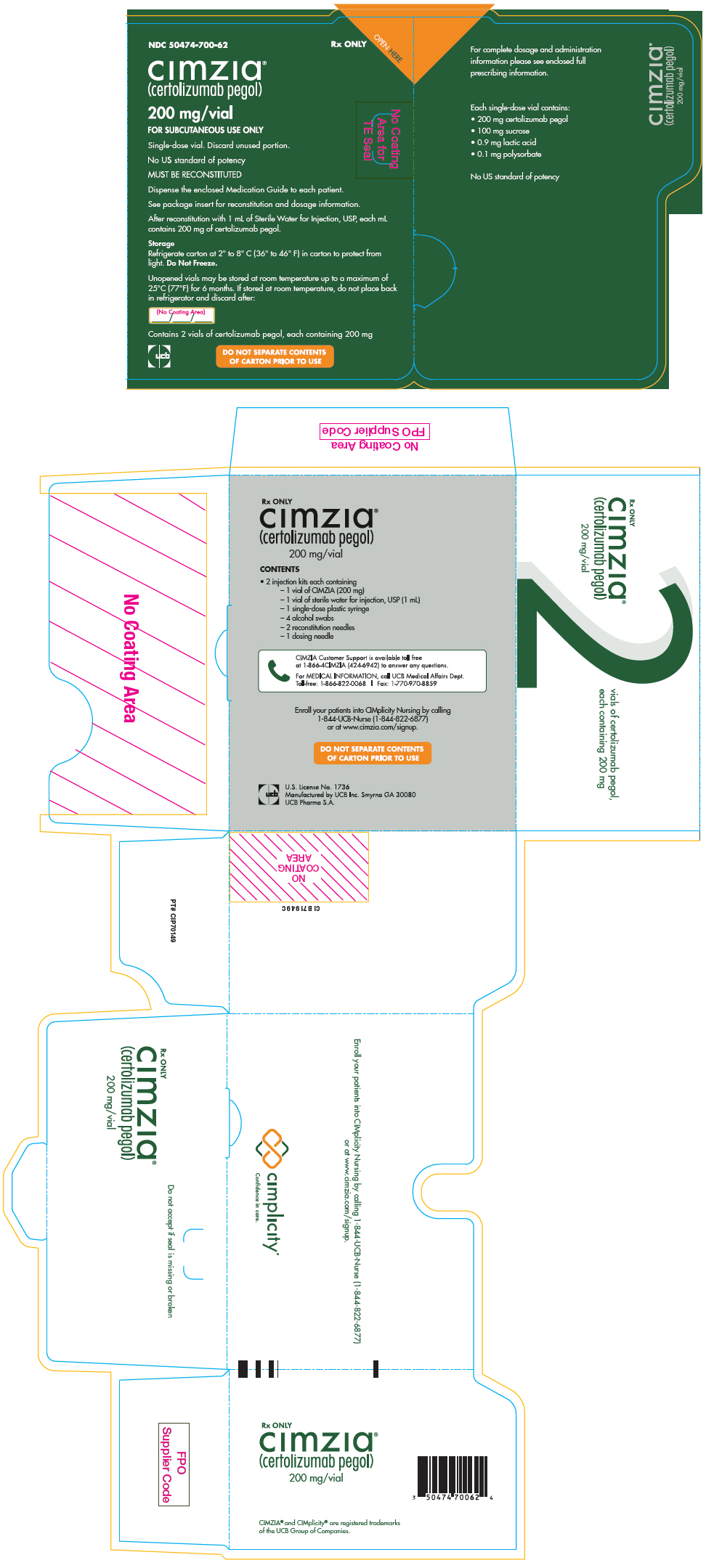
7PRINCIPAL DISPLAY PANEL - Kit Carton
NDC 50474-700-62
Rx ONLY
OPEN HERE
cimzia
200 mg/vial
FOR SUBCUTANEOUS USE ONLY
Single-dose vial. Discard unused portion.
No US standard of potency
MUST BE RECONSTITUTED
Dispense the enclosed Medication Guide to each patient.
See package insert for reconstitution and dosage information.
After reconstitution with 1 mL of Sterile Water for Injection, USP, each mL
Storage
Unopened vials may be stored at room temperature up to a maximum of
___/___/___
Contains 2 vials of certolizumab pegol, each containing 200 mg
ucb
DO NOT SEPARATE CONTENTS
PRINCIPAL DISPLAY PANEL - Kit Carton
8PRINCIPAL DISPLAY PANEL - 1 mL Syringe Carton - 50474-710-79
NDC 50474-710-79
Dispense the enclosed Medication Guide to each patient.
Contains 2 single-dose, prefilled syringes each containing
cimzia
2 x 200 mg/mL
FOR SUBCUTANEOUS INJECTION USE ONLY
LIFT HERE TO OPEN
Each syringe is intended for a single dose
DO NOT FREEZE
PRINCIPAL DISPLAY PANEL - 1 mL Syringe Carton - 50474-710-79
9PRINCIPAL DISPLAY PANEL - 1 mL Syringe Carton Box
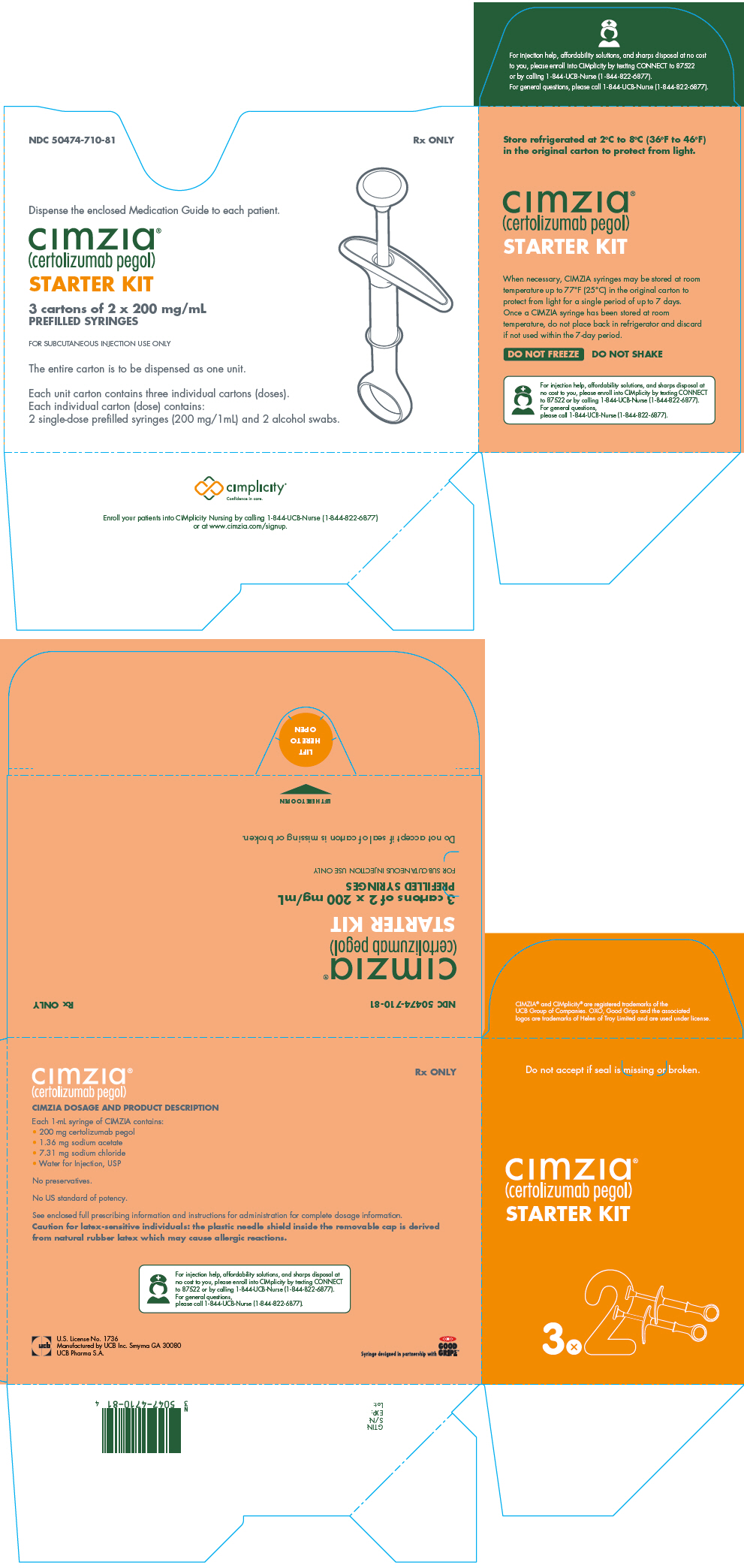
NDC 50474-710-81
Rx ONLY
Dispense the enclosed Medication Guide to each patient.
cimzia
STARTER KIT
3 cartons of 2 x 200 mg/mL
FOR SUBCUTANEOUS INJECTION USE ONLY
The entire carton is to be dispensed as one unit.
Each unit carton contains three individual cartons (doses).
PRINCIPAL DISPLAY PANEL - 1 mL Syringe Carton Box
10PRINCIPAL DISPLAY PANEL - 1 mL Syringe Carton - 50474-750-10
NDC 50474-750-10
cimzia
200 mg/vial
FOR SUBCUTANEOUS USE ONLY
Dispense the enclosed Medication Guide to each patient.
Contents: One single-dose prefilled syringe.
One alcohol swab.
PRINCIPAL DISPLAY PANEL - 1 mL Syringe Carton - 50474-750-10