Brand Name
Argatroban
View Brand InformationFDA approval date: January 05, 2012
Classification: Direct Thrombin Inhibitor
Form: Injection, Solution
What is Argatroban?
Argatroban in sodium chloride injection is a direct thrombin inhibitor indicated: For prophylaxis or treatment of thrombosis in adult patients with heparin-induced thrombocytopenia .
Approved To Treat
Top Global Experts
There are no experts for this drug
Save this treatment for later
Not sure about your diagnosis?
Related Clinical Trials
There is no clinical trials being done for this treatment
Related Latest Advances
There is no latest advances for this treatment
Brand Information
Argatroban (Argatroban)
1DOSAGE FORMS AND STRENGTHS
- Injection: 250 mg/2.5 mL (100 mg/mL) single-dose vial
- Injection: 50 mg/50 mL (1 mg/mL) ready for intravenous infusion single-dose vial
2CONTRAINDICATIONS
Argatroban is contraindicated in:
- Patients with major bleeding,
- Patients with a history of hypersensitivity to argatroban. Airway, skin, and generalized hypersensitivity reactions have been reported
3ADVERSE REACTIONS
The following adverse reaction is also discussed in other sections of the labeling:
- Risk of Hemorrhage
3.1Clinical Trials Experience
Adverse Reactions in Patients with HIT (With or Without Thrombosis)
Because clinical trials are conducted under widely varying conditions, adverse reaction rates observed in the clinical trials of a drug cannot be directly compared to rates in the clinical trials of another drug and may not reflect the rates observed in practice.
The following safety information is based on all 568 patients treated with argatroban in Study 1 and Study 2. The safety profile of the patients from these studies is compared with that of 193 historical controls in which the adverse reactions were collected retrospectively. Adverse reactions are separated into hemorrhagic and non-hemorrhagic reactions.
Major bleeding was defined as bleeding that was overt and associated with a hemoglobin decrease ≥ 2 g/dL, that led to a transfusion of ≥ 2 units, or that was intracranial, retroperitoneal, or into a major prosthetic joint. Minor bleeding was overt bleeding that did not meet the criteria for major bleeding.
Table 4 gives an overview of the most frequently observed hemorrhagic reactions, presented separately by major and minor bleeding, sorted by decreasing occurrence among argatroban-treated patients with HIT (with or without thrombosis).
* with or without thrombosis
Table 5 gives an overview of the most frequently observed non-hemorrhagic reactions sorted by decreasing frequency of occurrence (≥2%) among argatroban-treated HIT/HITTS patients.
a) Patients may have experienced more than 1 adverse reaction.
Adverse Reactions in Patients with or at Risk for HIT Undergoing PCI
The following safety information is based on 91 patients initially treated with argatroban and 21 patients subsequently re-exposed to argatroban for a total of 112 PCIs with argatroban anticoagulation. Adverse reactions are separated into hemorrhagic (Table 6) and non-hemorrhagic (Table 7) reactions.
Major bleeding was defined as bleeding that was overt and associated with a hemoglobin decrease ≥5 g/dL, that led to a transfusion of ≥2 units, or that was intracranial, retroperitoneal, or into a major prosthetic joint. The rate of major bleeding events in patients treated with argatroban in the PCI trials was 1.8%.
a) Patients may have experienced more than 1 adverse reaction.
Table 7 gives an overview of the most frequently observed non-hemorrhagic adverse reactions (>2%), sorted by decreasing frequency of occurrence among argatroban-treated PCI patients.
a) Patients may have experienced more than 1 adverse reaction.
There were 22 serious adverse reactions in 17 PCI patients (19.6% in 112 interventions). Table 8 lists the serious adverse reactions occurring in argatroban-treated patients with or at risk for HIT undergoing PCI.
a) Individual reactions may also have been reported elsewhere (see Table 6 and 7).
Intracranial Bleeding in Other Populations
Increased risks for intracranial bleeding have been observed in investigational studies of argatroban for other uses. In a study of patients with acute myocardial infarction receiving both argatroban and thrombolytic therapy (streptokinase or tissue plasminogen activator), the overall frequency of intracranial bleeding was 1% (8 out of 810 patients). Intracranial bleeding was not observed in 317 subjects or patients who did not receive concomitant thrombolysis
The safety and effectiveness of argatroban for cardiac indications other than PCI in patients with HIT have not been established. Intracranial bleeding was also observed in a prospective, placebo-controlled study of argatroban in patients who had onset of acute stroke within 12 hours of study entry. Symptomatic intracranial hemorrhage was reported in 5 of 117 patients (4.3%) who received argatroban at 1 to 3 mcg/kg/min and in none of the 54 patients who received placebo. Asymptomatic intracranial hemorrhage occurred in 5 (4.3%) and 2 (3.7%) of the patients, respectively.
Allergic Reactions
One hundred fifty-six allergic reactions or suspected allergic reactions were observed in 1,127 individuals who were treated with argatroban in clinical pharmacology studies or for various clinical indications. About 95% (148/156) of these reactions occurred in patients who concomitantly received thrombolytic therapy (e.g., streptokinase) or contrast media.
Allergic reactions or suspected allergic reactions in populations other than patients with HIT (with or without thrombosis) include (in descending order of frequency):
- Airway reactions (coughing, dyspnea): 10% or more
- Skin reactions (rash, bullous eruption): 1 to <10%
- General reactions (vasodilation): 1 to 10%
Limited data are available on the potential formation of drug-related antibodies. Plasma from 12 healthy volunteers treated with argatroban over 6 days showed no evidence of neutralizing antibodies. No loss of anticoagulant activity was noted with repeated administration of argatroban to more than 40 patients.
4OVERDOSAGE
Excessive anticoagulation, with or without bleeding, may be controlled by discontinuing argatroban or by decreasing the argatroban dose. In clinical studies, anticoagulation parameters generally returned from therapeutic levels to baseline within 2 to 4 hours after discontinuation of the drug. Reversal of anticoagulant effect may take longer in patients with hepatic impairment. No specific antidote to argatroban is available; if life-threatening bleeding occurs and excessive plasma levels of argatroban are suspected, discontinue argatroban immediately and measure aPTT and other coagulation parameters. When argatroban was administered as a continuous infusion (2 mcg/kg/min) prior to and during a 4-hour hemodialysis session, approximately 20% of argatroban was cleared through dialysis.
Single intravenous doses of argatroban at 200, 124, 150, and 200 mg/kg were lethal to mice, rats, rabbits, and dogs, respectively. The symptoms of acute toxicity were loss of righting reflex, tremors, clonic convulsions, paralysis of hind limbs, and coma.
5DESCRIPTION
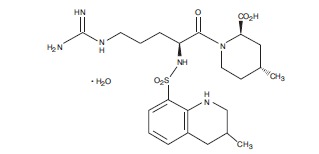
Argatroban is a synthetic direct thrombin inhibitor and the chemical name is 1-[5-[(aminoiminomethyl)amino]-1-oxo-2-[[(1,2,3,4-tetrahydro-3-methyl-8- quinolinyl)sulfonyl]amino]pentyl]-4-methyl-2-piperidinecarboxylic acid, monohydrate. Argatroban has 4 asymmetric carbons. One of the asymmetric carbons has an
The molecular formula of argatroban is C

Argatroban is a white, odorless crystalline powder that is freely soluble in glacial acetic acid, slightly soluble in ethanol, and insoluble in acetone, ethyl acetate, and ether.
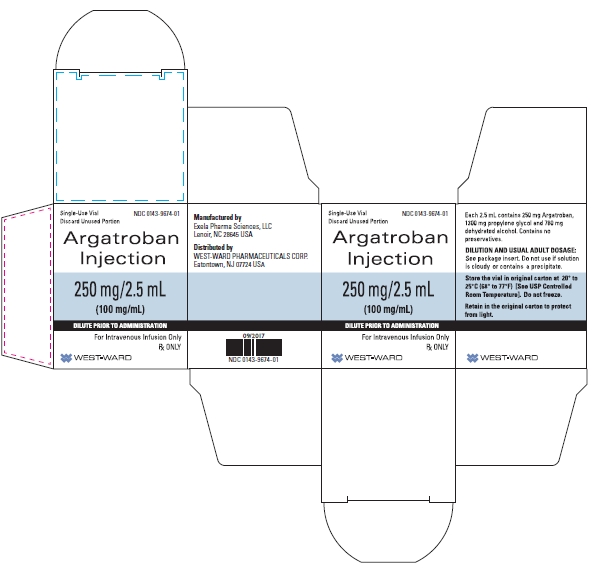
Argatroban Injection 250 mg/2.5 mL (100 mg/mL) is a sterile clear, colorless to pale yellow, slightly viscous solution. Argatroban Injection 250 mg/2.5 mL (100 mg/mL) is available in 250-mg (in 2.5-mL) single-dose amber vials, with white flip-top caps. Each mL of sterile, nonpyrogenic solution contains 100 mg Argatroban. Inert ingredients (per vial): 1300 mg Propylene glycol, 760 mg Dehydrated alcohol.
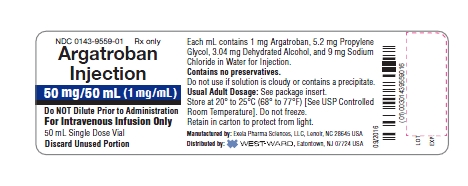
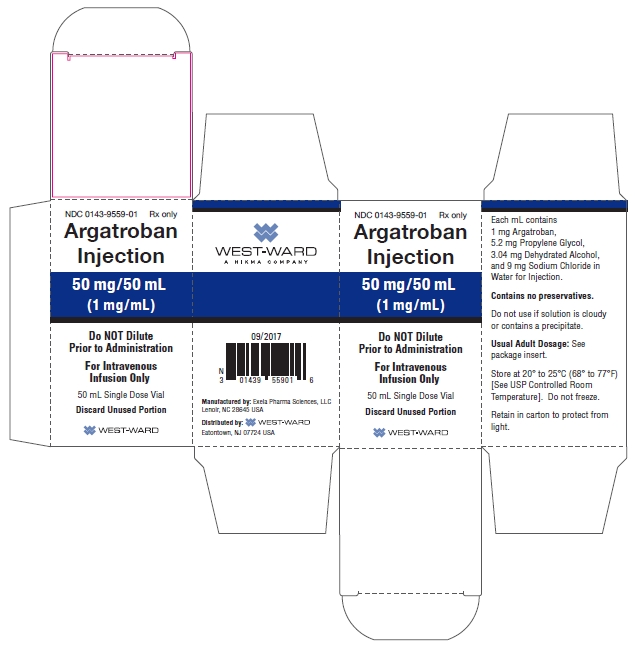
Argatroban Injection 50 mg/50 mL (1 mg/mL) is a sterile clear, colorless to pale yellow, solution. Argatroban Injection 50 mg/50 mL (1 mg/mL) is available in 50-mg (in 50-mL) single-dose vials, with white flip-top caps. Each mL of sterile, nonpyrogenic solution contains 1 mg Argatroban. Inert ingredients (per vial): 260 mg Propylene glycol, 152 mg Dehydrated alcohol, and 450 mg Sodium Chloride.
6HOW SUPPLIED/STORAGE AND HANDLING
Argatroban Injection is available in packages as follows:
NDC Strength Packaged
0143-9674-01 250 mg/2.5 mL (100 mg/mL) Single Dose Vial
0143-9559-01 50 mg/50 mL (1 mg/mL) Single Dose Vial
Storage and Handling
Store the vials in original carton at 20° to 25° C (68° to 77° F) [See USP Controlled Room Temperature]. Do not freeze. Retain in the original carton to protect from light. If the solution is cloudy, or if an insoluble precipitate is noted, the vial should be discarded.
7PATIENT COUNSELING INFORMATION
Inform patients of the risks associated with Argatroban Injection as well as the plan for regular monitoring during administration of the drug. Specifically, inform patients to report:
- the use of any other products known to affect bleeding.
- any medical history that may increase the risk for bleeding, including a history of severe hypertension; recent lumbar puncture or spinal anesthesia; major surgery, especially involving the brain, spinal cord, or eye; hematologic conditions associated with increased bleeding tendencies such as congenital or acquired bleeding disorders and gastrointestinal lesions such as ulcerations.
- any bleeding signs or symptoms.
- the occurrence of any signs or symptoms of allergic reactions (e.g., airway reactions, skin reactions and vasodilation reactions).
Manufactured by: Exela Pharma Sciences, LLC
Lenoir, NC 28645
Lenoir, NC 28645
Distributed by: Hikma Pharmaceuticals USA Inc.
Berkeley Heights, NJ 07922
November 2020
8PRINCIPAL DISPLAY PANEL
Single-Use Vial

9PRINCIPAL DISPLAY PANEL
NDC 0143-9559-01 Rx only

NDC 0143-9559-01 Rx only