Brand Name

Inlyta

Generic Name
Axitinib
View Brand Information
FDA approval date: January 27, 2012
Classification: Kinase Inhibitor
Form: Tablet

What is Inlyta (Axitinib)?

INLYTA is a kinase inhibitor indicated: in combination with avelumab, for the first-line treatment of patients with advanced renal cell carcinoma .
Save this treatment for later
Sign Up
Not sure about your diagnosis?
Check Your Symptoms

Related Clinical Trials

Phase 2 Study of Axitinib + Ipilimumab in Advanced Melanoma

Summary: The goal of this clinical research study is to find out if taking axitinib with ipilimumab is effective in treating advanced melanoma.

International Multicentric Study ARON-1

Summary: The ARON-1 Study is designed as an International Multicentric Retrospective Study to collect global experiences with the use of immuno-combinations in patients with metastatic RCC. Two Supplementary Studies (ARON-1α and ARON-1β) have been designed. The ARON-1α Supplementary Study has been designed to investigate for the presence of genomic signatures from tumor samples of patients treated with fir...

A Phase 3, Multicenter, Double-Masked, Randomized, 3-Arm Parallel Group Study to Evaluate the Efficacy and Safety of Intravitreal OTXTKI (Axitinib Implant) in Participants With Non-Proliferative Diabetic Retinopathy

Summary: The purpose of this trial is to study the safety and effectiveness of OTX-TKI (axitinib intravitreal hydrogel) for the treatment of Non-Proliferative Diabetic Retinopathy. OTX-TKI is an intravitreal hydrogel embedded with axitinib. When the OTX-TKI hydrogel is administered into the vitreous cavity of the eye, the hydrogel begins to slowly break down, which allows the axitinib to be slowly released...

Brand Information

INLYTA (axitinib)
1DOSAGE FORMS AND STRENGTHS
  • 1 mg tablets of INLYTA: red, film-coated, oval tablets, debossed with "Pfizer" on one side and "1 XNB" on the other side.
  • 5 mg tablets of INLYTA: red, film-coated, triangular tablets, debossed with "Pfizer" on one side and "5 XNB" on the other side.
2CONTRAINDICATIONS
None.
3ADVERSE REACTIONS
The following clinically significant adverse reactions are discussed elsewhere in the labeling
  • Hypertension
  • Arterial thromboembolic events
  • Venous thromboembolic events
  • Hemorrhage
  • Cardiac failure
  • Gastrointestinal perforation and fistula formation
  • Thyroid dysfunction
  • Reversible posterior leukoencephalopathy syndrome
  • Proteinuria
  • Hepatotoxicity
  • Hepatic impairment
3.1Clinical Trials Experience
Because clinical trials are conducted under widely varying conditions, adverse reaction rates observed in the clinical trials of a drug cannot be directly compared to rates in the clinical trials of another drug and may not reflect the rates observed in clinical practice.
The safety of INLYTA has been evaluated in combination with avelumab in JAVELIN Renal 101 and pembrolizumab in KEYNOTE-426 for the first-line treatment of patients with advanced RCC
The safety of INLYTA has been evaluated in 715 patients in second-line monotherapy studies, which included 537 patients with advanced RCC. The data described
3.2Postmarketing Experience
The following adverse reactions have been identified during postapproval use of INLYTA. Because these reactions are reported voluntarily from a population of uncertain size, it is not always possible to reliably estimate their frequency or establish a causal relationship to drug exposure.
Vascular disorders: arterial (including aortic), aneurysms, dissections, and rupture.
4OVERDOSAGE
There is no specific treatment for INLYTA overdose.
In a controlled clinical study with INLYTA for the treatment of patients with RCC, 1 patient inadvertently received a dose of 20 mg twice daily for 4 days and experienced dizziness (Grade 1).
In a clinical dose finding study with INLYTA, subjects who received starting doses of 10 mg twice daily or 20 mg twice daily experienced adverse reactions which included hypertension, seizures associated with hypertension, and fatal hemoptysis.
In cases of suspected overdose, INLYTA should be withheld and supportive care instituted.
5DESCRIPTION
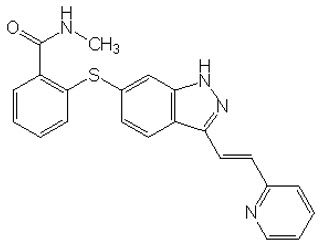
INLYTA (axitinib) is a kinase inhibitor. Axitinib has the chemical name N-methyl-2-[3-((E)-2-pyridin-2-yl-vinyl)-1H-indazol-6-ylsulfanyl]-benzamide. The molecular formula is C22H18N4OS and the molecular weight is 386.47 Daltons. The chemical structure is:
Chemical Structure
Axitinib is a white to light-yellow powder with a pKa of 4.8. The solubility of axitinib in aqueous media over the range pH 1.1 to pH 7.8 is in excess of 0.2 µg/mL. The partition coefficient (n-octanol/water) is 3.5.
INLYTA is supplied as red, film-coated tablets containing either 1 mg or 5 mg of axitinib together with microcrystalline cellulose, lactose monohydrate, croscarmellose sodium, magnesium stearate, and Opadry
6HOW SUPPLIED/STORAGE AND HANDLING
INLYTA tablets are supplied as follows:
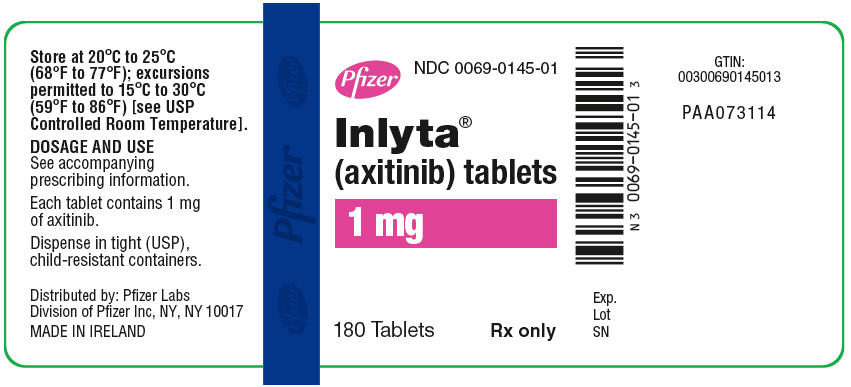
  • 1 mg tablets are red film-coated, oval tablets debossed with "Pfizer" on one side and "1 XNB" on the other; available in bottles of 180: NDC 0069-0145-01.
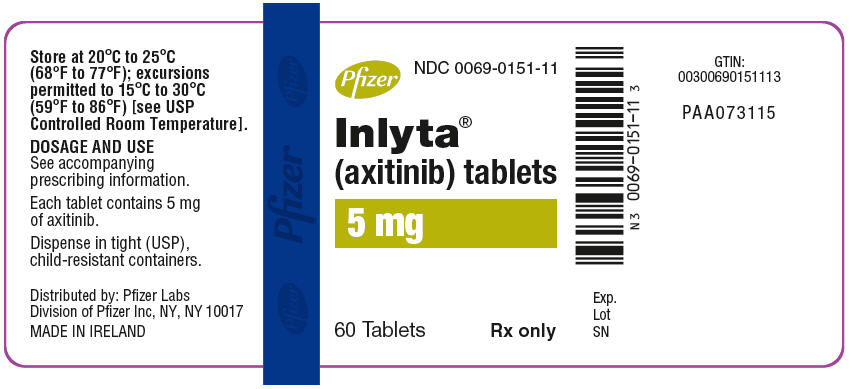
  • 5 mg tablets are red film-coated, triangular tablets debossed with "Pfizer" on one side and "5 XNB" on the other; available in bottles of 60: NDC 0069-0151-11.
  • Store at 20°C to 25°C (68°F to 77°F); excursions permitted to 15°C to 30°C (59°F to 86°F) [see USP Controlled Room Temperature].
7PATIENT COUNSELING INFORMATION
Advise the patient to read the FDA-approved patient labeling (Patient Information).
8PRINCIPAL DISPLAY PANEL - 1 mg Tablet Bottle Label
Pfizer
NDC 0069-0145-01
Inlyta
(axitinib) tablets
1 mg
180 Tablets
Rx only
PRINCIPAL DISPLAY PANEL - 1 mg Tablet Bottle Label
9PRINCIPAL DISPLAY PANEL - 5 mg Tablet Bottle Label
Pfizer
NDC 0069-0151-11
Inlyta
(axitinib) tablets
5 mg
60 Tablets
Rx only
PRINCIPAL DISPLAY PANEL - 5 mg Tablet Bottle Label