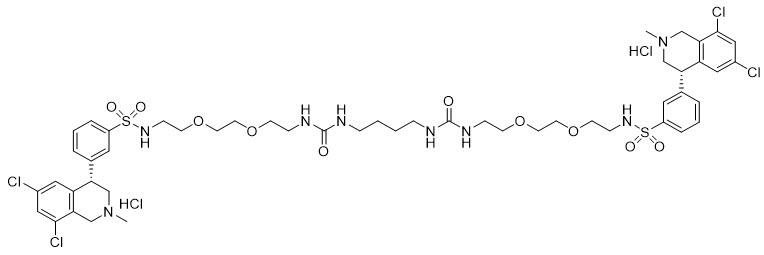
Tenapanor
What is Ibsrela (Tenapanor)?
Approved To Treat


Related Clinical Trials
Summary: This is a 26-week, multi-center, randomized, double-blind, placebo-controlled study with a 4-week treatment-free Safety Follow-up period to assess the safety and efficacy of tenapanor (5 mg, 25mg, and 50 mg) in adult patients with Chronic Idiopathic Constipation (CIC) when administered twice daily for 26 consecutive weeks.
Summary: Tenapanor is the newest FDA-approved drug for IBS with constipation (IBS-C). This study seeks to understand tenapanor as a treatment for cystic fibrosis-related constipation (CFrC) in CF patients. Participants will ingest one 50 mg tablet of tenapanor, twice daily, for a 4-week treatment period. They will also complete three questionnaires, the PAC-SYM, PAC-QoL, and IBS-SSS, and daily diaries to c...
Summary: Investigation of tenapanor as a potential treatment for synucleinopathy-associated constipation
Related Latest Advances
Brand Information
- IBSRELA is contraindicated in patients less than 6 years of age; in nonclinical studies in young juvenile rats administration of tenapanor caused deaths presumed to be due to dehydration
- Avoid use of IBSRELA in patients 6 years to less than 12 years of age
- The safety and effectiveness of IBSRELA have not been established in patients less than 18 years of age
- Patients less than 6 years of age due to the risk of serious dehydration
- Patients with known or suspected mechanical gastrointestinal obstruction
- a mean abdominal pain score of at least 3 on a 0-to-10-point numeric rating scale where a score of 0 indicates no pain and 10 indicates very severe pain
- less than 3 complete spontaneous bowel movements (CSBMs) per week, where a CSBM is defined as a spontaneous bowel movement (SBM) that is associated with a sense of complete evacuation (an SBM is a bowel movement occurring in the absence of laxative use)
- less than or equal to 5 SBMs per week
- CSBM responder: a patient who experienced an increase of at least 1 CSBM in weekly average from baseline.
- Abdominal pain responder: a patient who experienced at least a 30% reduction in the weekly average of abdominal pain score compared with baseline.