Brand Name

Crysvita

Generic Name
Burosumab
View Brand Information
FDA approval date: April 18, 2018
Form: Injection

What is Crysvita (Burosumab)?

CRYSVITA is a fibroblast growth factor 23 blocking antibody indicated for: The treatment of X-linked hypophosphatemia in adult and pediatric patients 6 months of age and older.
Save this treatment for later
Sign Up
Not sure about your diagnosis?
Check Your Symptoms

Related Clinical Trials

A Retrospective Observational Study of the Effect of Dosing Regimen of Burosumab on Biochemical Control of Serum Phosphate Levels in Patients With X-linked Hypophosphataemia (XLH)

Summary: X-linked hypophosphataemia (XLH) is a rare, hereditary condition. The genetic defect leads to low blood phosphate levels and vitamin D suppression. Phosphate is required for strong bones and teeth and to store energy in cells. Low phosphate leads to soft bones (rickets). Patients experience bowed legs, short stature, bone pain and dental pain. Prior to Burosumab, conventional treatment of XLH prev...

Post Marketing Surveillance Study to Observe Safety and Effectiveness of CRYSVITA® in S. Korean Patients

Summary: The objective of this post-marketing surveillance (PMS) study is to assess the safety and effectiveness of CRYSVITA injection 10, 20, and 30mg, equivalent to in routine clinical settings

Effect of Burosumab and 1-25 (OH) Vitamin D on Human Osteoblasts from Patients Requiring Craniosynostosis Surgery for Idiopathic Reason or Due to Hypophosphatemic Rickets (HR)

Summary: FGF23 is the cornerstone of phosphate / calcium / vitamin D metabolism: it is synthesized mainly by osteocytes and acts as a phosphaturizing agent, inhibitor of dihydroxyvitamin D, and inhibitor of synthesis and secretion of PTH in most tissues. The specific role of FGF23 on bone has yet to be demonstrated. In osteoblasts, overexpression of FGF23 in vitro suppresses not only osteoblastic different...

Brand Information

CRYSVITA (Burosumab)
1DOSAGE FORMS AND STRENGTHS
Injection: 10 mg/mL, 20 mg/mL, or 30 mg/mL clear to slightly opalescent and colorless to pale brown-yellow solution in a single-dose vial.
2CONTRAINDICATIONS
CRYSVITA is contraindicated:
  • In concomitant use with oral phosphate and/or active vitamin D analogs (e.g. calcitriol, paricalcitol, doxercalciferol, calcifediol) due to the risk of hyperphosphatemia
  • When serum phosphorus is within or above the normal range for age
  • In patients with severe renal impairment or end stage renal disease because these conditions are associated with abnormal mineral metabolism
3ADVERSE REACTIONS
The following adverse reactions are described below and elsewhere in the labeling:
  • Hypersensitivity
  • Hyperphosphatemia and Risk of Nephrocalcinosis
  • Hypercalcemia
  • Injection Site Reactions
3.1Clinical Trials Experience
Because clinical trials are conducted under widely varying conditions, adverse reaction rates observed in the clinical trials of a drug cannot be directly compared to rates in the clinical trials of another drug and may not reflect the rates observed in practice.
Adverse Reactions in Pediatric Patients with XLH
CRYSVITA was studied in three pediatric XLH studies. Study 1 is a randomized, open-label phase 3 study in XLH patients ages 1 to 12 years, who were randomized to treatment with CRYSVITA or treatment with active control of oral phosphate and active vitamin D (CRYSVITA N = 29, Active Control N = 32). Study 2 is an open-label phase 2 study in XLH patients ages 5 to 12 years (N = 52). Study 3 is an open-label phase 2 study in XLH patients ages 1 to less than 5 years (N = 13). Overall, the patient population was 1-12 years (mean age 7.0 years), 49% male, and 88% white.
In Study 1, patients randomized to CRYSVITA received a mean dose of approximately 0.90 mg/kg (range 0.8-1.2 mg/kg) every 2 weeks. All patients in this group and the active control group completed 64 weeks of treatment.
Adverse reactions occurring in ≥ 10% of subjects in the CRYSVITA group, with higher frequency than in the subjects in the active control group, through the 64-week treatment period in Study 1 are shown in
In Study 2, 26 of the patients received CRYSVITA at a mean dose of 1.05 mg/kg (range 0.4 – 2.0 mg/kg) every 2 weeks at Week 64; the other 26 patients received CRYSVITA every 4 weeks. The mean duration of exposure in Study 2 was 124 weeks. In Study 3, patients received CRYSVITA at a mean dose of 0.90 mg/kg (range 0.8-1.2 mg/kg) every 2 weeks at Week 40. The mean duration of exposure in Study 3 was 45 weeks.
Adverse reactions occurring in more than 10% of CRYSVITA-treated patients from Studies 2 and 3 are shown in
Hypersensitivity Reactions
In Study 1 (N=29 for CRYSVITA arm), the most frequent hypersensitivity reactions were rash (10%), injection site rash (10%) and injection site urticaria (7%). In Studies 2 and 3 (N=65), the most frequent hypersensitivity reactions were rash (22%), injection site rash (6%), and urticaria (5%).
Hyperphosphatemia
In pediatric studies, no events of hyperphosphatemia were reported.
Injection Site Reactions (ISR)
In Study 1 (N=29 for CRYSVITA arm), 52% of the patients had a local injection site reaction (e.g. injection site urticaria, erythema, rash, swelling, bruising, pain, pruritus, and hematoma) at the site of CRYSVITA injection. In Studies 2 and 3 (N=65), approximately 58% of the patients had a local injection site reaction at the site of CRYSVITA injection. Injection site reactions were generally mild in severity, occurred within 1 day of injection, lasted approximately 1 to 3 days, required no treatment, and resolved in almost all instances.
Adverse Reactions in Adult Patients with XLH
The safety of CRYSVITA in adult patients with XLH was demonstrated in a randomized, double-blind, placebo-controlled study (Study 4) of 134 patients, age 20-63 years (mean age 41 years), of whom most were white/Caucasian (81%) and female (65%). A total of 68 and 66 patients received at least one dose of CRYSVITA or placebo, respectively. The mean dose of CRYSVITA was 0.95 mg/kg (range 0.3 – 1.2 mg/kg) subcutaneously every 4 weeks. Adverse reactions reported in more than 5% of CRYSVITA-treated patients and 2 patients or more than with placebo from the 24-week placebo-controlled portion of Study 4 are shown in
The 24-week placebo controlled study was followed by a 24-week open-label treatment period in which all patients received CRYSVITA subcutaneously every 4 weeks. No new adverse reactions were identified in the open-label extension period.
Hypersensitivity Reactions
In the double-blind period of Study 4, approximately 6% of patients in both the CRYSVITA and placebo treatment groups experienced a hypersensitivity event. The events were mild or moderate and did not require discontinuation.
Hyperphosphatemia
In the double-blind period of Study 4, 7% of patients in the CRYSVITA treatment group experienced hyperphosphatemia meeting the protocol-specified criteria for dose reduction (either a single serum phosphorus greater than 5.0 mg/dL or serum phosphorus greater than 4.5 mg/dL [the upper limit of normal] on two occasions). The hyperphosphatemia was managed with dose reduction. The dose for all patients meeting the protocol-specified criteria was reduced 50 percent. A single patient required a second dose reduction for continued hyperphosphatemia.
Injection Site Reactions (ISR)
In the double-blind period of Study 4, approximately 12% of patients in both the CRYSVITA and placebo treatment groups had a local reaction (e.g. injection site reaction, erythema, rash, bruising, pain, pruritus, and hematoma) at the site of the injection. Injection site reactions were generally mild in severity, occurred within 1 day of injection, lasted approximately 1 to 3 days, required no treatment, and resolved in almost all instances.
Restless Legs Syndrome (RLS)
In the double-blind period of Study 4, approximately 12% of the CRYSVITA treatment group had worsening of baseline restless legs syndrome (RLS) or new onset RLS of mild to moderate severity; these events did not lead to dose discontinuation. Nonserious RLS has also been reported in other repeat dose adult XLH studies; in one case, worsening baseline RLS led to drug discontinuation and subsequent resolution of the event.
Spinal Stenosis
Spinal stenosis is prevalent in adults with XLH and spinal cord compression has been reported. In the CRYSVITA phase 2 and phase 3 studies of adults with XLH (total N=176), a total of 7 patients underwent spinal surgery. Most of these cases appeared to involve progression of a pre-existing spinal stenosis. It is unknown if CRYSVITA therapy exacerbates spinal stenosis or spinal cord compression.
Adverse Reactions in Patients with TIO
The safety of CRYSVITA in patients with TIO was demonstrated in two single-arm clinical studies (Study 6 and Study 7) that enrolled a total of 27 patients. Fourteen patients were male, and patients ranged from 33 to 73 years of age. The mean dose of CRYSVITA was 0.77 mg/kg every 4 weeks and the mean duration of exposure was 121 weeks.
Adverse reactions reported in adult TIO patients in the pooled data from Study 6 and Study 7 are shown in
Hypersensitivity reactions
In the pooled data for Studies 6 and 7, 22% of patients experienced a hypersensitivity reaction. The most frequent hypersensitivity reactions were eczema (11%) and rash (11%). The events were mild or moderate in severity.
Hyperphosphatemia
In the pooled data for Studies 6 and 7, 2 patients (7%) experienced hyperphosphatemia which was managed with dose reduction.
Injection site reactions
The frequency of injection site reactions was 15% (injection site reaction, injection site pain, and injection site swelling). The injection site reactions were generally mild in severity, required no treatment and resolved in all cases.
Restless Legs Syndrome
In the pooled data for Studies 6 and 7, 2 patients (7%) experienced symptoms of restless legs syndrome, which were mild and did not require treatment interruption.
3.2Postmarketing Experience
The following adverse reactions have been identified during postapproval use of CRYSVITA. Because these reactions are reported voluntarily from a population of uncertain size, it is not always possible to reliably estimate their frequency or establish a causal relationship to drug exposure.
Metabolism and nutrition disorders: Hypercalcemia
Skin and subcutaneous tissue disorders: Urticaria
Investigations: Blood phosphorus increased in pediatric XLH patients, blood parathyroid hormone increased
4OVERDOSAGE
There have been no reports of overdose with CRYSVITA. CRYSVITA has been administered in pediatric clinical trials without dose limiting toxicity using doses up to 2 mg/kg body weight with a maximal dose of 90 mg, administered every two weeks. In XLH adult clinical trials, no dose limiting toxicity has been observed using doses up to 1 mg/kg or a maximal total dose of 128 mg every 4 weeks. In non-XLH rabbits and cynomolgus monkeys, ectopic mineralization in multiple tissues and organs was observed at doses of burosumab-twza that resulted in supra-physiologic serum phosphate levels. Adverse effects on bone including reductions in bone mineral density, bone mineralization and bone strength were also observed at exposure greater than human exposure [
In case of overdose, it is recommended that serum phosphorus levels, serum calcium levels and renal function be measured immediately and monitored periodically until resolution to normal/baseline levels. In case of hyperphosphatemia, withhold CRYSVITA and initiate appropriate medical treatment.
5DESCRIPTION
Burosumab-twza is a human immunoglobulin G subclass 1 (IgG1), anti-human fibroblast growth factor 23 (FGF23) antibody produced by recombinant DNA technology using Chinese hamster ovary cells. Burosumab-twza is composed of two heavy chain (γ1-chain) molecules and two light chain (κ-chain) molecules. Each heavy chain has an N-linked carbohydrate moiety at asparagine 297 (Asn297). The molecular weight of burosumab-twza determined by mass spectrometry is approximately 147,000.
CRYSVITA (burosumab-twza) injection for subcutaneous administration is supplied as a sterile, preservative-free, clear to slightly opalescent and colorless to pale brown-yellow solution in a single-dose vial.
Each 1 mL of solution contains 10 mg, 20 mg or 30 mg of burosumab-twza, L-histidine (1.55 mg), L-methionine (1.49 mg), polysorbate 80 (0.5 mg), D-sorbitol (45.91 mg) in Water for Injection, USP. Hydrochloric acid may be used to adjust to a pH of 6.25.
6HOW SUPPLIED/STORAGE AND HANDLING
CRYSVITA (burosumab-twza) injection for subcutaneous administration is supplied as a sterile, preservative-free, clear to slightly opalescent and colorless to pale brown-yellow solution. The product is available as one single-dose vial per carton in the following strengths:
10 mg/mL (NDC# 42747-102-01)
20 mg/mL (NDC# 42747-203-01)
30 mg/mL (NDC# 42747-304-01)
7PATIENT COUNSELING INFORMATION
Drug Interactions
Advise patients not to use any oral phosphate and/or active vitamin D analog products
Hypersensitivity Reactions
Advise patients that CRYSVITA may cause hypersensitivity events such as rash, injection site rash and urticaria. Instruct the patients to contact their physician if such reactions occur [
Injection Site Reactions
Inform patients that injection site reactions (e.g. erythema, rash, swelling, bruising, pain, pruritus, urticaria, and hematoma) have occurred at the site of CRYSVITA injection. Instruct the patients to contact their physician if such reactions occur [
Restless Legs Syndrome
Advise patients that CRYSVITA can induce RLS or worsen the symptoms of existing RLS. Instruct the patients to contact their physician if such a reaction occurs [
Pregnancy
Report pregnancies to the Kyowa Kirin, Inc. Adverse Event reporting line at 1-844-768-3544
Manufactured by:
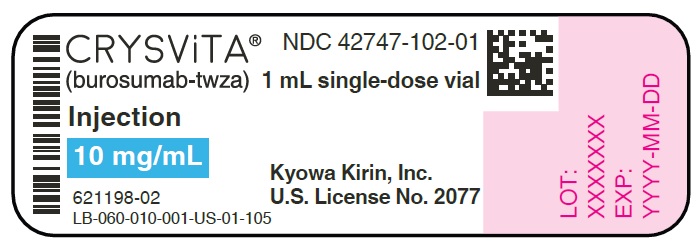
8PRINCIPAL DISPLAY PANEL - 10 mg/mL Vial
NDC 42747-102-01
CRYSViTA
Injection
10 mg/mL
1 mL single-dose vial
Kyowa Kirin, Inc.
U.S. License No. 2077
PRINCIPAL DISPLAY PANEL - 10 mg/mL Vial
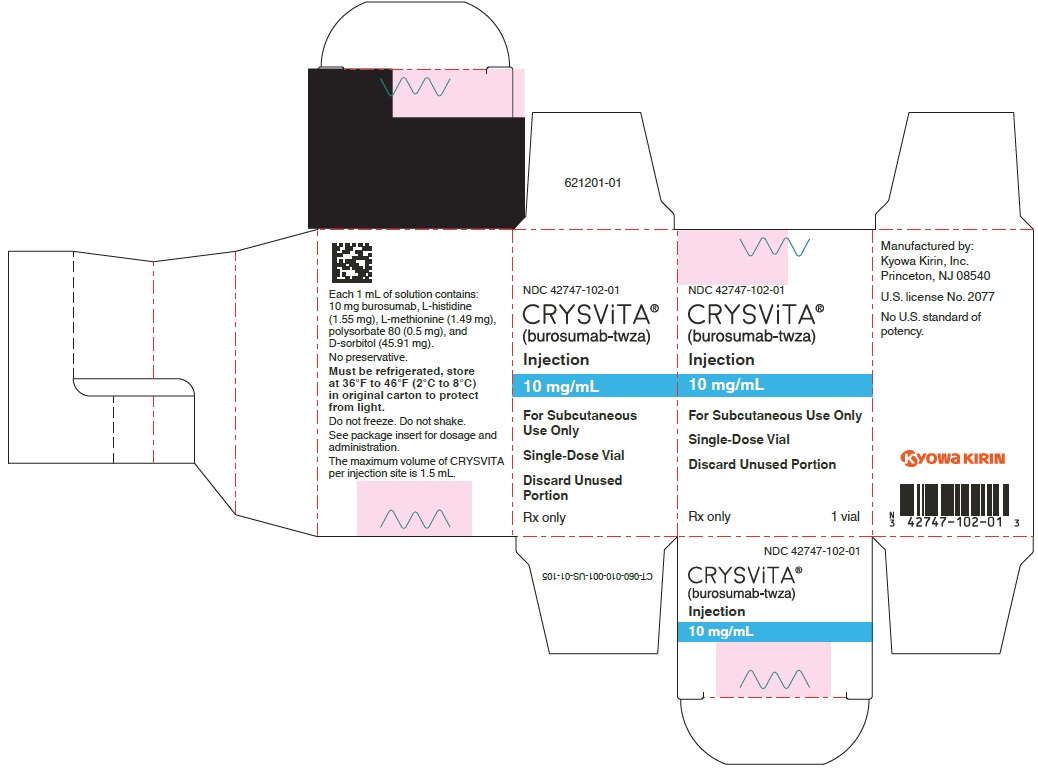
9PRINCIPAL DISPLAY PANEL - 10 mg/mL Vial Carton
NDC 42747-102-01
CRYSViTA
Injection
10 mg/mL
For Subcutaneous Use Only
Single-Dose Vial
Discard Unused Portion
Rx only
PRINCIPAL DISPLAY PANEL - 10 mg/mL Vial Carton
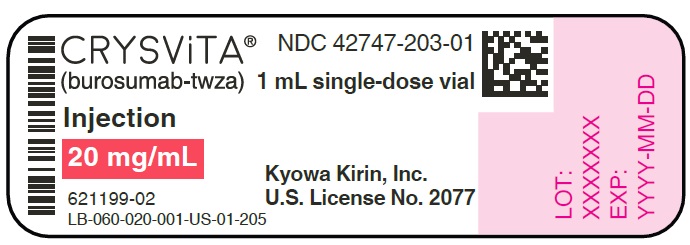
10PRINCIPAL DISPLAY PANEL - 20 mg/mL Vial
NDC 42747-203-01
CRYSViTA
Injection
20 mg/mL
1 mL single-dose vial
Kyowa Kirin, Inc.
U.S. License No. 2077
PRINCIPAL DISPLAY PANEL - 20 mg/mL Vial
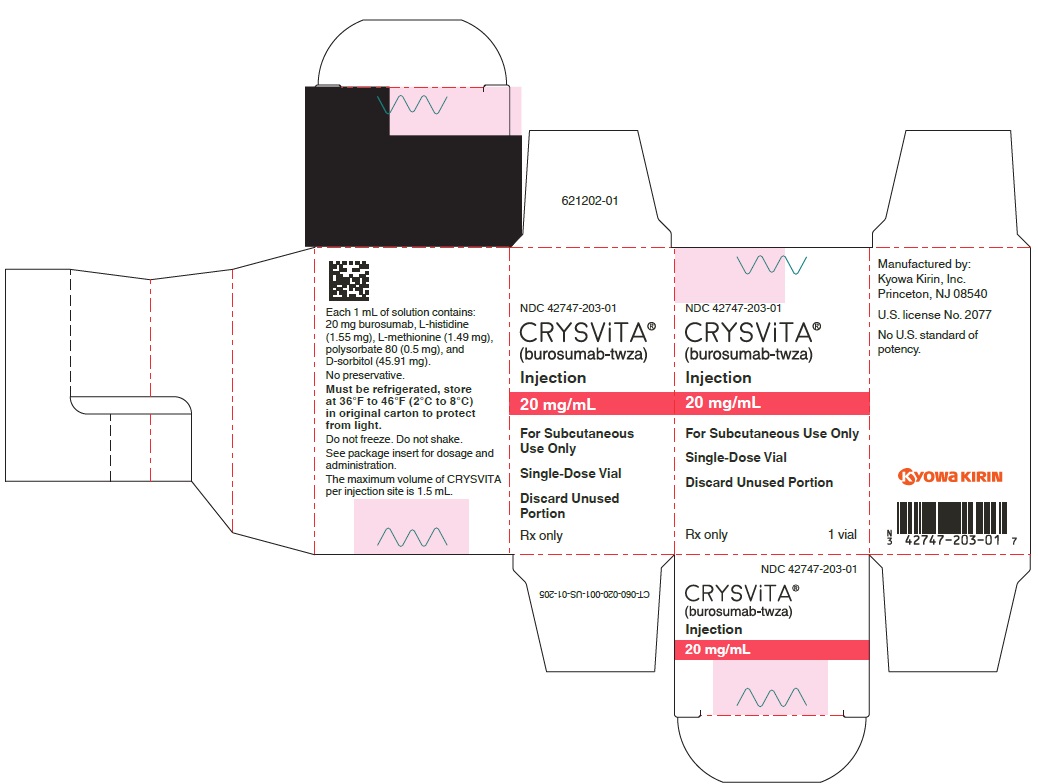
11PRINCIPAL DISPLAY PANEL - 20 mg/mL Vial Carton
NDC 42747-203-01
CRYSViTA
Injection
20 mg/mL
For Subcutaneous Use Only
Single-Dose Vial
Discard Unused Portion
Rx only
PRINCIPAL DISPLAY PANEL - 20 mg/mL Vial Carton
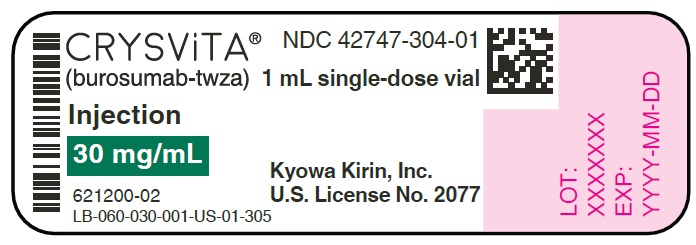
12PRINCIPAL DISPLAY PANEL - 30 mg/mL Vial
NDC 42747-304-01
CRYSViTA
Injection
30 mg/mL
1 mL single-dose vial
Kyowa Kirin, Inc.
U.S. License No. 2077
PRINCIPAL DISPLAY PANEL - 30 mg/mL Vial
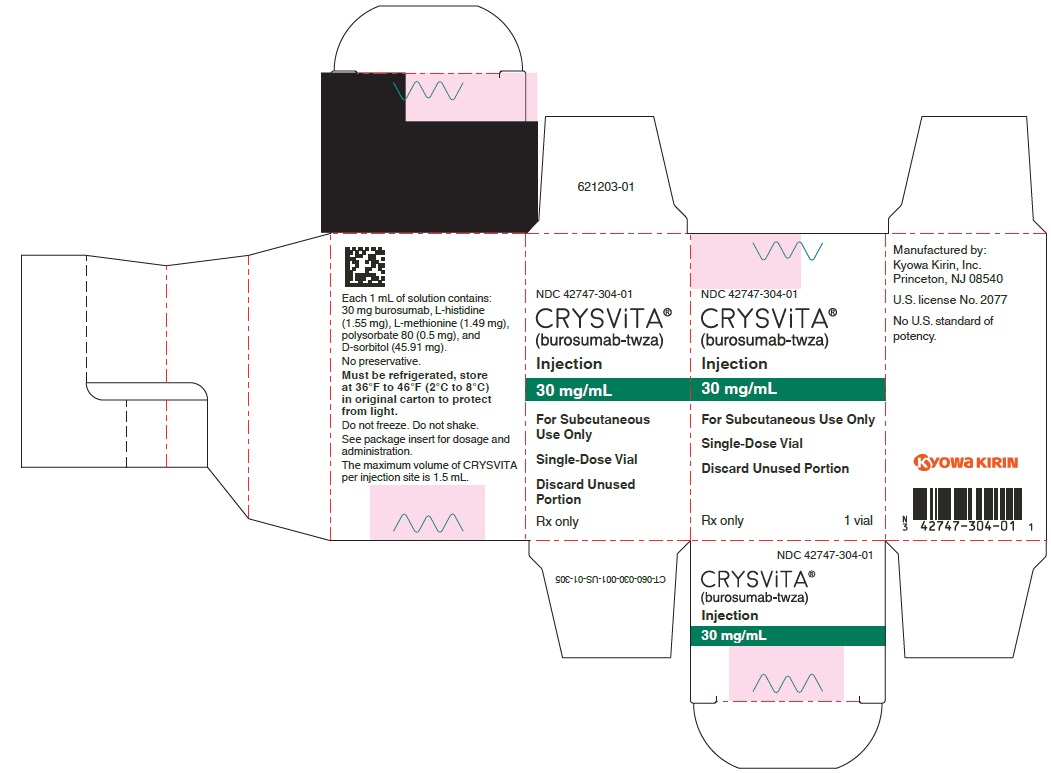
13PRINCIPAL DISPLAY PANEL - 30 mg/mL Vial Carton
NDC 42747-304-01
CRYSViTA
Injection
30 mg/mL
For Subcutaneous Use Only
Single-Dose Vial
Discard Unused Portion
Rx only
PRINCIPAL DISPLAY PANEL - 30 mg/mL Vial Carton