Generic Name

Choriogonadotropin

Brand Names
Ovidrel, Pregnyl
FDA approval date: October 06, 2003
Classification: Gonadotropin
Form: Injection, Kit

What is Ovidrel (Choriogonadotropin)?

Ovidrel ® PreFilled Syringe is indicated for the induction of final follicular maturation and early luteinization in infertile women who have undergone pituitary desensitization and who have been appropriately pretreated with follicle stimulating hormones as part of an Assisted Reproductive Technology program such as in vitro fertilization and embryo transfer. Ovidrel ® PreFilled Syringe is also indicated for the induction of ovulation and pregnancy in anovulatory infertile patients in whom the cause of infertility is functional and not due to primary ovarian failure. Selection of Patients Before treatment with gonadotropins is instituted, a thorough gynecologic and endocrinologic evaluation must be performed. This should include an assessment of pelvic anatomy. Patients with tubal obstruction should receive Ovidrel ® PreFilled Syringe only if enrolled in an in vitro fertilization program. Primary ovarian failure should be excluded by the determination of gonadotropin levels. Appropriate evaluation should be performed to exclude pregnancy. Patients in later reproductive life have a greater predisposition to endometrial carcinoma as well as a higher incidence of anovulatory disorders. A thorough diagnostic evaluation should always be performed in patients who demonstrate abnormal uterine bleeding or other signs of endometrial abnormalities before starting FSH and Ovidrel ® PreFilled Syringe therapy. Evaluation of the partner's fertility potential should be included in the initial evaluation.
Save this treatment for later
Sign Up
Not sure about your diagnosis?
Check Your Symptoms

Related Clinical Trials

IMMUNORARE5: A National Platform of 5 Academic Phase II Trials Coordinated by Lyon University Hospital to Assess the Safety and the Efficacy of the IMMUNOtherapy With Domvanalimab + Zimberelimab Combination in Patients With Advanced RARE Cancers

Summary: Immune checkpoint inhibitors (ICI) have revolutionized the management of advanced cancers. However, most rare cancers have been excluded from this progress due to the lack of clinical trials involving these diseases. After the standard first-line treatment, there are no other validated treatments for most of them. The management of these patients in ≥ 2nd line treatment relies on historic poorly e...

Effectiveness of Generic Cetrorelix Acetate Versus Reference Cetrorelix Acetate for Ovarian Stimulation Using a GnRH Antagonist Protocol in Women Undergoing IVF: A Multicenter Non-inferiority, Randomised Controlled Trial

Summary: The goal of this clinical trial is to compare the clinical outcomes using different cetrorelix acetate in the context of a GnRH antagonist protocol for ovarian stimulation in women undergoing IVF or intracytoplasmic sperm injection(ICSI) treatment.The main question it aims to answer is whether the generic cetrorelix acetate is non-inferior to the reference product in the GnRH antagonist based prot...

Eight Weeks of Low Dose hCG Priming in Women With Diminished Ovarian Reserve Undergoing IVF/ICSI - a Randomized Controlled Trial

Summary: The aim of this randomized controlled trial is to further examine the possible effects of low dose human chorionic gonadotropin (hCG) priming for eight weeks in women with diminished ovarian reserve (DOR) undergoing in vitro fertilization (IVF)/intracytoplasmic sperm injection (ICSI). The investigators want to retest the findings of our first study in an identical paired design (NCT04643925), as a...

Related Latest Advances

Exploring potential mid-trimester maternal serum biomarkers for fetal congenital heart disease: a retrospective case-control study.
Technical Update No. 462: Abnormal maternal serum markers and adverse pregnancy outcomes.

Brand Information

    Ovidrel (choriogonadotropin alfa)
    1DESCRIPTION
    Ovidrel
    The production process involves expansion of genetically modified Chinese Hamster Ovary (CHO) cells from an extensively characterized cell bank into large scale cell culture processing. Choriogonadotropin alfa is secreted by the CHO cells directly into the cell culture medium that is then purified using a series of chromatographic steps. This process yields a product with a high level of purity and consistent product characteristics including glycoforms and biological activity. The biological activity of choriogonadotropin alfa is determined using the seminal vesicle weight gain test in male rats described in the "Chorionic Gonadotrophins" monograph of the European Pharmacopoeia. The
    Ovidrel
    Therapeutic Class: Infertility
    2CLINICAL PHARMACOLOGY
    The physicochemical, immunological, and biological activities of recombinant hCG are comparable to those of placental and human pregnancy urine-derived hCG. Choriogonadotropin alfa stimulates late follicular maturation and resumption of oocyte meiosis, and initiates rupture of the pre-ovulatory ovarian follicle. Choriogonadotropin alfa, the active component of Ovidrel
    2.1Pharmacokinetics
    When given by intravenous administration, the pharmacokinetic profile of Ovidrel
    2.1.1Absorption
    Following subcutaneous administration of Ovidrel
    2.1.2Distribution
    Following intravenous administration of Ovidrel
    2.1.3Metabolism/Excretion
    Following subcutaneous administration of Ovidrel
    2.2Pharmacodynamics
    In female subjects on oral contraception after an initial latency period, Ovidrel
    2.3Population pharmacokinetics and pharmacodynamics
    In patients undergoing
    2.4Bioequivalence of Formulations
    Ovidrel
    2.4.1Special populations
    Safety, efficacy, and pharmacokinetics of Ovidrel
    2.4.2Drug-Drug Interactions
    No drug-drug interaction studies have been conducted. Administration of Ovidrel
    3CLINICAL STUDIES
    The safety and efficacy of Ovidrel
    3.1Assisted Reproductive Technologies (ART)
    The safety and efficacy of Ovidrel
    The primary efficacy parameter in this single-cycle study was the number of oocytes retrieved. 297 patients entered the study, of whom 94 were randomized to receive Ovidrel
    For the 33 patients who achieved a clinical pregnancy with Ovidrel
    The safety and efficacy of Ovidrel
    The primary efficacy parameter in this single-cycle study was the number of oocytes retrieved per patient. 205 patients entered the study, of whom 97 received Ovidrel
    For the 32 patients who achieved a clinical pregnancy with Ovidrel
    3.2Ovulation Induction (OI)
    The safety and efficacy of Ovidrel
    The primary efficacy parameter in this single-cycle study was the patient ovulation rate. 242 patients entered the study, of whom 99 received Ovidrel
    For the 22 patients who had a clinical pregnancy with Ovidrel
    4INDICATIONS AND USAGE
    Ovidrel
    4.1Selection of Patients
    1. Before treatment with gonadotropins is instituted, a thorough gynecologic and endocrinologic evaluation must be performed. This should include an assessment of pelvic anatomy. Patients with tubal obstruction should receive Ovidrel
    2. Primary ovarian failure should be excluded by the determination of gonadotropin levels.
    3. Appropriate evaluation should be performed to exclude pregnancy.
    4. Patients in later reproductive life have a greater predisposition to endometrial carcinoma as well as a higher incidence of anovulatory disorders. A thorough diagnostic evaluation should always be performed in patients who demonstrate abnormal uterine bleeding or other signs of endometrial abnormalities before starting FSH and Ovidrel
    5. Evaluation of the partner's fertility potential should be included in the initial evaluation.
    5CONTRAINDICATIONS
    Ovidrel
    1. Prior hypersensitivity to hCG preparations or one of their excipients.
    2. Primary ovarian failure.
    3. Uncontrolled thyroid or adrenal dysfunction.
    4. An uncontrolled organic intracranial lesion such as a pituitary tumor.
    5. Abnormal uterine bleeding of undetermined origin (see
    6. Ovarian cyst or enlargement of undetermined origin (see
    7. Sex hormone dependent tumors of the reproductive tract and accessory organs.
    8. Pregnancy.
    6WARNINGS
    Gonadotropins, including Ovidrel
    7ADVERSE REACTIONS
    (see
    The safety of Ovidrel
    Adverse events not listed in Table 9 that occurred in less than 2% of patients treated with Ovidrel
    Additional adverse events not listed in Table 10 that occurred in less than 2% of patients treated with Ovidrel
    The following medical events have been reported subsequent to pregnancies resulting from hCG therapy in controlled clinical studies:
    1. Spontaneous Abortion
    2. Ectopic Pregnancy
    3. Premature Labor
    4. Postpartum Fever
    5. Congenital Abnormalities
    Of 125 clinical pregnancies reported following treatment with FSH and Ovidrel
    The following adverse reactions have been previously reported during menotropin therapy:
    1. Pulmonary and vascular complications (see
    2. Adnexal torsion (as a complication of ovarian enlargement)
    3. Mild to moderate ovarian enlargement
    4. Hemoperitoneum
    There have been infrequent reports of ovarian neoplasms, both benign and malignant, in women who have undergone multiple drug regimens for ovulation induction; however, a causal relationship has not been established.
    7.1Post-Marketing Experience
    In addition to adverse events reported from clinical trials, the following events have been reported during post-marketing use of Ovidrel
    • Cases of allergic reactions, including anaphylactic reactions and mild reversible skin rashes have been reported in patients treated with Ovidrel
    • Thromboembolic events both in association with, and separate from, the Ovarian Hyperstimulation Syndrome (see "
    8DOSAGE AND ADMINISTRATION
    For Subcutaneous Use Only
    8.1Infertile Women Undergoing Assisted Reproductive Technologies (ART)
    Ovidrel
    8.2Infertile Women Undergoing Ovulation Induction (OI)
    Ovidrel
    Ovidrel
    Ovidrel
    8.3Directions for Administration of Ovidrel®Prefilled Syringe
    Ovidrel
    Ovidrel
    Step 1: Wash your hands thoroughly with soap and water.
    Step 2: Carefully clean the injection site.
    Make yourself comfortable by sitting or lying down. Carefully clean the injection site on the stomach with an alcohol wipe and allow it to air-dry.
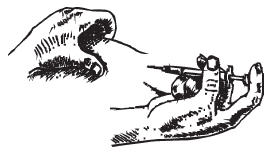
    Step 3: Administer your injection.
    Carefully remove the needle cap from the syringe. Do not touch the needle or allow the needle to touch any surface. Inject the prescribed dose as directed by your doctor, nurse or pharmacist.
    Figure 1
    Step 4: Gently withdraw the needle.
    Discard the needle and syringe into your safety container. Place gauze over the injection site. If any bleeding occurs, apply gentle pressure. If bleeding does not stop within a few minutes, place a clean piece of gauze over the injection site and cover it with an adhesive bandage.
    Figure 2
    Step 5: Storage and clean up.
    Remember that your injection materials must be kept sterile and cannot be reused.
    9HOW SUPPLIED
    Ovidrel
    The following package combination is available:
    • 1 pre-filled syringe containing 250 μg Ovidrel
    9.1Storage
    The Ovidrel
    Protect from light.
    Store in original package. Discard unused material.
    10PRINCIPAL DISPLAY PANEL - 250 µg/0.5 mL Syringe Carton
    OVIDREL
    NDC 44087-1150-1
    For subcutaneous injection
    1 Ovidrel® PreFilled Syringe
    EMD
    PRINCIPAL DISPLAY PANEL - 250 µg/0.5 mL Syringe Carton
    Ovidrel has been selected.