Brand Name
Lexapro
Generic Name
Escitalopram
View Brand Information FDA approval date: August 14, 2002
Classification: Serotonin Reuptake Inhibitor
Form: Tablet, Capsule, Solution
What is Lexapro (Escitalopram)?
Escitalopram is a selective serotonin reuptake inhibitor indicated for the: treatment of major depressive disorder in adults and pediatric patients 12 years of age and older treatment of generalized anxiety disorder in adults and pediatric patients 7 years and older escitalopram is indicated for the treatment of: major depressive disorder in adults and pediatric patients 12 years of age and older. generalized anxiety disorder in adults and pediatric patients 7 years of age and older.
Approved To Treat
Top Global Experts
There are no experts for this drug
Save this treatment for later
Not sure about your diagnosis?
Related Clinical Trials
There is no clinical trials being done for this treatment
Related Latest Advances
There is no latest advances for this treatment
Brand Information
Lexapro (ESCITALOPRAM)
WARNING: SUICIDALTHOUGHTS AND BEHAVIORS
Antidepressants increased the risk of suicidal thoughts and behaviors in pediatric and young adult patients in short-term studies.Closely monitor all antidepressant-treated patients for clinical worsening, and for emergence of suicidal thoughts and behaviors [see Warnings and Precautions (5.1)]. Lexapro is not approved for use in pediatric patients less than 7 years of age [see Use in Specific Populations (8.4)].
1INDICATIONS AND USAGE
Lexapro is indicated for the treatment of:
• major depressive disorder (MDD) in adults and pediatric patients 12 years of age and older.
• generalized anxiety disorder (GAD) in adults and pediatric patients 7 years of age and older.
2DOSAGE FORMS AND STRENGTHS
Tablets
5 mg: White to off-white, round, non-scored, film-coated. Imprint "FL" on one side of the tablet and "5" on the other side.
10 mg: White to off-white, round, scored, film-coated. Imprint on scored side with "F" on the left side and "L" on the right side. Imprint on the non-scored side with "10".
20 mg: White to off-white, round, scored, film-coated. Imprint on scored side with "F" on the left side and "L" on the right side. Imprint on the non-scored side with "20".
Oral Solution
1 mg/mL: Clear, colorless to opalescent liquid, peppermint flavor (not currently being marketed).
3CONTRAINDICATIONS
Lexapro is contraindicated in patients:
- taking MAOIs with Lexapro or within 14 days of stopping treatment with Lexapro because of an increased risk of serotonin syndrome. The use of Lexapro within 14 days of stopping an MAOI intended to treat psychiatric disorders is also contraindicated
- taking pimozide
- with a hypersensitivity to escitalopram or citalopram or any of the inactive ingredients in Lexapro.
4ADVERSE REACTIONS
The following adverse reactions are discussed in greater detail in other sections of the labeling:
- Suicidal thoughts and behaviors in adolescents and young adults
- Serotonin syndrome
- Discontinuation syndrome
- Seizures
- Activation of mania or hypomania
- Hyponatremia
- Increased Risk of Bleeding
- Interference with Cognitive and Motor Performance
- Angle-closure glaucoma
- Use in Patients with Concomitant Illness
- Sexual Dysfunction
4.1Clinical Trials Experience
Because clinical studies are conducted under widely varying conditions, adverse reaction rates observed in the clinical studies of a drug cannot be directly compared to rates in the clinical studies of another drug and may not reflect the rates observed in practice.
Clinical Trial Data Sources
Adults
Adverse reactions information for Lexapro was collected from 715 patients with major depressive disorder who were exposed to escitalopram and from 592 patients who were exposed to placebo in double-blind, placebo-controlled trials. An additional 284 patients with major depressive disorder were newly exposed to escitalopram in open-label trials. The adverse reaction information for Lexapro in patients with GAD was collected from 429 patients exposed to escitalopram and from 427 patients exposed to placebo in double-blind, placebo-controlled trials.
Adverse reactions information for Lexapro was collected from 715 patients with major depressive disorder who were exposed to escitalopram and from 592 patients who were exposed to placebo in double-blind, placebo-controlled trials. An additional 284 patients with major depressive disorder were newly exposed to escitalopram in open-label trials. The adverse reaction information for Lexapro in patients with GAD was collected from 429 patients exposed to escitalopram and from 427 patients exposed to placebo in double-blind, placebo-controlled trials.
Adverse reactions during exposure were obtained primarily by general inquiry and recorded by clinical investigators using terminology of their own choosing. Consequently, it is not possible to provide a meaningful estimate of the proportion of individuals experiencing adverse reactions without first grouping similar types of reactions into a smaller number of standardized event categories. In the tables and tabulations that follow, standard World Health Organization (WHO) terminology has been used to classify reported adverse reactions.
The stated frequencies of adverse reactions represent the proportion of individuals who experienced, at least once, a treatment emergent adverse event of the type listed. An event was considered treatment-emergent if it occurred for the first time or worsened while receiving therapy following baseline evaluation.
Pediatric Patients
Adverse reaction information for pediatric patients was collected in double-blind placebo-controlled studies in 576 pediatric patients 6 to 17 years of age, (286 Lexapro, 290 placebo) with major depressive disorder and in 273 pediatric patients 7 to 17 years of age (137 Lexapro, 136 placebo) with generalized anxiety disorder.
The safety and effectiveness of Lexapro have not been established in pediatric patients less than 12 years of age with MDD or less than 7 years of age with GAD.
Adverse ReactionsAssociated with Discontinuation of Treatment
Major Depressive Disorder
Adults
Among the 715 depressed patients who received Lexapro in placebo-controlled trials, 6% discontinued treatment due to an adverse event, as compared to 2% of 592 patients receiving placebo. In two fixed-dose studies, the rate of discontinuation for adverse reactions in patients receiving 10 mg/day Lexapro was not significantly different from the rate of discontinuation for adverse reactions in patients receiving placebo. The rate of discontinuation for adverse reactions in patients assigned to a fixed dose of 20 mg/day Lexapro was 10%, which was significantly different from the rate of discontinuation for adverse reactions in patients receiving 10 mg/day Lexapro (4%) and placebo (3%). Adverse reactions that were associated with the discontinuation of at least 1% of patients treated with Lexapro, and for which the rate was at least twice that of placebo, were nausea (2%) and ejaculation disorder (2% of male patients).
Among the 715 depressed patients who received Lexapro in placebo-controlled trials, 6% discontinued treatment due to an adverse event, as compared to 2% of 592 patients receiving placebo. In two fixed-dose studies, the rate of discontinuation for adverse reactions in patients receiving 10 mg/day Lexapro was not significantly different from the rate of discontinuation for adverse reactions in patients receiving placebo. The rate of discontinuation for adverse reactions in patients assigned to a fixed dose of 20 mg/day Lexapro was 10%, which was significantly different from the rate of discontinuation for adverse reactions in patients receiving 10 mg/day Lexapro (4%) and placebo (3%). Adverse reactions that were associated with the discontinuation of at least 1% of patients treated with Lexapro, and for which the rate was at least twice that of placebo, were nausea (2%) and ejaculation disorder (2% of male patients).
Pediatric Patients
Adverse reactions in pediatric patients 6 to 17 years of age were associated with discontinuation of 3.5% of 286 patients receiving Lexapro and 1% of 290 patients receiving placebo. The most common adverse reaction (incidence at least 1% for Lexapro and greater than placebo) associated with discontinuation was insomnia (1% Lexapro, 0% placebo).
The safety and effectiveness of Lexapro have not been established in pediatric patients less than 12 years of age with MDD.
Generalized Anxiety Disorder
Adults
Among the 429 GAD patients who received Lexapro 10 to 20 mg/day in placebo-controlled trials, 8% discontinued treatment due to an adverse event, as compared to 4% of 427 patients receiving placebo. Adverse reactions that were associated with the discontinuation of at least 1% of patients treated with Lexapro, and for which the rate was at least twice the placebo rate, were nausea (2%), insomnia (1%), and fatigue (1%).
Among the 429 GAD patients who received Lexapro 10 to 20 mg/day in placebo-controlled trials, 8% discontinued treatment due to an adverse event, as compared to 4% of 427 patients receiving placebo. Adverse reactions that were associated with the discontinuation of at least 1% of patients treated with Lexapro, and for which the rate was at least twice the placebo rate, were nausea (2%), insomnia (1%), and fatigue (1%).
Pediatric Patients
Adverse reactions in pediatric patients 7 to 17 years were associated with discontinuation of 2.9% of 137 patients receiving Lexapro and 1.5% of 136 patients receiving placebo. The most common adverse reaction (incidence at least 1% for Lexapro and greater than placebo) associated with discontinuation was activation syndrome (1% Lexapro, 0% placebo), intentional self injury (1% Lexapro, 0% placebo), epistaxis (1% Lexapro, 0% placebo), and nausea (1% Lexapro, 0% placebo).
Incidence of Adverse Reactions in Placebo-Controlled Clinical Trials
Major Depressive Disorder
Adults
The most commonly observed adverse reactions in Lexapro patients (incidence of approximately 5% or greater and approximately twice the incidence in placebo patients) were insomnia, ejaculation disorder (primarily ejaculatory delay), nausea, sweating increased, fatigue, and somnolence.
Table 2 enumerates the incidence, rounded to the nearest percent, of adverse reactions that occurred among 715 depressed patients who received Lexapro at doses ranging from 10 to 20 mg/day in placebo-controlled trials. Reactions included are those occurring in 2% or more of patients treated with Lexapro and for which the incidence in patients treated with Lexapro was greater than the incidence in placebo-treated patients.
1Primarily ejaculatory delay.
2Denominator used was for males only (N=225 Lexapro; N=188 placebo).
3Denominator used was for females only (N=490 Lexapro; N=404 placebo).
2Denominator used was for males only (N=225 Lexapro; N=188 placebo).
3Denominator used was for females only (N=490 Lexapro; N=404 placebo).
Pediatric Patients
The overall profile of adverse reactions in pediatric patients 6 to 17 years in major depressive disorder was generally similar to that seen in adult studies, as shown in Table 2. However, the following adverse reactions (excluding those which appear in Table 2 and those for which the coded terms were uninformative or misleading) were reported at an incidence of at least 2% for Lexapro and greater than placebo: back pain, urinary tract infection, vomiting, and nasal congestion.
The safety and effectiveness of Lexapro have not been established in pediatric patients less than 12 years of age with MDD.
Generalized Anxiety Disorder
Adults
The most commonly observed adverse reactions in Lexapro patients (incidence of approximately 5% or greater and approximately twice the incidence in placebo patients) were nausea, ejaculation disorder (primarily ejaculatory delay), insomnia, fatigue, decreased libido, and anorgasmia.
Table 3 enumerates the incidence, rounded to the nearest percent of treatment-emergent adverse reactions that occurred among 429 GAD patients who received Lexapro 10 to 20 mg/day in placebo-controlled trials. Reactions included are those occurring in 2% or more of patients treated with Lexapro and for which the incidence in patients treated with Lexapro was greater than the incidence in placebo-treated patients.
1Primarily ejaculatory delay.
2Denominator used was for males only (N=182 Lexapro; N=195 placebo).
3Denominator used was for females only (N=247 Lexapro; N=232 placebo).
2Denominator used was for males only (N=182 Lexapro; N=195 placebo).
3Denominator used was for females only (N=247 Lexapro; N=232 placebo).
Pediatric Patients
The overall profile of adverse reactions in pediatric patients 7 to 17 years in generalized anxiety disorder was generally similar to that seen in adult studies, as shown in Table 3. However, the following adverse reactions (excluding those which appear in Table 3) were reported at an incidence of at least 2% for Lexapro and greater than placebo: dizziness (3% Lexapro and 2% placebo), nasopharyngitis (3% Lexapro and 1% placebo), abdominal discomfort (3% Lexapro and 1% placebo), anxiety (3% Lexapro and 1% placebo), irritability (2% Lexapro and 1% placebo), and anger (2% Lexapro and 0% placebo).
Dose Dependency of Adverse Reactions
The potential dose dependency of common adverse reactions (defined as an incidence rate of ≥5% in either the 10 mg or 20 mg Lexapro groups) was examined on the basis of the combined incidence of adverse reactions in two fixed-dose trials. The overall incidence rates of adverse reactions in 10 mg Lexapro-treated patients (66%) was similar to that of the placebo-treated patients (61%), while the incidence rate in 20 mg/day Lexapro-treated patients was greater (86%). Table 4 shows common adverse reactions that occurred in the 20 mg/day Lexapro group with an incidence that was approximately twice that of the 10 mg/day Lexapro group and approximately twice that of the placebo group.
The potential dose dependency of common adverse reactions (defined as an incidence rate of ≥5% in either the 10 mg or 20 mg Lexapro groups) was examined on the basis of the combined incidence of adverse reactions in two fixed-dose trials. The overall incidence rates of adverse reactions in 10 mg Lexapro-treated patients (66%) was similar to that of the placebo-treated patients (61%), while the incidence rate in 20 mg/day Lexapro-treated patients was greater (86%). Table 4 shows common adverse reactions that occurred in the 20 mg/day Lexapro group with an incidence that was approximately twice that of the 10 mg/day Lexapro group and approximately twice that of the placebo group.
Male and Female Sexual Dysfunction with SSRIs
Although changes in sexual desire, sexual performance, and sexual satisfaction often occur as manifestations of a psychiatric disorder, they may also be a consequence of pharmacologic treatment. In particular, some evidence suggests that SSRIs can cause such untoward sexual experiences.
Although changes in sexual desire, sexual performance, and sexual satisfaction often occur as manifestations of a psychiatric disorder, they may also be a consequence of pharmacologic treatment. In particular, some evidence suggests that SSRIs can cause such untoward sexual experiences.
Reliable estimates of the incidence and severity of untoward experiences involving sexual desire, performance, and satisfaction are difficult to obtain, however, in part because patients and physicians may be reluctant to discuss them. Accordingly, estimates of the incidence of untoward sexual experience and performance cited in product labeling are likely to underestimate their actual incidence.
There are no adequately designed studies examining sexual dysfunction with escitalopram treatment.
Priapism has been reported with all SSRIs.
While it is difficult to know the precise risk of sexual dysfunction associated with the use of SSRIs, physicians should routinely inquire about such possible side effects.
Vital Sign Changes
Lexapro and placebo groups were compared with respect to (1) mean change from baseline in vital signs (pulse, systolic blood pressure, and diastolic blood pressure) and (2) the incidence of patients meeting criteria for potentially clinically significant changes from baseline in these variables. These analyses did not reveal any clinically important changes in vital signs associated with Lexapro treatment. In addition, a comparison of supine and standing vital sign measures in subjects receiving Lexapro indicated that Lexapro treatment is not associated with orthostatic changes.
Lexapro and placebo groups were compared with respect to (1) mean change from baseline in vital signs (pulse, systolic blood pressure, and diastolic blood pressure) and (2) the incidence of patients meeting criteria for potentially clinically significant changes from baseline in these variables. These analyses did not reveal any clinically important changes in vital signs associated with Lexapro treatment. In addition, a comparison of supine and standing vital sign measures in subjects receiving Lexapro indicated that Lexapro treatment is not associated with orthostatic changes.
Weight Changes
Patients treated with Lexapro in controlled trials did not differ from placebo-treated patients with regard to clinically important change in body weight.
Patients treated with Lexapro in controlled trials did not differ from placebo-treated patients with regard to clinically important change in body weight.
Laboratory Changes
Lexapro and placebo groups were compared with respect to (1) mean change from baseline in various serum chemistry, hematology, and urinalysis variables, and (2) the incidence of patients meeting criteria for potentially clinically significant changes from baseline in these variables. These analyses revealed no clinically important changes in laboratory test parameters associated with Lexapro treatment.
Lexapro and placebo groups were compared with respect to (1) mean change from baseline in various serum chemistry, hematology, and urinalysis variables, and (2) the incidence of patients meeting criteria for potentially clinically significant changes from baseline in these variables. These analyses revealed no clinically important changes in laboratory test parameters associated with Lexapro treatment.
ECG Changes
Electrocardiograms from Lexapro (N=625) and placebo (N=527) groups were compared with respect to outliers defined as subjects with QTc changes over 60 msec from baseline or absolute values over 500 msec post-dose, and subjects with heart rate increases to over 100 bpm or decreases to less than 50 bpm with a 25% change from baseline (tachycardic or bradycardic outliers, respectively). None of the patients in the Lexapro group had a QTcF interval >500 msec or a prolongation >60 msec compared to 0.2% of patients in the placebo group. The incidence of tachycardic outliers was 0.2% in the Lexapro and the placebo group. The incidence of bradycardic outliers was 0.5% in the Lexapro group and 0.2% in the placebo group.
Electrocardiograms from Lexapro (N=625) and placebo (N=527) groups were compared with respect to outliers defined as subjects with QTc changes over 60 msec from baseline or absolute values over 500 msec post-dose, and subjects with heart rate increases to over 100 bpm or decreases to less than 50 bpm with a 25% change from baseline (tachycardic or bradycardic outliers, respectively). None of the patients in the Lexapro group had a QTcF interval >500 msec or a prolongation >60 msec compared to 0.2% of patients in the placebo group. The incidence of tachycardic outliers was 0.2% in the Lexapro and the placebo group. The incidence of bradycardic outliers was 0.5% in the Lexapro group and 0.2% in the placebo group.
QTcF interval was evaluated in a randomized, placebo and active (moxifloxacin 400 mg) controlled cross-over, escalating multiple dose study in 113 healthy subjects. The maximum mean (95% upper confidence bound) difference from placebo arm were 4.5 (6.4) and 10.7 (12.7) msec for 10 mg and supratherapeutic 30 mg escitalopram given once daily, respectively. Based on the established exposure-response relationship, the predicted QTcF change from placebo arm (95% confidence interval) under the C
Other Reactions Observed During the Premarketing Evaluation of Lexapro
Following is a list of treatment-emergent adverse reactions, as defined in the introduction to the ADVERSE REACTIONS section, reported by the 1428 patients treated with Lexapro for periods of up to one year in double-blind or open-label clinical trials during its premarketing evaluation. The listing does not include those reactions already listed in Tables 2 & 3, those reactions for which a drug cause was remote and at a rate less than 1% or lower than placebo, those reactions which were so general as to be uninformative, and those reactions reported only once which did not have a substantial probability of being acutely life threatening. Reactions are categorized by body system. Reactions of major clinical importance are described in the Warnings and Precautions section (5).
Following is a list of treatment-emergent adverse reactions, as defined in the introduction to the ADVERSE REACTIONS section, reported by the 1428 patients treated with Lexapro for periods of up to one year in double-blind or open-label clinical trials during its premarketing evaluation. The listing does not include those reactions already listed in Tables 2 & 3, those reactions for which a drug cause was remote and at a rate less than 1% or lower than placebo, those reactions which were so general as to be uninformative, and those reactions reported only once which did not have a substantial probability of being acutely life threatening. Reactions are categorized by body system. Reactions of major clinical importance are described in the Warnings and Precautions section (5).
Cardiovascular: hypertension, palpitation.
Central and Peripheral Nervous System Disorders: light-headed feeling, migraine.
Gastrointestinal Disorders: abdominal cramp, heartburn, gastroenteritis.
General: allergy, chest pain, fever, hot flushes, pain in limb.
Metabolic and Nutritional Disorders: increased weight.
Musculoskeletal System Disorders: arthralgia, myalgiajaw stiffness.
Psychiatric Disorders: appetite increased, concentration impaired, irritability.
Reproductive Disorders/Female: menstrual cramps, menstrual disorder.
Respiratory System Disorders: bronchitis, coughing, nasal congestion, sinus congestion, sinus headache.
Skin and Appendages Disorders: rash.
Special Senses: vision blurred, tinnitus.
Urinary System Disorders: urinary frequency, urinary tract infection.
4.2Post-Marketing Experience
Adverse Reactions Reported Subsequent to the Marketing of Escitalopram
The following adverse reactions have been identified during post-approval use of Lexapro. Because these reactions are reported voluntarily from a population of uncertain size, it is not always possible to reliably estimate their frequency or establish a causal relationship to drug exposure.
The following adverse reactions have been identified during post-approval use of Lexapro. Because these reactions are reported voluntarily from a population of uncertain size, it is not always possible to reliably estimate their frequency or establish a causal relationship to drug exposure.
Blood and Lymphatic System Disorders: anemia, agranulocytis, aplastic anemia, hemolytic anemia, idiopathic thrombocytopenia purpura, leukopenia, thrombocytopenia.
Cardiac Disorders: atrial fibrillation, bradycardia, cardiac failure, myocardial infarction, tachycardia, torsade de pointes, ventricular arrhythmia, ventricular tachycardia.
Ear and labyrinth disorders: vertigo
Endocrine Disorders: diabetes mellitus, hyperprolactinemia, SIADH.
Eye Disorders: angle closure glaucoma, diplopia, mydriasis, visual disturbance.
Gastrointestinal Disorder: dysphagia, gastrointestinal hemorrhage, gastroesophageal reflux, pancreatitis, rectal hemorrhage.
General Disorders and Administration Site Conditions: abnormal gait, asthenia, edema, fall, feeling abnormal, malaise.
General Disorders and Administration Site Conditions: abnormal gait, asthenia, edema, fall, feeling abnormal, malaise.
Hepatobiliary Disorders: fulminant hepatitis, hepatic failure, hepatic necrosis, hepatitis.
Immune System Disorders: allergic reaction, anaphylaxis.
Investigations: bilirubin increased, decreased weight, electrocardiogram QT prolongation, hepatic enzymes increased, hypercholesterolemia, INR increased, prothrombin decreased.
Metabolism and Nutrition Disorders: hyperglycemia, hypoglycemia, hypokalemia, hyponatremia.
Musculoskeletal and Connective Tissue Disorders: muscle cramp, muscle stiffness, muscle weakness, rhabdomyolysis.
Nervous System Disorders: akathisia, amnesia, ataxia, choreoathetosis, cerebrovascular accident, dysarthria, dyskinesia, dystonia, extrapyramidal disorders, grand mal seizures (or convulsions), hypoaesthesia, myoclonus, nystagmus, Parkinsonism, restless legs, seizures, syncope, tardive dyskinesia, tremor.
Pregnancy, Puerperium and Perinatal Conditions: spontaneous abortion.
Psychiatric Disorders: acute psychosis, aggression, agitation, anger, anxiety, apathy, completed suicide, confusion, depersonalization, depression aggravated, delirium, delusion, disorientation, feeling unreal, hallucinations (visual and auditory), mood swings, nervousness, nightmare, panic reaction, paranoia, restlessness, self-harm or thoughts of self-harm, suicide attempt, suicidal ideation, suicidal tendency.
Renal and Urinary Disorders: acute renal failure, dysuria, urinary retention.
Reproductive System and Breast Disorders: menorrhagia, priapism.
Respiratory, Thoracic and Mediastinal Disorders: anosmia, dyspnea, epistaxis, pulmonary embolism, hyposmia, pulmonary hypertension of the newborn.
Skin and Subcutaneous Tissue Disorders: alopecia, angioedema, dermatitis, drug reaction with eosinophilia and systemic symptoms (DRESS), ecchymosis, erythema multiforme, photosensitivity reaction, Stevens Johnson Syndrome, toxic epidermal necrolysis, urticaria.
Vascular Disorders: deep vein thrombosis, flushing, hypertensive crisis, hypotension, orthostatic hypotension, phlebitis, thrombosis.
5DRUG INTERACTIONS
Table 6 presents clinically important drug interactions with Lexapro.
6OVERDOSAGE
The following have been reported with Lexapro tablet overdosage:
- Seizures, which may be delayed, and altered mental status including coma.
- Cardiovascular toxicity, which may be delayed, including QRS and QTc interval prolongation, wide complex tachyarrhythmias, and torsade de pointes. Hypertension most commonly seen, but rarely can see hypotension alone or with co-ingestants including alcohol.
- Serotonin syndrome (patients with a multiple drug overdosage with other proserotonergic drugs may have a higher risk).
Prolonged cardiac monitoring is recommended in Lexapro overdosage ingestions due to the arrhythmia risk.
Gastrointestinal decontamination with activated charcoal should be considered in patients who present early after a Lexapro overdose.
Consider contacting the Poison Help line (1-800-222-1222) or a medical toxicologist for additional overdose management recommendations.
7DESCRIPTION
Lexapro contains escitalopram, a selective serotonin reuptake inhibitor (SSRI), present as escitalopram oxalate salt. Escitalopram is the pure S- enantiomer (single isomer) of the racemic bicyclic phthalane derivative citalopram. Escitalopram oxalate is designated S-(+)-1-[3(dimethyl-amino)propyl]-1-(
![The following structural formula for Lexapro® (escitalopram oxalate) is an orally administered selective serotonin reuptake inhibitor (SSRI). Escitalopram is the pure S-enantiomer (single isomer) of the racemic bicyclic phthalane derivative citalopram. Escitalopram oxalate is designated S-(+)-1-[3-(dimethyl-amino)propyl]-1-(p-fluorophenyl)-5-phthalancarbonitrile oxalate.](https://dailymed.nlm.nih.gov/dailymed/image.cfm?name=lexapro-01.jpg&setid=13bb8267-1cab-43e5-acae-55a4d957630a)
The molecular formula is C
Escitalopram oxalate occurs as a fine, white to slightly-yellow powder and is freely soluble in methanol and dimethyl sulfoxide (DMSO), soluble in isotonic saline solution, sparingly soluble in water and ethanol, slightly soluble in ethyl acetate, and insoluble in heptane. Lexapro tablets, for oral use, are film-coated, round tablets containing 6.38 mg, 12.75 mg, 25.5 mg escitalopram oxalate in strengths equivalent to 5 mg, 10 mg, and 20 mg, respectively, of escitalopram base. The 10 and 20 mg tablets are scored. The tablets also contain the following inactive ingredients: talc, croscarmellose sodium, microcrystalline cellulose/colloidal silicon dioxide, and magnesium stearate. The film coating contains hypromellose, titanium dioxide, and polyethylene glycol.
Lexapro oral solution contains 1.29 mg/ml
8HOW SUPPLIED/STORAGE AND HANDLING
How Supplied
Tablets
5 mg Tablets:
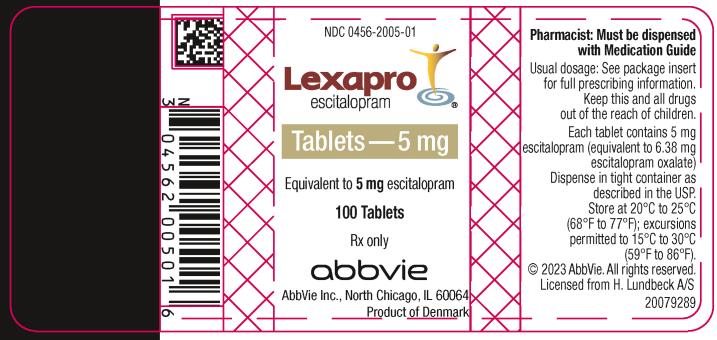
Bottle of 100 NDC # 0456-2005-01
White to off-white, round, non-scored, film-coated. Imprint "FL" on one side of the tablet and "5" on the other side.
10 mg Tablets:
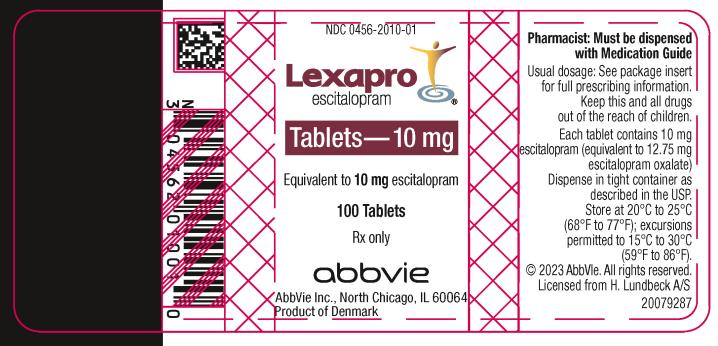
Bottle of 100 NDC # 0456-2010-01
10 x 10 Unit Dose NDC # 0456-2010-63
White to off-white, round, scored, film-coated. Imprint on scored side with "F" on the left side and "L" on the right side. Imprint on the non-scored side with "10".
20 mg Tablets:
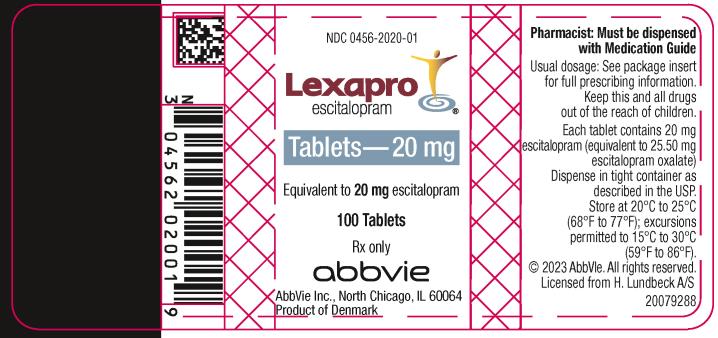
Bottle of 100 NDC # 0456-2020-01
10 x 10 Unit Dose NDC # 0456-2020-63
White to off-white, round, scored, film-coated. Imprint on scored side with "F" on the left side and "L" on the right side. Imprint on the non-scored side with "20".
Oral Solution
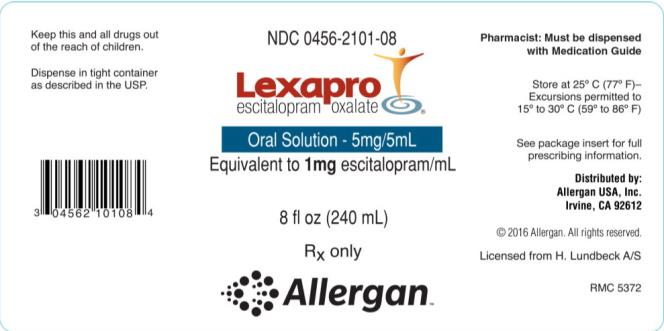
5 mg/5 mL, peppermint flavor (240 mL) NDC # 0456-2101-08. The oral solution is not currently being marketed.
Storage and Handling
Store at 20°C to 25°C (68°F to 77°F); excursions permitted to 15 to 30°C (59° to 86°F).
9PATIENT COUNSELING INFORMATION
Advise the patient to read the FDA-approved patient labeling (
Suicidal Thoughts and Behaviors
Advise patients, their families and caregivers to look for the emergence of suicidal ideation and behavior, especially during treatment and when the dose is adjusted up or down, and instruct them to report such symptoms to their healthcare provider
Serotonin Syndrome
Caution patients about the risk of serotonin syndrome, particularly with the with the concomitant use of Lexapro with other serotonergic drugs including triptans, tricyclic antidepressants, opioids, lithium, tryptophan, buspirone, amphetamines, and St. John’s Wort, and with drugs that impair metabolism of serotonin (in particular, MAOIs, both those intended to treat psychiatric disorders and also others, such as linezolid). Instruct patients to contact their health care provider or report to the emergency room if they experience signs or symptoms of serotonin syndrome [see Warnings and Precautions (5.2), Drug Interactions (7)].
Caution patients about the risk of serotonin syndrome, particularly with the with the concomitant use of Lexapro with other serotonergic drugs including triptans, tricyclic antidepressants, opioids, lithium, tryptophan, buspirone, amphetamines, and St. John’s Wort, and with drugs that impair metabolism of serotonin (in particular, MAOIs, both those intended to treat psychiatric disorders and also others, such as linezolid). Instruct patients to contact their health care provider or report to the emergency room if they experience signs or symptoms of serotonin syndrome [see Warnings and Precautions (5.2), Drug Interactions (7)].
Discontinuation Syndrome
Advise patients not to abruptly discontinue Lexapro and to discuss any tapering regimen with their healthcare provider. Inform patients that adverse reactions can occur when Lexapro is discontinued
Activation of Mania or Hypomania
Advise patients and their caregivers to observe for signs of activation of mania/hypomania and instruct them to report such symptoms to the healthcare provider [see Warnings and Precautions (5.5)].
Advise patients and their caregivers to observe for signs of activation of mania/hypomania and instruct them to report such symptoms to the healthcare provider [see Warnings and Precautions (5.5)].
Increased Risk of Bleeding
Inform patients about the concomitant use of Lexapro with NSAIDs, aspirin, warfarin, other antiplatelet drugs, or other anticoagulants because the combined use has been associated with an increased risk of bleeding. Advise patients to inform their healthcare providers if they are taking or planning to take any prescription or over-the-counter medications that increase the risk of bleeding
Angle Closure Glaucoma
Advise patients that taking Lexapro can cause mild pupillary dilation, which in susceptible individuals, can lead to an episode of angle closure glaucoma. Pre-existing glaucoma is almost always open-angle glaucoma because angle closure glaucoma, when diagnosed, can be treated definitively with iridectomy. Open-angle glaucoma is not a risk factor for angle closure glaucoma. Patients may wish to be examined to determine whether they are susceptible to angle closure, and have a prophylactic procedure (e.g., iridectomy), if they are susceptible [see Warnings and Precautions (5.9)].
Advise patients that taking Lexapro can cause mild pupillary dilation, which in susceptible individuals, can lead to an episode of angle closure glaucoma. Pre-existing glaucoma is almost always open-angle glaucoma because angle closure glaucoma, when diagnosed, can be treated definitively with iridectomy. Open-angle glaucoma is not a risk factor for angle closure glaucoma. Patients may wish to be examined to determine whether they are susceptible to angle closure, and have a prophylactic procedure (e.g., iridectomy), if they are susceptible [see Warnings and Precautions (5.9)].
Sexual Dysfunction
Advise patients that use of Lexapro may cause symptoms of sexual dysfunction in both male and female patients. Inform patients that they should discuss any changes in sexual function and potential management strategies with their healthcare provider [see Warnings and Precautions (5.11)].
Advise patients that use of Lexapro may cause symptoms of sexual dysfunction in both male and female patients. Inform patients that they should discuss any changes in sexual function and potential management strategies with their healthcare provider [see Warnings and Precautions (5.11)].
Concomitant Medications
Since escitalopram is the active isomer of racemic citalopram (Celexa), the two agents should not be coadministered. Patients should be advised to inform their physician if they are taking, or plan to take, any prescription or over-the-counter drugs, as there is a potential for interactions.
Since escitalopram is the active isomer of racemic citalopram (Celexa), the two agents should not be coadministered. Patients should be advised to inform their physician if they are taking, or plan to take, any prescription or over-the-counter drugs, as there is a potential for interactions.
Interference with Psychomotor Performance
Because psychoactive drugs may impair judgment, thinking, or motor skills, patients should be cautioned about operating hazardous machinery, including automobiles, until they are reasonably certain that Lexapro therapy does not affect their ability to engage in such activities.
Because psychoactive drugs may impair judgment, thinking, or motor skills, patients should be cautioned about operating hazardous machinery, including automobiles, until they are reasonably certain that Lexapro therapy does not affect their ability to engage in such activities.
Alcohol
Patients should be told that, although Lexapro has not been shown in experiments with normal subjects to increase the mental and motor skill impairments caused by alcohol, the concomitant use of Lexapro and alcohol in depressed patients is not advised.
Patients should be told that, although Lexapro has not been shown in experiments with normal subjects to increase the mental and motor skill impairments caused by alcohol, the concomitant use of Lexapro and alcohol in depressed patients is not advised.
Pregnancy
Advise pregnant women to notify their healthcare providers if they become pregnant or intend to become pregnant during treatment with LEXAPRO.
Advise pregnant women to notify their healthcare providers if they become pregnant or intend to become pregnant during treatment with LEXAPRO.
Advise patients that LEXAPRO use later in pregnancy may lead to increased risk for neonatal complications requiring prolonged hospitalization, respiratory support, tube feeding, and/or persistent pulmonary hypertension (PPHN) of the newborn
Advise women that there is a pregnancy exposure registry that monitors pregnancy outcomes in women exposed to LEXAPRO during pregnancy
Lactation
Advise breastfeeding women using LEXAPRO to monitor infants for excess sedation, restlessness, agitation, poor feeding and poor weight gain and to seek medical care if they notice these signs [see Use in Specific Populations (8.2)].
Advise breastfeeding women using LEXAPRO to monitor infants for excess sedation, restlessness, agitation, poor feeding and poor weight gain and to seek medical care if they notice these signs [see Use in Specific Populations (8.2)].
Distributed by:
Licensed from H. Lundbeck A/S
10PRINCIPAL DISPLAY PANEL
NDC 0456-2005-01
11PRINCIPAL DISPLAY PANEL
NDC 0456-2010-01
12PRINCIPAL DISPLAY PANEL
NDC 0456-2020-01
13PRINCIPAL DISPLAY PANEL
NDC 0456-2101-08