Generic Name

Levetiracetam

Brand Names
Keppra, Roweepra, Elepsia, Spritam
FDA approval date: April 24, 2000
Form: Injection, Tablet, Solution

What is Keppra (Levetiracetam)?

A diagnosis of epilepsy can bring a great deal of uncertainty into one’s life. The possibility of a seizure can feel like a constant shadow, affecting everything from daily routines to long-term plans. The primary goal of treatment is to regain control and predictability, allowing individuals to live their lives as fully and freely as possible. For decades, one of the most widely prescribed and trusted medications to achieve this goal has been Levetiracetam.

Levetiracetam is a prescription medication that belongs to a class of drugs known as anticonvulsants or anti-epileptic drugs (AEDs). It is a well-established, often first-line therapy used to manage and prevent seizures. Unlike some older medications in its class, Levetiracetam is known for its relatively straightforward use and unique mechanism of action. Whether used alone or in combination with other medications, it is a cornerstone of modern epilepsy care for both children and adults.

What does Levetiracetam do?

Levetiracetam is approved by the U.S. Food and Drug Administration (FDA) for the treatment of several different types of seizures in adults, children and even infants.

It is specifically used to treat:

  • Partial-Onset Seizures: These seizures begin in one specific area of the brain. Levetiracetam is used for this type of seizure in patients as young as one month old.
  • Myoclonic Seizures: These are characterized by brief, shock-like jerks of a muscle or group of muscles. It is used in patients 12 years and older with Juvenile Myoclonic Epilepsy.
  • Primary Generalized Tonic-Clonic Seizures: Formerly known as “grand mal” seizures, these involve a loss of consciousness and violent muscle contractions. It is used in patients 6 years and older with Idiopathic Generalized Epilepsy.

Levetiracetam aims to reduce or eliminate seizures, improving safety, confidence and quality of life for epilepsy patients through consistent control. Clinical studies and years of real-world use have shown it to be a highly effective medication for a broad range of patients.

How does Levetiracetam work?

The exact way Levetiracetam works is unique and still not fully understood, setting it apart from many other anti-seizure medications. Seizures are caused by sudden, abnormal bursts of excessive electrical activity between brain cells (neurons). Many AEDs work by acting on common channels or receptors on the surface of these neurons to calm this activity.

Levetiracetam, however, is believed to work through a different, more specific mechanism. It targets a protein called synaptic vesicle protein 2A (SV2A). Think of the brain’s neurons as constantly sending messages to each other using chemical messengers called neurotransmitters. These messengers are stored in tiny bubbles called synaptic vesicles. For a message to be sent, these vesicles must release their contents.

Levetiracetam modulates neurotransmitter release by binding to the SV2A protein, stabilizing nerve cells, and preventing excessive firing, thus controlling seizures without broadly depressing the central nervous system.

Levetiracetam side effects

Like all medications, Levetiracetam has potential side effects. Many are mild and may decrease as your body gets used to the drug.

The most common side effects include:

  • Drowsiness or sleepiness (somnolence)
  • Weakness or fatigue (asthenia)
  • Dizziness
  • Infection (such as the common cold)

One of the most important side effects to be aware of involves changes in mood or behavior. A significant number of patients, particularly children, may experience:

  • Irritability or agitation
  • Anxiety
  • Aggression
  • Depression or mood swings

Rarely, severe side effects like suicidal thoughts or psychosis can occur. Patients and caregivers must immediately report any new or worsening behavioral changes to a doctor.

Serious side effects of Levetiracetam are rare but include severe skin reactions (e.g., Stevens-Johnson syndrome) or reduced blood cell counts. Do not stop Levetiracetam suddenly; this can increase seizures. Dose changes must be gradual and supervised by your doctor. Kidney problems may require lower doses (National Institutes of Health, 2022).

Levetiracetam dosage

Levetiracetam, a versatile medication, comes in various forms: immediate-release and extended-release oral tablets, oral solution and intravenous injection (for hospital use).

Your doctor will gradually increase your low starting dose over days or weeks to minimize side effects. Swallow tablets whole unless designed to be chewed or crushed.

One of the benefits of Levetiracetam is that it generally doesn’t need routine blood tests for drug levels, unlike many other AEDs. Your doctor will regularly monitor your progress, seizure control, and side effects. For kidney disease patients, kidney function will be monitored to adjust the dose.

Does Levetiracetam have a generic version?

Yes, Levetiracetam is widely available as a generic medication. The most common brand name is Keppra, but there are others as well, such as Elepsia XR and Spritam. The U.S. Food and Drug Administration requires that generic medications be just as safe, effective, and high-quality as their brand-name counterparts (FDA, 2021). The availability of a generic version makes this important treatment highly accessible and affordable for most patients.

Conclusion

Levetiracetam is a cornerstone in the treatment of epilepsy, offering effective and reliable seizure control for a wide variety of seizure types in both adults and children. Its unique mechanism of action and generally favorable side effect profile have made it one of the most prescribed anti-seizure medications worldwide.

While it is essential to be aware of the potential for mood and behavioral side effects, these can be managed through close partnership with your healthcare provider. When taken as prescribed, Levetiracetam is a safe and powerful tool that can help individuals break free from the unpredictability of seizures and live a more stable, confident life.

References

  1. Food and Drug Administration (FDA). (2021). Generic Drug Facts. Retrieved from https://www.fda.gov/drugs/generic-drugs/generic-drug-facts
  2. National Institutes of Health. (2022). Levetiracetam. MedlinePlus. Retrieved from https://medlineplus.gov/druginfo/meds/a601028.html
  3. Mayo Clinic. (2024). Levetiracetam (Oral Route). Retrieved from https://www.mayoclinic.org/drugs-supplements/levetiracetam-oral-route/side-effects/drg-20068010

Top Global Experts

There are no experts for this drug

Save this treatment for later
Sign Up
Not sure about your diagnosis?
Check Your Symptoms

Related Clinical Trials

There is no clinical trials being done for this treatment

Related Latest Advances

There is no latest advances for this treatment

Brand Information

    Keppra (levetiracetam)
    1INDICATIONS AND USAGE
    KEPPRA XR
    2DOSAGE FORMS AND STRENGTHS
    KEPPRA XR tablets are white, oblong-shaped, film-coated extended-release tablets imprinted in red with "UCB 500XR" on one side and contain 500 mg levetiracetam.
    KEPPRA XR tablets are white, oblong-shaped, film-coated extended-release tablets imprinted in red with "UCB 750XR" on one side and contain 750 mg levetiracetam.
    3CONTRAINDICATIONS
    KEPPRA XR is contraindicated in patients with a hypersensitivity to levetiracetam
    4ADVERSE REACTIONS
    The following adverse reactions are discussed in more details in other sections of labeling:
    • Behavioral abnormalities and Psychotic Symptoms
    • Suicidal Behavior and Ideation
    • Somnolence and Fatigue
    • Anaphylaxis and Angioedema
    • Serious Dermatological Reactions
    • Drug Reaction with Eosinophilia and Systemic Symptoms (DRESS)/Multiorgan Hypersensitivity
    • Coordination Difficulties
    • Hematologic Abnormalities
    4.1Clinical Trials Experience
    Because clinical trials are conducted under widely varying conditions, adverse reaction rates observed in the clinical trials of a drug cannot be directly compared to rates in the clinical trials of another drug and may not reflect the rates observed in practice.
    4.2Postmarketing Experience
    The following adverse reactions have been identified during postapproval use of immediate-release KEPPRA tablets. Because these reactions are reported voluntarily from a population of uncertain size, it is not always possible to reliably estimate their frequency or establish a causal relationship to drug exposure.
    The listing is alphabetized: abnormal liver function test, acute kidney injury, anaphylaxis, angioedema, agranulocytosis, choreoathetosis, drug reaction with eosinophilia and systemic symptoms (DRESS), dyskinesia, erythema multiforme, hepatic failure, hepatitis, hyponatremia, muscular weakness, obsessive-compulsive disorders (OCD), pancreatitis, pancytopenia (with bone marrow suppression identified in some of these cases), panic attack, thrombocytopenia, weight loss, and worsening of seizures including in patients with SCN8A mutations. Alopecia has been reported with immediate-release KEPPRA use; recovery was observed in majority of cases where immediate-release KEPPRA was discontinued.
    5DESCRIPTION
    KEPPRA XR is an antiepileptic drug available as 500 mg and 750 mg (white) extended-release tablets for oral administration.
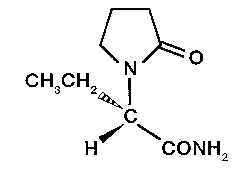
    The chemical name of levetiracetam, a single enantiomer, is (-)-(S)-α-ethyl-2-oxo-1-pyrrolidine acetamide, its molecular formula is C
    Chemical Structure
    Levetiracetam is a white to off-white crystalline powder with a faint odor and a bitter taste. It is very soluble in water (104.0 g/100 mL). It is freely soluble in chloroform (65.3 g/100 mL) and in methanol (53.6 g/100 mL), soluble in ethanol (16.5 g/100 mL), sparingly soluble in acetonitrile (5.7 g/100 mL) and practically insoluble in n-hexane. (Solubility limits are expressed as g/100 mL solvent.)
    KEPPRA XR tablets contain the labeled amount of levetiracetam. Inactive ingredients: colloidal anhydrous silica, hypromellose, magnesium stearate, polyethylene glycol 6000, polyvinyl alcohol-partially hydrolyzed, titanium dioxide (E171), Macrogol/PEG3350, and talc. The imprinting ink contains shellac, FD&C Red #40, n-butyl alcohol, propylene glycol, titanium dioxide, ethanol, and methanol.
    The medication is combined with a drug release controlling polymer that provides a drug release at a controlled rate. The biologically inert components of the tablet may occasionally remain intact during GI transit and will be eliminated in the feces as a soft, hydrated mass.
    6CLINICAL STUDIES
    The effectiveness of KEPPRA XR for the treatment of partial-onset seizures in adults was established in one multicenter, randomized, double-blind, placebo-controlled clinical study in patients who had refractory partial-onset seizures with or without secondary generalization. This was supported by the demonstration of efficacy of immediate-release KEPPRA tablets (see below) in partial seizures in three multicenter, randomized, double-blind, placebo-controlled clinical studies in adults, as well as a demonstration of comparable bioavailability between the XR and immediate-release formulations
    6.1KEPPRA XR in Adults
    The effectiveness of KEPPRA XR for the treatment of partial-onset seizures in adults was established in one multicenter, randomized, double-blind, placebo-controlled clinical study across 7 countries in patients who had refractory partial-onset seizures with or without secondary generalization (Study 1).
    6.2Immediate-Release KEPPRA in Adults
    The effectiveness of immediate-release KEPPRA for the treatment of partial-onset seizures in adults was established in three multicenter, randomized, double-blind, placebo-controlled clinical studies in patients who had refractory partial-onset seizures with or without secondary generalization (Studies 2, 3, and 4). The tablet formulation was used in all three studies. In these studies, 904 patients were randomized to placebo, KEPPRA 1000 mg, KEPPRA 2000 mg, or KEPPRA 3000 mg/day. Patients enrolled in Study 2 or Study 3 had refractory partial-onset seizures for at least two years and had taken two or more AEDs. Patients enrolled in Study 4 had refractory partial-onset seizures for at least 1 year and had taken one AED. At the time of the study, patients were taking a stable dose regimen of at least one AED and could take a maximum of two AEDs. During the baseline period, patients had to have experienced at least two partial-onset seizures during each 4-week period.
    6.3Immediate-Release KEPPRA in Pediatric Patients 4 Years to 16 Years
    The use of KEPPRA XR in pediatric patients 12 years of age and older is supported by Study 5, which was conducted using immediate-release KEPPRA. KEPPRA XR is not indicated in children below 12 years of age.
    7PATIENT COUNSELING INFORMATION
    Advise the patient to read the FDA-approved patient labeling (Medication Guide). The Medication Guide accompanies the product and can also be accessed on www.keppraxr.com or by calling 1-844-599-2273.
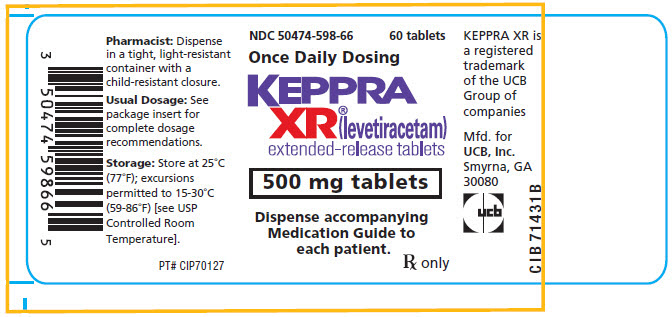
    8PRINCIPAL DISPLAY PANEL - 500 mg Tablet Bottle Label
    NDC 50474-598-66
    Once Daily Dosing
    KEPPRA
    500 mg tablets
    Dispense accompanying
    Rx only
    PRINCIPAL DISPLAY PANEL - 500 mg Tablet Bottle Label
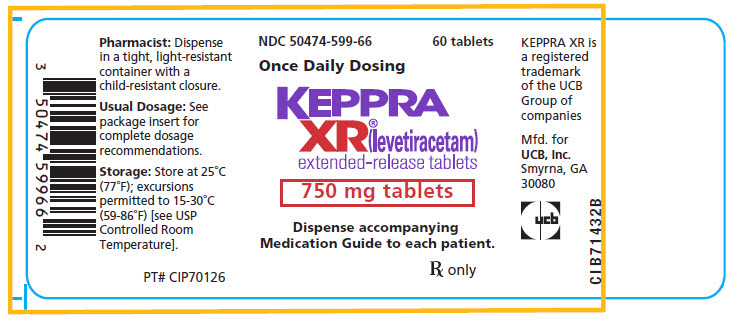
    9PRINCIPAL DISPLAY PANEL - 750 mg Tablet Bottle Label
    NDC 50474-599-66
    Once Daily Dosing
    KEPPRA
    750 mg tablets
    Dispense accompanying
    Rx only
    PRINCIPAL DISPLAY PANEL - 750 mg Tablet Bottle Label
    Keppra has been selected.