Brand Name
Etodolac
View Brand InformationFDA approval date: March 11, 1998
Classification: Nonsteroidal Anti-inflammatory Drug
Form: Tablet, Capsule
What is Etodolac?
Carefully consider the potential benefits and risks of etodolac and other treatment options before deciding to use etodolac. Use the lowest effective dose for the shortest duration consistent with individual patient treatment goals. Etodolac tablets, USP are indicated: For acute and long-term use in the management of signs and symptoms of the following: o Osteoarthritis o Rheumatoid arthritis, For the management of acute pain.
Approved To Treat
Top Global Experts
There are no experts for this drug
Save this treatment for later
Not sure about your diagnosis?
Related Clinical Trials
There is no clinical trials being done for this treatment
Related Latest Advances
There is no latest advances for this treatment
Brand Information
Etodolac (Etodolac)
1DESCRIPTION
Etodolac extended-release tablets contain etodolac, which is a member of the pyranocarboxylic acid group of non-steroidal anti-inflammatory drugs (NSAIDs). Each tablet contains etodolac for oral administration. Etodolac is a racemic mixture of [+]S and [-]R-enantiomers. It is a white crystalline compound, insoluble in water but soluble in alcohols, chloroform, dimethyl sulfoxide, and aqueous polyethylene glycol.
The chemical name is (±) 1,8-diethyl-1,3,4,9-tetrahydropyrano-[3,4-b]indole-1-acetic acid. It has the following structural formula:
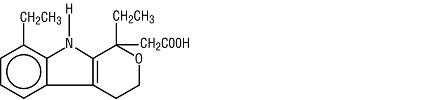
C
The inactive ingredients in etodolac extended-release tablets are calcium phosphate dibasic anhydrous, carbomer 934P, colloidal silicon dioxide, hydroxypropyl cellulose, hypromellose, lactose monohydrate, magnesium stearate, polyethylene glycol, sodium lauryl sulfate, and titanium dioxide. In addition, the following colorants are used: 400 mg tablets - D&C Yellow #10 Lake, FD&C Red #40, and FD&C Yellow #6; 500 mg tablets - D&C Yellow #10 Lake, FD&C Blue No. 2 Indigo Carmine Aluminum Lake, and iron oxide black; 600 mg tablets - FD&C Blue No. 2 Indigo Carmine Lake, iron oxide black, and iron oxide yellow.
2INDICATIONS AND USAGE
Carefully consider the potential benefits and risks of etodolac extended-release tablets and other treatment options before deciding to use etodolac extended-release tablets. Use the lowest effective dose for the shortest duration consistent with individual patient treatment goals (see
Etodolac extended-release tablets are indicated:
* For relief of signs and symptoms of juvenile arthritis
* For relief of the signs and symptoms of rheumatoid arthritis
* For relief of the signs and symptoms of osteoarthritis
3CONTRAINDICATIONS
Etodolac extended-release tablets are contraindicated in patients with known hypersensitivity to etodolac.
Etodolac extended-release tablets should not be given to patients who have experienced asthma, urticaria, or allergic-type reactions after taking aspirin or other NSAIDs. Severe, rarely fatal, anaphylactic-like reactions to NSAIDs have been reported in such patients (see
Etodolac extended-release tablets are contraindicated in the setting of coronary artery bypass graft (CABG) surgery (see
4ADVERSE REACTIONS
A total of 1552 patients were exposed to etodolac extended-release tablets in controlled clinical studies of at least 4 weeks in length and using daily doses in the range of 400 to 1200 mg. In the tabulations below, adverse event rates are generally categorized based on the incidence of events in the first 30 days of treatment with etodolac extended-release tablets. As with other NSAIDs, the cumulative adverse event rates may increase significantly over time with extended therapy.
In patients taking NSAIDs, including etodolac extended-release tablets, the most frequently reported adverse experiences occurring in approximately 1 to 10% of patients are:
gastrointestinal experiences including:
other events including:
* Adverse events that were observed in < 1% of patients in the first 30 days of treatment with etodolac extended-release tablets in clinical trials.
4.1Additional NSAID Adverse Experiences Reported Occasionally with NSAIDs or Etodolac Extended-Release Tablets Include
Body as a whole - allergic reaction, anaphylactic/anaphylactoid reactions (including shock), chills, fever, sepsis
Cardiovascular system - congestive heart failure, flushing, palpitations, tachycardia, syncope, vasculitis (including necrotizing and allergic)
Digestive system - anorexia, cholestatic hepatitis, cholestatic jaundice, dry mouth, duodenitis, eructation, esophagitis, gastritis, gastric/peptic ulcers, glossitis, hepatic failure, hepatitis, hematemesis, intestinal ulceration, jaundice, liver necrosis, melena, pancreatitis, rectal bleeding, stomatitis
Hemic and lymphatic system - agranulocytosis, ecchymosis, eosinophilia, hemolytic anemia, leukopenia, neutropenia, pancytopenia, purpura, thrombocytopenia
Metabolic and nutritional - hyperglycemia in previously controlled diabetic patients
Nervous system - anxiety, confusion, depression, dream abnormalities, insomnia, nervousness, paresthesia, somnolence, tremors, vertigo
Respiratory system - asthma, dyspnea, pulmonary infiltration with eosinophilia
Skin and appendages - angioedema, cutaneous vasculitis with purpura, erythema multiforme, hyperpigmentation, sweating, urticaria, vesiculobullous rash
Special senses - blurred vision, photophobia, transient visual disturbances
Urogenital system - dysuria, elevated BUN, oliguria/polyuria, proteinuria, renal failure, renal insufficiency, renal papillary necrosis, serum creatinine increase, urinary frequency
4.2Other NSAID Adverse Reactions, Which Occur Rarely Are
Body as a whole - anaphylactic reactions, appetite changes, death
Cardiovascular system - arrhythmia, cerebrovascular accident, hypotension, myocardial infarction
Digestive system - colitis, esophagitis with or without stricture or cardiospasm, thirst, ulcerative stomatitis
Hemic and lymphatic system - aplastic anemia, lymphadenopathy
Metabolic and nutritional - change in weight
Nervous system - coma, convulsions, hallucinations, meningitis
Respiratory - bronchitis, pneumonia, respiratory depression, sinusitis
Skin and appendages - alopecia, exfoliative dermatitis, maculopapular rash, photosensitivity, skin peeling, Stevens-Johnson syndrome, toxic epidermal necrosis
Special senses - conjunctivitis, deafness, hearing impairment, taste perversion
Urogenital system - cystitis, hematuria, interstitial nephritis, leukorrhea, renal calculus, uterine bleeding irregularities
5OVERDOSAGE
Symptoms following acute NSAID overdose are usually limited to lethargy, drowsiness, nausea, vomiting, and epigastric pain, which are generally reversible with supportive care. Gastrointestinal bleeding can occur. Hypertension, acute renal failure, respiratory depression and coma may occur, but are rare. Anaphylactoid reactions have been reported with therapeutic ingestion of NSAIDs, and may occur following an overdose.
Patients should be managed by symptomatic and supportive care following an NSAID overdose. There are no specific antidotes. Emesis and/or activated charcoal (60 to 100 g in adults, 1 to 2 g/kg in children) and/or osmotic cathartic may be indicated in patients seen within 4 hours of ingestion with symptoms or following a large overdose (5 to 10 times the usual dose). Forced diuresis, alkalinization of the urine, hemodialysis, or hemoperfusion may not be useful due to high protein binding.
6DOSAGE AND ADMINISTRATION
Carefully consider the potential benefits and risks of etodolac extended-release tablets and other treatment options before deciding to use etodolac extended-release tablets. Use the lowest effective dose for the shortest duration consistent with individual patient treatment goals (see
After observing the response to initial therapy with etodolac extended-release tablets, the dose and frequency should be adjusted to suit an individual patient's needs.
6.1Juvenile Rheumatoid Arthritis
For the relief of the signs and symptoms of juvenile rheumatoid arthritis in patients 6 to 16 years of age, the recommended dose given orally once per day should be based on body weight, according to the following table:
6.2Rheumatoid Arthritis and Osteoarthritis
For the relief of the signs and symptoms of osteoarthritis or rheumatoid arthritis, the recommended starting dose of etodolac extended-release tablets is 400 to 1000 mg given orally once per day.
As with other NSAIDs, the lowest effective dose should be sought for each patient. In chronic conditions, a therapeutic response to therapy with etodolac extended-release tablets is sometimes seen within one week of therapy, but most often is observed by two weeks.
7HOW SUPPLIED
Etodolac extended-release tablets, 400 mg, are available as orange, film-coated, oval-shaped tablets, debossed “1122” on one side and “93” on the other. They are available in bottles of 30 (NDC 71205-140-30) bottles of 60 (NDC 71205-140-60) and bottles of 90 (NDC 71205-140-90).
Store at 20° to 25°C (68° to 77°F) [See USP Controlled Room Temperature].
Protect from excessive heat and humidity.
Dispense in a tight, light-resistant container as defined in the USP, with a child-resistant closure (as required).
Manufactured In Israel By:
Repackaged by:
Rev. I 7/2015
8Package/Label Display Panel
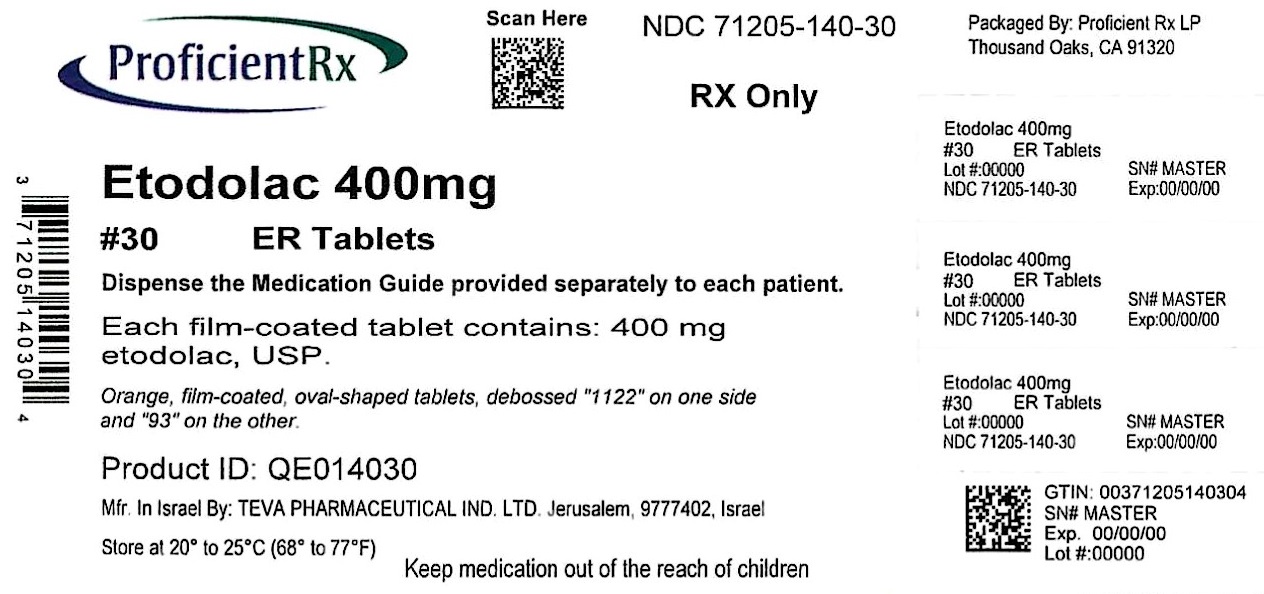
8.1Etodolac Extended-Release Tablets 400 mg 30s Label Text
NDC 71205-140-30
Etodolac
Extended-Release
Extended-Release
Tablets
400 mg
400 mg
PHARMACIST: Dispense the Medication Guide
provided separately to each patient.
Rx only
30 TABLETS