Brand Name

Esbriet

Generic Name
Pirfenidone
View Brand Information
FDA approval date: October 15, 2014
Classification: Pyridone
Form: Tablet, Capsule

What is Esbriet (Pirfenidone)?

Pirfenidone tablets are indicated for the treatment of idiopathic pulmonary fibrosis . Pirfenidone is a pyridone indicated for the treatment of idiopathic pulmonary fibrosis .
Save this treatment for later
Sign Up
Not sure about your diagnosis?
Check Your Symptoms

Related Clinical Trials

Evaluation of Pirfenidone as a Novel Therapeutic Strategy Against Recurrent Acute Pancreatitis.

Summary: This clinical will evaluate the safety, tolerability and early efficacy of pirenidone in patients with recurrent acute pancreatitis.

A Randomized, Double-Blind, Placebo-Controlled, Phase 2b Study Evaluating the Safety and Efficacy of Pirfenidone Solution for Inhalation (AP01) in Participants With PPF

Summary: A randomized, double-blind, placebo-controlled clinical study to evaluate the safety and efficacy of 2 doses of inhaled pirfenidone (AP01) versus placebo on top of standard of care in participants with PPF over 52 weeks.

A Multinational, Long-Term, Safety and Tolerability, Open-Label Extension Study of Subjects Who Have Participated in Avalyn Pharma Studies of Inhaled Antifibrotic Agents (AP-LTE-008 [SAIL])

Summary: This is an open-label extension study for participants who were previously enrolled in and completed an Avalyn Pharma Sponsored study with an inhaled antifibrotic, such as AP01. Eligible participants will have their final dose of drug at the end of study visit from the lead-in study and first AP-LTE-008 study visit on the same day. All participants will receive 100 mg inhaled pirfenidone inhalatio...

Brand Information

ESBRIET (PIRFENIDONE)
1INDICATIONS AND USAGE
ESBRIET is indicated for the treatment of idiopathic pulmonary fibrosis (IPF).
2DOSAGE FORMS AND STRENGTHS
Capsules: 267 mg, white to off-white, hard gelatin capsules printed with "PFD 267 mg" on the cap of the capsule in brown ink.
Film-coated tablets: oval, biconvex, debossed with "PFD", containing 267 mg (yellow) and 801 mg (brown) pirfenidone
3CONTRAINDICATIONS
None.
4ADVERSE REACTIONS
The following adverse reactions are discussed in greater detail in other sections of the labeling:
  • Liver Enzyme Elevations and Drug-Induced Liver Injury
  • Photosensitivity Reaction or Rash
  • Severe Cutaneous Adverse Reactions
  • Gastrointestinal Disorders
4.1Clinical Trials Experience
Because clinical trials are conducted under widely varying conditions, adverse reaction rates observed in the clinical trials of a drug cannot be directly compared to rates in the clinical trials of another drug and may not reflect the rates observed in practice.
The safety of pirfenidone has been evaluated in more than 1400 subjects with over 170 subjects exposed to pirfenidone for more than 5 years in clinical trials.
ESBRIET was studied in 3 randomized, double-blind, placebo-controlled trials (Studies 1, 2, and 3) in which a total of 623 patients received 2403 mg/day of ESBRIET and 624 patients received placebo. Subjects ages ranged from 40 to 80 years (mean age of 67 years). Most patients were male (74%) and Caucasian (95%). The mean duration of exposure to ESBRIET was 62 weeks (range: 2 to 118 weeks) in these 3 trials.
At the recommended dosage of 2403 mg/day, 14.6% of patients on ESBRIET compared to 9.6% on placebo permanently discontinued treatment because of an adverse event. The most common (>1%) adverse reactions leading to discontinuation were rash and nausea. The most common (>3%) adverse reactions leading to dosage reduction or interruption were rash, nausea, diarrhea, and photosensitivity reaction.
The most common adverse reactions with an incidence of ≥10% and more frequent in the ESBRIET than placebo treatment group are listed in
Adverse reactions occurring in ≥5 to <10% of ESBRIET-treated patients and more commonly than placebo are photosensitivity reaction (9% vs. 1%), pruritus (8% vs. 5%), asthenia (6% vs. 4%), dysgeusia (6% vs. 2%), and non-cardiac chest pain (5% vs. 4%).
4.2Postmarketing Experience
In addition to adverse reactions identified from clinical trials the following adverse reactions have been identified during post-approval use of ESBRIET. Because these reactions are reported voluntarily from a population of uncertain size, it is not always possible to reliably estimate their frequency.
Blood and Lymphatic System Disorders: Agranulocytosis
Hepatobiliary Disorders: Drug-induced liver injury
Immune System Disorders: Angioedema
Skin and Subcutaneous Tissue Disorders: Severe Cutaneous Adverse Reactions (SCAR)
5OVERDOSAGE
There is limited clinical experience with overdosage. Multiple dosages of ESBRIET up to a maximum tolerated dose of 4005 mg per day were administered as five 267 mg capsules three times daily to healthy adult volunteers over a 12-day dose escalation.
In the event of a suspected overdosage, appropriate supportive medical care should be provided, including monitoring of vital signs and observation of the clinical status of the patient.
6DESCRIPTION
ESBRIET belongs to the chemical class of pyridone. ESBRIET is available as a white to off-white hard gelatin capsule containing 267 mg of pirfenidone for oral administration, or, as film-coated tablets containing 267 mg (yellow) and 801 mg (brown) pirfenidone.
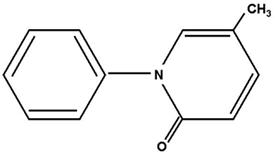
Pirfenidone has a molecular formula of C
Chemical Structure
Pirfenidone is a white to pale yellow, non-hygroscopic powder. It is more soluble in methanol, ethyl alcohol, acetone and chloroform than in water and 1.0 N HCl. The melting point is approximately 109°C.
ESBRIET capsule contains pirfenidone and the following inactive ingredients: microcrystalline cellulose, croscarmellose sodium, povidone, and magnesium stearate.
In addition, the capsule shell contains gelatin and titanium dioxide. The capsule brown printing ink includes shellac, iron oxide black, iron oxide red, iron oxide yellow, propylene glycol, ammonium hydroxide.
ESBRIET tablets contain pirfenidone and the following inactive ingredients: Microcrystalline cellulose, colloidal anhydrous silica, povidone, croscarmellose sodium, magnesium stearate, polyvinyl alcohol, titanium dioxide, macrogol (polyethylene glycol), talc, and iron oxide.
7CLINICAL STUDIES
The efficacy of ESBRIET was evaluated in patients with IPF in three phase 3, randomized, double-blind, placebo-controlled, multicenter trials (Studies 1, 2, and 3).
Study 1 was a 52-week trial comparing ESBRIET 2403 mg/day (n=278) versus placebo (n=277) in patients with IPF. Study 2 and Study 3 were nearly identical to each other in design, with few exceptions, including an intermediate dose treatment arm in Study 2. Study 2 compared treatment with either ESBRIET 2403 mg/day (n=174) or ESBRIET 1197 mg/day (n=87) to placebo (n=174), while Study 3 compared ESBRIET 2403 mg/day (n=171) to placebo (n=173). Study drug was administered three times daily with food for a minimum of 72 weeks. Patients continued on treatment until the last patient completed 72 weeks of treatment, which included observations to approximately 120 weeks of study treatment. The primary endpoint was the change in percent predicted forced vital capacity (%FVC) from baseline to study end, measured at 52 weeks in Study 1, and at 72 weeks in Studies 2 and 3.
Studies 1, 2 and 3 enrolled adult patients who had a clinical and radiographic diagnosis of IPF (with or without accompanying surgical lung biopsy), without evidence or suspicion of an alternative diagnosis for interstitial lung disease. Eligible patients were to have %FVC greater than or equal to 50% at baseline and a percent predicted diffusing capacity of the lungs for carbon monoxide (%DL
A total of 1247 patients with IPF were randomized to receive ESBRIET 2403 mg/day (n=623) or placebo (n=624) in these three trials. Baseline characteristics were generally balanced across treatment groups. The study population ranged from 40 to 80 years of age (mean age 67 years). Most patients were male (74%), white (95%), and current or former smokers (65%). Approximately 93% of patients met criteria for definite IPF on high resolution computed tomography (HRCT). Baseline mean %FVC and %DL
8HOW SUPPLIED/STORAGE AND HANDLING
ESBRIET white to off-white hard gelatin capsules contain 267 mg of pirfenidone. The cap of the capsule is printed with "PFD 267 mg" in brown ink. The capsule is supplied either in a bottle, a 14-day titration blister pack or a 4-week maintenance blister pack.
ESBRIET film-coated tablets are oval, biconvex, debossed with "PFD", containing 267 mg (yellow) and 801 mg (brown) pirfenidone. The film-coated tablets are supplied in bottles.
ESBRIET capsules:
  • NDC 50242-121-01, bottle for a 30-day supply containing 270 capsules and closed with a child-resistant closure
  • NDC 50242-121-02, 14-day titration blister pack, carton containing a total of 63 capsules in two blister cards – a Week 1 blister card containing 21 capsules (1 capsule per blister well) and a Week 2 blister card containing 42 capsules (2 capsules per blister well)
  • NDC 50242-121-03, 4-week maintenance blister pack, carton containing a total of 252 capsules in four blister cards each with 63 capsules (3 capsules per blister well)
ESBRIET film-coated tablets:
  • NDC 50242-122-05, carton containing 3 bottles, each containing ninety 267 mg tablets (270 tablets total) with a child-resistant closure
  • NDC 50242-122-06, carton containing 1 bottle containing 270 tablets, 267 mg each, with a child-resistant closure
  • NDC 50242-123-01, carton containing 1 bottle containing ninety 801 mg tablets, with a child-resistant closure
9PATIENT COUNSELING INFORMATION
Advise the patient to read the FDA-approved patient labeling (
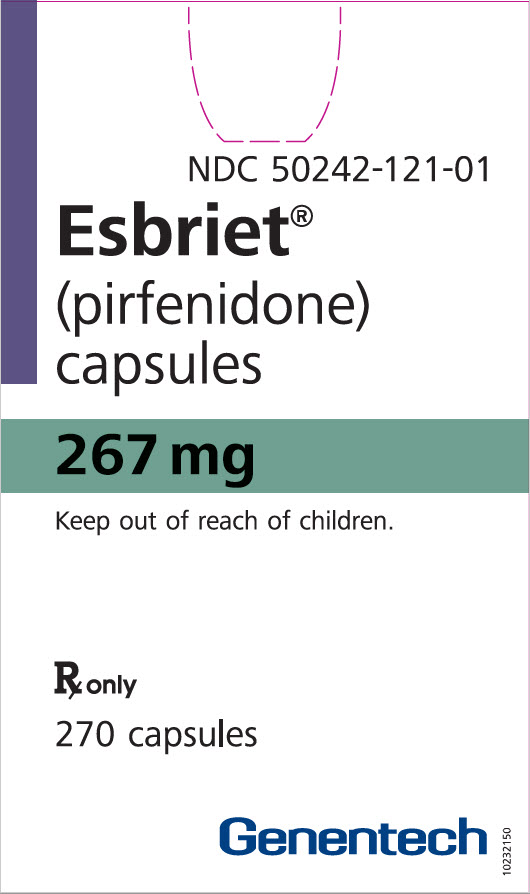
10PRINCIPAL DISPLAY PANEL - 267 mg Capsule Bottle Carton
NDC 50242-121-01
Esbriet
267 mg
Keep out of reach of children.
Rx only
Genentech
10232150
PRINCIPAL DISPLAY PANEL - 267 mg Capsule Bottle Carton
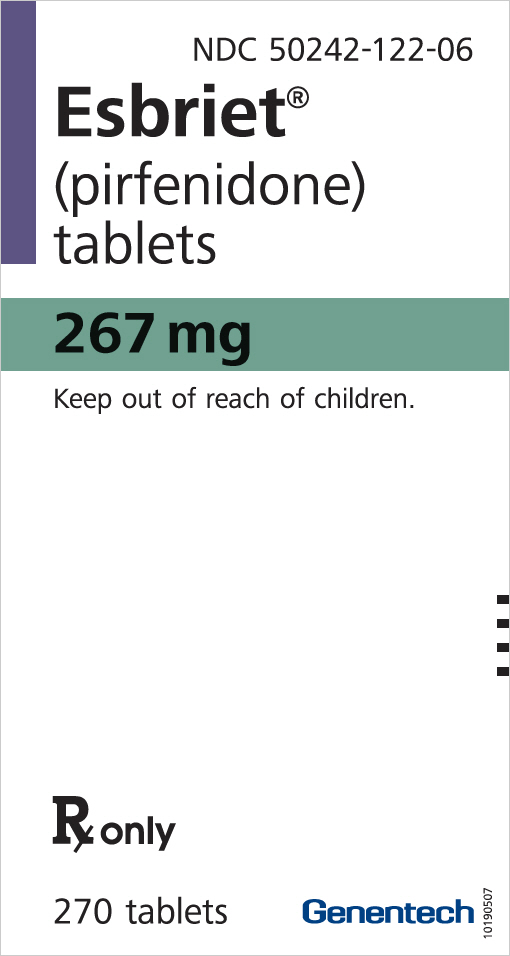
11PRINCIPAL DISPLAY PANEL - 267 mg Tablet Bottle Carton
NDC 50242-122-06
Esbriet
267 mg
Keep out of reach of children.
Rx only
270 tablets
10190507
PRINCIPAL DISPLAY PANEL - 267 mg Tablet Bottle Carton
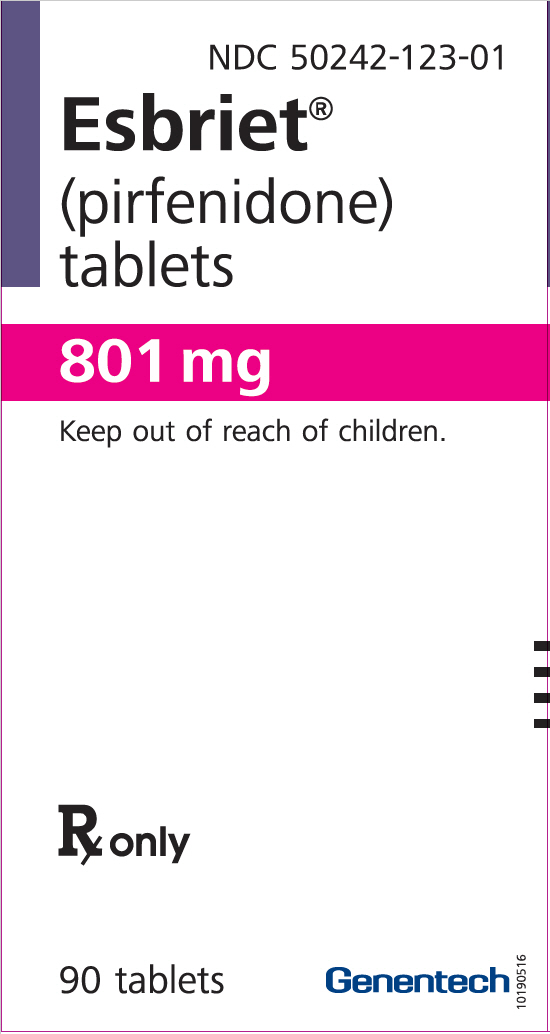
12PRINCIPAL DISPLAY PANEL - 801 mg Tablet Bottle Carton
NDC 50242-123-01
Esbriet®
(pirfenidone)
tablets
801 mg
Keep out of reach of children.
Rx only
90 tablets
Genentech
10190516
PRINCIPAL DISPLAY PANEL - 801 mg Tablet Bottle Carton