Brand Name

Uplizna

Generic Name
Inebilizumab
View Brand Information
FDA approval date: June 11, 2020
Classification: CD19-directed Cytolytic Antibody
Form: Injection

What is Uplizna (Inebilizumab)?

UPLIZNA is a CD19-directed cytolytic antibody indicated for: The treatment of neuromyelitis optica spectrum disorder in adult patients who are anti-aquaporin-4 antibody positive.
Save this treatment for later
Sign Up
Not sure about your diagnosis?
Check Your Symptoms

Related Clinical Trials

An Open-Label Multicenter Study to Evaluate the Pharmacokinetics, Pharmacodynamics, and Safety of Inebilizumab in Pediatric Subjects With Neuromyelitis Optica Spectrum Disorder

Summary: A Phase 2, open-label, multicenter study to evaluate the pharmacokinetics (PK), pharmacodynamics (PD), and safety of inebilizumab in eligible pediatric participants 2 to \< 18 years of age with recently active neuromyelitis optica spectrum disorder (NMOSD) who are seropositive for autoantibodies against aquaporin-4 (AQP4-immunoglobulin \[Ig\]G).

A Phase 2a, Open Label, Multicenter, Platform Trial to Assess the Safety, Tolerability, and Efficacy of Inebilizumab and Blinatumomab in Subjects With Autoimmune Diseases

Summary: The main objective is to assess the safety and tolerability of inebilizumab in adult participants with active and refractory systemic lupus erythematosus (SLE) with nephritis (Subprotocol A) and to assess the safety and tolerability of subcutaneous (SC) blinatumomab in adult participants with active and refractory SLE with and without nephritis (Subprotocol B) and in adult participants with active...

A Phase-2b, Double-Blind, Randomized Controlled Trial to Evaluate the Activity and Safety of Inebilizumab in Anti-Nmda Receptor Encephalitis and Assess Markers of Disease

Summary: Determine the difference in the modified Rankin score at 16 weeks in participants with anti-N-methyl-D-aspartate receptor (NMDAR) encephalitis treated with first-line immunomodulatory therapies provided as standard-of-care, and either inebilizumab (investigational agent) or placebo.

Brand Information

UPLIZNA (Inebilizumab)
1INDICATIONS AND USAGE
UPLIZNA is indicated for the treatment of neuromyelitis optica spectrum disorder (NMOSD) in adult patients who are anti-aquaporin-4 (AQP4) antibody positive.
2DOSAGE FORMS AND STRENGTHS
Injection: 100 mg/10 mL (10 mg/mL) clear to slightly opalescent, colorless to slightly yellow solution in a single-dose vial.
3CONTRAINDICATIONS
UPLIZNA is contraindicated in patients with:
  • A history of a life-threatening infusion reaction to UPLIZNA 
  • Active hepatitis B infection 
  • Active or untreated latent tuberculosis
4ADVERSE REACTIONS
The following clinically significant adverse reactions are described elsewhere in the labeling:
  • Infusion Reactions
  • Infections
  • Reduction in Immunoglobulins
4.1Clinical Trial Experience
Because clinical trials are conducted under widely varying conditions, adverse reaction rates observed in the clinical trials of a drug cannot be directly compared to rates in the clinical trials of another drug and may not reflect the rates observed in practice.
The safety of UPLIZNA was evaluated in Study 1, in which 161 patients were exposed to UPLIZNA at the recommended dosage regimen during the randomized, controlled treatment period; during which 52 patients received placebo
Two-hundred and eight patients in the randomized and open-label treatment periods had a total of 324 person-years of exposure to UPLIZNA, including 165 patients with exposure for at least 6 months and 128 with exposure for one year or more.
Table 3 lists adverse reactions that occurred in at least 5% of patients treated with UPLIZNA and at a greater incidence than in patients who received placebo in Study 1. The most common adverse reactions (incidence of at least 10% in patients treated with UPLIZNA and at a greater incidence than placebo) were urinary tract infection and arthralgia.
Across both the randomized and open-label treatment in Study 1, the most common adverse reactions (greater than 10%) were urinary tract infection (20%), nasopharyngitis (13%), infusion reaction (12%), arthralgia (11%), and headache (10%).
Laboratory Abnormalities
Decreased Immunoglobulins
At the end of the 6.5-month randomized, controlled period, relative to baseline, the total immunoglobulin level was reduced approximately 8% from baseline for patients treated with UPLIZNA as compared to an increase of 6% in patients treated with placebo. The mean decreases from baseline in immunoglobulin G (IgG) and immunoglobulin M (IgM) were approximately 4% and 32%, respectively, in patients treated with UPLIZNA, whereas IgG was increased by 6% and IgM was increased by approximately 13% in placebo-treated patients. The proportion of patients treated with UPLIZNA who had IgG levels below the lower limit of normal at year 1 was 6.6% and at year 2 was 13%. The proportion of patients treated with UPLIZNA who had IgM levels below the lower limit of normal at year 1 was 31% and at year 2 was 42%.
Decreased Neutrophil Counts
Neutrophil counts between 1.0-1.5 x10
Decreased Lymphocyte Counts
A reduction in lymphocyte counts was observed more frequently in patients treated with UPLIZNA compared to those who received placebo. At the end of the 6.5-month randomized, controlled period, the proportion of patients with a lymphocyte count below the limit of normal was 5.3% for patients treated with UPLIZNA compared to 4.2% for patients who received placebo.
4.2Immunogenicity
As with all therapeutic proteins there is potential for immunogenicity. The detection of antibody formation is highly dependent on the sensitivity and specificity of the assay. Additionally, the observed incidence of antibody (including neutralizing antibody) positivity in an assay may be influenced by several factors including assay methodology, sample handling, timing of sample collection, concomitant medications, and underlying disease. For these reasons, comparison of the incidence of antibodies in the studies described below with the incidence of antibodies in other studies or to other inebilizumab products may be misleading.
In Study 1, treatment-emergent antibodies (those that appeared or significantly increased from baseline after administration of UPLIZNA), were detected in 5.6% patients receiving UPLIZNA. Although these data do not demonstrate an impact of anti-inebilizumab-cdon antibody development on the efficacy or safety of UPLIZNA in these patients, the available data are too limited to make definitive conclusions.
5DESCRIPTION
Inebilizumab-cdon is a CD19-directed humanized afucosylated IgG1 monoclonal antibody produced by recombinant DNA technology in Chinese hamster ovary (CHO) cell suspension culture. The molecular weight is approximately 149 kDa.
UPLIZNA (inebilizumab-cdon) injection is a sterile, preservative-free, clear to slightly opalescent, colorless to slightly yellow solution, free from visible particles, for intravenous use.
Each single-dose vial contains 100 mg of inebilizumab in 10 mL of solution. Each mL contains 10 mg of inebilizumab-cdon, L-histidine (1.4 mg), L-histidine hydrochloride monohydrate (2.3 mg), polysorbate 80 (0.1 mg), sodium chloride (4.1 mg), α,α-trehalose dihydrate (40.1 mg), and Water for Injection, USP and a pH of 6.
6CLINICAL STUDIES
The efficacy of UPLIZNA for the treatment of NMOSD was established in Study 1 (NCT02200770), a randomized (3:1), double-blind, placebo-controlled trial that enrolled 213 patients with NMOSD who were anti-AQP4 antibody positive and 17 who were anti-AQP4 antibody negative.
Patients met the following eligibility criteria:
  1. A history of one or more relapses that required rescue therapy within the year prior to screening, or 2 or more relapses that required rescue therapy in 2 years prior to screening.
  2. Expanded Disability Status Scale (EDSS) score of 7.5 or less. Patients with an EDSS score of 8.0 were eligible if they were deemed capable of participating.
  3. Patients were excluded if previously treated with immunosuppressant therapies within an interval specified for each such therapy.
The use of immunosuppressants during the blinded phase of the trial was prohibited.
The use of oral or intravenous corticosteroids during the blinded phase of the trial was prohibited, with the exception of premedication for investigational treatment and treatment for a relapse.
Of the 213 enrolled anti-AQP4 antibody positive patients, a total of 161 were randomized to receive treatment with UPLIZNA, and 52 were randomized to receive placebo.
The baseline demographic and disease characteristics were balanced between the treatment groups. Females accounted for 94% of the study population. Fifty-two percent of patients were White, 21% Asian, and 9% Black or African American. The mean age was 43 years (range 18 to 74 years). The mean EDSS score was 4.0. The number of relapses in the two years prior to randomization was 2 or more in 83% of the patients.
UPLIZNA was administered according to the recommended dosage regimen
All potential relapses were evaluated by a blinded, independent, adjudication committee, who determined whether the relapse met protocol-defined criteria. Patients who experienced an adjudicated relapse in the randomized-controlled period (RCP), or who completed the Day 197 visit without a relapse, exited the RCP.  
The primary efficacy endpoint was the time to the onset of the first adjudicated relapse on or before Day 197.
The time to the first adjudicated relapse was significantly longer in patients treated with UPLIZNA compared to patients who received placebo (relative risk reduction 73%; hazard ratio: 0.272; p < 0.0001). In the anti-AQP4 antibody positive population there was a 77.3% relative reduction (hazard ratio: 0.227, p < 0.0001). There was no evidence of a benefit in patients who were anti-AQP4 antibody negative.
a Cox regression method, with placebo as the reference group.
Figure 1Kaplan-Meier Plot of Time to First Adjudication Committee-Determined NMOSD Relapsein the Randomized-Controlled Period (ITT Population; anti-AQP4 Antibody Positive Patients)
Figure 1 Kaplan-Meier Plot of Time to First Adjudication Committee-Determined NMOSD Relapse in the Randomized-Controlled Period (ITT Population; anti-AQP4 Antibody Positive Patients)
Note: Numbers of patients at risk are shown at each time point.
Compared to placebo-treated patients, patients treated with UPLIZNA who were anti-AQP4 antibody positive had reduced annualized rates of hospitalizations (0.11 for UPLIZNA versus 0.50 for placebo).
7PATIENT COUNSELING INFORMATION
Advise the patient and/or caregiver to read the FDA-approved patient labeling (Medication Guide).
Infusion Reactions
Inform patients about the signs and symptoms of infusion reactions and advise them to contact their healthcare provider immediately if they observe signs or symptoms of infusion reactions
Infections
Advise patients to contact their healthcare provider for any signs of infection during treatment or after the last dose
Advise patients that UPLIZNA may cause reactivation of hepatitis B infection and that monitoring will be required if they are at risk
Advise patients that PML has happened with drugs that are similar to UPLIZNA and may happen with UPLIZNA. Inform the patient that PML is characterized by a progression of deficits and usually leads to death or severe disability over weeks or months. Instruct the patient of the importance of contacting their healthcare provider if they develop any symptoms suggestive of PML. Inform the patient that typical symptoms associated with PML are diverse, progress over days to weeks, and include progressive weakness on one side of the body or clumsiness of limbs, disturbance of vision, and changes in thinking, memory, and orientation leading to confusion and personality changes
Vaccinations
Advise patients to complete any required vaccinations at least 4 weeks prior to initiation of UPLIZNA. Administration of live-attenuated or live vaccines is not recommended during UPLIZNA treatment and until B-cell recovery
Pregnancy
Instruct patients that if they are pregnant or plan to become pregnant while taking UPLIZNA, they should inform their healthcare provider
Manufactured by: Viela Bio, Inc., 1 Medimmune Way, Gaithersburg, MD 20878 USA
U.S. License No. 2129
For more information, go to www.UPLIZNA.com or call 1-855-558-4352
8PRINCIPAL DISPLAY PANEL
NDC 72677-551-01
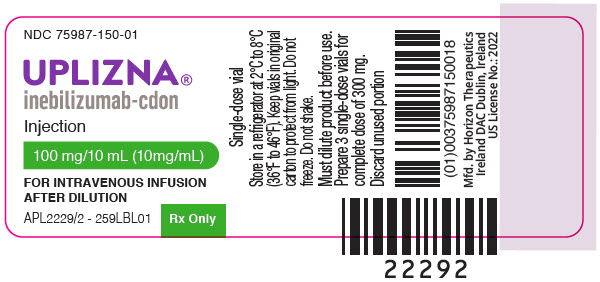
PRINCIPAL DISPLAY PANEL NDC 72677-551-01 UPLIZNA® (inebilizumab-cdon) INJECTION 100 mg/10 mL Contents: 3 single-dose vials Rx Only
9PRINCIPAL DISPLAY PANEL
NDC 72677-551-03
PRINCIPAL DISPLAY PANEL NDC 72677-551-03 UPLIZNA® (inebilizumab-cdon) INJECTION 100 mg/10 mL FOR INTRAVENOUS INFUSION AFTER DILUTION Rx Only