Brand Name
Visipaque
Generic Name
Iodixanol
View Brand Information FDA approval date: December 13, 2002
Classification: Radiographic Contrast Agent
Form: Injection
What is Visipaque (Iodixanol)?
VISIPAQUE is indicated in for: VISIPAQUE injection is a radiographic contrast agent indicated for the following: Intra-arterial Procedures.
Approved To Treat
Top Global Experts

Save this treatment for later
Not sure about your diagnosis?
Related Clinical Trials
Evaluation of the Efficacy of Suprascapular Nerve Block in Adhesive Capsulitis: a Randomized Controlled Superiority Trial
Summary: This is a double-blind interventional superiority study evaluating the efficacy of suprascapular nerve block in addition to conventional therapies for adhesive capsulitis. Adhesive capsulitis is a pathology that results in reduced shoulder mobility due to retraction of the periarticular capsule. It may be primary or secondary to traumatic or neurological events, or associated with diabetes in part...
Related Latest Advances
Brand Information
Visipaque (Iodixanol)
WARNING: NOT FOR INTRATHECAL USE
Inadvertent intrathecal administration may cause death, convulsions/seizures, cerebral hemorrhage, coma, paralysis, arachnoiditis, acute renal failure, cardiac arrest, rhabdomyolysis, hyperthermia, and brain edema
1INDICATIONS AND USAGE
VISIPAQUE is indicated for:
1.1Intra-arterial Procedures
Adult and pediatric patients 12 years of age and older
- (270 and 320 mg Iodine/mL) intra-arterial digital subtraction angiography (IA-DSA).
- (320 mg Iodine/mL) angiocardiography (left ventriculography and selective coronary arteriography), peripheral arteriography, visceral arteriography, and cerebral arteriography.
Pediatric patients less than 12 years of age
- (320 mg Iodine/mL) angiocardiography, cerebral arteriography, and visceral arteriography.
1.2Intravenous Procedures
Adult and pediatric patients 12 years of age and older
- (270 and 320 mg Iodine/mL) CT imaging of the head and body.
- (270 and 320 mg Iodine/mL) excretory urography.
- (270 mg Iodine/mL) peripheral venography.
- (320 mg Iodine/mL) coronary computed tomography angiography (CCTA) to assist in the diagnostic evaluation of patients with suspected coronary artery disease.
Pediatric patients less than 12 years of age
- (270 mg Iodine/mL) CT imaging of the head and body.
- (270 mg Iodine/mL) excretory urography.
2DOSAGE FORMS AND STRENGTHS
Injection: Non-ionic, isotonic, water-soluble, sterile, pyrogen-free, colorless to pale yellow solution in the following strengths:
- 270 mg of organically bound iodine per mL (550 mg Iodixanol per mL).
- 320 mg of organically bound iodine per mL (652 mg Iodixanol per mL).
Available in the following formats: Multiple-dose polymer bottle (+
3CONTRAINDICATIONS
VISIPAQUE is contraindicated for Intrathecal use
4ADVERSE REACTIONS
The following clinically significant adverse reactions are described elsewhere in the labeling:
- Risks Associated with Inadvertent Intrathecal Administration
- Hypersensitivity Reactions
- Contrast-Induced Kidney Injury
- Cardiovascular Adverse Reactions
- Thromboembolic Events
- Thyroid Dysfunction in Pediatric Patients 0 to 3 Years of Age
- Severe Cutaneous Adverse Reactions
4.1Clinical Trials Experience
Because clinical trials are conducted under widely varying conditions, adverse reaction rates observed in the clinical trials of a drug cannot be directly compared to rates in the clinical trials of another drug and may not reflect the rates observed in practice.
VISIPAQUE is often associated with sensations of discomfort, warmth or pain. In a subgroup of 1259 patients; 30% who received VISIPAQUE or a comparator had application site discomfort, pain, warmth or cold. VISIPAQUE had a trend toward fewer patient reports of moderate or severe pain or warmth. Pain was reported in 2% of patients receiving VISIPAQUE and 10% of patients receiving a comparator. Heat was reported in 29% of patients receiving VISIPAQUE and 51% of patients receiving a comparator.
Table 3 shows the incidence of events reported in blinded, controlled clinical studies of VISIPAQUE in a total of 1244 adult patients. Adverse events (AEs) are listed by body system and in decreasing order of occurrence greater than 0.5% of patients. One or more adverse events were reported in 20% of patients during the study period (24 to 72 hours). In a 757 patient subgroup, the number of women reporting adverse events was 83/299 (28%) and the number of men was 77/458 (16%). A total of 3% of women and 0.8% of men reported chest pain.
The following selected adverse events were reported in ≤0.5% of the 1244 patients.
Body as a Whole—General Disorders: back pain, fatigue, malaise
Cardiovascular Disorders: arrhythmias, cardiac failure, conduction abnormalities, hypotension, myocardial infarction
Gastrointestinal System Disorders: dyspepsia
Hypersensitivity Disorders: pharyngeal edema
Nervous System: cerebral vascular disorder, convulsions, hypoesthesia, stupor, confusion
Peripheral Vascular Disorders: flushing, peripheral ischemia
Renal System Disorders: abnormal renal function, acute renal failure, hematuria
Respiratory System Disorders: asthma, bronchitis, dyspnea, pulmonary edema, rhinitis
Skin and Appendage Disorders: hematoma, increased sweating
Special Senses, Other Disorders: tinnitus
Vision Disorders: abnormal vision
4.2Post-marketing Experience
The following additional adverse reactions have been identified during post approval use of VISIPAQUE. Because these reactions are reported voluntarily from a population of uncertain size, it is not always possible to reliably estimate their frequency or establish a causal relationship to exposure.
Cardiovascular Disorders: Cardiac arrest, palpitations, spasms of coronary arteries, hypertension, and flushing
Endocrine Disorders: Hyperthyroidism, hypothyroidism
Eye Disorders: Transient visual impairment including cortical blindness, diplopia, and blurred vision
Gastrointestinal Disorders: Abdominal pain, pancreatitis, salivary gland enlargement
General Disorders and Administration Site Conditions: Chills, pyrexia, pain and discomfort, administration site reactions including extravasation
Immune System Disorders: Hypersensitivity reactions, anaphylactic shock including, life-threatening or fatal anaphylaxis
Nervous System Disorders: Tremor (transient), coma, disturbance in consciousness, transient contrast-induced encephalopathy caused by extravasation of contrast media (including amnesia, hallucination, paralysis, paresis, transient speech disorder, aphasia, dysarthria)
Psychiatric Disorders: Anxiety, agitation
Respiratory, Thoracic, and Mediastinal Disorders: Cough, sneezing, throat irritation or tightness, laryngeal edema, pharyngeal edema, bronchospasm
Skin and subcutaneous tissue disorders: Reactions range from mild (e.g., rash, erythema, pruritus, urticaria, and skin discoloration) to severe: [e.g., Stevens-Johnson syndrome and toxic epidermal necrolysis (SJS/TEN), acute generalized exanthematous pustulosis (AGEP) and drug reaction with eosinophilia and systemic symptoms (DRESS)]
4.3Pediatric Adverse Reactions
The overall character, quality, and severity of adverse reactions in pediatric patients is similar to that reported in adult patients from post marketing surveillance and other information.
Additional safety data was obtained in studies of VISIPAQUE in 459 pediatric patients. A total of 26 patients ranged in age from birth to <29 days, 148 ranged from 29 days to 2 years, 263 from 2 to <12 years, and 22 from 12 to 18 years. A total of 252 (55%) of the patients were male. The racial distribution was: Caucasian-81%, Black-14%, Oriental-2%, and other or unknown-4%. The proportion of patients undergoing an intra-arterial procedure by age was: 92% (<29 days), 55% (29 days to 6 months), and 29% (>6 months). In these studies, adverse events were numerically higher in pediatric patients less than one year of age compared to older pediatric patients.
In pediatric patients who received intravenous injections of VISIPAQUE for computerized tomography or excretory urography, a concentration of 270 mg Iodine/mL was used in 144 patients, and a concentration of 320 mg Iodine/mL in 154 patients. All patients received one intravenous injection of 1 to 2 mL/kg.
In pediatric patients who received intra-arterial and intracardiac studies, a concentration of 320 mg Iodine/mL was used in 161 patients. Twenty-two patients were < 29 days of age; 78 were 29 days to 2 years of age; and 61 were over 2 years. Most of these pediatric patients received initial volumes of 1 to 2 mL/kg and most patients received a maximum of 3 injections.
5OVERDOSAGE
The adverse effects of overdosage of any contrast agent may be life-threatening and affect mainly the pulmonary and cardiovascular systems. Treatment of an overdosage is directed toward the support of all vital functions and prompt institution of symptomatic therapy. VISIPAQUE Injection does not bind to plasma or serum protein and can be dialyzed.
6CLINICAL STUDIES
VISIPAQUE was studied in 1244 adult patients. Approximately one-half (590) of the VISIPAQUE patients were 60 years of age or older; the mean age was 56 years (range 18 to 90). A total of patients, 806 (65%) were male. The racial distribution was: Caucasian-85%, Black-12%, Oriental <1%, and other or unknown-3%.
A total of 1235 patients were evaluable for efficacy. Efficacy assessment was based on quality of the radiographic diagnostic visualization (i.e., either: excellent, good, poor, or none) and on the ability to make a diagnosis (i.e., either: confirmed a previous diagnosis, found normal, or diagnosed new findings).
6.1Intra-arterial Administration Studies
Angiocardiography, cerebral arteriography, peripheral arteriography, and visceral arteriography were studied with either one or both concentrations of VISIPAQUE Injection (270 mg Iodine/mL or 320 mg Iodine/mL). In these intra-arterial studies, diagnostic visualization ratings were good or excellent in all the patients and a radiologic diagnosis was made in all of the patients. In additional intra-arterial studies, overall quality of diagnostic visualization was rated optimal in the majority of patients and a radiologic diagnosis was made in all (100%) of the patients. The number of patients studied in each indication is provided below.
Angiocardiography was evaluated in two randomized, double-blind clinical studies in 101 adult patients given VISIPAQUE 320 mg Iodine/mL. Seven additional angiocardiography studies were performed in 217 adult patients given VISIPAQUE 320 mg Iodine/mL. Visualization ratings were good or excellent in all the patients given VISIPAQUE; a radiologic diagnosis was made in the majority of the patients. Confirmation of the radiologic findings by other diagnostic methods was not obtained.
Cerebral arteriography was evaluated in two randomized, double-blind clinical trials in 51 adult patients given VISIPAQUE 320 mg Iodine/mL. Two additional cerebral arteriography studies were performed in 15 adult patients given VISIPAQUE Injection 270 mg Iodine/mL, 40 patients given VISIPAQUE 320 mg Iodine/mL. Visualization ratings were good or excellent in all the patients a radiologic diagnosis was made in the majority of the patients. Confirmation of the radiologic findings by other diagnostic methods was not obtained.
Peripheral arteriography was evaluated in two randomized, double-blind clinical trials in 49 adult patients given VISIPAQUE 320 mg Iodine/mL. Four additional peripheral arteriography studies were performed in 41 adult patients given VISIPAQUE 270 mg Iodine/mL, 85 patients given VISIPAQUE 320 mg Iodine/mL. Visualization ratings were good or excellent in 100% of the patients given VISIPAQUE; a radiologic diagnosis was made in the majority of the patients. Confirmation of the radiologic findings by other diagnostic methods was not obtained.
Visceral arteriography was evaluated in two randomized, double-blind clinical trials in 55 adult patients given VISIPAQUE 320 mg Iodine/mL. Visualization ratings were good or excellent in all of the patients; a radiologic diagnosis was made in the majority of the patients. Confirmation of the radiologic findings by other diagnostic methods was not obtained.
Similar studies with digital subtraction angiography (DSA) were completed with comparable findings noted in cerebral arteriography, peripheral arteriography, and visceral arteriography. Studies have not been conducted to determine the lowest effective concentration of VISIPAQUE.
6.2Intravenous Administration Studies
Excretory urography, computed tomography (CT) of the head, CT of the body, peripheral venography, and coronary computed tomography angiography (CCTA) were studied with either one or both VISIPAQUE Injection concentrations (270 mg Iodine/mL or 320 mg Iodine/mL). In the non-CCTA intravenous studies, diagnostic visualization ratings were good or excellent in 96 to 100% of the patients and a radiologic diagnosis was made in all of the patients given VISIPAQUE.
In the CCTA studies results were computed in terms of sensitivity and specificity compared to a standard of reference. The number of patients studied in each indication is provided below.
Excretory urography was evaluated in one uncontrolled, unblinded clinical trial in 40 patients, 20 given VISIPAQUE 270 mg Iodine/mL and 20 given VISIPAQUE 320 mg Iodine/mL, and in two randomized, double-blind clinical trials in 50 adult patients given VISIPAQUE 270 mg Iodine/mL, 50 patients given VISIPAQUE 320 mg Iodine/mL. Visualization ratings were good or excellent in all of the patients given VISIPAQUE; a radiologic diagnosis was made in the majority of the patients. Confirmation of the radiologic findings by other diagnostic methods was not obtained.
CT of the head was evaluated in two randomized, double-blind clinical trials in 49 adult patients given VISIPAQUE 270 mg Iodine/mL, in 50 patients given VISIPAQUE 320 mg Iodine/mL. CT of the body was evaluated in three randomized, double-blind clinical trials in 104 adult patients given VISIPAQUE 270 mg Iodine/mL, and 109 patients given VISIPAQUE 320 mg Iodine/mL. In both CT of the head and body, visualization ratings were good or excellent in all of the patients given VISIPAQUE; a radiologic diagnosis was made in the majority of the patients. Confirmation of the radiologic findings by other diagnostic methods was not obtained.
Peripheral venography was evaluated in two randomized, double-blind clinical studies in 46 adult patients given VISIPAQUE 270 mg Iodine/mL. Visualization ratings were good or excellent in all of the patients given VISIPAQUE; a radiologic diagnosis was made in the majority of the patients. The results were similar to those of the active control. Confirmation of the radiologic findings by other diagnostic methods was not obtained.
VISIPAQUE 320 mg Iodine/mL for CCTA was evaluated in two prospective, multicenter clinical studies in a total of 1106 adult patients. The patient population consisted of stable outpatients with chest pain or other symptoms suggestive of coronary artery disease, and no known history of coronary disease. All the CCTAs were done using 64 detector row CT scanners. Most of the patients received beta-blocker medication for heart rate control and nitroglycerin for vasodilation. Patients with irregular cardiac rhythm or heart rate above 100 beats per minute were excluded. The mean patient age was 57 years in the first study and 59 years in the second study. Both studies had more men than women (59% male in the first study and 51% male in the second study), and more Caucasian patients (88% in the first study and 78% in the second study) than Black, Asian, or other patients. The BMI range was 17 to 50 with a mean of 31 in the first study and a BMI range of 15 to 71 with a mean of 30 in the second study.
In the first study, 230 patients (906 vessels) were evaluable for efficacy using the reference standard of invasive coronary angiography. Seventy-five vessels (8%, in 49 patients) were evaluated as positive for ≥ 50% stenosis. The CCTA images were randomized and read by three blinded, independent readers; the coronary angiography images were interpreted by an independent, blinded reader. Assuming independence between vessels, the vessel-level sensitivity (95% CI) for assessing ≥ 50% stenosis was 76% (63, 86) for reader 1, 89% (79, 95) for reader 2 and 77% (65, 86) for reader 3. The vessel-level specificity (95% CI) was 85% (81, 89) for reader 1, 84% (81, 87) for reader 2, and 89% (86, 91) for reader 3. The vessel-level sensitivity and specificity for assessing ≥ 70% stenosis were similar.
In a second study, 857 patients were evaluable for efficacy. Patients were followed up for 12 months after CCTA and the reference standard was a composite of pre-specified clinical outcomes (death, major adverse cardiac event, or coronary revascularization). Seventy-six patients (9%) experienced one or more of the pre-specified outcomes over 12 months of follow-up. The sensitivity (95% CI) and specificity (95% CI) of a positive CCTA finding (≥ 50% stenosis at the patient level) to predict one or more of the pre-specified clinical outcomes was 95% (87, 99) and 87% (84, 89), respectively.
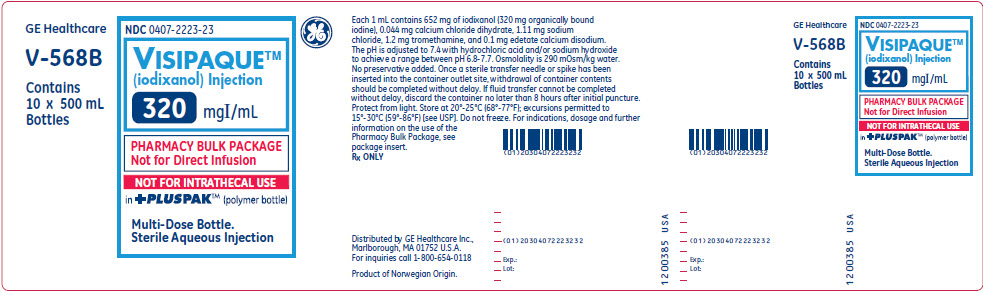
7PRINCIPAL DISPLAY PANEL - 500 mL Bottle Box Label
NDC 0407-2223-23
V-568B
Contains
VISIPAQUE™
320 mgI/mL
PHARMACY BULK PACKAGE
NOT FOR INTRATHECAL USE
in +PLUSPAK™ (polymer bottle)
Multi-Dose Bottle
Each 1 mL contains 652 mg of iodixanol (320 mg organically bound iodine),
Distributed by GE Healthcare Inc.,
Product of Norwegian Origin.
(01) 20304072223232
Exp.:
Lot:
1209204 USA GE HealthCare