Brand Name

Rezlidhia

Generic Name
Olutasidenib
View Brand Information
FDA approval date: December 01, 2022
Form: Capsule

What is Rezlidhia (Olutasidenib)?

Relapsed or Refractory Acute Myeloid Leukemia REZLIDHIA is indicated for the treatment of adult patients with relapsed or refractory acute myeloid leukemia with a susceptible isocitrate dehydrogenase-1 mutation as detected by an FDA-approved test [see Dosage and Administration.
Save this treatment for later
Sign Up
Not sure about your diagnosis?
Check Your Symptoms

Related Clinical Trials

Olutasidenib Combined With Co-targeted Therapy in Relapsed or Refractory IDH1-mutated Myeloid Malignancies Harboring Activated Signaling Pathway Mutations

Summary: To learn about the safety and tolerability of study drug combinations in patients with relapsed/refractory, IDH1-mutated myeloid malignancies with a co-signaling mutation.

Master Screening and Reassessment Protocol (MSRP) for the NCI MyeloMATCH Clinical Trials

Summary: This MyeloMATCH Master Screening and Reassessment Protocol (MSRP) evaluates the use of a screening tool and specific laboratory tests to help improve participants' ability to register to clinical trials throughout the course of their myeloid cancer (acute myeloid leukemia or myelodysplastic syndrome) treatment. This study involves testing patients' bone marrow and blood for certain biomarkers. A b...

Brand Information

REZLIDHIA (olutasidenib)
WARNING: DIFFERENTIATION SYNDROME
Differentiation syndrome, which can be fatal, can occur with REZLIDHIA treatment. Symptoms may include dyspnea, pulmonary infiltrates/pleuropericardial effusion, kidney injury, hypotension, fever, and weight gain.
If differentiation syndrome is suspected, withhold REZLIDHIA and initiate treatment with corticosteroids and hemodynamic monitoring until symptom resolution
1INDICATIONS AND USAGE
Relapsed or Refractory Acute Myeloid Leukemia
REZLIDHIA is indicated for the treatment of adult patients with relapsed or refractory acute myeloid leukemia (AML) with a susceptible isocitrate dehydrogenase-1 (IDH1) mutation as detected by an FDA-approved test
2DOSAGE FORMS AND STRENGTHS
Capsules: 150 mg opaque white capsules imprinted with "OLU 150".
3CONTRAINDICATIONS
None.
4ADVERSE REACTIONS
The following clinically significant adverse reactions are described elsewhere in the labeling:
  • Differentiation Syndrome
  • Hepatotoxicity
Because clinical trials are conducted under widely varying conditions, adverse reaction rates observed in the clinical trials of a drug cannot be directly compared to rates in the clinical trials ofanother drug and may not reflect the rates observed in practice.
4.1Clinical Trials Experience
Relapsed or Refractory AML
The safety of REZLIDHIA 150 mg administered twice daily was evaluated in 153 adults with relapsed or refractory AML with an IDH1 mutation
Serious adverse reactions occurred in 25% of patients who received REZLIDHIA. Serious adverse reactions in ≥5% included differentiation syndrome (9%) and transaminitis (6%). Fatal adverse reactions occurred in 1% of patients who received REZLIDHIA, due to differentiation syndrome.
Permanent discontinuation of REZLIDHIA due to an adverse reaction occurred in 8% of patients. Adverse reactions leading to permanent discontinuation in ≥1% of patients included transaminitis, differentiation syndrome, and gallbladder disorders.
Dosage interruptions of REZLIDHIA due to an adverse reaction occurred in 32% of patients. Adverse reactions which required dosage interruption in >5% of patients included transaminitis and differentiation syndrome.
Dose reductions of REZLIDHIA due to an adverse reaction occurred in 11% of patients. Adverse reactions which required dose reductions in ≥2% of patients included transaminitis.
The most common (≥20%) adverse reactions, including laboratory abnormalities, were aspartate aminotransferase increased, alanine aminotransferase increased, potassium decreased, sodium decreased, alkaline phosphatase increased, nausea, creatinine increased, fatigue/malaise, arthralgia, constipation, lymphocytes increased, bilirubin increased, leukocytosis, uric acid increased, dyspnea, pyrexia, rash, lipase increased, mucositis, diarrhea and transaminitis.
Table 2 summarizes the adverse reactions in the clinical trial for relapsed or refractory AML.
Clinically relevant adverse reactions in <10% of patients who received REZLIDHIA include:
  • Gallbladder disorders: biliary tract disorder, biliary colic, cholangitis, and cholestasis
  • Electrocardiogram QT prolonged
Table 3 summarizes the laboratory abnormalities in the clinical trial for relapsed or refractory AML.
5DESCRIPTION
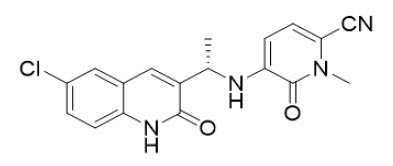
Olutasidenib is an isocitrate dehydrogenase-1 (IDH1) inhibitor. The chemical name is (S)-5-((1-(6-chloro-2-oxo-1,2-dihydroquinolin-3-yl)ethyl)amino)-1-methyl-6-oxo-1,6-dihydropyridine-2-carbonitrile. The chemical structure is:
chemical structure
The molecular formula is C
REZLIDHIA (olutasidenib) is available as hard gelatin capsules for oral administration. Each capsule contains 150 mg olutasidenib and the following ingredients: croscarmellose sodium, magnesium stearate and microcrystalline cellulose. The capsule shell contains gelatin and titanium dioxide. Each capsule is printed with black ink containing ferrosoferric oxide, propylene glycol, and shellac.
6HOW SUPPLIED/STORAGE AND HANDLING
How Supplied
Storage
Store at 20°C to 25°C (68°F to 77°F); excursions permitted between 15°C and 30°C (59°F and 86°F)
7PATIENT COUNSELING INFORMATION
Advise the patient to read the FDA-approved patient labeling (
Differentiation Syndrome
Advise patients of the risks of developing differentiation syndrome as early as 1 day after start of therapy and up to 18 months on treatment. Ask patients to immediately report any symptoms suggestive of differentiation syndrome, such as fever, cough or difficulty breathing, decreased urinary output, low blood pressure, weight gain, or swelling of their arms or legs, to their healthcare provider for further evaluation
Hepatotoxicity
Advise patients of the potential for hepatic effects and to immediately report any associated signs and symptoms such as right upper abdominal discomfort, dark urine, jaundice, anorexia, or fatigue to their healthcare provider for further evaluation
Gastrointestinal Adverse Reactions
Advise patients on the risks of experiencing gastrointestinal reactions such as nausea, constipation, diarrhea, vomiting, abdominal pain, and mucositis. Ask patients to report these events to theirhealthcare provider and advise patients how to manage them
Lactation
Advise women not to breastfeed during treatment with REZLIDHIA and for 2 weeks after the last dose
Dosing and Storage Instructions
  • Advise patients to swallow capsules whole. Do not break, open, or chew the capsules.
  • Advise patients to take REZLIDHIA on an empty stomach (at least 1 hour before or 2 hours after a meal).
  • Advise patients that if a dose of REZLIDHIA is vomited, do not administer a replacement dose; wait until the next scheduled dose is due.
  • If a dose of REZLIDHIA is missed or not taken at the usual time, instruct patients to take the dose as soon as possible unless the next dose is due within 8 hours. Patients can return to the normal schedule the following day.
  • Store REZLIDHIA at room temperature from 20°C to 25°C (68°F to 77°F).
Manufactured by Catalent Greenville, Inc. 1240 Sugg Pkwy, Greenville, NC 27834
REZLIDHIA
04/2024
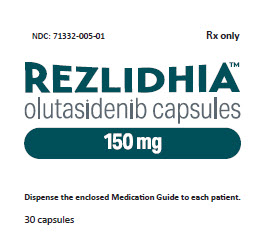
8PRINCIPAL DISPLAY PANEL - REZLIDHIA - NDC 71332-005-01 - 150 mg Capsule 30-Count Carton Label
NDC: 71332-005-01
Rx only
REZLIDHIA
olutasidenib capsules
150 mg
Dispense the enclosed Medication Guide to each patient.
30 capsules
150 mg Tablet 30-Count Carton Label - Principal Display Panel