Brand Name

Iressa

Generic Name
Gefitinib
View Brand Information
FDA approval date: July 13, 2015
Classification: Kinase Inhibitor
Form: Tablet

What is Iressa (Gefitinib)?

Gefitinib tablets are indicated for the first-line treatment of patients with metastatic non-small cell lung cancer whose tumors have epidermal growth factor receptor exon 19 deletions or exon 21 substitution mutations as detected by an FDA-approved test. Limitation of Use: Safety and efficacy of gefitinib tablets have not been established in patients with metastatic NSCLC whose tumors have EGFR mutations other than exon 19 deletions or exon 21 substitution mutations. Gefitinib tablets are tyrosine kinase inhibitor indicated for the first-line treatment of patients with metastatic non-small cell lung cancer whose tumors have epidermal growth factor receptor exon 19 deletions or exon 21 substitution mutations as detected by an FDA-approved test. Limitation of Use: Safety and efficacy of gefitinib tablets have not been established in patients whose tumors have EGFR mutations other than exon 19 deletions or exon 21 substitution mutations.
Save this treatment for later
Sign Up
Not sure about your diagnosis?
Check Your Symptoms

Related Clinical Trials

Improvement of the Value of Orally Administered Cancer Drugs: Arm 1: Osimertinib for Advanced EGFR-positive NSCLC Patients: A Phase II Study

Summary: Lung cancer is the leading cause of cancer incidence (11.6%) and mortality (18.4%) globally\[1\]. Development of targeted therapies in the context of precision medicine changed the way lung cancer was diagnosed and treated. Small molecule inhibitors, like tyrosine kinase inhibitors (TKIs), are now standard first-line therapy for EGFR-positive non-small cell lung cancer (NSCLC). First-generation EG...

Serial Measurements of Molecular and Architectural Responses to Therapy (SMMART): Adaptive Clinical Treatment (ACT)

Summary: This phase II trial tests the how well a precision medicine approach (serial measurements of molecular and architectural response to therapy \[SMMART\])-adaptive clinical treatment \[ACT\]) works in treating patients with sarcoma, prostate, breast, ovarian or pancreatic cancer that may have spread from where it first started to nearby tissue, lymph nodes, or distant parts of the body (advanced). S...

A Phase I/Phase II Study of Nintedanib Plus EGFR TKI In EGFR-mutated Non-small Cell Lung Cancer Patients

Summary: The purpose of this study is to evaluate the efficacy and safety of Nintedanib with EGFR-TKI in participants with advanced EGFR-TKI-resistant non-small cell lung cancer

Brand Information

IRESSA (Gefitinib)
1INDICATIONS AND USAGE
IRESSA is indicated for the first-line treatment of patients with metastatic non-small cell lung cancer (NSCLC) whose tumors have epidermal growth factor receptor (EGFR) exon 19 deletions or exon 21 (L858R) substitution mutations as detected by an FDA-approved test
Limitation of Use: Safety and efficacy of IRESSA have not been established in patients with metastatic NSCLC whose tumors have EGFR mutations other than exon 19 deletions or exon 21 (L858R) substitution mutations
2DOSAGE FORMS AND STRENGTHS
250 mg tablets: round, biconvex, brown film-coated, debossed with "IRESSA 250" on one side and plain on the other side.
3CONTRAINDICATIONS
None.
4ADVERSE REACTIONS
The following adverse drug reactions are discussed in more detail in other sections of the labeling:
  • Interstitial Lung Disease
  • Hepatotoxicity
  • Gastrointestinal Perforation
  • Severe or Persistent Diarrhea
  • Ocular Disorders including Keratitis
  • Bullous and Exfoliative Skin Disorders
4.1Clinical Trials Experience
Because clinical trials are conducted under widely varying conditions, adverse reaction rates observed in the clinical trials of a drug cannot be directly compared to rates in the clinical trials of another drug and may not reflect the rates observed in practice.
The safety of IRESSA is based on the data from 2462 patients with NSCLC who received IRESSA 250 mg daily monotherapy in three randomized clinical studies (Study 2, Study 3 and Study 4). Patients with a history of interstitial lung disease, drug-induced interstitial disease, radiation pneumonitis that required steroid treatment or any evidence of clinically active interstitial lung disease were excluded from these studies.
Controlled Studies:
Study 2 was a randomized, multicenter, open-label trial in which 1217 patients were randomized to receive first-line treatment for metastatic NSCLC; 607 patients received IRESSA 250 mg daily and 589 patients received carboplatin/paclitaxel. The median duration of treatment with IRESSA was 5.9 months. The study population characteristics were: median age 57 years, age less than 65 years (73%), female (79%), Asian (100%), NSCLC adenocarcinoma histology (100%), never smoker (94%), light ex-smoker (6%), ECOG PS 0 or 1 (90%).
Study 3 was a randomized, multicenter, double-blind, placebo-controlled trial in which 1692 patients were randomized to receive second- or third-line treatment for metastatic NSCLC; of which 1126 patients received IRESSA 250 mg daily and 562 patients received placebo. The median duration of treatment with IRESSA was 2.9 months. The study population characteristics were: median age 62 years, age less than 65 years (60%), female (33%), Caucasian (75%), Asian (21%), NSCLC adenocarcinoma histology (48%), never smoker (22%), ECOG PS 0 or 1 (65%), PS 2 (29%), PS 3 (5%) and two or more prior therapies (51%).
Study 4 was a randomized, multicenter, open-label trial in which 1466 patients were randomized to receive second-line treatment for metastatic NSCLC; 729 patients received IRESSA 250 mg daily and 715 patients received docetaxel. The median duration of treatment with IRESSA was 2.4 months. The study population characteristics were: median age 61 years, age less than 65 years (61%), female (36%), Caucasian (79%), Asian (21%), NSCLC adenocarcinoma histology (54%), never smoker (20%), ECOG PS 0 or 1 (88%) and two or more prior therapies (16%).
The pooled safety database from the three randomized trials was used to evaluate for serious and uncommon adverse drug reactions. Common adverse reactions were evaluated in Study 3. The most frequent adverse reactions in Study 3 (incidence of >20% and greater than placebo) reported in IRESSA-treated patients were skin reactions (47%) and diarrhea (29%). The most frequent fatal adverse reactions in IRESSA-treated patients were respiratory failure (0.9%), pneumonia (0.8%), and pulmonary embolism (0.5%).
Approximately 5% of IRESSA-treated patients and 2.3% of placebo-treated patients discontinued treatment due to an adverse event. The most frequent adverse reactions that led to discontinuation in patients treated with IRESSA were nausea (0.5%), vomiting (0.5%) and diarrhea (0.4%).
The following adverse reactions have been reported with IRESSA across NSCLC trials (Study 2, Study 3 and Study 4) and are not listed elsewhere in Section 6: nausea (18%), asthenia (17%), pyrexia (9%), alopecia (4.7%), hemorrhage (including epistaxis and hematuria) (4.3%), dry mouth (2%), dehydration (1.8%), elevations in blood creatinine (1.5%), allergic reactions including angioedema and urticaria (1.1%), palmar-plantar erythrodysesthesia syndrome (0.2%) and pancreatitis (0.1%).
4.2Postmarketing Experience
The following adverse reactions have been identified during post-approval use of IRESSA. Because these reactions are reported voluntarily from a population of uncertain size, it is not always possible to reliably estimate their frequency or establish a causal relationship to drug exposure.
Renal and urinary disorders: cystitis, hemorrhagic cystitis
Skin and subcutaneous tissue disorders: cutaneous vasculitis
5OVERDOSAGE
Twenty three patients were treated weekly with doses from 1500 mg to 3500 mg, and IRESSA exposure did not increase with increasing dose. Adverse events were mostly mild to moderate in severity, and were consistent with the known safety profile of IRESSA. In the event of suspected overdose, interrupt IRESSA, institute supportive care, and observe until clinical stabilization. There are no specific measures/treatments that should be taken following IRESSA overdosing.
6DESCRIPTION
Gefitinib is a kinase inhibitor.
The chemical name of gefitinib is 4-Quinazolinamine
structural formula for gefitinib
Gefitinib has the molecular formula C
IRESSA
7CLINICAL STUDIES
Non-Small Cell Lung Cancer (NSCLC)
Study 1
The efficacy and safety of IRESSA for the first-line treatment of patients with metastatic NSCLC containing EGFR exon 19 deletions or L858R substitution mutations was demonstrated in a multicenter, single-arm, open-label clinical study (Study 1). A total of 106 treatment-naive patients with metastatic EGFR mutation positive NSCLC received IRESSA at a dose of 250 mg once daily until disease progression or intolerable toxicity. The major efficacy outcome measure was objective response rate (ORR) according to RECIST v1.1 as evaluated by both a Blinded Independent Central Review (BICR) and investigators. Duration of response (DOR) was an additional outcome measure. Eligible patients were required to have a deletion in EGFR exon 19 or L858R, L861Q, or G719X substitution mutation and no T790M or S768I mutation or exon 20 insertion in tumor specimens as prospectively determined by a clinical trial assay. Tumor samples from 87 patients were tested retrospectively using the
The study population characteristics were: median age 65 years, age 75 years or older (25%), age less than 65 years (49%), white (100%), female (71%), never smokers (64%), WHO PS 0 (45%), WHO PS 1 (48%), WHO PS 2 (7%), and adenocarcinoma histology (97%). Sixty patients had exon 19 deletions (65%), 29 patients had L858R substitution (31%), while two patients each had tumors harboring L861Q or G719X substitution mutation.
The median duration of treatment was 8.0 months. Efficacy results from Study 1 are summarized below.
The response rates were similar in patients whose tumors had EGFR exon 19 deletions and exon 21 L858R substitution mutations. Two partial responses were observed in both patients whose tumors had G719X substitution mutation with duration of response of at least 2.8 months and 5.6 months, respectively. One of two patients whose tumors had L861Q substitution mutation also achieved a partial response with duration of response of at least 2.8 months.
Study 2
The results of Study 1 were supported by an exploratory analysis of a subset of a randomized, multicenter, open-label trial (Study 2) conducted in patients with metastatic adenocarcinoma histology NSCLC receiving first-line treatment. Patients were randomized (1:1) to receive IRESSA 250 mg orally once daily or up to 6 cycles of carboplatin/paclitaxel. The efficacy outcomes included progression-free survival (PFS) and objective response rate (ORR) as assessed by BICR.
The subset population consisted of 186 of 1217 patients (15%) determined to be EGFR positive by the same clinical trial assay as used in Study 1 and had radiographic scans available for a retrospective assessment by BICR. In this subset, there were 88 IRESSA-treated patients and 98 carboplatin/paclitaxel-treated patients.
Demographic and baseline characteristics of this subset were a median age of 59 years, age 75 years or older (7%), age less than 65 (70%), Asian (100%), female (83%), never smokers (96%), adenocarcinoma histology (100%), and PS 0-1 (94%).
The median duration of treatment for IRESSA-treated patients was 9.8 months. The hazard ratio for PFS favored the IRESSA-treated patients [HR of 0.54 (95% CI: 0.38, 0.79)] with a median PFS of 10.9 months for the IRESSA-treated patients and 7.4 months for the carboplatin/paclitaxel-treated patients as assessed by BICR. In addition, the objective response rate was 67% (95% CI: 56, 77) for IRESSA-treated patients and 41% (95% CI: 31, 51) for carboplatin/paclitaxel-treated patients based on BICR assessment. The median duration of response was 9.6 months for IRESSA-treated patients and 5.5 months for carboplatin/paclitaxel-treated patients.
8HOW SUPPLIED/STORAGE AND HANDLING
IRESSA
IRESSA 250 mg tablets are round, biconvex, brown film-coated, debossed with "IRESSA 250" on one side and plain on the other side.
IRESSA
Bottles of 30 Tablets (NDC 0310-0482-30)
Store at controlled room temperature 20°C-25°C (68°F-77°F) [see
9PATIENT COUNSELING INFORMATION
Advise the patient to read the FDA-approved patient labelling (Patient Information).
Interstitial Lung Disease: Advise patients to immediately contact their healthcare provider for new onset or worsening of pulmonary symptoms such as dyspnea, cough and fever [see .
Hepatotoxicity: Inform patients that they will need to undergo lab tests to monitor for liver function. Advise patients to contact their healthcare provider to report any new symptoms indicating hepatic toxicity [see .
Gastrointestinal Perforation: Advise patients that IRESSA can increase the risk of gastrointestinal perforation and to seek immediate medical attention for severe abdominal pain [see .
Severe or Persistent Diarrhea: Advise patients to contact their healthcare provider for severe or persistent diarrhea [see .
Ocular Disorders including Keratitis: Advise patients promptly to contact their healthcare provider if they develop eye symptoms, lacrimation, light sensitivity, blurred vision, eye pain, red eye or changes in vision [see .
Bullous and Exfoliative Skin Disorders: Advise patients that IRESSA can increase the risk of bullous and exfoliative skin disorders and to seek immediately medical attention for severe skin reactions [see .
Embryo-fetal Toxicity: Advise pregnant women of the potential risk to a fetus or potential risk for loss of the pregnancy [see . Advise females of reproductive potential to use effective contraception during treatment with IRESSA and for at least two weeks following completion of therapy [see .
Lactation: Advise women to discontinue breast-feeding during treatment with IRESSA [see .
IRESSA is a trademark of the AstraZeneca group of companies.
©AstraZeneca 2023
Distributed by:
AstraZeneca Pharmaceuticals LP
Wilmington, DE 19850
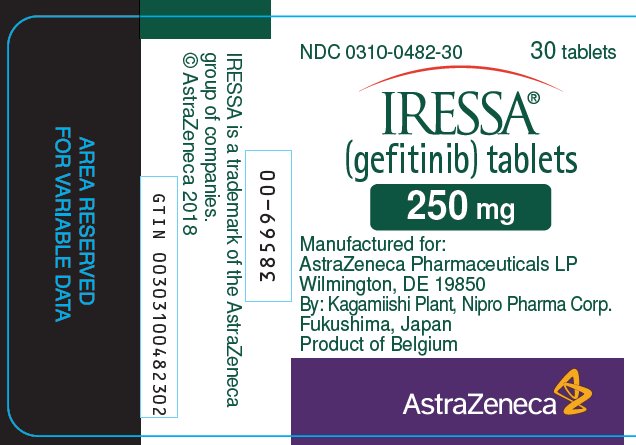
10PACKAGE/LABEL PRINCIPAL DISPLAY PANEL – 250 mg
NDC 0310-0482-30          30 tablets
IRESSA®
(gefitinib) tablets
250 mg
Manufactured for:
AstraZeneca Pharmaceuticals LP
Wilmington, DE 19850
By: Kagamiishi Plant, Nipro Pharma Corp.
Fukushima, Japan
Product of Belgium
AstraZeneca
IRESSA_BTL_Nipro